

Watching your child struggle with their weight can feel isolating and overwhelming. You might wonder if it’s your fault, or if there’s anything you can actually do to help. The hard truth is that childhood obesity isn’t just about willpower or a lack of exercise-it’s a complex medical condition deeply tied to family dynamics, environment, and biology. But here is the good news: science has found a way out. It’s not about putting your child on a restrictive diet alone. It’s about changing how your whole household operates.
The gold standard for treating this issue today is Family-Based Behavioral Treatment (FBT). This approach recognizes that children live in an ecosystem. If you want a child to eat healthier and move more, the entire family needs to shift gears. Research shows that when parents participate actively, outcomes improve dramatically-not just for the child, but for everyone at the table.
What Exactly Is Family-Based Behavioral Treatment?
Family-Based Behavioral Treatment is a structured intervention program where parents and children work together with health coaches to change eating and activity habits. Unlike older methods that focused solely on the child, FBT treats the family unit as the patient. Developed by researchers like Leonard Epstein in the 1980s, this method relies on behavioral psychology rather than calorie counting.
Here is how it typically works:
- Duration: Programs usually run for 6 to 24 months, involving 16 to 32 sessions.
- Participants: At least one parent or caregiver must be present and active in every session alongside the child.
- Setting: Ideally delivered in primary care settings by certified health coaches, making it more accessible than specialty clinics.
- Goal: To create sustainable lifestyle changes that stick long after the program ends.
A major study published in JAMA Network Open in August 2023 highlighted the power of this model. Families participating in FBT saw a 12.3% greater reduction in BMI compared to those receiving usual care. Even more surprisingly, siblings who weren’t directly targeted in the treatment still showed 7.2% better weight outcomes. This proves that changing the home environment helps everyone.
The Core Tools: The Stoplight Diet and Beyond
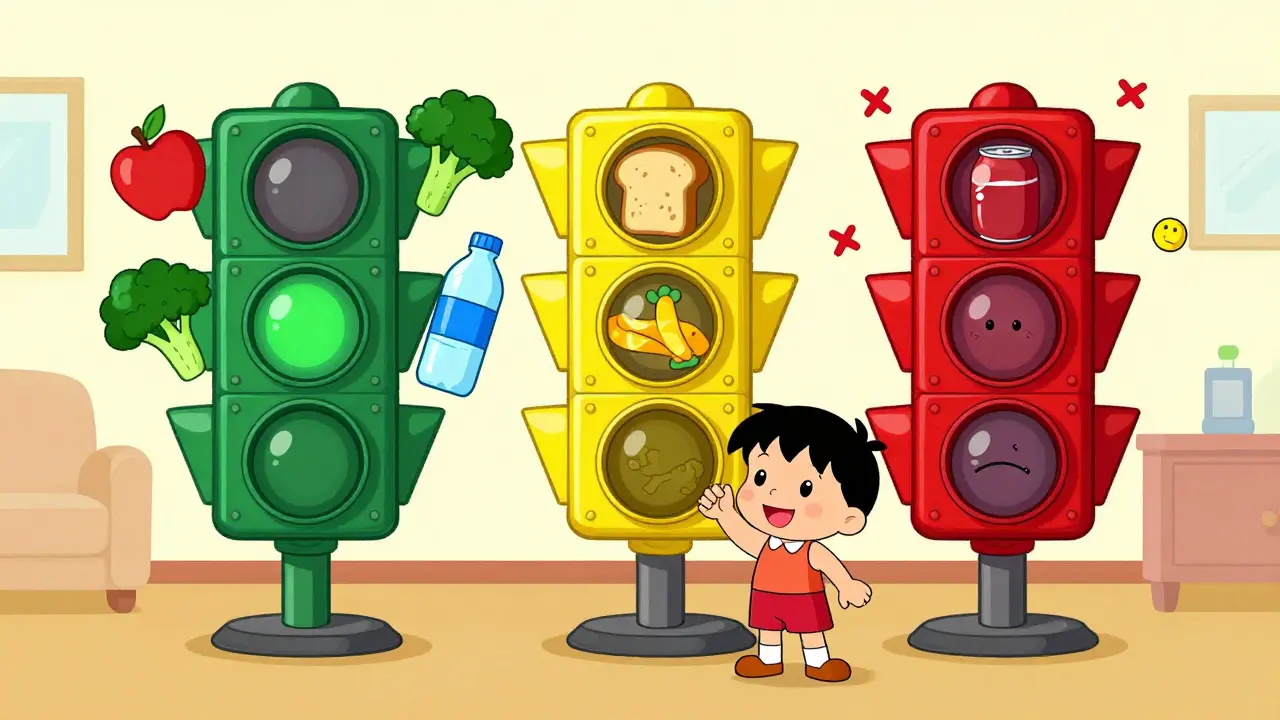
You don’t need to become a nutritionist to implement FBT. The most famous tool used in these programs is the Stoplight Diet, which is a simple food classification system using green, yellow, and red categories to guide eating choices. Created by Dr. Leonard Epstein, this system removes the guilt and complexity from food decisions.
| Category | Rule | Examples |
|---|---|---|
| Green | Eat freely | Fruits, vegetables, water, lean proteins |
| Yellow | Eat in moderation | Bread, pasta, rice, low-fat dairy |
| Red | Eat sparingly | Sugary snacks, soda, fried foods, candy |
This framework teaches children to make choices without feeling deprived. Instead of saying "no" to pizza, you teach them that pizza is a "red" food-something enjoyed occasionally, not daily. Combined with a goal of 60 minutes of moderate-to-vigorous physical activity daily, these rules form the backbone of the treatment.
Why Parents Must Be Involved
One of the biggest mistakes families make is trying to manage a child’s weight in secret. They hide the junk food or restrict portions while eating differently themselves. This creates confusion and resentment. In FBT, parents are required to model healthy behaviors.
Dr. Stephen Cook from the University of Rochester Medical Center emphasizes that "when parents can see their own benefit in addition to the child, it's easier for them to be a role model." Data supports this: parents in FBT programs often lose weight themselves, seeing a 5.7% greater BMI reduction than those in control groups. When mom and dad are drinking water instead of soda and taking evening walks, the child follows suit naturally. It becomes a family culture, not a punishment.
Prevention Starts Early
Waiting until your child is a teenager to address weight issues makes the problem much harder to solve. The American Academy of Pediatrics (AAP) recommends intervening as early as age 4 or 5 if excessive weight gain is detected. Early intervention prevents the development of severe obesity, which carries higher risks for type 2 diabetes, heart disease, and psychological struggles.
Simple preventive steps include:
- Shared Meals: Families who eat together have a 12% lower risk of obesity. These meals provide structure and allow parents to monitor intake.
- Screen Time Limits: Keeping screens under 2 hours per day is linked to a 0.8 BMI unit reduction.
- No Sugar-Sweetened Beverages: Eliminating sodas and juices can reduce BMI by 1.0 unit over 12 months.
Is It Worth the Cost and Effort?
A common concern is whether FBT is too expensive or time-consuming. While specialty clinics can cost upwards of $4,100, integrated primary care FBT averages around $3,200 per family over two years. More importantly, it is highly cost-effective, with an incremental cost-effectiveness ratio of $18,400 per quality-adjusted life year gained-well below the threshold considered valuable in healthcare.
Accessibility remains a challenge. Only 12% of children currently access specialty weight management clinics due to wait times and travel distances. However, new models integrating FBT into regular pediatric visits are expanding reach. The JAMA trial showed that 87% of families completed at least 12 sessions in primary care settings, compared to just 63% in specialty clinics. This suggests that bringing treatment to where kids already go-their doctor’s office-is a winning strategy.

When FBT Isn't Enough
While FBT is the first-line treatment, it doesn’t work for everyone. For children with severe obesity (BMI ≥120% of the 95th percentile), lifestyle changes alone may result in less than 5% weight loss for some. In these cases, the 2023 AAP guidelines suggest considering additional interventions, such as pharmacotherapy or metabolic surgery for eligible adolescents. It’s crucial to have an open conversation with your pediatrician about all available options if progress stalls.
Getting Started Today
You don’t need to wait for a diagnosis to start making changes. Begin by auditing your home environment. Are fruits visible on the counter? Is soda kept in the fridge? Small shifts in routine can signal big changes. Talk to your pediatrician about referring you to a certified health coach or a family-based program. Remember, this isn’t about perfection; it’s about consistent, collective effort. Your involvement is the single most powerful factor in your child’s success.
At what age should I start worrying about my child's weight?
You should consult your pediatrician if you notice rapid weight gain starting as early as age 2. The AAP recommends formal intervention as young as 4-5 years old if growth charts show excessive trajectories. Early action prevents severe obesity later in life.
Does my child need to count calories in FBT?
No. FBT typically avoids strict calorie counting, which can lead to disordered eating. Instead, it uses frameworks like the Stoplight Diet to categorize foods and focuses on portion awareness and balanced meals.
Will insurance cover Family-Based Behavioral Treatment?
Coverage varies by provider and plan. CMS reimburses for Intensive Behavioral Therapy (IBT) code G0447, covering 15-minute sessions. Many private insurers now cover FBT following the 2023 AAP guidelines, but you should verify benefits with your specific insurer.
How many sessions does FBT require?
Standard protocols recommend 16 to 32 sessions over 6 to 24 months. The JAMA 2023 trial aimed for 26 sessions over 24 months, though families averaged 19.7 sessions. Consistency is more important than hitting an exact number.
Can siblings benefit even if they aren't overweight?
Yes. Studies show that untreated siblings in FBT families experienced 7.2% greater improvement in weight outcomes than siblings in control families. The improved home environment benefits all children involved.