
Your liver is working hard right now, filtering toxins and processing nutrients without you even thinking about it. But if you have risk factors like fatty liver disease or chronic hepatitis, that silent worker might be scarring. For years, the only way to know for sure was a liver biopsy, an invasive procedure where a needle extracts tissue samples from the liver. It’s uncomfortable, carries a small but real risk of bleeding, and often misses the mark due to sampling errors. Today, we have better ways to check your liver health without breaking the skin. We’re talking about noninvasive liver fibrosis tests, medical assessments that measure liver scarring without surgical intervention.
Two main approaches dominate the clinic today: FibroScan and serum-based scores like FIB-4, a calculated index using blood markers to estimate liver fibrosis risk. One uses sound waves; the other uses math and blood work. Neither is perfect, but together they form a powerful toolkit for doctors to catch liver disease early. Let’s break down how they work, what they cost, and which one might be right for your next checkup.
How FibroScan Measures Liver Stiffness
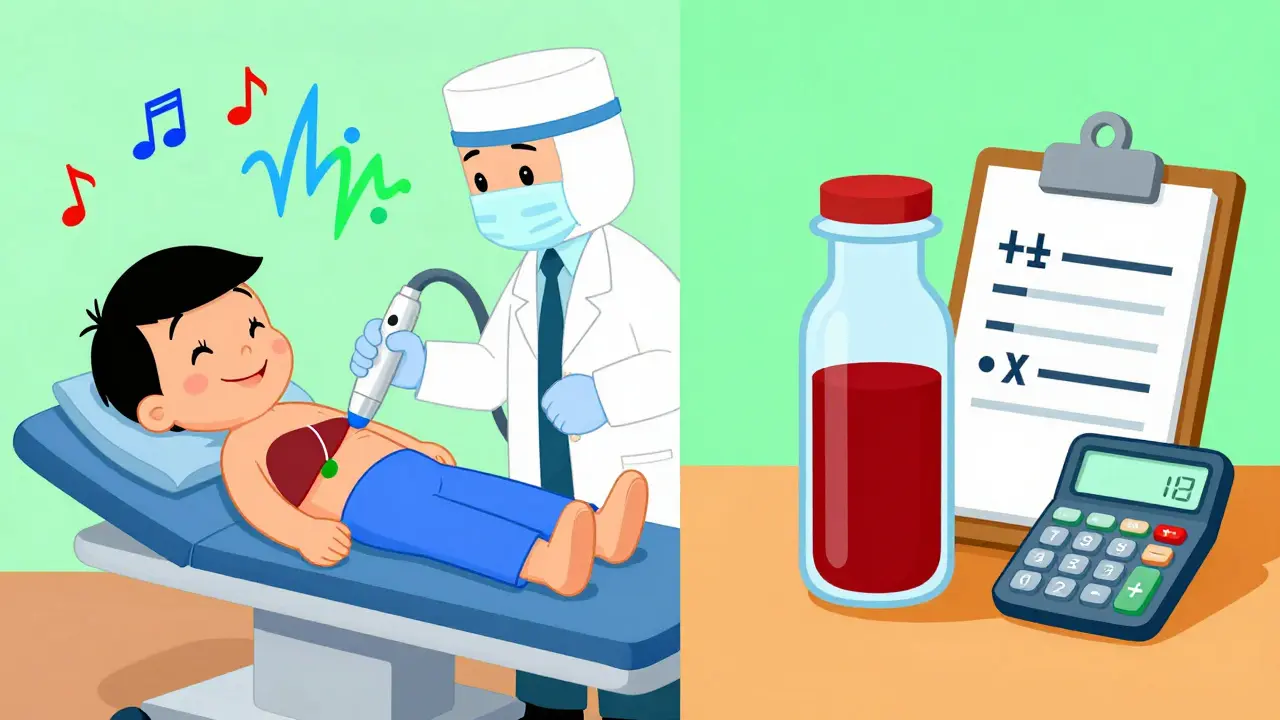
FibroScan, a medical device developed by Echosens that uses transient elastography to assess liver fibrosis and steatosis is essentially an ultrasound machine with a twist. Instead of just taking pictures, it sends low-frequency shear waves (50Hz) into your liver. Think of it like tapping a watermelon to see if it’s ripe. A healthy liver is soft and bouncy. A fibrotic, scarred liver is stiff and rigid.
The device measures this stiffness in kilopascals (kPa). According to the UK’s National Health Service, a normal liver reads between 2 and 7 kPa. As scarring increases, so does the number. The current standard models, the FibroScan 502 Touch and the newer 630, also measure fat content using something called the Controlled Attenuation Parameter (CAP). CAP scores range from 100 to 400 dB/m. If your score hits 290-400 dB/m, you likely have significant fat accumulation-more than 67% of your liver cells are filled with fat.
The beauty of FibroScan is speed. You lie on a table, the technician places a probe on your ribs, and within minutes, you have results. No waiting for lab reports. However, it’s not magic. The test requires at least 10 valid measurements with a success rate over 60%. If you’re obese, the sound waves struggle to penetrate. Patients with a BMI over 28 kg/m² often need the XL probe, and even then, technical failure rates hover around 10-15% in clinical practice. One user on Reddit shared that their scan failed three times before the XL probe worked, adding unexpected costs and frustration.
Understanding Serum Scores: FIB-4 and APRI
If FibroScan is high-tech hardware, serum scores are clever software running on existing data. You’ve probably had these blood tests done already as part of a routine checkup. FIB-4, the Fibrosis-4 Index, calculates liver fibrosis probability using age, AST, ALT, and platelet count takes four common values: your age, aspartate aminotransferase (AST), alanine aminotransferase (ALT), and platelet count. It plugs them into a formula and spits out a number.
A FIB-4 score below 1.3 generally rules out advanced fibrosis with 90% confidence. A score above 2.67 suggests a high risk of advanced scarring. It’s incredibly cheap-often costing less than $10-and widely available because it uses standard blood work. Another option is APRI, the Aspartate Aminotransferase-to-Platelet Ratio Index, used to screen for liver cirrhosis, which relies only on AST and platelets. An APRI score of 2.0 or higher usually points toward cirrhosis.
The downside? These scores can be blunt instruments. Inflammation from a recent cold, alcohol binge, or even intense exercise can spike your AST levels, giving you a falsely high score. Conversely, young patients under 35 often get misleadingly low scores because their bodies compensate differently. Dr. Zobair Younossi, Editor-in-Chief of Hepatology, noted that relying solely on serum markers means missing nearly half of advanced fibrosis cases. They are excellent for screening large populations but risky for making final diagnoses on their own.
Head-to-Head: Accuracy and Limitations
So, which test is better? The answer depends on what you’re trying to find. A 2023 study published in PMC found that FibroScan correctly identified only 45.9% of patients with biopsy-confirmed advanced fibrosis (F3/F4). That sounds bad, but context matters. FibroScan excels at detecting *significant* fibrosis (≥F2) with an accuracy area under the curve (AUROC) of 0.83. It’s great for catching the problem early.
Serum scores like FIB-4 shine when you want to rule things out. If your FIB-4 is low, you can sleep easy knowing you don’t have advanced scarring. But if it’s high, you still need more proof. Here is where the numbers get tricky:
| Feature | FibroScan | FIB-4 Score | ELF Test |
|---|---|---|---|
| Method | Ultrasound/Sound Waves | Blood Calculation | Blood Biomarkers |
| Cost (Approx.) | $50 - $150 | $10 - $20 | $100+ |
| Best For | Detecting significant fibrosis & fat | Ruling out advanced fibrosis | Tie-breaking discordant results |
| Limitations | Obesity, acute inflammation | Age bias, inflammation spikes | High cost, less availability |
| Turnaround Time | Immediate | 24-72 hours (lab) | Days to weeks |
The Enhanced Liver Fibrosis (ELF) test, a specialized blood test measuring specific biomarkers of liver fibrosis sits somewhere in the middle. It’s more accurate than FIB-4 for staging but costs significantly more. Most guidelines suggest using ELF only when FibroScan and FIB-4 disagree.
The Sequential Approach: Why Doctors Use Both
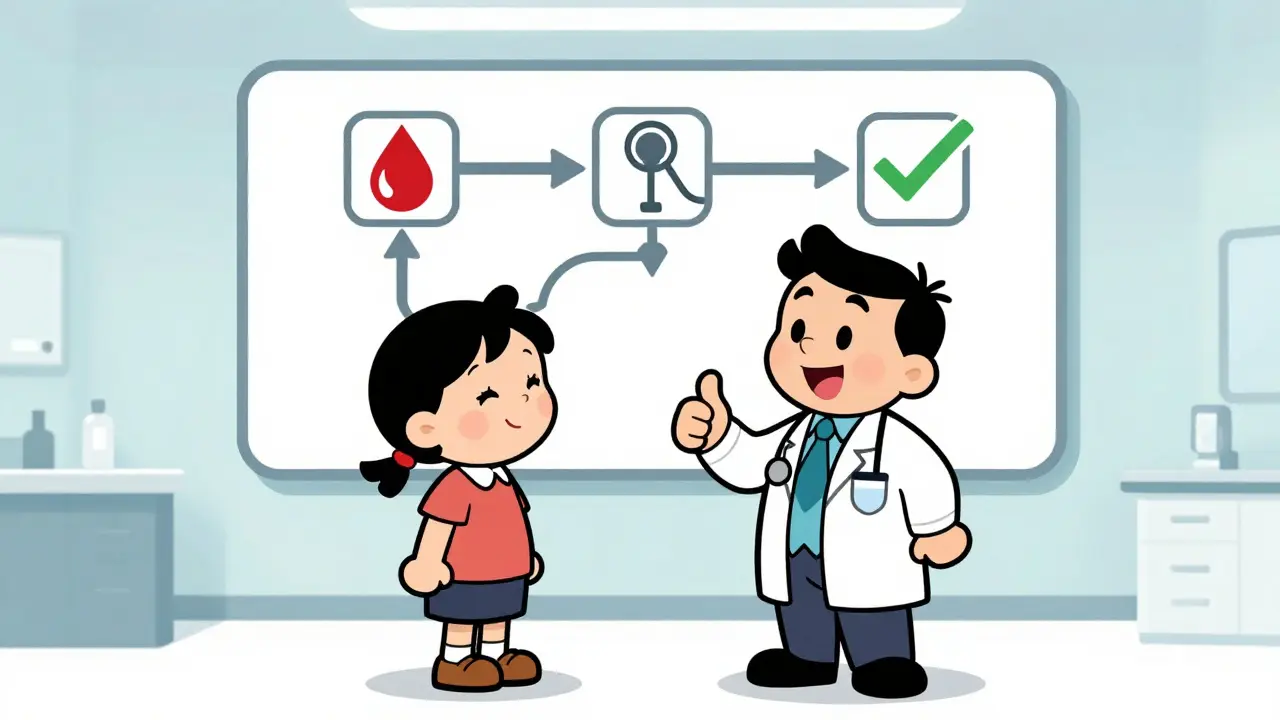
Because no single test is perfect, top liver specialists recommend a step-by-step strategy. The European Association for the Study of the Liver (EASL) and American Association for the Study of Liver Diseases (AASLD) both advocate for sequential testing.
- Start with FIB-4: Since it’s cheap and easy, calculate this first. If it’s low (<1.3), you likely don’t have advanced fibrosis. Monitor annually.
- Middle Ground: If FIB-4 is indeterminate (1.3 to 2.67), move to FibroScan. This catches the people who slipped through the cracks of the blood test.
- Advanced Imaging: If FibroScan shows high stiffness but clinical signs don’t match, consider MRI Elastography (MRE). MRE is highly accurate (95% for significant fibrosis) but costs ten times more than FibroScan.
- Biopsy: Reserve the needle for cases where noninvasive tests conflict or show unclear results. This protocol reduces unnecessary biopsies by up to 70%.
This approach saves money, reduces patient anxiety, and keeps the invasive procedures for when they are truly needed. A 2020 study in the journal Gut confirmed that this algorithm maintains high sensitivity for cirrhosis detection while drastically cutting down on procedural risks.
Real-World Challenges and Patient Experiences
Guidelines look clean on paper, but real life is messier. Obesity is the biggest hurdle for FibroScan. About 68% of users discussing their experiences online mention body weight as a barrier. The standard probe simply can’t reach the liver in many patients. While the XL probe helps, it’s not always available, and some clinics charge extra for the extended time it takes to get a valid reading.
Then there’s the confusion factor. A survey by the NAFLD Foundation found that 43% of patients were baffled by conflicting results. One patient reported a FibroScan indicating mild scarring (F2) while their FIB-4 screamed high risk. The resulting biopsy showed moderate scarring (F3)-proving both noninvasive tests were slightly off. This highlights why clinical judgment matters. Your doctor looks at your whole picture: alcohol use, diabetes status, medication history, and physical exam.
Acute inflammation is another trap. If you have a flare-up of hepatitis or eat a heavy meal within three hours of the test, your liver stiffness readings will skyrocket temporarily. This doesn’t mean permanent scarring; it means temporary swelling. Always fast for at least three hours before a FibroScan to avoid false alarms.
Future Trends: AI and New Scores
The field isn’t standing still. Echosens recently announced the FibroScan 730, which features AI-powered reliability scoring. Early trials show it cuts technical failures by 22%, meaning fewer retakes for obese patients. Meanwhile, researchers are refining serum scores. The new FIB-5 score, introduced in 2024 guidelines, adds glucose levels to the equation. This is huge for diabetic patients, whose liver disease progression often ties closely to blood sugar control. Studies show FIB-5 hits 89% accuracy for advanced fibrosis in this group.
We’re moving toward integrated algorithms. The NIH NASH Clinical Research Network is piloting a combined “FibroScan-FIB-4-ELF” approach that reduced unnecessary biopsies by 82% in feasibility studies. The goal is clear: make liver care accessible, accurate, and painless for everyone.
Is FibroScan painful?
No, FibroScan is completely painless. It feels similar to having an ultrasound performed. You may feel slight pressure from the probe against your ribs, but there are no needles or incisions involved.
Can I do a FibroScan if I am overweight?
Yes, but it can be challenging. Standard probes may fail to get a reading if your BMI is over 28 kg/m². Clinics equipped with the XL probe can usually accommodate larger body types, though it may take longer to obtain valid measurements.
What should I do before a FibroScan appointment?
You must fast for at least three hours before the test. Eating increases blood flow to the liver, which can falsely elevate stiffness readings. Avoid alcohol for 24-48 hours prior as well, as acute inflammation can skew results.
How often should I repeat these tests?
Frequency depends on your risk level. If your initial tests are normal, annual monitoring is typical. If you have established fibrosis, your doctor may recommend every 6-12 months to track progression or response to treatment.
Why did my FIB-4 score change overnight?
FIB-4 relies on blood enzymes like AST and ALT. These levels can fluctuate daily due to muscle strain, alcohol consumption, viral infections, or even certain medications. A single high score doesn’t confirm fibrosis; it warrants further investigation with imaging like FibroScan.
Does insurance cover FibroScan?
Coverage varies by region and provider. In the US, CMS reimburses approximately $54.67 per procedure. Many private insurers cover it when medically necessary for diagnosing liver disease, but prior authorization is often required.
What is the difference between fibrosis and cirrhosis?
Fibrosis is the buildup of scar tissue in the liver, graded from F0 (none) to F4 (severe). Cirrhosis is stage F4 fibrosis, where extensive scarring disrupts liver function and structure. Early fibrosis is often reversible; cirrhosis is generally permanent but manageable.
Can lifestyle changes reverse liver fibrosis?
Yes, especially in early stages. Weight loss, reducing alcohol intake, and managing diabetes can halt and sometimes reverse fibrosis. Regular monitoring via noninvasive tests helps track these improvements without needing repeated biopsies.