
Why Some Medicines Need the Fridge
Not all medicines are created equal when it comes to storage. While your aspirin or blood pressure pill can sit happily on your bathroom counter, others-like insulin, certain vaccines, and biologic drugs-need to stay cold. If they don’t, they can lose their power, and in some cases, become dangerous.
Medications that require refrigeration are mostly biologics, which are made from living cells. These include insulin for diabetes, treatments for rheumatoid arthritis like Humira or Remicade, some cancer drugs, and nearly all vaccines. These drugs are delicate. Heat or freezing can break down their structure, making them less effective-or useless. The FDA says any deviation from labeled storage conditions is considered unapproved use, and that’s not just a technicality. It’s a safety rule.
The Right Temperature: 2°C to 8°C (36°F to 46°F)
The universal standard for refrigerated medications is between 2°C and 8°C. That’s the sweet spot. Too cold-below 0°C-and you risk freezing. Frozen insulin, for example, forms crystals that can’t be reversed, even if you thaw it. That’s not just a waste of money; it’s a health risk. Too warm-above 8°C-and the drug starts breaking down. One study showed some biologics lose half their strength in just 24 hours at 25°C.
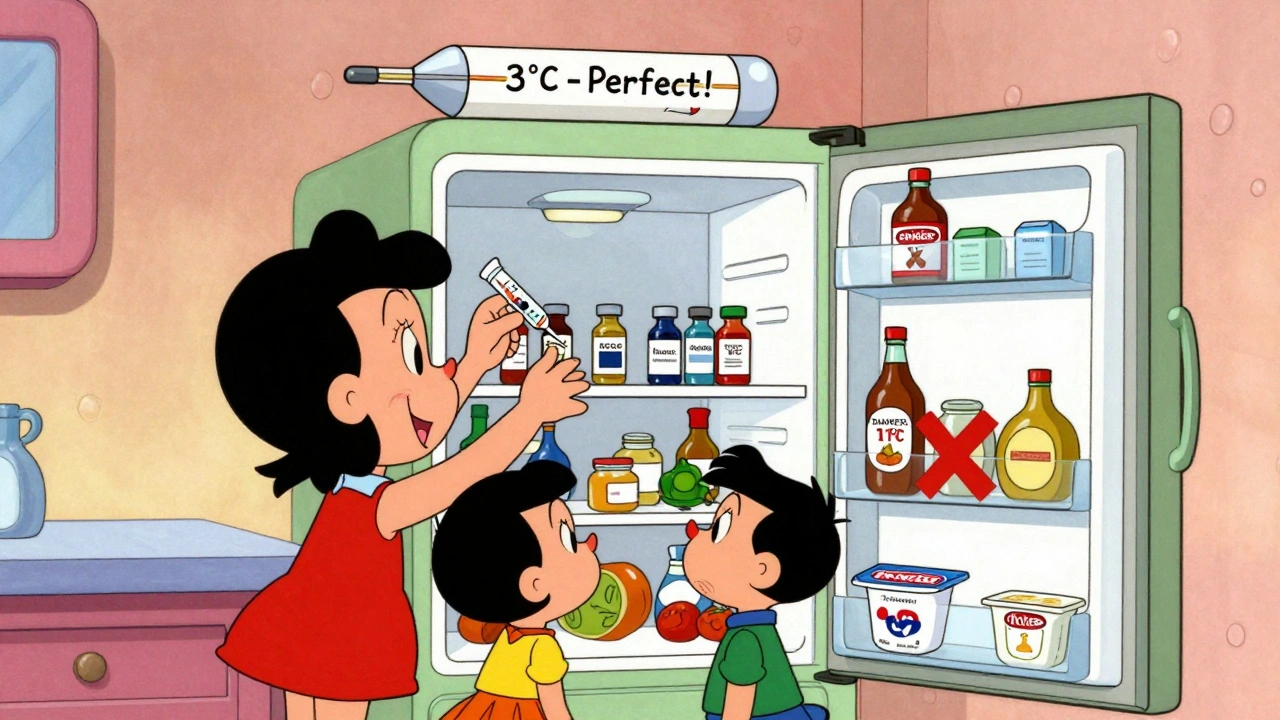
Most home fridges don’t hold this range evenly. The door shelves? They’re often around 11°C. The back wall? That’s usually the coldest spot, around 3-4°C. The middle shelf? That’s your best bet. Keep your meds there, away from the door, away from the freezer compartment, and away from the vegetable crisper. Don’t just toss them in wherever there’s space.
Insulin: The Most Common Refrigerated Medication
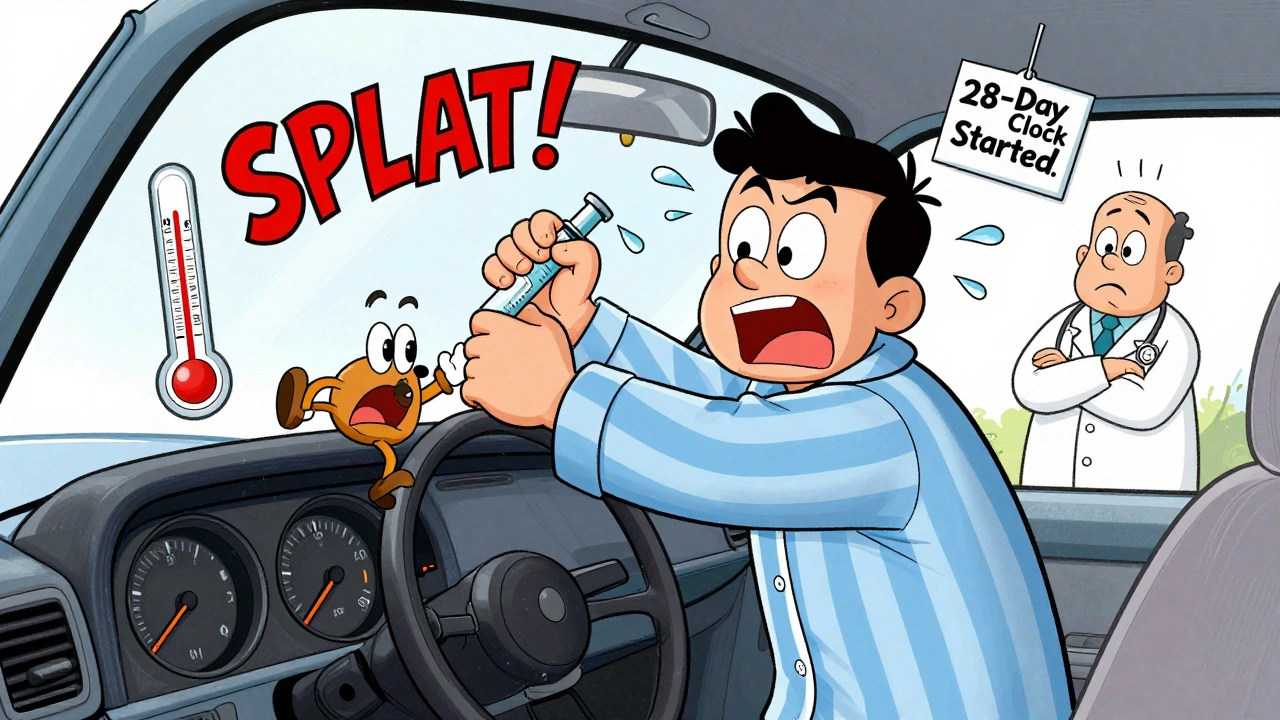
If you or someone you care for uses insulin, this is critical. Unopened insulin vials or pens must be kept refrigerated until first use. Once you start using them, most types can stay at room temperature (up to 30°C) for 28 to 30 days. Lantus, for example, can’t go above 30°C after opening and must be used within 28 days. Novo Nordisk’s newer insulin formulations now last up to 7 days at 37°C, but only if they’re the latest version-always check the label.
Here’s what users report: 68% of insulin users have had at least one incident where they suspected their insulin failed due to heat. One Reddit user shared their pump reservoir failed after being left in a hot car for two hours. Blood sugar spiked to 450. It took 12 hours to get it under control. That’s not an outlier. That’s a pattern.
Vaccines: No Room for Error
Vaccines are even less forgiving. MMR, flu shots, shingles vaccine-all need strict 2°C to 8°C storage. If they warm up, they can lose potency in days. The CDC says 15-25% of vaccines experience temperature excursions during home storage. That’s why pharmacies and clinics use medical-grade fridges with alarms. At home? You need to be just as careful.
Don’t leave vaccines in the fridge overnight if you’re picking them up the next day. If you’re traveling, use a validated cooler with ice packs designed for medications. Never use regular ice cubes-they can freeze the vial. Use gel packs that stay cold but don’t drop below freezing. And always carry a thermometer with you.
What Happens When You Get It Wrong?
When refrigerated meds go bad, the effects aren’t always obvious. You might not feel sick right away. But over time, your treatment stops working. Diabetics may see unexplained high blood sugar. People on biologics for autoimmune diseases might flare up without reason. In 2021, the FDA documented a case where improperly stored insulin led to diabetic ketoacidosis-requiring hospitalization.
Signs your medicine may be damaged:
- Cloudy or clumped insulin (when it should be clear)
- Particles or discoloration in liquid medications
- Changes in how you feel-more fatigue, worse symptoms, no improvement
If you suspect your medication has been exposed to bad temperatures, don’t guess. Call your pharmacist. They can tell you if it’s still safe to use-or if you need a replacement.
Equipment That Actually Works
You don’t need a $2,500 medical fridge to keep your meds safe. But you do need something better than a standard kitchen fridge.
- Dedicated mini-fridge: Models like the Whynter FM-50G or Mobicool cost $150-$300. They’re small, energy-efficient, and can be set to a steady 4°C. Plug them in and forget them.
- Digital thermometer: Get one with a data logger. It records the lowest and highest temperatures over time. You can check it weekly. If it shows a spike above 8°C, you know something went wrong.
- Travel cooler: For trips, use a validated insulated cooler like TempAid MediCool. These maintain 2°C-8°C for up to 48 hours. Don’t use a regular lunchbox.
Most people don’t use any of this. A 2023 survey found only 38% of households with refrigerated meds use a dedicated fridge. The rest rely on their kitchen appliance-even though its temperature swings by 8°C between the door and the back.
Power Outages and Travel
What if the power goes out? Your meds could be at risk in just a few hours.
- Keep the fridge closed. A full fridge can stay cold for 24-48 hours.
- Have a backup plan: Keep a small insulated cooler with ice packs ready. Use phase-change materials-they stay cold longer than regular ice.
- If you’re away for more than a day, ask your pharmacy if they can store your meds for you.
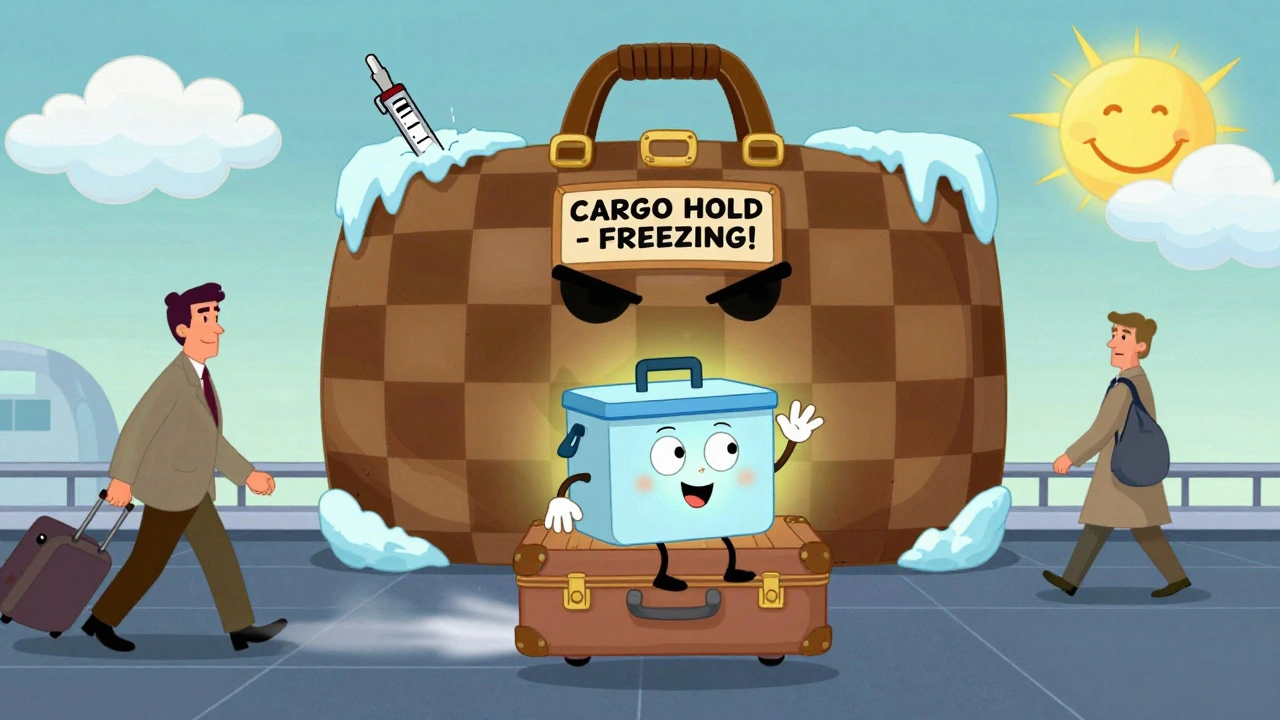
Traveling? Always carry your meds in your carry-on. Never check them in luggage. Airplane cargo holds can drop below freezing. One patient lost their entire month’s supply of biologic when their checked bag froze in the hold. They had to delay treatment for two weeks.
What to Do If You’re Unsure
When in doubt, throw it out. It’s not just about money-it’s about safety. A $100 insulin pen is cheaper than an ER visit.
Always read the label. Manufacturers are required to list storage conditions. If it says “store refrigerated,” don’t assume you can leave it out. If it says “may be stored at room temperature after opening,” that’s your green light-but only for the time specified.
Ask your pharmacist. Most don’t explain storage unless you ask. Don’t be shy. Say: “I’m not sure how to store this. Can you show me?” They’re trained to help.
What’s Changing in 2025
The rules are slowly evolving. Newer insulin formulations are more stable. The FDA is considering broader temperature allowances for some biologics. Samsung even launched a fridge with a “medication mode” that locks in 3°C-5°C. But until your specific drug is approved for room-temperature storage, stick to the label.
By 2030, the American Society of Health-System Pharmacists predicts 30% of all prescriptions will need refrigeration. That’s up from 15-20% today. This isn’t a niche issue anymore. It’s a core part of managing chronic illness.
Final Rule: When in Doubt, Check
Medications that need the fridge aren’t optional. They’re life-sustaining. A little extra care-keeping them on the middle shelf, checking the thermometer once a week, using a travel cooler-makes all the difference. You wouldn’t let your child’s vaccine sit in a hot car. Don’t treat your own medicine any differently.
Storing your meds right isn’t just about following rules. It’s about making sure your treatment works when you need it most.
Comments (12)
Graham Abbas
7 Dec, 2025So many people treat their insulin like it’s just another bottle of syrup. I had a cousin who kept hers in the door of the fridge for years. One day her sugar went through the roof and she ended up in the ER. Turns out the heat had killed half the dose. We’re talking life-or-death stuff here, not a ‘meh, it’s probably fine’ situation.
It’s wild how we’ll go out of our way to protect a phone or a coffee maker but treat our own health like an afterthought.
Andrea DeWinter
9 Dec, 2025My mom’s on Humira and we got her a mini fridge just for meds. $180 but worth every penny. She used to forget to check the temp and would get sick for days with no reason. Now she just glances at the digital readout once a week. Life changed. Also side note - don’t use those gel packs from Amazon unless they’re labeled for meds. Some freeze too hard and crack vials.
Pharmacists are your secret weapon. Ask them. They know more than your doctor sometimes.
Steve Sullivan
9 Dec, 2025Bro i just leave my insulin on the counter lol. Its fine. I mean look at the label it says room temp after opening right? 30c is like... 86f. My house is 78. So its chill. 🤷♂️
Also why are people buying $300 fridges? My aunt uses a styrofoam cooler with a frozen water bottle and its been 2 years. No problems. 🥶
Also i once left my biologic in my car for 6 hours. 95 degrees. Still worked. Maybe the pharma companies are just trying to sell us stuff??
Tejas Bubane
11 Dec, 2025Let’s be real. This whole post is just a marketing pamphlet for companies selling $250 mini fridges. The FDA doesn’t care if your insulin spends 48 hours at 10°C. It’s not like the drug turns into poison. You’re just slightly less effective. Big whoop.
And don’t get me started on the vaccine hysteria. 15-25% temperature excursions? So what? The immune system doesn’t need a lab-grade environment to recognize a spike protein.
Most of this is fearmongering disguised as ‘safety.’
Ronald Ezamaru
11 Dec, 2025As someone who grew up in a household where meds were stored in a drawer next to the toaster, this hit different.
I didn’t know refrigeration was a thing until my dad had a diabetic episode because his insulin was left in the sun during a road trip. We thought it was just ‘bad luck.’ Turns out it was negligence.
Now I keep a little thermometer in my med box. I check it every Sunday. It’s not about being perfect. It’s about not being careless.
Rich Paul
12 Dec, 2025ok so here’s the tea: insulin is a protein. proteins denature at heat. that’s bio 101. but nobody teaches this. pharmacists don’t explain it. docs just scribble scripts. so people treat it like aspirin. big mistake.
also the ‘middle shelf’ thing? yeah that’s the sweet spot. fridge temp swings like 5-8 degrees depending on where you put it. door = death. freezer = crystallization. bottom shelf = too cold. middle = goldilocks.
and if you’re using a travel cooler? get one with phase change material. not ice. ice freezes shit. phase change = cold but not freezing. trust me i’m a chemist.
Ruth Witte
13 Dec, 2025Y’all are overthinking this 😍 Just get a mini fridge, plug it in, and chill (pun intended). I got mine for $120 on sale and it’s been a game changer for my mom’s biologics. She hasn’t had a flare in 8 months 🙌
Also - if you’re traveling, put your meds in a ziplock with a cold pack and keep it in your bra. Yes, I said bra. It stays cool, it’s safe, and no one’s gonna check. 💪❤️
Katherine Rodgers
13 Dec, 2025Oh wow another ‘meds need to be stored perfectly or you’ll die’ article. Next you’ll tell me not to breathe air because it might have 0.0001% of a pollutant.
My insulin sat in my glovebox for 3 days at 100°F. I still took it. My sugar was fine. So was my bank account. You people are so scared of everything it’s exhausting.
Also, ‘medical-grade fridge’? Really? You’re gonna spend $2500 on a fridge when your phone costs more than your rent?
Lauren Dare
14 Dec, 2025Let’s not ignore the elephant in the room: pharmaceutical companies benefit from this fear. Why? Because if you need a $300 fridge, you’re more likely to stick with their expensive drugs. They know people won’t switch if they’ve invested in the ‘system’.
Also, the 68% stat about insulin failure? Where’s the peer-reviewed source? Sounds like a survey from a company selling thermometers.
And ‘throw it out’? That’s just profit-driven advice. I’ve reused meds past expiration. Still worked. Just sayin’.
Gilbert Lacasandile
15 Dec, 2025I get what you’re saying about the fridge. But honestly, most people just don’t have the space or money for a dedicated unit.
I keep mine on the top shelf, away from the door. It’s not perfect, but it’s better than the door. And I check the temp once a week with a cheap digital one from Walmart.
It’s not about being perfect. It’s about being better than before.
Michael Robinson
16 Dec, 2025Medicine isn’t milk. It doesn’t go bad the same way. But it does lose power. And if you’re diabetic, losing power means your body doesn’t get what it needs. That’s not drama. That’s biology.
Keep it cool. Not too cold. Not too warm. Simple.
Andrea Petrov
17 Dec, 2025Wait… did you know that the FDA allows up to 72 hours of temperature deviation for some biologics under emergency conditions? But they don’t tell you that. Why? Because they want you to panic and buy their expensive fridges.
And that ‘phase-change’ cooler? It’s just a fancy ice pack. The real reason they recommend it is because they’re paid by the manufacturers.
Also - have you ever seen the inside of a pharmacy fridge? They’re often warmer than 8°C. So why are we stressing over our home fridges?
Something’s off here.