

Your child snores loudly every night, stops breathing for seconds at a time, and wakes up exhausted. It’s easy to dismiss this as "growing pains" or just a bad cold, but for many kids, it’s a sign of pediatric sleep apnea. This condition is more common than you might think, affecting roughly 1% to 5% of all children. The peak age for diagnosis is between 2 and 6 years old, which is exactly when a child's airway is smallest relative to the size of their tonsils and adenoids.
If left untreated, these interrupted nights can do more than just cause tiredness. They can impact brain development, heart health, and even growth. The good news? There are effective treatments. For most kids, surgery is the first step. For others, a machine called CPAP does the job. Let’s break down how doctors decide which path is right for your child.
Why Tonsils and Adenoids Are the Main Culprits
To understand why kids get sleep apnea, you have to look at their anatomy. Unlike adults, who often develop sleep apnea due to weight gain or aging, children usually suffer from physical blockages. The two main suspects are the Tonsils and Adenoids, which are patches of lymphoid tissue located in the throat and behind the nose, respectively.
Between ages 2 and 6, these tissues are at their largest proportionally. If they become enlarged-often due to chronic infections or allergies-they can physically squeeze the airway shut. When a child tries to breathe in during sleep, the relaxed muscles of the throat can’t hold the airway open against the bulk of this tissue. The result is an obstruction. The child struggles to pull air in, oxygen levels drop, and the brain triggers a "startle" response to wake them up enough to reopen the airway. This cycle repeats throughout the night, fragmenting sleep.
It’s not just about size. Research from the University of Chicago highlights that both structural issues (the size of the tissue) and neuromuscular issues (how well the throat muscles coordinate) play a role. This is why doctors recommend removing both the tonsils and the adenoids, rather than just one, to maximize the space in the airway.
How Doctors Diagnose Pediatric Sleep Apnea
You can’t diagnose this condition by watching your child sleep at home. While snoring is a red flag, it isn't specific enough. The gold standard for diagnosis is a test called Polysomnography, commonly known as a sleep study.
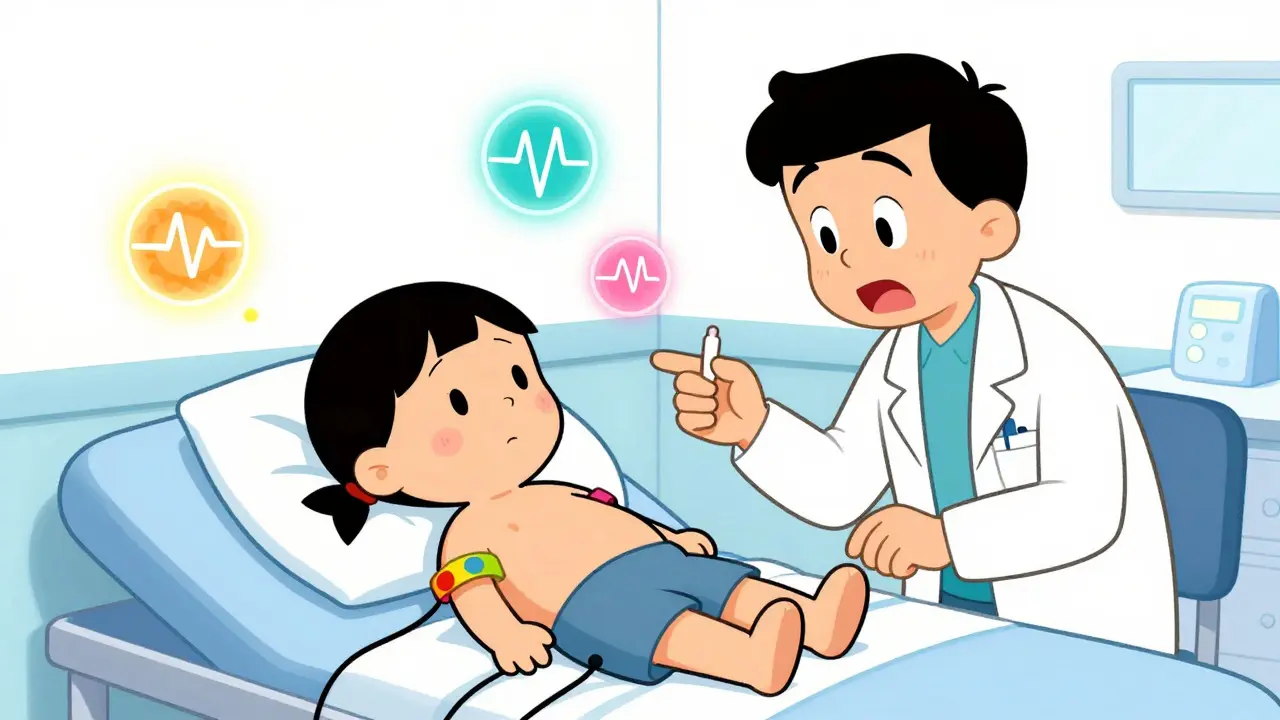
During this overnight test, your child sleeps in a monitored room (either at a hospital or a specialized sleep center). Sensors attach to various parts of the body to track seven key parameters simultaneously:
- Brain activity (to determine sleep stages)
- Heart electrical activity
- Oxygen saturation in the blood
- Carbon dioxide levels
- Chest and abdominal movement
- Muscle activity
- Airflow through the nose and mouth
The results help doctors calculate an Apnea-Hypopnea Index (AHI), which measures how many times the airway blocks per hour of sleep. A normal adult might have less than 5 events per hour. For children, even a few significant pauses can be clinically meaningful because of their developing brains. Severe cases can involve 15 to 30 interruptions per hour, according to data from Mayo Clinic researchers.
First-Line Treatment: Adenotonsillectomy
For the vast majority of children with moderate to severe obstructive sleep apnea caused by enlarged tonsils and adenoids, surgery is the recommended first step. This procedure, known as Adenotonsillectomy, involves the complete removal of both the tonsils and the adenoids under general anesthesia.
According to guidelines from the American Academy of Pediatrics, this surgery cures the condition in 70% to 80% of otherwise healthy children. It’s a relatively quick outpatient procedure, but recovery takes time. Most children need 7 to 14 days of rest, sticking to a liquid or soft diet to avoid irritating the surgical sites.
Some specialized centers, like Yale Medicine, offer a "partial tonsillectomy." This technique leaves a small portion of the tonsil tissue behind, which may lead to faster healing and less postoperative pain. However, the traditional full removal remains the standard of care because leaving tissue behind can sometimes allow the problem to recur.
| Feature | Adenotonsillectomy | Pediatric CPAP |
|---|---|---|
| Best For | Children with enlarged tonsils/adenoids as the primary cause | Children with craniofacial issues, obesity, or residual OSA after surgery |
| Efficacy Rate | 70-80% cure rate in typical cases | 85-95% elimination of apneas if used consistently |
| Recovery/Adjustment | 7-14 days post-surgical recovery | 2-8 weeks to adapt to wearing the mask |
| Key Risk | Postoperative bleeding (1-3%) | Non-adherence (30-50% of patients struggle) |
When Surgery Isn't Enough: The Role of CPAP
Sometimes, removing the tonsils and adenoids doesn't fix the problem entirely. This happens in about 15% to 20% of cases. Other times, the child has risk factors that make surgery risky or ineffective, such as significant obesity, neuromuscular disorders, or craniofacial abnormalities like Down syndrome. In these scenarios, CPAP therapy becomes the primary treatment.
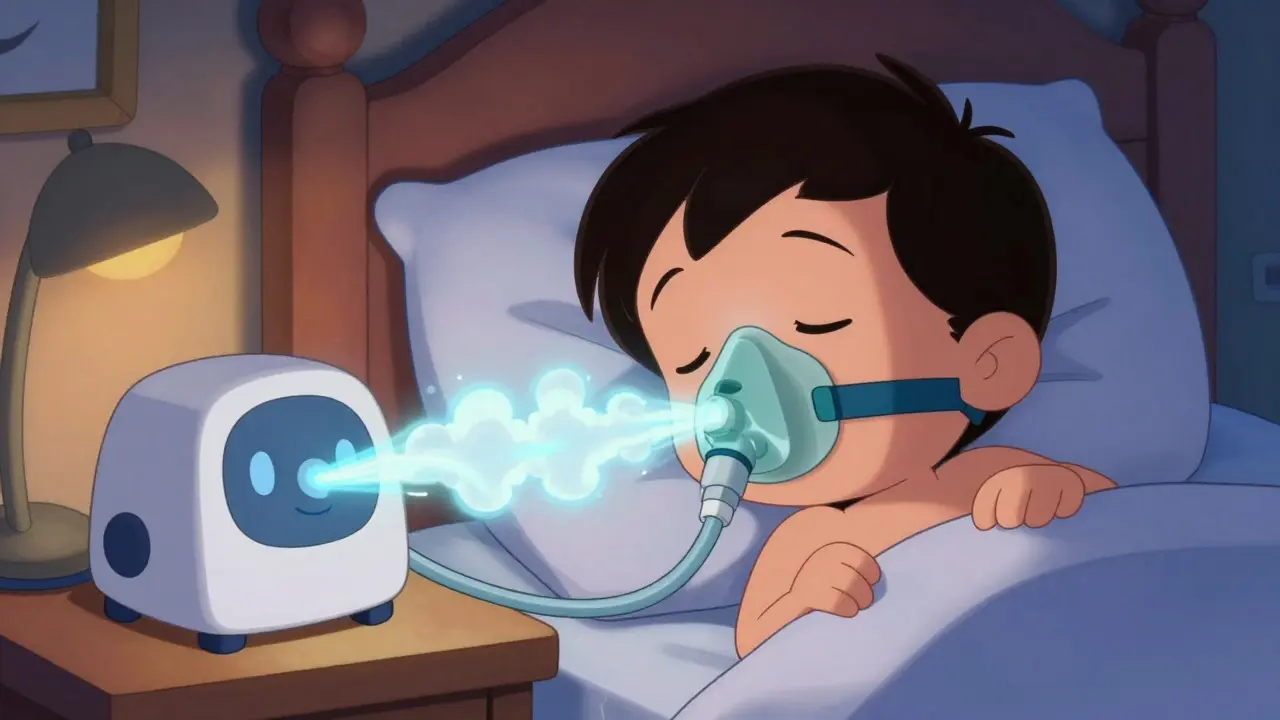
CPAP stands for Continuous Positive Airway Pressure. It works by delivering a steady stream of pressurized air through a mask worn over the nose or face. Think of it as a pneumatic splint that keeps the airway propped open so the child can breathe without effort. For children, the pressure settings are much lower than for adults, typically ranging from 5 to 12 cm H2O.
The challenge with CPAP in kids isn't the technology; it's the compliance. Children don't always want to wear a mask while sleeping. Studies show that 30% to 50% of pediatric patients initially struggle with adherence. It often takes 2 to 8 weeks for a child to get comfortable with the device. Furthermore, because children grow quickly, the mask fit changes frequently. Parents need to expect refittings every 6 to 12 months to ensure the seal is tight enough to work but loose enough to be comfortable.
Alternative and Adjunctive Therapies
If surgery and CPAP aren't options, or if the case is mild, doctors might consider other approaches. These are rarely standalone cures but can help manage symptoms or reduce inflammation.
- Inhaled Corticosteroids: Sprays containing fluticasone (typically 88-440 mcg daily) can reduce swelling in the airway. They are most effective for mild cases and may take 3 to 6 months to show significant improvement.
- Rapid Maxillary Expansion: An orthodontic device that widens the upper jaw. This creates more space for the tongue and airway. It applies 300-500 grams of force over 6 to 9 months and is useful for children with narrow palates.
- Montelukast: An oral medication often used for asthma that also helps reduce airway inflammation. It’s sometimes prescribed as an adjunct to other treatments.
Newer technologies are also emerging. Hypoglossal nerve stimulation, previously only for adults, received limited FDA approval for pediatric use in 2022. This implantable device stimulates the tongue muscle to keep the airway open, offering hope for complex cases where other methods fail.
Monitoring Progress and Long-Term Health
Treatment isn't a one-and-done event. After adenotonsillectomy, the American Thoracic Society recommends a follow-up sleep study 2 to 3 months later for children who had severe OSA or other risk factors. This confirms that the breathing issues have resolved. If symptoms persist, the doctor needs to investigate other causes, such as nasal congestion or reflux.
For those on CPAP, regular check-ins are vital. If a child develops "complex sleep apnea" (a mix of obstructive and central apneas), the pressure settings on the machine may need adjustment. This usually resolves within a week or two of fine-tuning the device.
Addressing pediatric sleep apnea early is crucial because chronic sleep fragmentation leads to intermittent hypoxia (low oxygen). Over time, this can cause neurocognitive deficits, behavioral problems, and cardiovascular strain. By identifying the root cause-whether it's tissue size or airway mechanics-and applying the right combination of surgery or positive airway pressure, you can protect your child's development and give them back their restful nights.
Is tonsil removal permanent?
Yes, once removed, tonsils do not grow back. However, if the sleep apnea was caused by factors other than the tonsils (like obesity or jaw structure), the breathing issues may persist even after the surgery, requiring additional treatment like CPAP.
Can my child outgrow sleep apnea?
Often, yes. As children grow, their airways widen, and the relative size of the tonsils decreases. Many children diagnosed between ages 2 and 6 see significant improvement or complete resolution by age 8 or 9, especially if the initial cause was simply anatomical crowding.
How long does it take to adjust to CPAP?
Most children take between 2 and 8 weeks to become fully comfortable with CPAP therapy. Patience is key. Using desensitization techniques, such as letting the child wear the mask while awake during playtime, can speed up the adaptation process.
What are the risks of adenotonsillectomy?
The most common risks include postoperative pain, nausea, and bleeding. Bleeding occurs in about 1% to 3% of cases and can happen immediately after surgery or up to two weeks later. Respiratory complications requiring intensive care are rare, occurring in less than 1% of patients.
Does CPAP damage the nose or sinuses?
Generally, no. Modern masks are designed to minimize pressure points. However, if the mask fits poorly, it can cause skin irritation or nasal dryness. Using a humidifier with the CPAP machine and ensuring proper mask fit can prevent these side effects.