
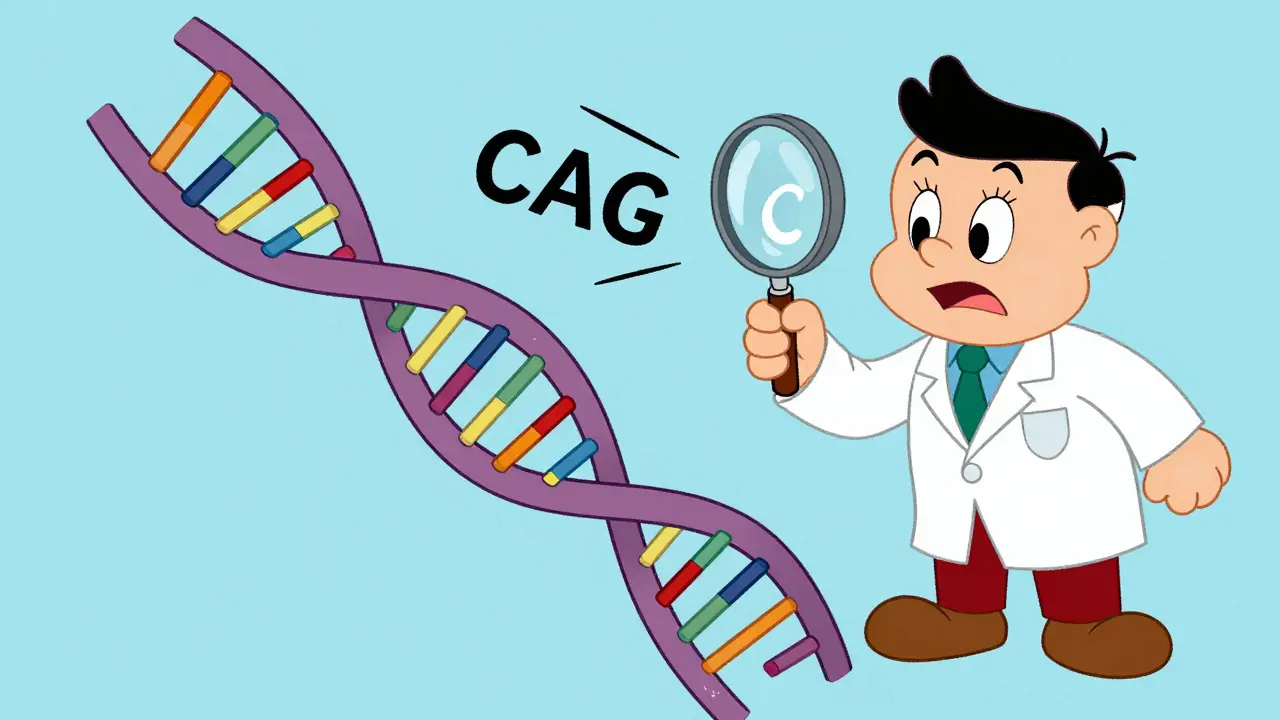
The Genetic Blueprint of HD
At its core, this condition is a matter of genetic repetition. It is caused by a mutation in the HTT gene is the gene located on chromosome 4p16.3 that provides instructions for making a protein called huntingtin. In a healthy gene, a specific sequence of DNA bases-CAG-repeats a few times. But in people with HD, these repeats expand. Think of it like a stutter in the genetic code. If you have 10 to 26 repeats, you're in the clear. However, if that number climbs to 40 or more, the disease is a certainty. There is a gray area between 36 and 39 repeats where the disease might develop, or it might not. When the repeat count is exceptionally high-often over 60-the disease hits much earlier, leading to the Westphal variant, or juvenile HD, which affects children before age 20. One of the most stressful parts for families is the "coin flip" of inheritance. Because HD is autosomal dominant, if one parent has the mutation, every child has a 50% chance of inheriting it. There is also a phenomenon called genetic anticipation. This usually happens when the mutation is passed down from the father; the CAG repeat length can jump significantly, often causing the child to develop symptoms much earlier than the parent did.Understanding Chorea and Motor Decline
When people think of Huntington's, they usually picture Chorea is a movement disorder characterized by involuntary, irregular, and purposeless muscle contractions. It starts subtly-maybe a slight fidget or an awkward gesture-and eventually evolves into flowing, dance-like movements that the person cannot control. These movements aren't random. They happen because the brain's striatum, specifically the GABAergic medium spiny neurons, begin to wither away. This creates a breakdown in the communication lines that normally tell your muscles *not* to move. While chorea is the most visible symptom, it's often joined by dystonia (muscle rigidity) and bradykinesia (slowness of movement) as the disease progresses. To track this, doctors use the Unified Huntington's Disease Rating Scale (UHDRS). They score body regions from 0 (no movement) to 4 (severe, continuous movements). While these movements can be physically exhausting and socially isolating, they typically disappear during sleep and can flare up during times of high stress.| Medication | Primary Benefit | Common Side Effects | FDA Approval Status |
|---|---|---|---|
| Tetrabenazine | Reduces chorea by 25-30% | Depression (22%), Sedation (18%) | Approved (2008) |
| Deutetrabenazine | Sustained chorea control | Drowsiness, fatigue | Approved (2017) |
| Valbenazine | 28% UHDRS improvement | Somnolence | Approved (2023) |

Structuring a Lifetime Care Plan
Since there is currently no cure, the goal shifts from "fixing" to "managing." The most successful outcomes happen when patients move away from general neurology and toward a multidisciplinary team. This includes neurologists, psychiatrists, social workers, and physical therapists. Data shows that using a specialized center can actually extend survival by over two years because it reduces fatal complications like aspiration pneumonia. Care planning isn't a one-time event; it's a phased approach that evolves with the patient.- Early Stage (Diagnosis to 5 Years): This phase is about the "paperwork of life." Focus on genetic counseling for children, updating employment plans, and establishing advance directives. Most patients at specialized centers complete their living wills within the first two years.
- Mid Stage (5 to 15 Years): Physical and communicative abilities begin to slide. This is where occupational therapy becomes vital for daily tasks, and speech therapy helps manage dysarthria (difficulty speaking).
- Late Stage (15+ Years): Eventually, 24-hour supervision becomes necessary. Residential care facilities often become the safest option to prevent falls and manage severe cognitive decline.
The Mental and Emotional Toll
HD isn't just a movement disorder; it's a psychiatric challenge. Many patients experience severe depression, anxiety, and irritability long before the chorea ever starts. This creates a heartbreaking paradox where the person is cognitively aware of their decline but loses the emotional tools to cope with it. For the family, the burden is immense. Caregivers often spend upwards of 15 hours a week just coordinating appointments between different specialists. This "coordination fatigue" is often cited as the hardest part of the journey. There's also the heavy emotional weight of the genetic test. Many at-risk adults delay testing until symptoms appear, fearing the psychological impact of a positive result.
Practical Tips for Families and Caregivers
If you are navigating this, start by building a support network. Don't wait for the crisis to happen to find a social worker or a nutritionist. Because swallowing becomes difficult in later stages, a nutritionist can help prevent choking and malnutrition early on. For those struggling with balance and mobility, try aquatic therapy. Research indicates it's significantly more effective than land-based exercise for improving balance in HD patients. Additionally, start the conversation about long-term finances early. The annual cost of late-stage care can be staggering, often exceeding $125,000 in the US, so exploring insurance and government support now is critical.What is the chance my child will inherit Huntington's if I have it?
Since Huntington's Disease is an autosomal dominant disorder, each child of an affected parent has a precisely 50% chance of inheriting the mutated HTT gene, regardless of the child's gender.
Can chorea be completely stopped?
While chorea cannot be completely cured, medications like Tetrabenazine, Deutetrabenazine, and Valbenazine can significantly reduce the severity of involuntary movements. These treatments focus on managing symptoms rather than curing the underlying genetic cause.
What is the difference between adult-onset and juvenile HD?
Adult-onset HD typically manifests between ages 30 and 50 and is often associated with 40-50 CAG repeats. Juvenile HD (Westphal variant) occurs before age 20, usually involves 60+ CAG repeats, and often presents with more rigidity and stiffness than the typical chorea seen in adults.
How does genetic anticipation work in HD?
Genetic anticipation occurs when the CAG repeat length increases as the gene is passed to the next generation. This is most common in paternal transmission, where the repeat count can expand by 5-10 units, often leading to an earlier onset of symptoms in the child.
Why is a multidisciplinary team important for HD?
HD affects motor, cognitive, and psychiatric functions simultaneously. A coordinated team of neurologists, psychiatrists, speech therapists, and social workers ensures that all these needs are met, which has been shown to reduce hospitalizations and improve overall quality of life.
Comments (13)
Rauf Ronald
7 Apr, 2026Aquatic therapy is a total game changer for balance. I've seen it work wonders in clinical settings because it takes the gravity out of the equation, letting patients move with way less fear of falling.
Danielle Kelley
7 Apr, 2026Of course they tell you to go to a "Center of Excellence" and spend 125k a year. Just follow the money trail and you'll see who really benefits from these "multidisciplinary teams" while they keep the real cures hidden in a vault somewhere.
Toby Sirois
8 Apr, 2026You guys are missing the point. It is not just about meds. If you don't fix your mindset and diet first, the pharma stuff is just a bandage. I've seen a lot of cases and the common thread is always a lack of spiritual alignment with the body.
Christopher Cooper
8 Apr, 2026It's truly fascinating how the CAG repeats function as a genetic clock. I wonder if there are emerging CRISPR technologies that could actually target those specific expansions without affecting the rest of the genome. The precision required would be immense, but the potential for altering the disease trajectory is what keeps the scientific community hopeful. It is an incredibly complex biological puzzle, yet the progress in genomic sequencing gives me a lot of confidence that we are moving in the right direction for future generations. We should really keep an eye on the current clinical trials for antisense oligonucleotides because that's where the real breakthrough might happen. The way the protein misfolds and aggregates in the striatum is just brutal, but if we can stop the production at the source, we might actually save people. It's a long road, but every single discovery brings us closer to a world where this isn't a death sentence. I've read that some labs are already experimenting with viral vectors to deliver these corrections. The ethical implications are huge, obviously, but the human cost of doing nothing is even higher. We have to keep pushing the boundaries of what's possible in neurology. The synergy between geneticists and neurologists is the only way forward here. Let's stay positive and keep supporting the researchers who are spending their lives on this. The complexity of the brain is a challenge, but human ingenuity is stronger.
Vivek Hattangadi
8 Apr, 2026I totally agree with the point about the legal bridge. Getting the paperwork done early is the kindest thing you can do for your family so they aren't fighting in court later on.
Brady Davis
9 Apr, 2026Oh great, a 50% coin flip for a slow-motion train wreck. Just what I needed in my genetic portfolio today. Simply thrilling.
Rupert McKelvie
9 Apr, 2026It's heartening to see such a comprehensive guide for families. Having a plan makes the impossible feel a bit more manageable.
jack hunter
11 Apr, 2026who cares about the stats... laife is just a series of random glitches anyway and we pretend these lists of meds actully make a diffrence when the void just eats u regardless
Daniel Trezub
13 Apr, 2026Actually, the UHDRS is way more subjective than people think. You can't just trust a 0 to 4 scale when different doctors have totally different ideas of what "severe" looks like.
charles mcbride
14 Apr, 2026Stay strong everyone. There is always hope for new treatments around the corner.
Sarabjeet Singh
16 Apr, 2026Keep fighting the good fight.
Alexander Idle
17 Apr, 2026The sheer audacity of the healthcare system to charge 125k for basic care is just peak capitalism. Absolute madness.
Darius Prorok
17 Apr, 2026Tetrabenazine is just for the shakes. It does not fix the brain parts that are gone.