
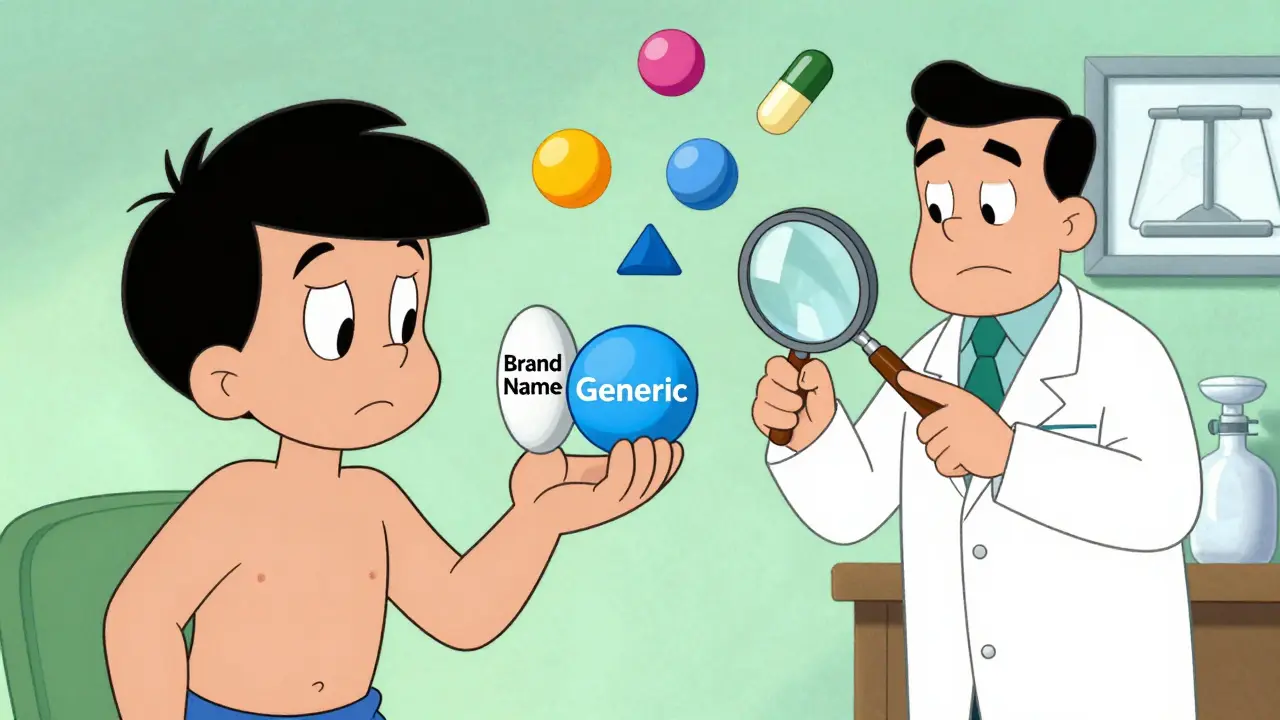
Have you ever picked up your prescription and thought, "Wait, this pill doesn’t look the same as last time?" You’re not imagining it. Generic drugs often change color, shape, or size between refills-and it’s not a mistake. It’s the law.
Why Do Generic Drugs Look Different?
Generic drugs are chemically identical to their brand-name counterparts. They contain the same active ingredient, work the same way, and have the same risks and benefits. So why do they look different? The answer lies in U.S. trademark law, not medicine.
Trademark law exists to protect brands. If a company spends years building recognition around a blue oval pill with a specific logo, they have legal rights to that appearance. That’s why you can’t buy a generic version that looks exactly like the brand-name version. The law says: no two drugs on the market can look identical, even if they’re made by different companies and contain the same active ingredient.
This rule isn’t about safety or effectiveness. It’s about preventing confusion in the marketplace. If a generic looked exactly like the brand, a patient might think they’re getting the original, or worse-a pharmacist might accidentally dispense the wrong product. Trademark law forces generic manufacturers to create a unique visual identity, even when the medicine inside is the same.
What Exactly Changes?
When a generic drug hits the market, it must differ in at least one of these physical traits:
- Color - A brand-name pill might be white; the generic could be yellow or light blue.
- Shape - The brand may use a capsule; the generic might be a tablet, or vice versa.
- Size - Generic pills can be slightly larger or smaller.
- Scoring - Some pills have a line down the middle to help split them. Generics may or may not have that line.
- Flavoring or coating - Especially in liquid or chewable forms, the taste or texture can vary.
All of these differences are intentional. The U.S. Food and Drug Administration (FDA) requires generic manufacturers to submit proof that their drug performs the same as the brand-name version. But they also require that the pill’s appearance doesn’t copy another drug already on the market.
Here’s what stays the same:
- Active ingredient (e.g., atorvastatin, metformin, sertraline)
- Dosage strength
- How fast it works
- How long it lasts
- Side effects
- How it’s taken (by mouth, under the tongue, etc.)
The FDA confirms this clearly: "Generic medicines and brand-name medicines share the same active ingredient, but other characteristics, such as colors and flavorings, that do not affect the performance, safety, or effectiveness of the generic medicine, may be different."
How Much Do They Differ?
It’s not just about looks. The science behind generic drugs is strict. To get approved, a generic must deliver the same amount of medicine into your bloodstream as the brand-name version-within a narrow range of 80% to 125%. A large study found that, on average, generics differ from brand-name drugs by just 3.5% in absorption. That’s less than the natural variation your body has from day to day.
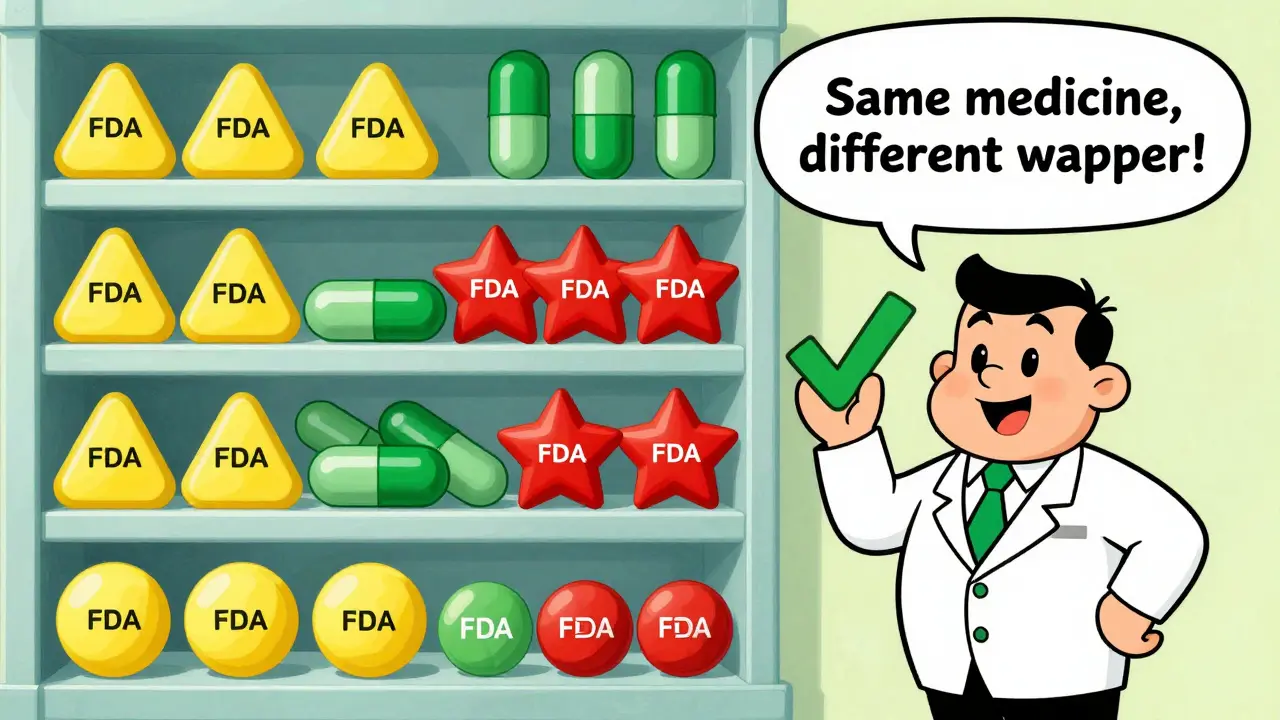
So even if the pill looks different, your body absorbs it the same way. The inactive ingredients-like fillers, binders, and dyes-are what change. These don’t affect how the drug works. They’re just there to hold the pill together or make it easier to swallow. Think of them like the packaging of a product. The contents are identical; the wrapper is different.
Why Does This Matter to Patients?
For most people, the difference doesn’t matter. Generics save money-often 80% to 85% less than brand-name drugs. Over 90% of prescriptions filled in the U.S. are for generics. That’s billions of dollars saved every year.
But for some, the change in appearance causes real confusion. A patient who’s been taking a small white pill for years might panic when they get a large, light green one. They might think:
- "Is this the right drug?"
- "Did the pharmacy make a mistake?"
- "Is this fake?"
Pharmacies see this all the time. That’s why they now put clear labels on vials: "Generic version of [brand name]. Appearance may vary. Same active ingredient."
Some pharmacies even include a small photo of the pill on the label. Others call patients directly when the appearance changes. These steps help prevent mistakes-and they’re especially important for older adults or people taking multiple medications. Here’s a common scenario: You refill your blood pressure pill. The first time, it’s a white oval. The second time, it’s a blue circle. The third time, it’s a white capsule. Why? Because the pharmacy switched suppliers. Generic drugs aren’t made by one company. Dozens of manufacturers can produce the same drug. Each one has its own version with a unique look. When your pharmacy orders from a different supplier, you get a different pill-even though it’s the same medicine. This isn’t a flaw. It’s normal. But it’s also why the FDA recommends that generic manufacturers try to match the size and shape of the original brand, as long as they don’t copy it exactly. It’s a balance: protect trademarks, reduce confusion. Yes. The FDA inspects every generic drug factory, just like brand-name ones. They test for purity, strength, and how well the drug dissolves. They also monitor reports of side effects after the drug hits the market. Dr. Janet Woodcock, former director of the FDA’s drug review center, put it simply: "Generic drug companies must provide scientific evidence that shows their active ingredient is the same as the brand-name medicine. The FDA reviews that evidence before approving it."
The American Medical Association backs this up too. There’s no evidence that generics are less safe or effective. In fact, a 2022 Consumer Reports survey found that 89% of patients reported no difference in how well their generic worked compared to the brand. If you notice a change in your pill: Some people keep a small photo of their pill on their phone. Others write down the color and shape when they first get a prescription. These small habits prevent anxiety and mistakes. This system exists because it works. Generics make life-saving drugs affordable. Without them, millions of people couldn’t afford their medicine. But trademark law keeps the market fair for innovators too. Brand-name companies invest millions to develop new drugs. Trademark protection gives them a chance to recover that investment before generics enter the market. The real win? You get the same medicine for a fraction of the cost. And while the pill might look different, your health doesn’t have to.What Happens When You Switch Manufacturers?
Is It Safe?
What Should You Do?
The Bigger Picture
Comments (11)
Alfred Noble
26 Feb, 2026I used to freak out every time my generic pill changed color. Then I learned to check the name on the label. Now I just laugh. Same medicine, different wrapper. 🤷♂️
Brooke Exley
28 Feb, 2026This is such a dope breakdown. I love how you framed it like packaging-because that’s literally what it is. The product inside is the same, but the box got a glow-up. Generics are the unsung heroes of healthcare. Keep fighting the good fight, folks!
Cory L
1 Mar, 2026I keep a little photo of my pills on my phone. Just in case. My grandma does too. She’s 82 and takes six meds. She calls it her ‘pill diary.’ Smart AF. If you’re scared of the color change, just snap a pic next time you get it. Peace of mind for less than five seconds.
Emily Wolff
1 Mar, 2026The FDA’s stance is laughably naive. If you think patients don’t panic when their ‘blue oval’ turns into a ‘pink triangle,’ you’ve never met someone on SSRIs.
Bhaskar Anand
1 Mar, 2026In India we don't have this problem because generics are made by same company as brand. Why do Americans overcomplicate everything? The medicine works. End of story.
Joseph Cantu
2 Mar, 2026Let me guess. Big Pharma is secretly controlling the pill colors to keep us confused. They want us to doubt our own bodies. They want us to panic. They want us to pay more. This isn't trademark law-it's mind control. And they're winning.
Matthew Brooker
3 Mar, 2026I used to think changing pill shapes meant something was wrong. Then I found out my pharmacy switched suppliers. Now I just appreciate the variety. It's like getting a surprise flavor of your favorite snack. Different look, same deliciousness. Keep taking it. You're doing fine.
Lisandra Lautert
4 Mar, 2026I’ve had patients cry because their ‘green pill’ became ‘yellow.’ They thought they were being poisoned. I now print out a picture of the generic version and tape it to the prescription. Simple. Human. Effective.
Jacob Carthy
6 Mar, 2026America’s obsession with labels is wild. You’re paying less. You’re getting the same drug. Stop overthinking. This isn’t a fashion show. It’s medicine. Just swallow it and move on
Lou Suito
6 Mar, 2026Wait. Hold on. The FDA requires that generics not look like brand-name drugs? So, legally, you can’t have the same appearance? But the active ingredient is identical? So, the entire regulatory framework is built on aesthetics? And you’re telling me this isn’t a joke? This is a system designed by someone who thinks pills are cereal boxes. This is insane. This is absurd. This is ridiculous. This is a national embarrassment.
William James
8 Mar, 2026It’s wild how much fear is tied to something as simple as a pill’s color. We’ve been trained to equate appearance with authenticity. But medicine doesn’t care about aesthetics. It cares about chemistry. And chemistry doesn’t lie. The real revolution? When we stop judging pills by their cover and start trusting the science inside. That’s the real win.