
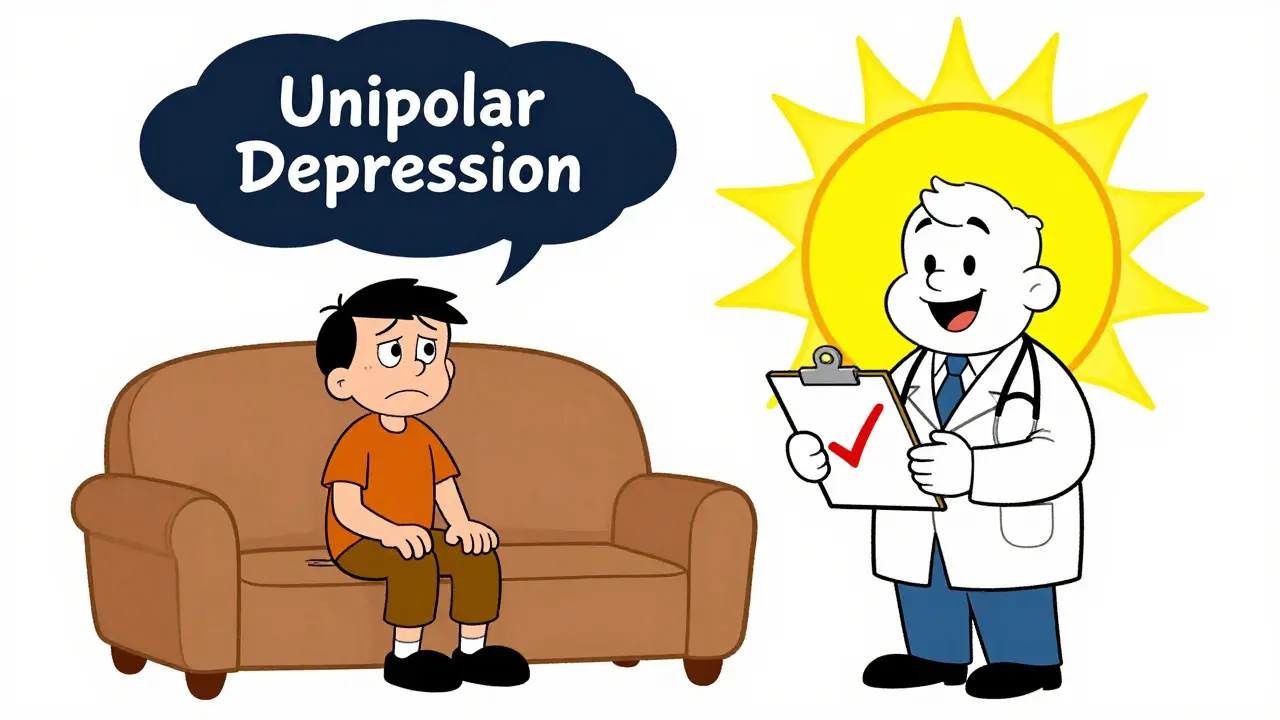
When someone is deeply depressed, it’s easy to assume they have unipolar depression - also called Major Depressive Disorder (MDD). But what if their depression is actually part of something bigger? Misdiagnosing bipolar depression as unipolar depression isn’t just a mistake - it can make things worse. Antidepressants, which help many people with unipolar depression, can trigger mania, rapid cycling, or even hospitalization in someone with bipolar disorder. The difference between these two conditions isn’t subtle. It changes everything: how you’re diagnosed, what meds you take, and whether your treatment helps or hurts.
What Exactly Is Unipolar Depression?
Unipolar depression, or Major Depressive Disorder, means you experience periods of intense sadness, loss of interest, fatigue, and hopelessness - but only depression. No highs. No energy surges. No impulsivity. No racing thoughts. Just the weight of depression, sometimes for weeks or months at a time. To meet the DSM-5 criteria, you need at least five symptoms - including depressed mood or loss of pleasure - lasting two weeks or longer. These symptoms must cause real trouble in your life: you can’t work, you’re not sleeping, you’re withdrawing from friends, or you’re thinking about death.
Most people with unipolar depression respond well to SSRIs like sertraline or escitalopram. In clinical trials, about 60-65% of patients see improvement after 8-12 weeks of treatment. Therapy, especially Cognitive Behavioral Therapy (CBT), helps too. It teaches you to challenge negative thoughts and rebuild routines. For first-time episodes, doctors often suggest stopping medication after 6-12 months of stability. Relapse rates are around 37% if you stay on meds, but jump to 73% if you stop - though that’s still lower than bipolar disorder.
What Is Bipolar Depression?
Bipolar depression looks almost identical to unipolar depression - same low energy, same crying spells, same inability to get out of bed. But here’s the catch: the person has had at least one manic or hypomanic episode in their life. Mania means inflated self-esteem, little need for sleep, racing thoughts, reckless spending, or risky behavior. Hypomania is milder - maybe you feel unusually productive or talkative - but it still stands out from your normal self. Without that history, you can’t be diagnosed with bipolar disorder.
That’s why so many people get it wrong. A 2007 study found that 40% of people with bipolar disorder were first diagnosed with unipolar depression. Many stay on antidepressants for years before someone notices the pattern: they get hyper after starting Zoloft. They go from crying all day to staying up for three nights straight, buying a car they can’t afford. That’s not recovery - that’s a switch.
How Do Symptoms Differ?
On the surface, both types of depression feel the same. But deeper down, there are clues. People with bipolar depression are more likely to:
- Wake up hours before sunrise, unable to go back to sleep (57% vs. 39% in unipolar)
- Feel worse in the morning and slightly better by evening (63% vs. 41%)
- Have slowed movements and speech - known as psychomotor retardation (68% vs. 42%)
- Experience hallucinations or delusions (22% vs. 8%)
- Struggle with memory and decision-making, scoring significantly lower on cognitive tests
These aren’t random quirks. They’re patterns doctors use to spot bipolar depression. If someone comes in with depression and early morning awakening, mixed with a family history of bipolar disorder, that’s a red flag. Same if they’ve had poor response to two or more antidepressants. The STAR*D trial showed those patients were 3.7 times more likely to later be diagnosed with bipolar disorder.
Diagnostic Tools: What Doctors Look For
There’s no blood test or brain scan that confirms bipolar depression. Diagnosis relies on history, symptom patterns, and screening tools. Two are widely used:
- Mood Disorders Questionnaire (MDQ): A 13-item checklist. If someone answers yes to 7 or more items and says those symptoms caused problems, it’s a positive screen. It’s good at ruling out bipolar - 94% specificity - but misses about 72% of cases.
- Hypomania Checklist-32 (HCL-32): More sensitive. It catches 69% of bipolar cases but also flags some people who don’t have it. Still, it’s better for spotting subtle hypomania - like feeling unusually confident or needing less sleep without feeling tired.
Doctors also ask direct questions: “Have you ever gone days without sleeping and felt wired?” “Did you ever spend money you couldn’t afford?” “Did you ever feel so good you thought you could fly?” Many patients don’t realize those episodes are abnormal. They think they’re just “on a roll.”
Family history matters too. If a parent or sibling has bipolar disorder, your risk jumps from 1-2% to 5-10%. That’s a big clue.
Why Antidepressants Can Be Dangerous in Bipolar Depression
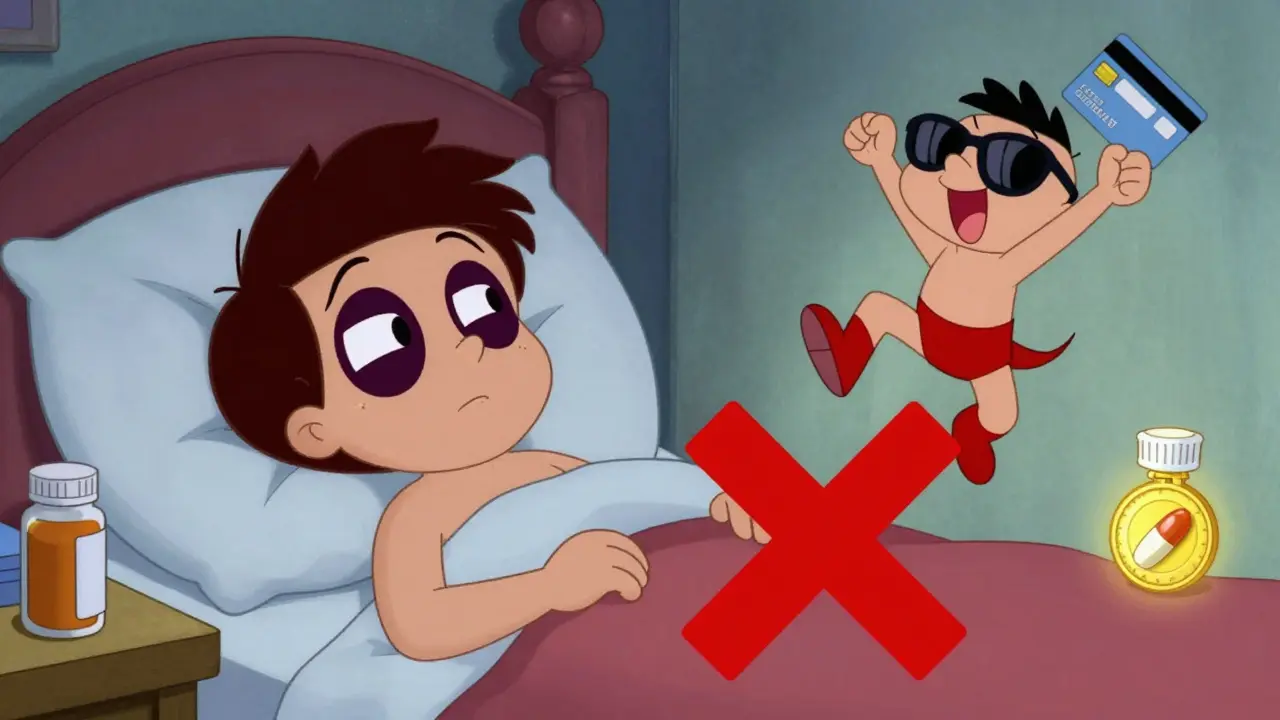
This is the most critical point. For unipolar depression, antidepressants are the go-to. For bipolar depression? They’re risky. The STEP-BD study found that 76% of bipolar patients on antidepressants alone had mood destabilization - meaning they cycled into mania, mixed episodes, or rapid cycling. One Reddit user, u/BipolarSurvivor, shared: “I was on Prozac for seven years. I went from two episodes a year to twelve. I lost my job. I got hospitalized twice.”
Antidepressants don’t cause bipolar disorder. But in people who already have it, they can trigger episodes. The odds of switching to mania are 2.3 times higher with antidepressants alone, according to NICE guidelines. That’s why experts say: never use them as monotherapy in bipolar depression.
How Treatment Is Different
Unipolar depression treatment is straightforward: antidepressant + therapy. Bipolar depression? It’s layered.
For bipolar depression, first-line treatments are:
- Lithium: A mood stabilizer. It reduces depressive episodes by 48% compared to placebo. It’s old, but still one of the most effective.
- Quetiapine (Seroquel): An atypical antipsychotic. It’s FDA-approved for bipolar depression and works faster than lithium. Response rate: 58% vs. 36% for placebo.
- Lurasidone (Latuda): Another antipsychotic. Approved for bipolar depression in 2013. It has fewer weight gain side effects than others.
Antidepressants? Only used as an add-on - and only after mood stabilizers are already working. Even then, they’re used cautiously and for short periods.
Therapy is different too. CBT helps both, but for bipolar, Interpersonal and Social Rhythm Therapy (IPSRT) is gold standard. It focuses on sleep, meals, and daily routines. Keeping a steady schedule helps prevent episodes. One study showed 68% of patients on IPSRT reached remission after a year - compared to 42% with standard care.
What Happens When You’re Misdiagnosed?
It’s not just about wrong meds. It’s about lost time. A 2017 study found people misdiagnosed with unipolar depression spent an average of 8.2 years on the wrong treatment before getting the right diagnosis. During that time, 63% had at least one hospitalization due to antidepressant-induced mania.
Real-world data from the National Comorbidity Survey shows 89.7% of bipolar patients initially diagnosed with unipolar depression were put on antidepressants - often for years. That’s not care. That’s harm.
And the cost? A 2021 study estimated misdiagnosed bipolar patients cost the system $13,247 more per year - because of extra ER visits, hospital stays, and medication changes.
What About the Bipolar Spectrum?
Some experts, like Dr. Kay Jamison, argue that depression exists on a spectrum. They point to genetics: a 2019 study in Nature Genetics found a 0.72 genetic correlation between bipolar disorder and unipolar depression. That’s huge. It suggests they share biological roots.
But Dr. Michael First, co-editor of DSM-5, disagrees. He says only 10-15% of people with recurrent depression develop mania within 10 years. That’s why the DSM-5-TR (2022) still keeps them separate - but added a “with mixed features” specifier. That lets doctors note if someone has manic symptoms during a depressive episode, without changing the diagnosis.
The takeaway? Don’t assume. If depression doesn’t improve after two antidepressants, or if there’s a family history, or if you’ve had sudden mood shifts - get re-evaluated. It could change your life.
What’s New in Treatment?
There’s progress. In 2019, the FDA approved esketamine (Spravato) for treatment-resistant unipolar depression. It works fast - some feel better in hours. For bipolar depression, cariprazine (Vraylar) was approved the same year. In trials, 36.6% of patients went into remission vs. 23% on placebo.
Researchers are also testing digital tools. Apps that track sleep, voice patterns, typing speed, and location can spot subtle mood shifts before they become episodes. A 2023 Lancet study found a 12-gene blood test could distinguish bipolar from unipolar depression with 83% accuracy. It’s not ready for clinics yet - but it’s coming.
What Should You Do?
If you’ve been diagnosed with unipolar depression but:
- Antidepressants didn’t help - or made things worse
- You’ve had periods of high energy, impulsivity, or reduced need for sleep
- Family members have bipolar disorder
- You’ve cycled between depression and mania without realizing it
Ask for a second opinion. Request a screening with the HCL-32 or MDQ. Bring a family member to help recall past episodes. Don’t let a misdiagnosis cost you years of your life.
Bipolar depression isn’t just “depression with mood swings.” It’s a different illness. And treating it like unipolar depression is like giving insulin to someone with type 1 diabetes - and then wondering why their blood sugar keeps spiking.
Can you have bipolar depression without ever having mania?
No. By definition, bipolar depression only occurs in people who’ve had at least one manic or hypomanic episode. If someone has only depressive episodes, they’re diagnosed with unipolar depression (Major Depressive Disorder). But many people don’t recognize hypomania - they think feeling energetic or productive is normal. That’s why doctors ask about past behavior, family history, and response to antidepressants.
Are antidepressants ever safe for bipolar depression?
Only as an add-on, and only after a mood stabilizer is already working. Using antidepressants alone carries a high risk of triggering mania or rapid cycling. Guidelines from NICE and the American Psychiatric Association strongly warn against monotherapy. When used carefully with lithium, quetiapine, or lurasidone, antidepressants may help in stubborn cases - but they’re never the first choice.
How do I know if my depression is bipolar?
Look for clues: early morning waking, morning worsening of mood, psychomotor slowing, psychotic symptoms, or a strong family history of bipolar disorder. Also, ask yourself: did you ever feel unusually confident, talkative, or impulsive? Did you ever go days without sleep and feel fine? Did antidepressants make you feel worse or more agitated? If yes, ask your doctor for a mood disorder screening like the HCL-32.
Can bipolar depression turn into unipolar depression?
No. Once you’ve had a manic or hypomanic episode, you have bipolar disorder - even if you haven’t had one in years. The diagnosis doesn’t go away. But some people go long periods without mania, especially with proper treatment. That doesn’t mean they’ve “cured” bipolar disorder. It means their treatment is working.
Is bipolar depression more serious than unipolar depression?
Both are serious. But bipolar depression often comes with more complications: higher risk of suicide, more frequent hospitalizations, and greater functional impairment over time. The added risk of mania makes it harder to treat and more unpredictable. That’s why accurate diagnosis is so critical - it’s not just about labels. It’s about survival.
Comments (12)
Joanna Ebizie
15 Dec, 2025Oh sweet mercy, I knew someone was gonna say this eventually - antidepressants are basically emotional fireworks in a bipolar person’s brain. I was on Lexapro for 3 years thinking I was ‘finally fixed,’ then I bought a Tesla on a whim and cried for 72 hours straight. Turns out I wasn’t depressed - I was one bad prescription away from a psychiatric ward. Don’t trust your doctor if they don’t ask about your ‘wild phase’ in college.
Elizabeth Bauman
15 Dec, 2025Let me tell you something about the medical-industrial complex - they don’t want you to know this, but bipolar disorder is being suppressed by Big Pharma because mood stabilizers like lithium cost 20 cents a pill. SSRIs? $500/month. That’s why they push antidepressants like candy. And don’t get me started on how the DSM is a tool of cultural control. If you’re from a conservative family and you’re ‘moody,’ they label you bipolar to keep you quiet. Wake up, sheeple.
Aditya Kumar
15 Dec, 2025Yeah, I read all that. Too long. I have depression. I take meds. It works. I don’t care about the rest.
Tiffany Machelski
16 Dec, 2025i had no idea about the morning waking thing… i thought i was just a morning person 😅 but now i’m like… wait, was i depressed the whole time? i’ll check my hcl-32 tonight. thanks for this
SHAMSHEER SHAIKH
18 Dec, 2025It is with profound respect for the scientific literature and the lived experiences of countless individuals that I must emphasize the critical importance of differential diagnosis in mood disorders. The data presented herein - particularly the 8.2-year diagnostic delay and the 76% destabilization rate with antidepressant monotherapy - constitute not merely clinical observations, but moral imperatives for psychiatric practice. The human cost of misdiagnosis is not statistical; it is familial, occupational, and existential. Let us not treat mental health as a diagnostic checkbox, but as a sacred trust.
Souhardya Paul
19 Dec, 2025Just wanna say - if you’ve been on an SSRI for a while and suddenly feel ‘too good’ or can’t sleep for days, that’s not a win. That’s your brain going, ‘Wait, this isn’t right.’ I didn’t realize my ‘productive streak’ in 2021 was hypomania until my mom said, ‘You talked to the mailman for 45 minutes about quantum physics.’ I got tested. Turned out I needed lithium, not Zoloft. Life changed.
anthony epps
21 Dec, 2025so if you’re depressed and antidepressants make you feel weird… maybe it’s bipolar? that’s it? no test? just guess?
Dan Padgett
21 Dec, 2025You know, depression ain’t just sadness - it’s the sound of your soul forgetting how to breathe. But bipolar? That’s your soul doing the cha-cha between a funeral and a rave. One day you’re crying over spilled milk, next day you’re starting a podcast, buying a yacht, and telling strangers you’re the reincarnation of Einstein. And nobody sees it ‘cause they think ‘high energy’ = good. Nah, brother. That’s your brain on fire.
Hadi Santoso
22 Dec, 2025my cousin in nigerian got diagnosed after she went on a 3-day shopping spree and then cried for a week straight. her doctor asked ‘did you ever feel like you could fly?’ and she said ‘yes, but i thought everyone felt that when they ate jollof rice.’ 😂 so true - we don’t know what’s normal till someone points it out
Arun ana
24 Dec, 2025👏 this is so important. i didn’t know about the HCL-32. gonna send it to my sister. she’s been on antidepressants for 5 years and still feels ‘off’. maybe she’s bipolar? 🤔
Kayleigh Campbell
24 Dec, 2025So let me get this straight - you’re telling me the whole medical system is just waiting for someone to buy a yacht on a whim before they say, ‘Oh, you’re not depressed, you’re just… bipolar’? Cool. Cool cool cool. I’ll just keep crying quietly then. 🙃
Dave Alponvyr
25 Dec, 2025My therapist asked me if I ever felt like I could fly. I said, ‘No.’ Then she said, ‘What about the time you drove to Chicago at 3 a.m. because you ‘heard the stars calling’?’ …Oh. Right. That.