
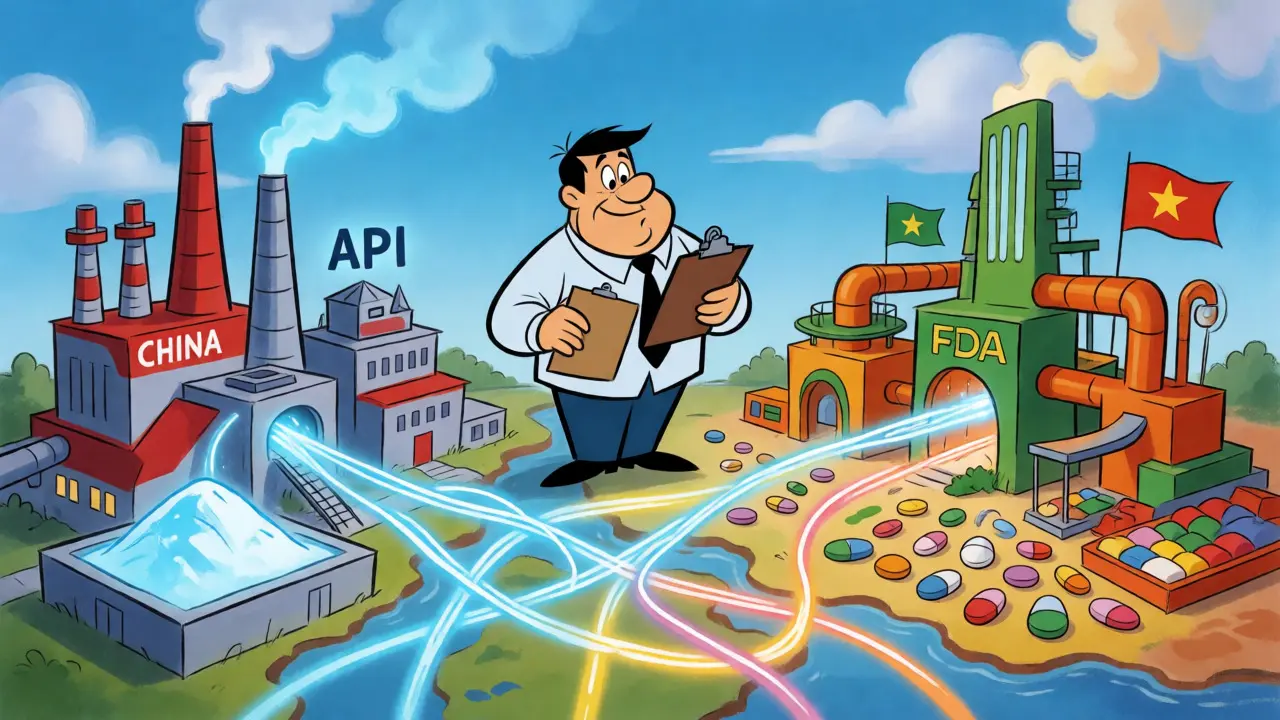
You think you know where your medicine comes from? Think again. While the final pill might say "Made in USA" or "Packaged in Germany," the active ingredients often start their journey thousands of miles away. For decades, India and China have been the twin engines powering the global pharmaceutical supply chain. But they are not interchangeable. If you are a procurement manager, a regulatory affairs specialist, or just someone worried about drug shortages, understanding the distinct risk profiles of these two giants is no longer optional-it's survival.
The stakes are incredibly high. Recent data shows that China controls roughly 80% of the global generic Active Pharmaceutical Ingredient (API) supply chain. Meanwhile, India dominates the production of finished generic drugs, serving as the world's pharmacy for low-cost treatments. The problem? These two systems are deeply intertwined. A disruption in Chinese chemical synthesis ripples through Indian factories, which then impacts US and European shelves. The US Food and Drug Administration (FDA) knows this. Their monitoring strategies reflect a growing anxiety about geopolitical fragility and quality consistency. Let's break down who does what, where the cracks are forming, and how regulators are trying to keep up.
The Big Picture: Volume vs. Value
It’s easy to look at map size and assume bigger output means better control. That’s wrong here. India is the world’s third-largest pharmaceutical producer by volume but ranks only fourteenth by value. Why? Because it focuses on generics-cheap, high-volume copies of expired patents. China, conversely, has pivoted from being just a factory floor to an R&D hub, though it still holds the monopoly on the raw materials everyone else needs.
For Western buyers, this creates a specific dependency loop. You buy APIs from China because they’re cheap and available. You ship them to India because Indian manufacturers have mastered the art of turning those powders into tablets that pass strict FDA inspections. Then you sell the final product globally. Break one link, and the whole chain snaps. This isn't hypothetical; we saw it during the pandemic when API shortages led to critical drug deficits in hospitals across the US.
FDA Monitoring: Who Gets Scrutinized More?
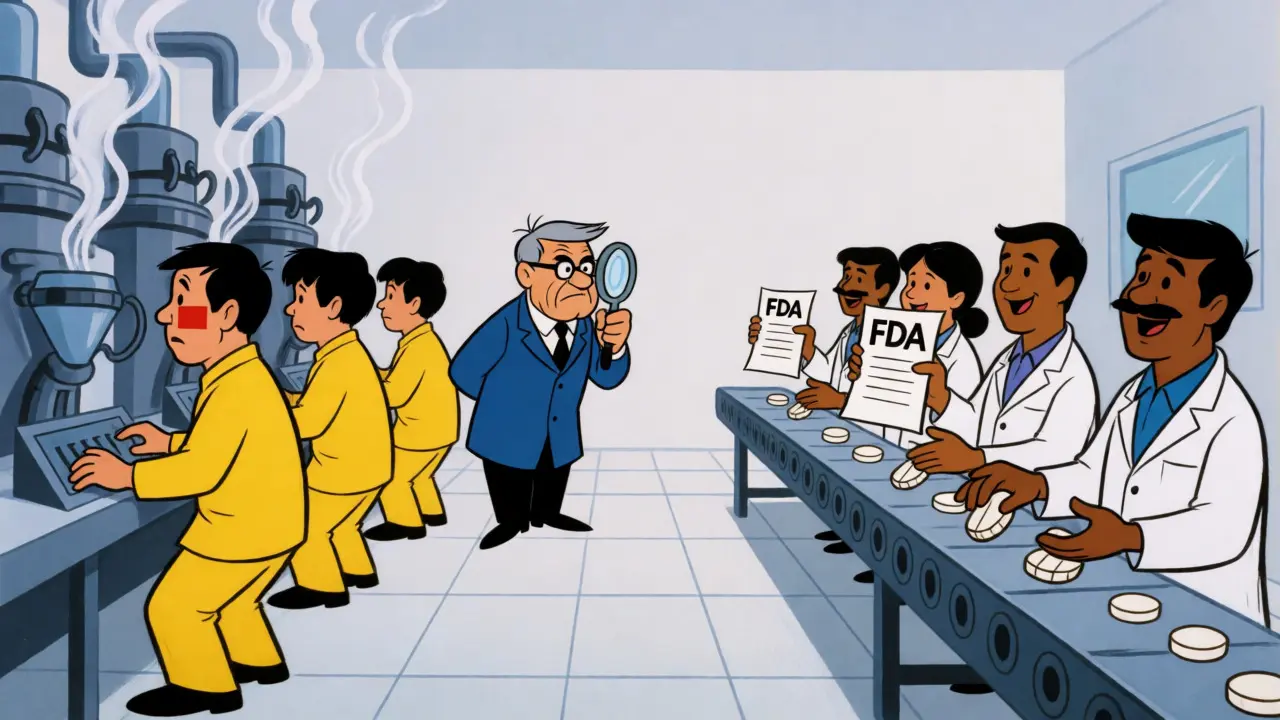
If you’ve ever looked at FDA inspection reports, you’ll notice a pattern. The agency doesn’t treat every country equally. They prioritize facilities based on risk history. Historically, Chinese facilities have faced more intense scrutiny due to past scandals involving contaminated products and falsified data. In 2023, industry analyses suggested that 37% of Chinese pharmaceutical facilities faced import alerts, compared to 18% of Indian facilities. That’s a massive gap.
India maintains over 100 US FDA-approved manufacturing plants, significantly outpacing China’s 28 approved facilities. This gives India a 257% advantage in certified production capacity for direct export to the US. Indian companies have invested heavily in digital interventions to eliminate human error, aligning closely with Good Manufacturing Practice (GMP) standards. When an FDA inspector walks into an Indian plant, they often find English-speaking staff familiar with 21 CFR Part 211 regulations. In contrast, language barriers and different cultural approaches to documentation can sometimes complicate audits in China, even if the technical equipment is top-tier.
Key Risk Factors: Geopolitics and Quality
Risk isn't just about dirty labs. It’s about politics and economics. For China, the primary risk is geopolitical tension. Trade wars and sanctions can freeze shipments overnight. Additionally, rising labor costs in China are narrowing the price advantage it once had over other regions. Companies are asking: "Is it worth the risk for a 5% cost saving?"
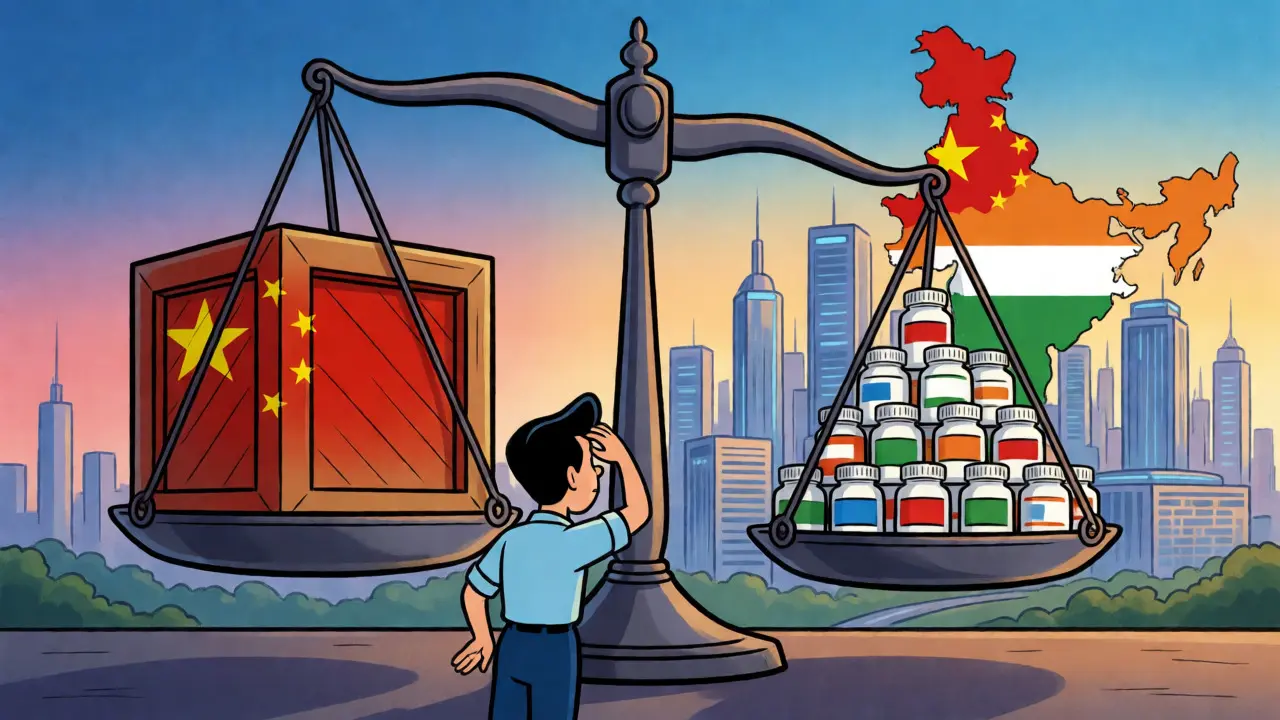
For India, the biggest vulnerability is its reliance on China. Approximately 72% of India’s bulk drug imports come from China. This is a single point of failure. If China restricts exports, India’s finished drug production stalls. There’s also the issue of fragmented manufacturing. India has many small suppliers, making supply chain management complex. You need to vet dozens of vendors rather than dealing with one giant integrated ecosystem like you might in China.
| Feature | China | India |
|---|---|---|
| Primary Strength | API Production (80% global share) | Finished Generics & Compliance |
| FDA-Approved Plants | ~28 | >100 |
| Import Alert Rate (Est.) | High (~37%) | Moderate (~18%) |
| Regulatory Familiarity | Variable; improving ISO/CE focus | High; strong GMP/FDA alignment |
| Geopolitical Risk | High (Trade tensions) | Low-Medium (Supply chain dependency) |
| Cost Advantage | Narrowing due to labor costs | Consistently low labor costs |
The "China+1" Strategy: Is India the Answer?
Many global companies are adopting a "China+1" strategy. This means keeping some manufacturing in China for scale but adding a second source, usually in India or Vietnam, to mitigate risk. India is the preferred alternative because of its "solid compliance history." Executives cite good pricing, a skilled English-speaking workforce, and predictable regulatory outcomes as key reasons for shifting orders.
However, switching isn't instant. Setting up manufacturing in India takes 6-9 months for regulatory compliance alignment, whereas China might take 3-6 months initially, though remediation issues often drag the timeline out. The learning curve involves navigating India’s revised Schedule M regulations, which aim to boost specialty generics. But don't be fooled: while India wins on finished goods, it loses on raw materials. Until India builds its own API infrastructure-a goal supported by billions in government incentives-it remains tethered to Chinese chemistry.
What This Means for Buyers and Patients
If you are sourcing drugs, diversification is your best defense. Don't put all your eggs in one basket. Audit your suppliers' sub-suppliers. Do you know where your API maker gets their solvents? Transparency is rare, so demand it. Look for partners who use digital quality management systems. These tools provide real-time data, reducing the chance of hidden defects.
For patients, this landscape explains why certain medications go out of stock. It’s rarely because the factory broke down; it’s because a supplier upstream failed an audit or faced a trade ban. The FDA’s increased monitoring helps catch bad actors before they reach you, but it’s a reactive system. Prevention lies in robust supply chains that aren't overly reliant on any single nation.
The future points toward India gaining market share as China’s outsourced portion declines. Projections suggest India could capture 20-30% of the share lost by China by 2047. But this hinges on India solving its API dependency. If they succeed, they become a true dual-threat powerhouse. If they fail, the global supply chain remains fragile, held together by duct tape and hope.
Why does the FDA inspect Chinese facilities more frequently?
The FDA prioritizes inspections based on risk. Historical data shows higher rates of compliance violations, such as falsified records or contamination, in Chinese facilities compared to Indian ones. Consequently, Chinese sites face stricter scrutiny and higher rates of import alerts to ensure patient safety.
Can India replace China for API manufacturing?
Not immediately. Currently, India imports about 72% of its bulk drugs and intermediates from China. While the Indian government is investing billions to build domestic API capacity, this transition will take years. For now, India relies on China for raw materials while exporting finished drugs.
What is the 'China+1' strategy in pharma?
This is a supply chain diversification tactic where companies maintain operations in China but add a second manufacturing location, often in India or Southeast Asia. The goal is to reduce geopolitical risk and avoid disruptions caused by trade wars or regional lockdowns.
How do FDA Form 483 observations differ between the two countries?
Form 483s document inspectional observations. Industry analyses indicate that Indian facilities receive approximately 30% fewer Form 483 observations than Chinese facilities. This suggests that Indian manufacturers generally have stronger familiarity with FDA expectations and better internal quality control processes.
Does lower cost always mean higher risk?
Not necessarily, but it requires diligence. Both China and India offer significant cost advantages over US/EU manufacturing. However, the risk profile differs: China poses geopolitical and quality consistency risks, while India poses supply chain dependency risks. Proper auditing mitigates these dangers regardless of location.
Comments (8)
Shu Chowdhury
4 Sep, 2026the interdependency is terrifying
we think we have supply chain resilience but one bad audit in wuhan shuts down hospitals in ohio
it’s not just about cost anymore it’s about survival of the fittest regulatory compliance
Louis Tarro
4 Sep, 2026I feel your pain on this, and honestly, it’s heartbreaking to see how fragile our medical infrastructure really is. We’ve been so blinded by the convenience of cheap generics that we ignored the structural rot underneath. It’s like building a skyscraper on a foundation of sand and then acting surprised when the tide comes in.
The emotional toll on procurement teams must be immense. They are trying to balance the ledger while knowing that a single geopolitical hiccup could mean patients don’t get their meds. I appreciate the collaborative tone of the article because it doesn’t just point fingers; it offers a path forward through diversification. However, I worry that "China+1" is just a buzzword until companies actually commit the capital to build those secondary sources properly.
We need to stop treating quality as a checkbox and start treating it as a core value proposition. The empathy shown towards the workers in these factories is often missing from these discussions. These are real people dealing with intense pressure to meet quotas while maintaining GMP standards. If we want a resilient system, we have to respect the human element in the supply chain, not just the chemical one.
Amy B
5 Sep, 2026omg yes!! 🤯 i had no idea china controlled like 80% of the apis?? that’s insane. i always thought india was the big player because they make all the pills. this whole "twin engines" thing is wild.
i’m curious though, does anyone know if the new digital quality systems mentioned actually work? or is it just fancy software to hide the same old problems? feels like every industry says "digital transformation" fixes everything but then we still get recalls left and right. 🧐
also, the language barrier point is super interesting. i work in customer service and trust me, nuance gets lost in translation all the time. imagine that happening with critical drug data! yikes. 😬
Rob Alderman
6 Sep, 2026The analysis is superficial at best. You gloss over the fundamental issue: Western regulatory hegemony imposes its standards on sovereign nations, creating artificial friction rather than genuine quality improvement. India's advantage isn't moral superiority; it's linguistic alignment with Anglo-American bureaucratic norms. China's technical capacity is vastly underestimated here.
Focusing on FDA approval counts is a metric for amateurs. It measures compliance with paperwork, not therapeutic efficacy. The real story is the erosion of national sovereignty in health policy. We allow foreign entities to dictate our medicine cabinet based on inspection checklists that prioritize process over outcome.
Until we decouple regulatory authority from trade leverage, we will continue to see these performative shifts in manufacturing locations without any real gain in patient safety.
Evelyn Reed
7 Sep, 2026valid points on the api bottleneck but let’s chill on the panic mode
most of us are fine with generic substitution protocols anyway as long as bioequivalence holds up which it usually does despite the noise
the cdmo landscape is shifting toward more automated gmp monitoring anyway so the human error factor is dwindling regardless of geography
just keep an eye on the cold chain logistics that’s where the real fragility lies imo
Somnath Thombre
8 Sep, 2026hey guys great post really eye opening stuff here!! 🙌
as someone from india i can tell you we are working hard to fix the api dependency issue govt is throwing tons of money at pharma parks now
its not easy tho cause setting up chem plants takes years not months like you said but the momentum is there!! 💪
we also have some serious talent in r&d now too so maybe soon we wont just be copying patents but making new ones
keep hope alive fam the shift is coming even if its slow ⏳
Kimberley Odish
8 Sep, 2026This entire narrative is dangerously naive. You cite FDA approval numbers as if they equate to absolute safety, ignoring the fact that inspections are scheduled and predictable, allowing facilities to prepare specifically for the auditor's visit rather than maintaining constant vigilance. The "China+1" strategy is merely a band-aid on a gaping wound of corporate negligence.
Let’s look at the actual data, shall we? The reduction in Form 483 observations in India isn't proof of superior quality; it’s proof of better legal defense teams and more experienced regulatory consultants who know exactly how to game the system. Chinese facilities are often penalized for minor documentation errors that Indian counterparts might gloss over due to closer cultural ties with US regulators.
Furthermore, the geopolitical risk assessment is laughably incomplete. You mention trade wars but ignore the sheer scale of environmental degradation in Chinese chemical hubs, which poses a long-term toxicity risk that no amount of final-stage testing can fully mitigate. We are gambling with public health for quarterly earnings reports, and pretending that moving assembly lines to Mumbai solves the root cause of contamination is delusional.
Mary Tait
10 Sep, 2026It is high time we stopped relying on foreign entities for our essential medicines. The United States should mandate domestic production for all critical APIs. Relying on countries with questionable labor practices and lax environmental regulations is a threat to national security, not just healthcare.
Every dollar spent on imported drugs is a dollar sent to economies that do not prioritize American interests. We need strict tariffs and incentives to bring manufacturing back home. Quality control cannot be outsourced when lives are at stake.