
Medication Shortage Risk Assessment Tool
Assess Your Shortage Risk
This tool helps determine your facility's vulnerability to medication shortages based on factors from the article.
When your hospital runs out of morphine, or the IV antibiotics your patient needs don’t arrive, you don’t get a warning. You just wake up to a broken system. Medication shortages aren’t rare glitches-they’re a daily reality in hospitals across the U.S., and increasingly in places like New Zealand, Canada, and Australia too. In 2022, the FDA recorded 287 drug shortages, affecting nearly one in five essential medications used in hospitals. And it’s not just about running out of pills. It’s about delayed surgeries, increased errors, and patients getting sicker because the right drug isn’t there when they need it.
What’s Really Causing These Shortages?
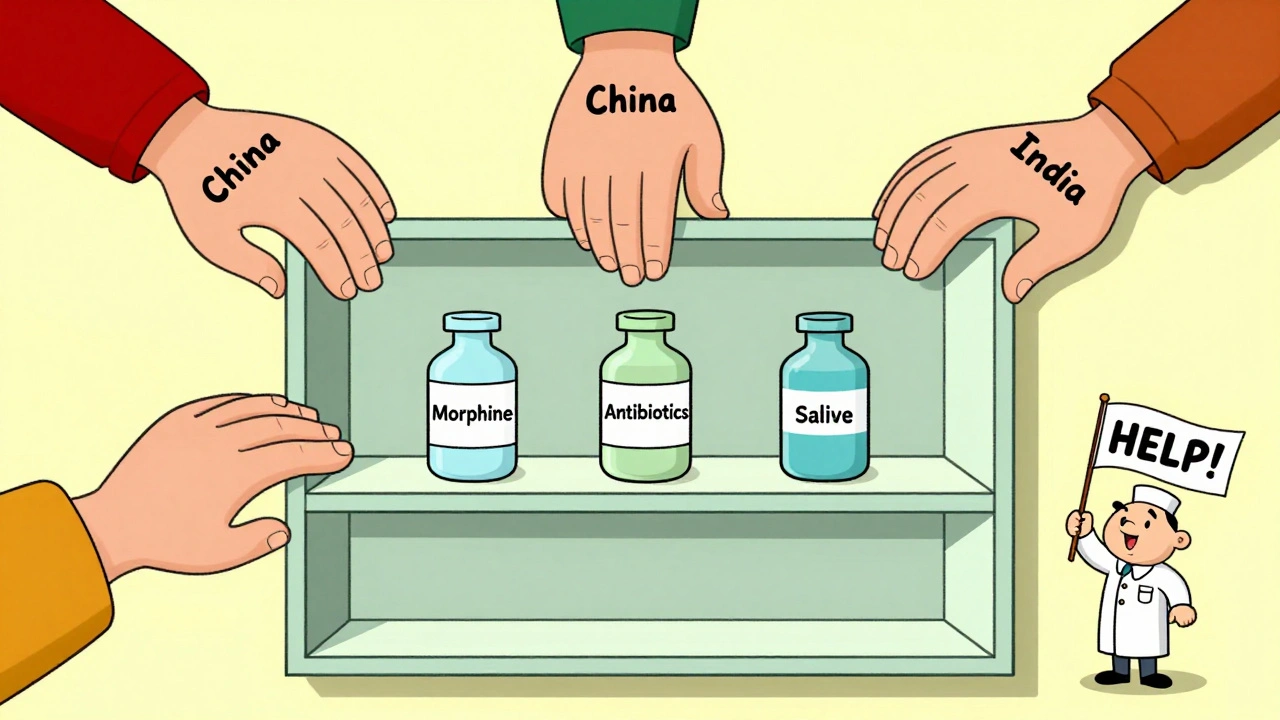
The biggest culprit? Manufacturing problems. In 2022, 46% of all drug shortages were caused by quality failures in production facilities-contaminated batches, unclean equipment, or failed inspections. Most of these are generic sterile injectables: the drugs you rely on during emergencies-morphine, saline, antibiotics, cancer treatments, and IV nutrition. These aren’t fancy brand-name pills. They’re cheap, high-volume drugs made by just a few factories. And here’s the problem: three companies control 75% of the U.S. supply for these critical injectables. If one plant shuts down for cleaning or fails an FDA audit, the whole country feels it.
Why does this keep happening? Because there’s little financial incentive to fix it. Generic drug makers operate on razor-thin margins. When the government forces them to sell drugs at rock-bottom prices through Medicaid and 340B programs, they can’t afford to invest in better equipment, redundant systems, or quality controls. A 2023 HHS report found that these reimbursement rules actively discourage manufacturers from improving reliability. Meanwhile, 80% of the raw ingredients (APIs) for U.S. drugs come from overseas-mostly China and India. A single flood, political disruption, or export ban can ripple through the entire supply chain.
Who Gets Hit the Hardest?
It’s not evenly distributed. Rural hospitals, safety-net clinics, and facilities serving Medicaid or uninsured patients are hit hardest. A 2023 American College of Physicians study found that 78% of these hospitals had to cancel or delay procedures because of drug shortages. In urban centers, pharmacies might scramble to find a substitute. In small towns, there’s often no backup at all. Patients with cancer, chronic pain, or heart failure are the most vulnerable. One oncology nurse in Ohio told me her team had to delay chemotherapy for three weeks because the only available alternative wasn’t FDA-approved for that use. That’s not a choice-it’s a compromise forced by systemic failure.
Even when alternatives exist, they’re not always safe. When morphine ran out, many hospitals switched to hydromorphone. Sounds similar, right? But hydromorphone is five to seven times more potent. A 2023 Reddit thread from a hospital pharmacist described a spike in medication errors-15% more mistakes during the transition. Nurses weren’t trained on the new dosing. Charts weren’t updated. Patients got too much. Or too little. And nobody had time to fix it because everyone was working 12 extra hours a week just to keep up.
How Hospitals Are Trying to Cope (And Failing)
Most hospitals react, not plan. A 2024 report from the Mountain Plains Regional Drug Handicapping and Rehabilitation Services found that 87% of pharmacy directors only learned about a shortage when the delivery didn’t show up. That’s like waiting for a fire to start before calling 911. By then, it’s too late to organize alternatives, train staff, or warn patients.
What should happen? A shortage management team-pharmacists, nurses, IT, risk managers, and finance-should meet weekly. When a shortage hits, they activate within four hours. They check inventory, identify alternatives, update electronic systems, and communicate with clinicians. But only 12% of U.S. hospitals have a formal process like this. The rest are flying blind.
Buffer stocks help. ASHP recommends keeping 14 to 30 days’ worth of critical drugs on hand. But most safety-net hospitals can’t afford it. They’re lucky to hold 8 to 12 days. And even if they do, storage matters. Sterile injectables need clean rooms meeting USP <797> standards. Not every hospital has them. So they stockpile drugs in fridges that aren’t properly monitored. And then wonder why a batch spoils.
What Works: Real Solutions from Other Countries
Other countries don’t wait for disaster. Germany maintains a national strategic stockpile for critical medications. During the 2020-2022 crisis, their shortage impact dropped by 52%. France and Canada require manufacturers to report potential shortages months in advance. That’s mandatory. Not optional. And because of that, shortage duration dropped by 37% compared to the U.S.
In the U.S., reporting is voluntary. Only 65% of manufacturers comply with FDA’s Section 506C rules. That’s like asking drivers to report accidents-and hoping they do. Meanwhile, the FDA’s draft guidance on Risk Management Plans (released in 2022) says manufacturers should map their supply chains, identify risks, and have backup plans. But without penalties, most ignore it.
One promising idea? Reward reliability. Dr. Scott Gottlieb, former FDA commissioner, suggested changing Medicare Part B reimbursement to pay more for drugs from manufacturers with proven quality records. That could unlock $1.5 billion in new investment. Another? Advanced manufacturing tech that lets factories switch between drugs in hours instead of weeks. If 50% of plants adopted this, shortages could drop by 40%.
What You Can Do Right Now
If you’re a clinician, pharmacist, or administrator, here’s what you can do today:
- Track shortages daily. Bookmark the FDA’s Drug Shortage Database. It’s updated every business day. Don’t wait for an email.
- Build a local list of alternatives. For your top 10 most-used drugs, identify one or two clinically appropriate substitutes. Know the dosing. Know the risks. Train your team.
- Use your pharmacy’s inventory system. Set alerts for low stock on critical drugs. Don’t wait for the warehouse to call you.
- Push for a shortage committee. Even if it’s just you, a pharmacist, and a nurse meeting once a week. Document everything: what happened, what you did, what went wrong.
- Advocate. Tell your hospital leadership this isn’t just a pharmacy problem. It’s a patient safety issue. Demand funding for buffer stocks and training.
And if you’re a patient? Ask your doctor: “Is this drug in short supply? Are there alternatives?” Don’t assume your treatment is set in stone. Sometimes, a different drug, slightly adjusted dose, or delayed schedule can keep you safe until the original is back.
The Bigger Picture: Why This Won’t Get Better Soon
The Congressional Budget Office projects that without policy changes, drug shortages will rise 8-12% every year through 2030. Oncology, anesthesia, and critical care drugs will be the worst hit. The average shortage now lasts nearly 10 months-up from 6 months in 2015. And the cost? Hospitals spend an average of $218,000 per drug shortage managing the chaos. That’s $1.2 billion a year across the U.S. alone.
This isn’t about running out of Tylenol. It’s about whether a cancer patient gets their next infusion. Whether a heart attack victim gets the right dose of epinephrine. Whether a child in the ICU gets the antibiotics that could save their life.
There’s no single fix. But there’s a path forward: mandatory reporting, financial incentives for quality, strategic stockpiles, and smarter manufacturing. Until then, the burden falls on the people on the front lines-nurses, pharmacists, doctors-who are expected to fix a broken system with no extra time, no extra pay, and no backup.
It’s time we stopped treating medication shortages as an inevitable part of healthcare. They’re not. They’re a failure we can fix-if we choose to.
Comments (14)
Arjun Deva
6 Dec, 2025So let me get this right… the FDA doesn’t even force companies to report shortages?? And we wonder why people are dying?? It’s not a shortage-it’s a conspiracy. Big Pharma + Chinese factories + lazy regulators = mass euthanasia by omission. They don’t want you to have morphine. They want you to suffer. So you’ll beg for the next overpriced drug they push. It’s all calculated. I’ve seen it. I know. They’re watching. They’re always watching…
Inna Borovik
6 Dec, 2025Let’s be clear: this isn’t a ‘system failure.’ It’s a predictable outcome of deregulation, price controls, and outsourcing critical infrastructure to authoritarian regimes. The FDA’s voluntary reporting? A joke. The 340B program? A subsidy for bad actors. The fact that we’re still surprised by this? That’s the real failure. We’ve outsourced our medical sovereignty and now we’re surprised when the supply chain snaps? Wake up. This was written in the contract.
Jackie Petersen
8 Dec, 2025China’s running the show?? Of course they are. We let them take over everything-phones, solar panels, PPE, and now our LIFE-SAVING DRUGS?? And we wonder why our hospitals are crumbling?? It’s not a shortage. It’s a betrayal. We need to ban all API imports from China. Right now. Build our own factories. Nationalize the supply chain. Or stop pretending we’re a first-world country. This is war. And we’re losing.
Annie Gardiner
9 Dec, 2025What if… the problem isn’t the drugs? What if it’s the idea that medicine should be a commodity at all? We treat pain like a spreadsheet line item. We treat cancer like a quarterly report. We treat nurses like disposable labor. Maybe the shortage isn’t of morphine… it’s of compassion. Of dignity. Of seeing people as more than cost centers. I’m not saying we fix the supply chain. I’m saying we burn the whole damn system down and start over-with empathy, not efficiency.
Rashmi Gupta
10 Dec, 2025Everyone’s blaming China. But have you looked at how many Indian manufacturers got FDA warning letters last year? Or how many US hospitals just… don’t bother tracking? I’ve seen inventory logs that look like doodles. Nurses using Excel sheets from 2012. No alerts. No backups. No one cares until someone dies. The problem isn’t just overseas-it’s right here. In the quiet corners where no one’s checking the fridge.
Kay Jolie
11 Dec, 2025Let’s deconstruct the epistemological crisis of pharmaceutical scarcity through the lens of post-capitalist biopolitics. The commodification of essential medicines under neoliberal governance has produced a pathological rupture in the pharmacological lifeworld-where the body becomes a site of algorithmic neglect. The FDA’s voluntary reporting regime is not merely bureaucratic inertia-it is a symptom of the ontological collapse of public health as a social contract. We must reimagine drug production as a commons-not a market. The 14-day buffer stock? A Band-Aid on a hemorrhage. We need structural re-ontologization.
pallavi khushwani
13 Dec, 2025I work in a rural clinic in Rajasthan. We don’t have morphine. We don’t have antibiotics. We use whatever we can find. Sometimes it’s old stock. Sometimes it’s from a neighbor’s hospital. Sometimes it’s nothing. I don’t need a committee. I don’t need a report. I just need someone to say: ‘Your patients matter.’ Not as data. Not as cost. But as people. We’ve been saying this for years. No one listens. But we keep going. Because someone has to.
Max Manoles
14 Dec, 2025There’s a 2023 JAMA study showing that hospitals with formal shortage protocols had 63% fewer medication errors during crises. Yet only 12% have them. Why? Because leadership sees pharmacy as a cost center, not a clinical function. It’s not about money-it’s about priorities. If you spent half as much on shortage preparedness as you do on fancy new MRI machines, this wouldn’t be happening. Fix the culture. Not the supply chain.
Katie O'Connell
16 Dec, 2025It is, without question, a matter of profound institutional dereliction. The absence of mandatory reporting mechanisms, coupled with the systemic underfunding of generic drug manufacturing infrastructure, constitutes a failure of governance that is both statistically quantifiable and ethically indefensible. One must, therefore, conclude that the current paradigm is not merely inefficient-it is morally bankrupt. The requisite remediation demands legislative intervention of the highest order.
Clare Fox
17 Dec, 2025tbh i think the real issue is that no one gives a crap until someone dies. i work in a pharmacy. we get emails about shortages. we ignore them. because what are we gonna do? call the CEO? he’s on a yacht in the caribbean. we just make do. i’ve given people half-doses. i’ve mixed stuff. i’ve lied to patients and said ‘it’s coming tomorrow.’ it’s not. but we say it anyway. because what else can we do?
Akash Takyar
17 Dec, 2025Thank you for writing this with such clarity. To every nurse, pharmacist, and doctor reading this: you are not alone. Your work matters. Even when the system fails, you still show up. Please, start a local shortage team-even if it’s just two people. Document everything. Share your stories. The change begins in your hospital, your unit, your shift. You don’t need permission. You just need courage. And I’m rooting for you.
Andrew Frazier
19 Dec, 2025Let’s be real-this is what happens when you let brown people make your drugs. India and China don’t care about your kids. They care about profit. We need to bring manufacturing home. Build plants in Ohio. Pay workers $30/hour. No more outsourcing. No more excuses. This isn’t globalization-it’s national suicide. And if you’re okay with it, you’re part of the problem.
Kumar Shubhranshu
20 Dec, 2025Shortages? Yeah. We’ve had them for years. No one cares. Nurses get yelled at for not having meds. Doctors get sued when patients die. But no one fixes the system. Just blame the frontline. Classic. Send help. Or shut up.
Clare Fox
20 Dec, 2025you said it. i’ve seen a nurse cry because she had to give a kid a drug that wasn’t approved for their age. she knew it could kill them. but the other one was gone. she did it anyway. no one thanked her. no one even asked. just another day in the apocalypse.