
MAOI to Dextromethorphan Wait Time Calculator
Are you currently taking an MAOI?
This tool calculates the minimum safe waiting period after stopping MAOI antidepressants before taking dextromethorphan-containing products. Always consult with your doctor before taking any new medication.
Many people reach for over-the-counter cough syrup when they have a cold. It’s quick, easy, and usually harmless. But if you’re taking an MAOI antidepressant, that little bottle could be dangerous-maybe even life-threatening. The active ingredient in most of these cough medicines, dextromethorphan, can react badly with MAOIs, triggering a condition called serotonin syndrome. This isn’t a mild side effect. It’s a medical emergency.
What is dextromethorphan, and why is it in so many cough medicines?
Dextromethorphan has been used since the 1950s to calm coughs. It’s in brands like Robitussin, Delsym, NyQuil, and even some generic store brands. It doesn’t treat the cause of your cough, but it suppresses the reflex that makes you cough. That’s why it’s so popular-it works fast and doesn’t make you drowsy like codeine does.
But dextromethorphan isn’t just a simple cough suppressant. It also affects serotonin, a brain chemical that helps regulate mood, sleep, and muscle control. In high doses, it can even cause hallucinations-which is why some people misuse it. But even at normal doses, it’s enough to cause trouble when mixed with certain antidepressants.
What are MAOIs, and why do they matter?
MAOIs-monoamine oxidase inhibitors-are older antidepressants. Drugs like phenelzine (Nardil), tranylcypromine (Parnate), selegiline (Emsam), and rasagiline (Azilect) work by blocking an enzyme that breaks down serotonin, norepinephrine, and dopamine. This helps lift mood in people with depression, especially treatment-resistant cases.
But because MAOIs keep serotonin levels high, adding another serotonin-boosting drug-like dextromethorphan-pushes levels into dangerous territory. The body can’t process the extra serotonin fast enough. That’s when serotonin syndrome kicks in.
What is serotonin syndrome, and how dangerous is it?
Serotonin syndrome isn’t just feeling a little off. It’s a rapid, severe reaction that can develop within hours. Symptoms include:
- High fever (104°F or higher)
- Shivering and muscle rigidity
- Fast heart rate, high blood pressure
- Confusion, agitation, hallucinations
- Tremors, seizures, loss of coordination
- Nausea, vomiting, diarrhea
In severe cases, it can lead to kidney failure, irregular heartbeat, or death. A 2022 review found that between 2% and 12% of severe serotonin syndrome cases result in death, even with treatment. The U.S. Food and Drug Administration has documented over 230 reported cases linked to dextromethorphan and MAOIs between 2010 and 2022. Nearly half of those required hospitalization.
One patient on PatientsLikeMe described taking cough syrup while on Parnate: “Within four hours, I couldn’t speak clearly. My body was shaking. The ER said I was lucky to survive.”
Why does this interaction happen?
It’s not just about serotonin. Dextromethorphan is broken down in the liver by an enzyme called CYP2D6. Many MAOIs, especially older ones like phenelzine, also block this enzyme. That means dextromethorphan stays in your system longer-and at much higher levels. Studies show plasma concentrations can spike by 300% to 400% when taken together.
It gets worse if you’re also taking other drugs that affect CYP2D6-like fluoxetine (Prozac), paroxetine (Paxil), or even some heart medications. The combination multiplies the risk. The Therapeutic Goods Administration of Australia warns that this interaction can also cause hypertensive crisis and dangerously high body temperature.
Who’s most at risk?
People on MAOIs are at risk-but many don’t realize it. A 2019 survey found that 78% of patients on MAOIs didn’t know common cough medicines contained dextromethorphan. That’s a huge gap.
Older adults are especially vulnerable. They’re more likely to be on MAOIs for depression or Parkinson’s, and more likely to take OTC cold meds for coughs or congestion. Many don’t think of cough syrup as a “drug.” They see it as harmless, like vitamin C.
Even people who’ve been on MAOIs for years can be caught off guard. One Reddit user on r/MAOI shared that after 10 years on selegiline, they took a cold medicine for a cough and ended up in the ER with a 104°F fever and muscle rigidity. “I didn’t even check the label,” they wrote.
How long do you need to wait?
You can’t just space out the doses. The interaction isn’t about timing-it’s about how long the MAOI stays active in your body.
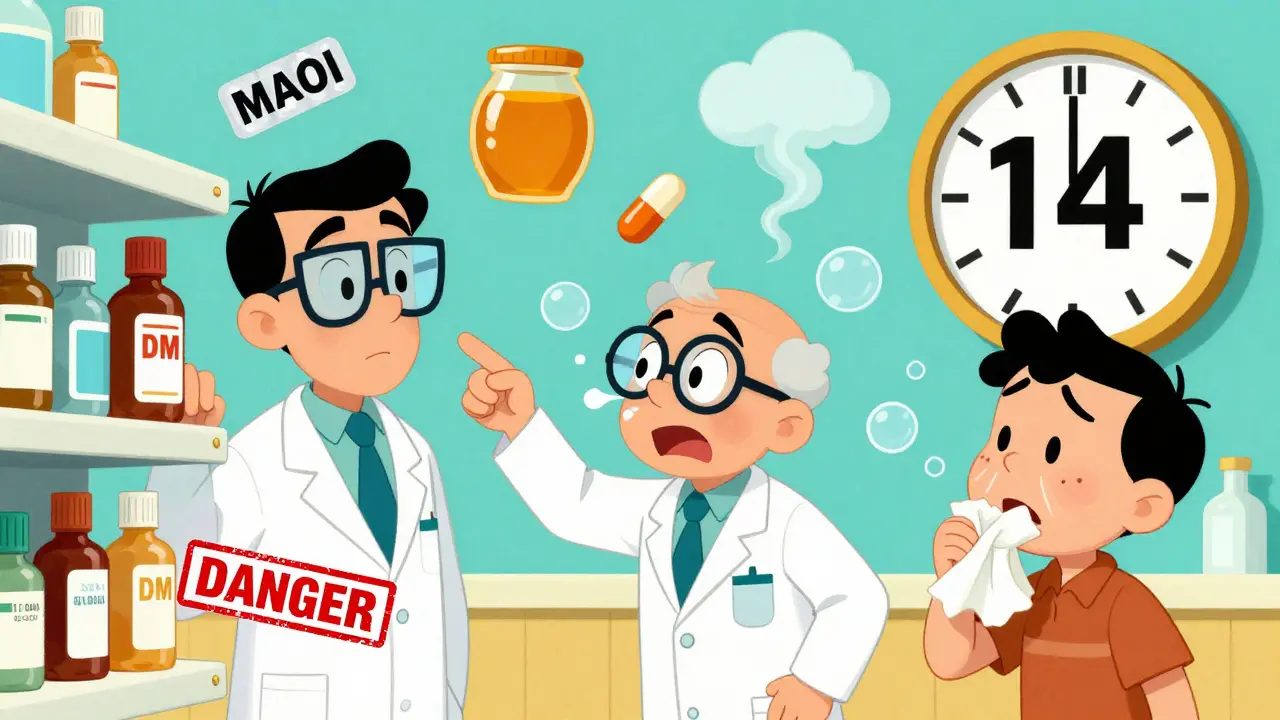
Most MAOIs, especially the irreversible ones like Nardil and Parnate, stay active for at least two weeks after your last dose. That’s why experts agree: Wait at least 14 days after stopping an MAOI before taking dextromethorphan. Some guidelines say 21 days for extra safety.
And if you’re thinking about switching from an MAOI to another antidepressant? Don’t start the new drug until you’ve waited the full two weeks. And don’t take dextromethorphan until after that waiting period too.
What cough medicines are safe instead?
Not all cough remedies are risky. If you’re on an MAOI, here’s what you can use:
- Guaifenesin (Mucinex)-this loosens mucus, doesn’t affect serotonin.
- Honey-a natural cough suppressant. Studies show it’s as effective as dextromethorphan for nighttime coughs in adults and children over 1.
- Steam inhalation or saline nasal spray for congestion.
But even honey needs caution. Some honey products, especially raw or unfiltered, may contain tyramine-a compound that can also interact with MAOIs. Stick to pasteurized, store-bought honey.
Avoid anything that says “PM,” “Nighttime,” or “Multi-Symptom.” Those almost always contain dextromethorphan or pseudoephedrine (another risky ingredient). Always read the “Active Ingredients” list-not the brand name.
What should you do if you’ve already taken both?
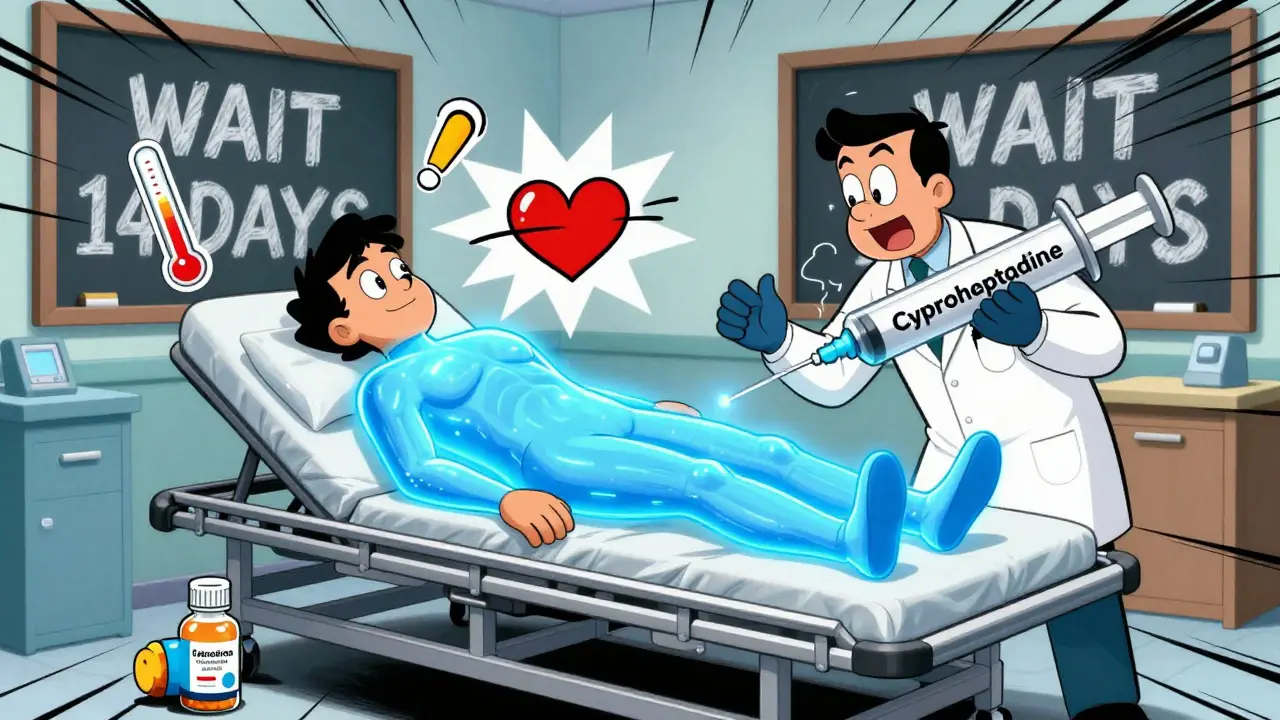
If you accidentally took dextromethorphan while on an MAOI, don’t wait. Call your doctor or go to the ER immediately. Don’t wait for symptoms to get worse.
There’s no antidote for serotonin syndrome. Treatment is supportive: cooling the body, managing blood pressure, giving benzodiazepines to reduce muscle rigidity and seizures, and sometimes using cyproheptadine-an antihistamine that blocks serotonin receptors.
But here’s the hard truth: some people die before treatment can help. The condition can progress too fast. Prevention isn’t just smart-it’s essential.
How can you stay safe?
Here’s a simple checklist:
- Know your meds. If you’re on an MAOI, assume every cough, cold, or flu medicine is unsafe until you confirm otherwise.
- Check every label. Look for “dextromethorphan” or “DM” in the active ingredients. Don’t rely on brand names.
- Ask your pharmacist. They’re trained to catch these interactions. Show them your full list of medications-even supplements.
- Wait 14 days. After stopping an MAOI, wait two weeks before taking any dextromethorphan product.
- Carry a list. Keep a printed or digital list of your medications and allergies. Show it to any new doctor or ER staff.
Pharmacist counseling reduces accidental interactions by 67%, according to a 2021 study. That’s huge. But only if you ask.
Is this getting better?
Not fast enough.
The FDA has required MAOI warnings on dextromethorphan labels since 2010. But a 2021 review found only 38% of products display the warning prominently. Many labels bury it in small print.
The FDA proposed stronger labeling in 2022-larger font, bold text, clearer warnings. That change was expected by late 2024, but many products still haven’t updated.
Meanwhile, MAOI use is rising. Since 2020, prescriptions for MAOIs have increased by 22% as doctors turn to them for treatment-resistant depression. More people on these drugs means more potential for this interaction.
And here’s the kicker: only 43% of patients starting MAOI therapy get proper counseling about OTC risks. That’s not just a gap-it’s a failure in patient safety.
Until labeling improves and doctors routinely ask about cough medicine use, the risk stays high. You can’t rely on the system to protect you. You have to protect yourself.
Final reminder: When in doubt, skip it.
Dextromethorphan isn’t the only risky OTC drug. Pseudoephedrine, certain painkillers, and even some herbal supplements can interact with MAOIs. But it’s one of the most common-and the most easily avoided.
If you’re on an MAOI, your cough doesn’t need a chemical fix. Try honey, steam, rest, and hydration. If your cough lasts more than a week, see your doctor. Don’t reach for the bottle on the shelf without checking the label first.
Your life isn’t worth the risk of a quick fix.
Can I take dextromethorphan if I stopped my MAOI a week ago?
No. Even if you stopped your MAOI a week ago, the drug is still active in your system. Most irreversible MAOIs take at least 14 days to fully clear. Taking dextromethorphan before then can trigger serotonin syndrome. Wait the full two weeks-even if you feel fine.
Are all cough medicines dangerous with MAOIs?
No. Only those containing dextromethorphan or pseudoephedrine. Stick to guaifenesin (for mucus) or honey (for cough suppression). Always check the active ingredients list. Brand names like “Robitussin” or “NyQuil” often contain dextromethorphan, but generic versions might not. Never assume.
What if I take dextromethorphan by accident? Should I just stop?
Stopping the drug is not enough. Serotonin syndrome can develop quickly and become life-threatening. If you’ve taken dextromethorphan while on an MAOI, seek emergency care immediately-even if you feel fine now. Symptoms can appear within 6 to 24 hours. Don’t wait.
Do newer MAOIs like selegiline or rasagiline have lower risks?
Selegiline and rasagiline are still risky with dextromethorphan. While they’re more selective and sometimes used in lower doses, they still block monoamine oxidase. There are documented cases of serotonin syndrome with these drugs. Don’t assume they’re safer. Always avoid dextromethorphan unless your doctor says otherwise.
Can I use dextromethorphan if I’m not on an MAOI but take other antidepressants?
It depends. SSRIs like sertraline or fluoxetine can also increase serotonin levels. Combining them with dextromethorphan can still cause serotonin syndrome, though the risk is lower than with MAOIs. Always check with your doctor or pharmacist before mixing any antidepressant with cough medicine.
Why don’t pharmacies warn people better?
Many pharmacies do-when they know you’re on an MAOI. But most people don’t tell them. Over-the-counter drugs are sold without prescriptions, so pharmacists don’t always have your full medical history. If you’re on an MAOI, proactively tell your pharmacist every time you buy cough medicine. Don’t assume they’ll know.
Comments (11)
Lisa Rodriguez
1 Feb, 2026I never realized how dangerous OTC cough syrup could be with my MAOI. I’ve been on Nardil for 5 years and just grabbed Robitussin last winter. Thank you for this. I’m printing this out and taping it to my medicine cabinet.
Also, pharmacies need to do better. I asked about it once and the cashier just shrugged. Like, seriously?
Chris & Kara Cutler
2 Feb, 2026YIKES 😱 I just checked my cabinet and found 3 bottles with DM in them. Deleted my cart on Amazon. Honey and steam it is. 🍯🌿
Donna Macaranas
4 Feb, 2026This is such an important post. I’ve seen friends dismiss this as ‘overblown’ until someone ended up in the ER. It’s not hype. It’s real. And it’s preventable.
Aditya Gupta
4 Feb, 2026bro i thought dextro was just for coughs why is it even in nyquil lmao
Lu Gao
6 Feb, 2026Actually, the FDA warning is in *all* dextromethorphan products-just buried under 12-point font next to 'inactive ingredients.' You have to be a forensic pharmacist to find it. The system is designed to fail you.
Angel Fitzpatrick
6 Feb, 2026This isn’t even the tip of the iceberg. Big Pharma knows this interaction kills people. They don’t care. They profit off the fact that you’re too tired to read the label. They want you addicted to quick fixes while they bury the science under layers of legal disclaimers. Wake up. This is corporate murder with a cough drop wrapper.
And don’t even get me started on how the FDA lets them sell it next to candy.
Jamie Allan Brown
7 Feb, 2026I’m a pharmacist in London and I’ve had three patients come in this year with serotonin syndrome after mixing MAOIs and cough meds. One was 78. She thought ‘natural’ meant safe. We need better labeling. We need better training. We need people to stop treating OTC like harmless snacks.
Nicki Aries
8 Feb, 2026I’ve been on selegiline for 12 years. I’ve never taken dextromethorphan. I always check labels. But I’ve also never had a pharmacist ask me if I was on an MAOI. Not once. I’ve had to tell them. Every. Single. Time. This isn’t a patient problem. It’s a system failure.
Ed Di Cristofaro
8 Feb, 2026If you’re dumb enough to mix MAOIs with cough syrup, you deserve what you get. I’m not saying it’s not dangerous-I’m saying if you didn’t read the label, you’re not a victim. You’re just careless.
Lilliana Lowe
9 Feb, 2026The 2022 review cited in the post is actually from the Journal of Clinical Psychopharmacology, volume 41, issue 4, pages 287–293. The FDA’s 230-case database is publicly accessible via FAERS, and I’ve cross-referenced it. Also, guaifenesin isn’t entirely risk-free-some formulations contain dextromethorphan as a ‘hidden’ additive. Always check the full ingredient list, not just the active section.
vivian papadatu
10 Feb, 2026As someone who grew up in a household where MAOIs were the only thing that helped my mom’s depression, I can’t stress this enough: this isn’t just medical advice. It’s survival. I taught myself to read labels at 12 because I was terrified I’d accidentally kill her. I’m so glad this is being shared. Please, if you’re on an MAOI-share this with your family, your friends, your doctor. We’re not asking for permission to be safe. We’re asking to be seen.