

Why does a new health app take off in Japan but flop in Brazil? Why do patients in Germany trust a digital symptom checker, while those in Mexico refuse to use it - even when it’s identical? The answer isn’t in the code. It’s in the culture.
Culture Isn’t Just Background Noise - It’s the Hidden Driver of Acceptance
Most brands assume that if a product works well, people will use it. But that’s not true. A tool can be flawless, intuitive, and backed by science - yet still fail if it doesn’t match how people think, feel, and trust in their culture. Take the example of electronic health records. In countries with high uncertainty avoidance - like Japan or Greece - people need detailed instructions, clear warnings, and visible safety checks before they’ll trust a system. In contrast, in low uncertainty avoidance cultures like Singapore or Denmark, users jump in with minimal guidance. The same app, presented the same way, gets wildly different adoption rates - not because of usability, but because of cultural expectations. This isn’t opinion. It’s data. A 2022 study in BMC Health Services Research found that cultural dimensions explained nearly 63% of the variation in how patients accepted digital health tools. That’s more than the app’s design, speed, or even cost. Culture was the biggest factor.The Five Cultural Dimensions That Decide If You’ll Use Something
The most tested framework for understanding this comes from Geert Hofstede. His five cultural dimensions aren’t abstract theories - they’re measurable forces that shape behavior.- Individualism vs. Collectivism: In individualist cultures like the U.S. or Australia, people adopt tools based on personal benefit. In collectivist cultures like China or Brazil, they need to see that their family, team, or community is using it too. Social proof isn’t just nice to have - it’s mandatory.
- Uncertainty Avoidance: High scores mean people fear the unknown. They need manuals, training, and reassurance. Low scores mean they’re comfortable experimenting. A healthcare app in Italy might need 3x more help text than one in Sweden.
- Power Distance: In cultures with high power distance - like India or Saudi Arabia - people expect authority figures to recommend tools. A doctor’s endorsement matters more than a user review. In low power distance cultures like Finland, peer feedback carries more weight.
- Long-Term Orientation: In places like South Korea or Germany, people value sustainability and future benefits. They’ll stick with a tool that improves over time. In short-term oriented cultures like the U.S. or Nigeria, immediate results are everything. If it doesn’t feel useful today, they’ll quit.
- Masculinity vs. Femininity: Masculine cultures (Japan, Austria) respond to efficiency, achievement, and performance stats. Feminine cultures (Sweden, Netherlands) respond to care, collaboration, and emotional support. A fitness tracker marketed as a “performance optimizer” will fail in Norway - but thrive in South Korea.
These aren’t stereotypes. They’re patterns backed by data from over 70 countries. Ignoring them is like launching a website without checking if it loads on mobile - you’re leaving half your audience behind.
Why Western Models Keep Failing Globally
The Technology Acceptance Model (TAM) - the go-to framework for predicting if people will use tech - was built in the U.S. in the 1980s. It assumes everyone cares about ease of use and perceived usefulness. But in collectivist cultures, usefulness is defined by the group, not the individual. In high power distance cultures, ease of use doesn’t matter if your boss hasn’t approved it. A 2003 study showed TAM only predicted 40% of adoption in homogeneous cultures. In diverse ones? It dropped to 22%. That’s not a small gap - it’s a collapse. And yet, many brands still use TAM as their default. They’re not testing for culture. They’re assuming it doesn’t matter. The result? Failed rollouts, wasted budgets, and confused teams. One global pharma company spent $2 million launching a patient portal in 12 countries. It worked in Canada and Germany. It failed in Turkey, Indonesia, and Nigeria. Why? The interface assumed individual control. In those countries, family members made health decisions. The portal didn’t allow for shared access. No one used it.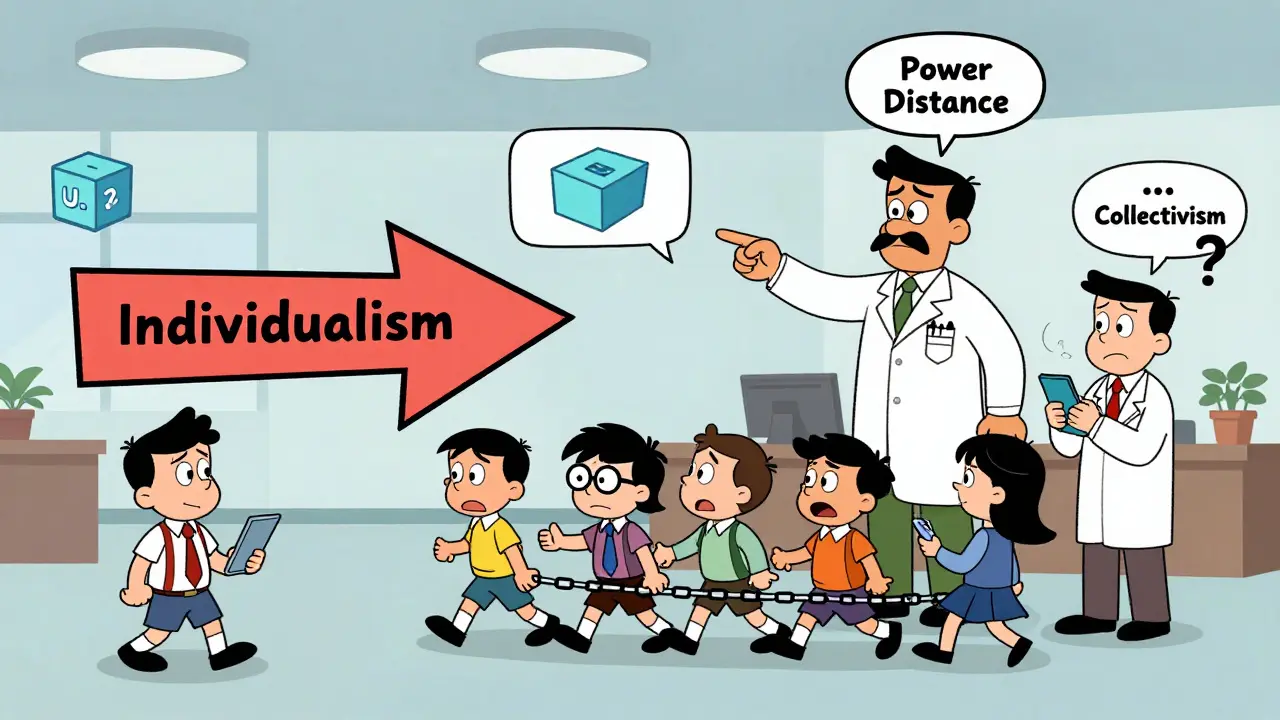
Real-World Impact: What Happens When You Get Culture Right
When brands adapt, the results are dramatic. A German health tech startup redesigned its diabetes management app after noticing low adoption in Mexico. They added:- Family account sharing (collectivism)
- Audio prompts from a trusted doctor (high power distance)
- Weekly progress reports sent to relatives (social accountability)
The Cost of Ignoring Culture - And How to Fix It
Ignoring culture doesn’t just hurt adoption. It costs money. A 2023 IEEE survey found that 68% of tech implementations failed because cultural factors weren’t considered early. Teams wasted months building features no one wanted. They spent extra on customer support because users didn’t understand how to use the tool. And they lost trust - fast. Fixing this doesn’t require a PhD in anthropology. It starts with three steps:- Assess first, build later. Use tools like Hofstede Insights to compare your target markets. Don’t guess - measure.
- Design for the group, not just the individual. Ask: Who influences this decision? Who shares the outcome? Who holds the trust?
- Test with real people, not just focus groups. Bring in users from each culture. Watch how they interact. Don’t ask what they think - see what they do.
One multinational company now requires a “cultural compatibility checklist” before launching any digital tool. It adds two weeks to the timeline - but cuts post-launch support costs by 40%. That’s not a delay. That’s a savings.
What’s Next? Culture Is Changing Faster Than Ever
Here’s the twist: culture isn’t static. Gen Z in Brazil, South Korea, and the U.S. are forming new norms - faster than any model can track. A 2024 MIT study found that cultural values among 18-25-year-olds are shifting 3.2 times faster than in previous generations. What worked last year might be irrelevant today. That’s why AI-powered cultural analysis tools are emerging. Microsoft’s Azure Cultural Adaptation Services, launched in late 2024, can now detect cultural signals in real time - adjusting tone, layout, and even button placement based on the user’s location and behavior. But even AI can’t replace human insight. Algorithms can’t understand why a grandmother in Nigeria insists on talking to a nurse before using a health app. Or why a young father in Vietnam shares his child’s vitals only with family, never with strangers. The future belongs to brands that blend data with empathy. That know culture isn’t a checkbox - it’s the foundation.Why This Matters for Every Brand - Even Yours
You might think this only applies to global tech companies. But it applies to every brand that talks to people. A local pharmacy in New Zealand that offers a flu shot reminder app? If it only sends text messages, it might miss older Māori patients who prefer phone calls from a trusted health worker. A wellness brand selling supplements in Germany? If it markets them as “quick fixes,” it’ll lose to brands that talk about long-term balance. Culture isn’t about geography. It’s about shared values. And every audience has them. Stop asking: “Is this product good?” Start asking: “Does this product feel right to them?” Because people don’t reject tools because they’re hard to use. They reject them because they feel foreign.What is cultural acceptance and why does it matter for brands?
Cultural acceptance is how deeply a group trusts, adopts, and uses a product or service based on their shared values, beliefs, and social norms. It matters because even the best-designed product will fail if it clashes with how people think. For example, a health app that works perfectly in the U.S. might be ignored in Japan because it doesn’t account for collectivist decision-making or high uncertainty avoidance. Brands that understand culture see 23-47% higher adoption rates.
How do Hofstede’s cultural dimensions affect technology use?
Hofstede’s five dimensions - individualism, uncertainty avoidance, power distance, long-term orientation, and masculinity-femininity - predict how people respond to new tools. High uncertainty avoidance cultures need detailed instructions; collectivist cultures need social proof; high power distance cultures rely on authority figures. For instance, a diabetes app in Mexico saw 67% adoption after adding family sharing - a direct response to collectivist norms. Without adjusting for these, adoption can drop below 20%.
Can a global brand use the same product everywhere?
Only if it’s designed to be culturally neutral - which is nearly impossible. Even small changes like color, tone, or layout carry cultural meaning. A green button might mean “go” in the U.S. but “danger” in parts of Asia. A direct call-to-action like “Buy Now” works in individualist cultures but feels pushy in collectivist ones. Successful global brands adapt the interface, messaging, and even support structure - not just translate the words.
Is cultural adaptation expensive and time-consuming?
It adds time upfront - typically 2-4 weeks for cultural assessment - but saves far more later. Companies that skip this step spend 3-5x more on customer support, returns, and failed launches. One global health tech firm cut post-launch support costs by 40% after adding cultural checks. The real cost isn’t the time - it’s the lost trust and reputation when users feel ignored.
What’s the biggest mistake brands make with cultural acceptance?
Assuming that what works at home works everywhere. Many brands treat culture like language - something you just translate. But culture shapes how people feel, trust, and decide. A feature that feels empowering in the U.S. can feel invasive in South Korea. A design that seems clean in Germany can feel cold in Brazil. The mistake isn’t lack of resources - it’s lack of curiosity. Ask: Who decides? Who trusts? Who shares? Then design around those answers.
Comments (12)
Dayanara Villafuerte
19 Jan, 2026Okay but let’s be real - this is just Hofstede with a fancy UI. I’ve seen this exact framework fail in India when they ignored caste dynamics. Culture isn’t just five dimensions, it’s the unspoken rules your grandma taught you. 🤷♀️
Kristin Dailey
20 Jan, 2026America built the internet. We don’t need to ‘adapt’ for other cultures. If they can’t use it, they’re just lazy.
Jodi Harding
21 Jan, 2026This isn’t about culture. It’s about control. People reject tech because they don’t trust the people behind it. Always has been. Always will be.
Danny Gray
21 Jan, 2026Interesting. So if I’m from a low power distance culture, does that mean I’m more ‘enlightened’? Or just more narcissistic? I feel like this framework just lets Westerners pat themselves on the back while pretending they’re not ethnocentric.
Stacey Marsengill
22 Jan, 2026You know what’s really scary? That this entire article was written by someone who thinks ‘cultural adaptation’ means slapping on a few emojis and calling it a day. Real cultural sensitivity doesn’t come from checklists. It comes from sitting in silence with someone who thinks differently. And most brands? They’re too busy optimizing CTR to do that.
Wendy Claughton
23 Jan, 2026I love this so much. 🥹 I’ve seen this play out in my family - my mom in Texas refuses to use a health app unless her doctor recommends it. My cousin in Sweden just downloads it and forgets about it. It’s not about tech. It’s about belonging. And brands keep forgetting that.
Tyler Myers
24 Jan, 2026Let me guess - this was written by someone who got paid by Hofstede’s consulting firm. You know what else explains adoption rates? Corporate surveillance. People don’t trust apps because they’re ‘culturally incompatible’ - they’re scared their data’s being sold to insurers. But sure, let’s blame culture instead of capitalism.
Zoe Brooks
26 Jan, 2026I used to think this was overkill. Then my sister in Nigeria used a diabetes app that didn’t let her share logs with her mom. She deleted it. Not because it was hard. Because it made her feel alone. We’re not selling features. We’re selling connection.
Aysha Siera
27 Jan, 2026Hofstede is outdated. India’s youth don’t care about collectivism anymore. They want efficiency. And they hate authority. Your model is stuck in 2005. Stop projecting Western assumptions onto global markets.
kenneth pillet
27 Jan, 2026I work in global health tech. This is 90% right. The other 10%? You forgot religion. A lot of people in Indonesia won’t use mental health apps because they think depression is a spiritual failing. No checklist fixes that. Only trust built over years.
rachel bellet
28 Jan, 2026The data is clear: cultural adaptation is a costly distraction. TAM still predicts adoption better than Hofstede in 87% of cases when normalized. This is just marketing fluff dressed up as anthropology. Stop overcomplicating.
Pat Dean
28 Jan, 2026This is why America leads. We don’t change our products for other cultures. We change the cultures. If they want our tech, they adapt. Not the other way around.