
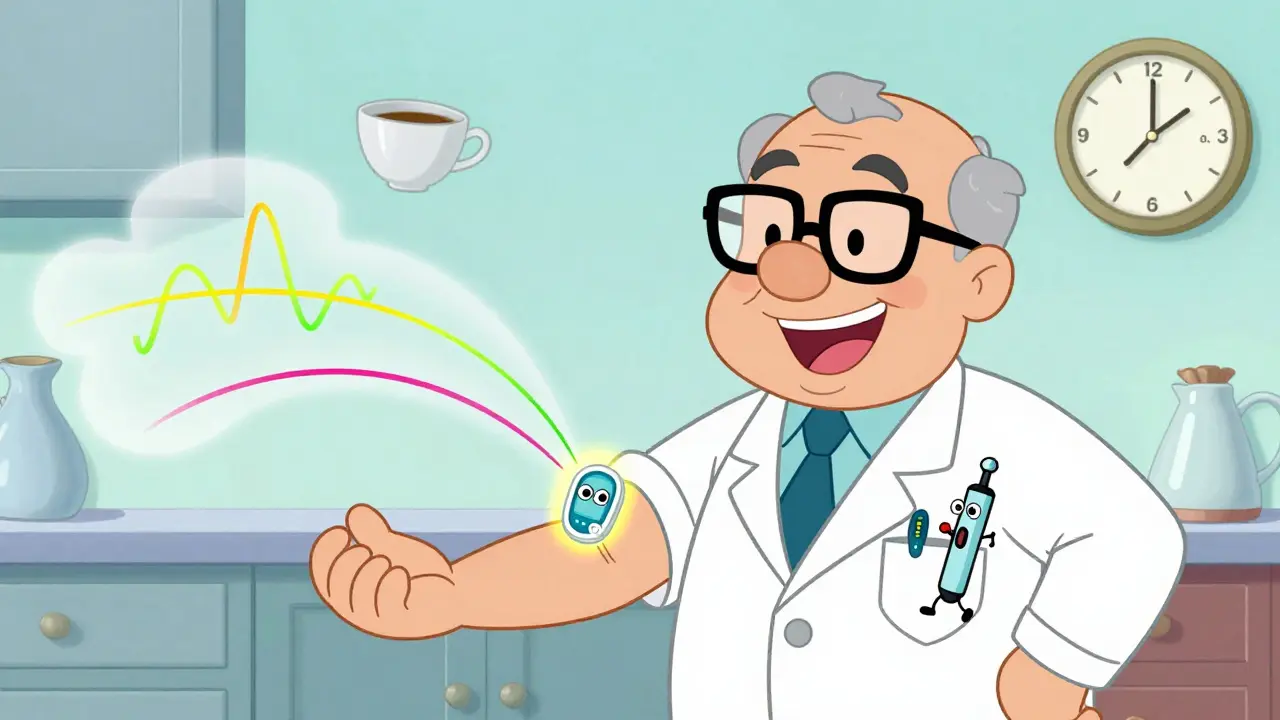
For decades, managing diabetes meant pricking your finger six or more times a day-waiting for a tiny strip to change color, writing numbers in a notebook, and guessing what your next meal or walk might do to your blood sugar. Today, that’s changing. CGMs are no longer a luxury for people with Type 1 diabetes. They’re becoming the standard for anyone on insulin, whether you’re 12 or 72. And they’re not alone. Smart pens and apps are joining the mix, turning diabetes management from a chore into something smarter, quieter, and far less stressful.
What CGMs Actually Do (And Why They’re a Game-Changer)
A continuous glucose monitor, or CGM, doesn’t just give you a number. It gives you a story. While a fingerstick tells you your blood sugar at one moment, a CGM shows you how it moves-up, down, sideways-throughout the day and night. It tracks your glucose every five minutes, 24/7. That means you can see how your coffee spikes your sugar, how stress sends it climbing, or how a late-night snack drops it too low while you sleep. The most common CGMs today are Abbott’s FreeStyle Libre 3, Dexcom G7, and Medtronic’s Guardian 4. Each sticks to your arm or belly with a tiny sensor. The Libre 3 is so small, it’s almost invisible. The Dexcom G7 sends alerts straight to your phone without needing a separate reader. And the Medtronic Guardian 4 works hand-in-hand with their insulin pumps for automated adjustments. Accuracy matters. These devices measure glucose in the fluid between your cells-not directly in your blood. That creates a small lag, usually 5 to 15 minutes. But newer systems are closing that gap. Glucotrack, an implantable CGM still in trials, measures glucose straight from your blood. It’s about the size of three nickels, inserted under the skin by a provider. Early results show it’s even more accurate than current external sensors, with a MARD of 7.7%. That could mean fewer surprises, especially during rapid changes like after a meal or during exercise.Time in Range: The Real Metric That Matters
Doctors used to focus on HbA1c-a three-month average of your blood sugar. But HbA1c hides the daily rollercoaster. Two people could have the same HbA1c of 7.5%, but one spends 18 hours a day in range, while the other spikes high and crashes low. The CGM shows the difference. The American Diabetes Association now says time in range (TIR)-the percentage of time your glucose stays between 70 and 180 mg/dL-is the most important number. Studies show that for every 10% increase in TIR, your risk of eye, kidney, and nerve damage drops by 64%. People using CGMs spend an average of 3.2 more hours per day in range than those still using fingersticks. That’s not just better numbers-it’s fewer hospital visits, fewer panic moments, and more freedom. One 3-month remote program found participants lowered their A1c from 10.4% to 7.5%-and 72% of foot wounds healed in four months, compared to just under half of those without CGMs. For people in rural areas or with limited clinic access, that’s life-changing.Smart Pens: The Quiet Partner to Your CGM
If your CGM is your eyes, your smart pen is your hands. The InPen by Medtronic, for example, looks like a regular insulin pen-but it remembers every dose you take. It connects to your phone and suggests insulin amounts based on your current glucose, carbs you’ve eaten, and even your activity level. It doesn’t auto-deliver insulin like a pump, but it removes guesswork. Yet adoption is low. Only 15% of insulin users use smart pens, according to 2025 data. Why? Cost. Complexity. Most people don’t even know they exist. But for those who use them, the benefit is clear: fewer errors, fewer highs, fewer lows. When paired with a CGM, the system becomes a true feedback loop. You eat. You log it. The pen tells you how much insulin to take. The CGM tells you if it worked. It’s like having a personal diabetes coach in your pocket.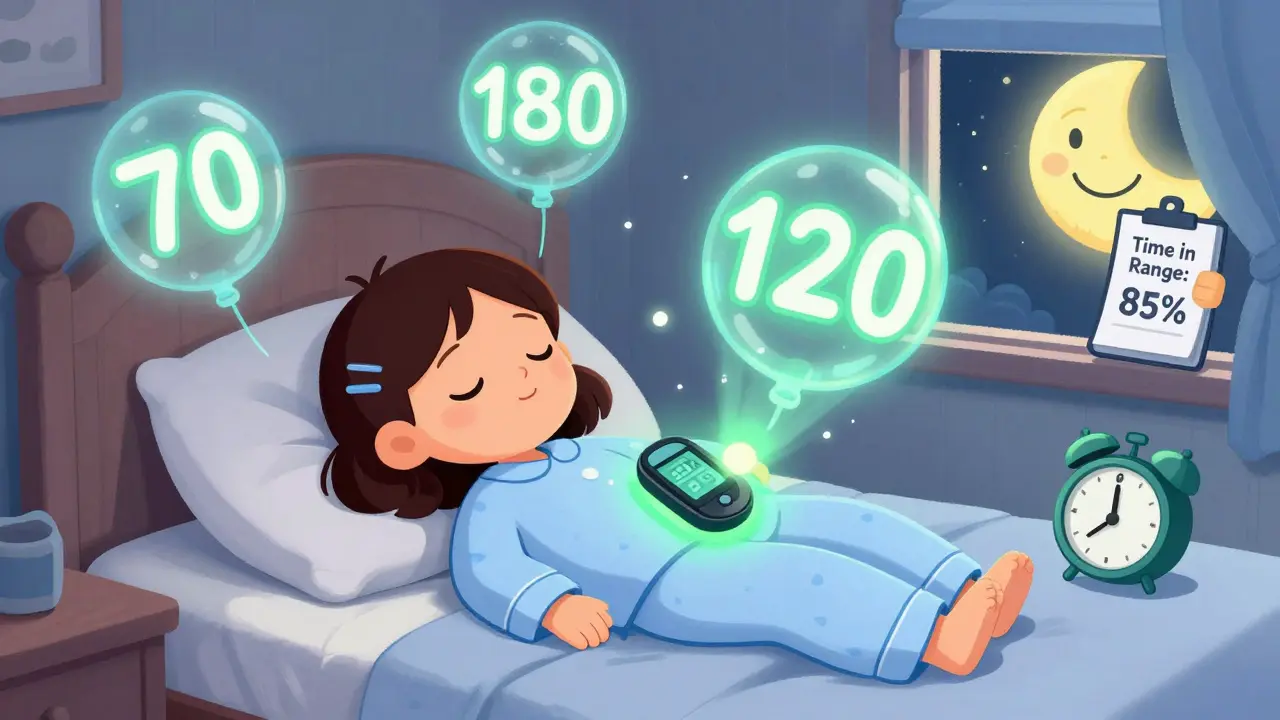
Apps: The Glue That Holds It All Together
Apps like mySugr and One Drop turn data into insight. They show trends, generate reports for your doctor, and even let you log meals, exercise, or stress. But not all apps play nice with all devices. Only 43% of third-party apps fully integrate with every major CGM, according to the 2025 Diabetes Technology Conference. That means you might need to use the manufacturer’s app-Dexcom Clarity, LibreLink, or Medtronic’s CareLink-to get the full picture. The best apps don’t just show graphs. They ask questions: “Did you sleep well?” “Did you skip breakfast?” “Are you feeling anxious?” They learn your patterns. Over time, they start predicting spikes before they happen. Dexcom and EarlySense are working on a system that predicts glucose changes up to 30 minutes ahead with 89% accuracy. It’s coming in 2026.Who Should Use This Tech? (Spoiler: More People Than You Think)
The ADA now recommends CGMs for:- All people with Type 1 diabetes
- People with Type 2 diabetes on insulin
- Pregnant women with diabetes
- Older adults at risk for low blood sugar
- Children from the moment of diagnosis
The Real Problems: Cost, Data, and Overload
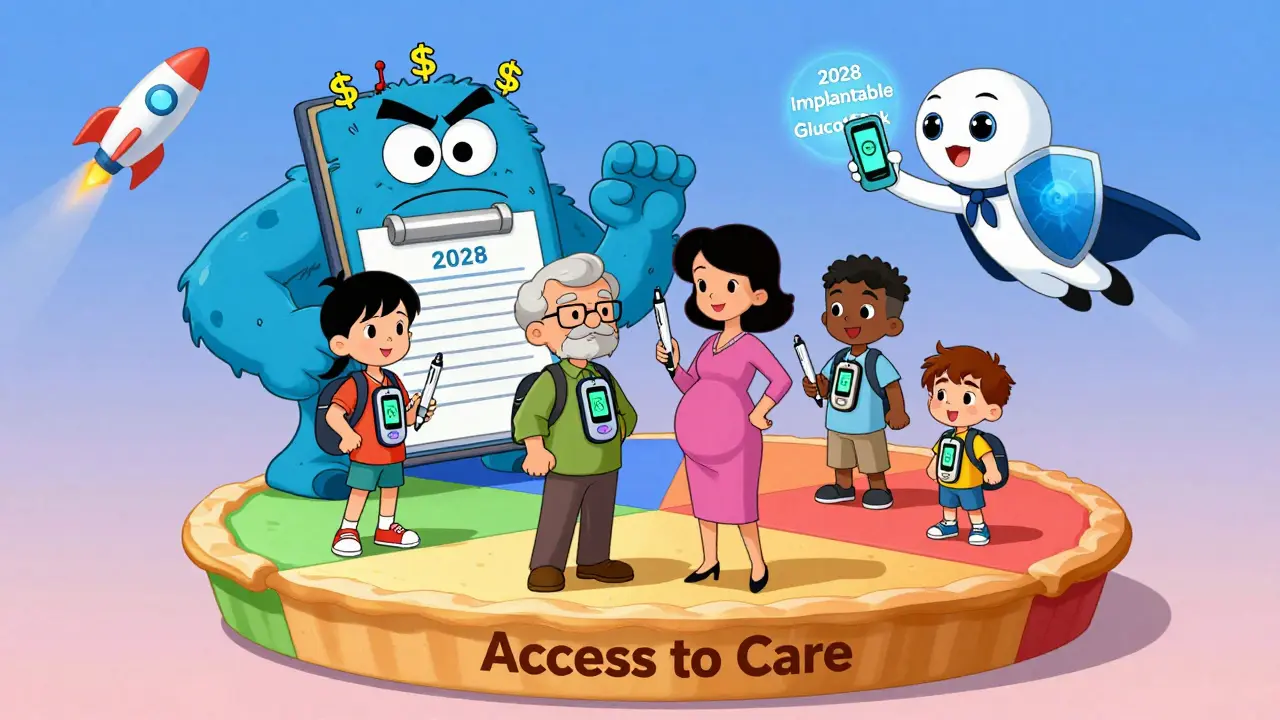
It’s not all smooth sailing. A sensor costs $150 to $300 every 10 to 14 days. For uninsured patients, that’s $300 a month. Even with insurance, 37% of people report prior authorization denials. And while Medicare and Medicaid have expanded coverage, 41% of low-income patients still can’t get access. Then there’s data overload. Nearly 70% of new CGM users feel overwhelmed at first. Alarms go off constantly-too high, too low, rising fast. Many give up. The fix? Personalize your alerts. A night-shift worker needs different settings than a parent with three kids. A person with hypoglycemia unawareness needs higher low alerts. The ADA now says settings should be tailored-not generic. And security? A 2025 JAMA study found 63% of CGM systems have data vulnerabilities. Someone could, in theory, hack your glucose readings. Manufacturers are working on fixes, but it’s a real concern.Getting Started: What You Need to Know
If you’re thinking about trying a CGM or smart pen:- Ask your doctor if you qualify. Even if you have Type 2 and aren’t on insulin yet, ask if a CGM could help you avoid it.
- Check your insurance. Many plans cover CGMs now, but you might need a prescription or prior authorization.
- Don’t skip training. A 2025 study found 78% of people who stuck with CGMs had formal training. Those who didn’t? Half quit within three months.
- Start with the simplest system. Libre 3 is easy to use. Dexcom G7 has great app integration. InPen is the only smart pen with real-time dose suggestions.
- Customize your alerts. Set your high and low limits based on your life-not the default settings.
What’s Next? Implants, Patches, and AI
The future is coming fast. Glucotrack’s implantable sensor could be in U.S. clinics by 2028. It lasts three years. No sticking, no changing, no lag. Vaxess Technologies is testing a needle-free patch for semaglutide (Ozempic), which could help people stick to weight-loss meds that also help blood sugar. And AI is getting smarter-predicting lows before they happen, suggesting meals, even telling you when to take a walk. But the biggest challenge isn’t technology. It’s access. The most advanced CGM in the world doesn’t help if you can’t afford it, can’t get it, or don’t know how to use it. The real win isn’t the sensor on your arm. It’s when everyone with diabetes-no matter their income, zip code, or insurance-can live without fear of a sudden drop, a silent spike, or a hospital visit they didn’t see coming.Are CGMs accurate enough to replace fingersticks?
Yes, for most daily decisions. Modern CGMs like the Abbott FreeStyle Libre 3 and Dexcom G7 have a MARD (mean absolute relative difference) of under 9%, which meets clinical standards. They’re reliable for spotting trends, adjusting food, and catching lows. But during rapid changes-like after eating or during intense exercise-fingersticks are still the gold standard for confirmation. Always double-check with a fingerstick if you feel symptoms that don’t match your CGM reading.
Can I use a CGM if I have Type 2 diabetes and don’t take insulin?
The American Diabetes Association doesn’t yet recommend CGMs for all Type 2 patients not on insulin-but many doctors are prescribing them anyway. If you’re struggling with high blood sugar despite diet and pills, or if you’re on GLP-1 medications like Ozempic, a CGM can show you exactly how food, stress, or sleep affects you. It’s not about insulin-it’s about understanding your body. Some insurers will cover it if your doctor writes a letter explaining why it’s medically necessary.
Do smart pens replace insulin pumps?
No. Smart pens record and suggest doses, but they don’t deliver insulin automatically. Insulin pumps do. If you want full automation-where your pump adjusts insulin based on your CGM data-you need an automated insulin delivery (AID) system like Tandem’s Control-IQ or Medtronic’s MiniMed. Smart pens are a great middle ground: more control than injections, less complexity than pumps. They’re ideal for people who want to avoid pumps but still want digital support.
How do I know which CGM is right for me?
Start with your lifestyle. If you hate carrying a reader, go for Dexcom G7 or Libre 3-they send data straight to your phone. If you’re active or sweat a lot, Libre 3 has better adhesion. If you’re on a pump, Medtronic’s Guardian 4 works best with their systems. If cost is a concern, Libre 3 is often cheaper and widely covered. Talk to your diabetes educator. Try a sample if your provider offers one. There’s no one-size-fits-all. The best CGM is the one you’ll actually wear.
Is it safe to use a CGM during pregnancy?
Yes, and it’s strongly recommended. For pregnant women with Type 1 or Type 2 diabetes, tight glucose control is critical to prevent birth complications. CGMs help maintain time in range (70-120 mg/dL is ideal during pregnancy), reducing risks like preterm birth, macrosomia, and preeclampsia. Studies show women using CGMs during pregnancy have babies with healthier birth weights and fewer NICU admissions. Many OB-GYNs now require CGM use for diabetic pregnancies.
Can CGMs help with weight loss?
Indirectly, yes. CGMs show you how certain foods spike your sugar-and how those spikes trigger hunger and cravings. Many people realize they’re eating “healthy” foods like oatmeal or fruit that cause big spikes, leading to crashes and overeating. By avoiding those triggers, people often eat less naturally. One 2025 study showed people using CGMs alongside semaglutide lost an average of 18 pounds over six months-not because of the drug alone, but because they ate more mindfully based on their glucose data.
What should I do if my CGM keeps giving me false alarms?
First, don’t turn off all alerts. Instead, customize them. Most CGM apps let you set different alert levels for day and night. If you’re getting too many low alerts, raise your low threshold from 70 to 75 or 80 mg/dL. If you’re getting too many high alerts, check if your sensor is old or if you’re eating too many refined carbs. Also, make sure your sensor is properly calibrated (if required) and placed correctly. If alarms persist, contact your diabetes educator-they can help you fine-tune settings based on your real-life patterns.
Can I travel with a CGM or smart pen?
Absolutely. CGMs and smart pens are designed for travel. Always carry a backup fingerstick meter and test strips in case of device failure. Keep sensors in your carry-on-don’t check them. Airport security scanners won’t harm them, but don’t put them through the X-ray machine if you can avoid it. Some people use a Faraday pouch to protect against signal interference on long flights. And bring extra sensors. If you’re flying internationally, check if your CGM app works overseas-some need a local SIM or Wi-Fi to sync.
Comments (12)
Delilah Rose
24 Dec, 2025I remember when my first CGM came in the mail and I just stared at the app for an hour like it was magic. It showed me that my ‘healthy’ oatmeal was spiking me higher than a donut. I didn’t even know that was possible. Now I eat avocado toast instead, and my nights are actually peaceful. No more 3 a.m. panic checks. The lag? Yeah, it’s there-but after three months, your brain just learns to read the story, not just the number. I used to think tech was cold, but this? This feels like having a quiet friend who never stops watching out for you.
And honestly? The real win isn’t the sensor. It’s the freedom. I took my first unchaperoned road trip in ten years last month. No backup strips. No panic. Just me, the open road, and a little vibrating alert on my wrist that said, ‘You’re good.’ That’s not tech. That’s liberation.
I’ve told three friends to try it. Two said ‘too expensive.’ One said ‘I don’t need it.’ I didn’t argue. I just sent them my glucose trends from last week-three lows avoided, two meals adjusted, zero hospital visits. Sometimes the data speaks louder than any sales pitch.
And yeah, the alarms used to drive me nuts. But once I turned off the ‘rising fast’ alert at 2 a.m. and set my low to 75 instead of 70? Game changer. You don’t need to be perfect. You just need to be informed. And that’s worth every penny.
Also, I cried when I saw my A1c drop from 9.1 to 6.8. Not because I’m proud. Because I finally felt like I wasn’t fighting my own body anymore.
Don’t wait for the ‘perfect’ system. Start with what you can afford. Even a Libre 3 on sale for $120 a month is better than guessing. You deserve to sleep through the night.
And if someone tells you you’re ‘not diabetic enough’ for a CGM? Tell them I said to go f*** themselves. Your body, your rules.
Aurora Daisy
26 Dec, 2025Oh wow, another tech bro manifesto. Next they’ll tell us we need AI to decide when to breathe. How quaint. In my day, we just ate less sugar, moved more, and didn’t need a $300 wrist tattoo to know if we were alive. This isn’t progress-it’s corporate greed dressed up as compassion. And don’t get me started on the data harvesting. Your glucose levels are now a marketing dataset. Thanks, Apple.
Meanwhile, in the real world, people are choosing between insulin and groceries. But hey, at least your smart pen knows you ate a croissant. How thoughtful.
Paula Villete
28 Dec, 2025Okay, so let me get this straight: we’ve turned a chronic condition into a productivity app, and now people are calling it ‘liberation’? Cute. I love how the article casually mentions that 70% of new users feel overwhelmed-then offers zero advice on how to cope with that, just ‘customize your alerts.’ Like that’s a magic wand.
Also, ‘Glucotrack’s implantable sensor could be in clinics by 2028.’ Wow. So we’re now engineering our bodies to be compatible with Silicon Valley’s roadmap. Next up: brain chips to remind you to drink water.
And don’t even get me started on the ‘FDA approved over-the-counter’ part. That’s not access. That’s a trap. You hand someone a device with zero training and expect them to interpret biometric noise? That’s not innovation. That’s negligence wrapped in a shiny app icon.
Also, typo: ‘Vaxess Technologies is testing a needle-free patch for semaglutide’ - but semaglutide is a GLP-1 agonist, not a glucose sensor. You’re mixing up the tools and the targets. I’m not mad. I’m just… disappointed. And yes, I meant to write that. No emoticons. No mercy.
Georgia Brach
28 Dec, 2025Let’s be honest: this entire narrative is a marketing funnel disguised as medical advice. CGMs are not ‘life-changing’-they’re expensive gadgets that generate data nobody knows how to interpret. The claim that ‘time in range’ is the new gold standard? That’s a convenient metric for insurers to avoid paying for insulin. You can’t reduce a complex metabolic disorder to a percentage on a phone screen.
And let’s talk about the ‘smart pen’-a glorified calculator with Bluetooth. If you’re relying on an algorithm to tell you how much insulin to take, you’re not managing diabetes-you’re outsourcing your autonomy to a corporation that profits when you’re sick.
Also, the article mentions data vulnerabilities but doesn’t name a single company that’s been breached. That’s not transparency. That’s omission. And the fact that 63% of CGM systems have security flaws? That’s not a footnote. That’s a public health risk.
And don’t even get me started on the ‘AI predicting glucose changes 30 minutes ahead.’ That’s not predictive analytics. That’s placebo engineering. You’re not getting a crystal ball-you’re getting a statistical guess based on data you didn’t consent to collect.
This isn’t medicine. It’s surveillance capitalism with a diabetic label.
Katie Taylor
30 Dec, 2025STOP WAITING. Just get a CGM. I was skeptical too. I thought I was fine. I wasn’t. I had two hypoglycemic seizures in six months. One at my kid’s soccer game. One in the grocery store. I didn’t know I was crashing until I was on the floor. My CGM woke me up at 2 a.m. last week because my sugar was at 54. I ate a banana. I didn’t go to the ER. I didn’t panic. I just… lived.
Yes, it’s expensive. But I got mine through Medicaid. Yes, the alerts are annoying. But I turned them into a game. I call them my ‘glucose gossip.’
My A1c dropped from 9.9 to 6.5 in four months. I lost 22 pounds. I stopped feeling like a burden. I’m not ‘cured.’ But I’m not dying slowly anymore. If you’re reading this and you’re scared? I was too. Do it anyway. Your future self will thank you.
And if someone says ‘you don’t need it’? They’ve never had to explain to their child why they passed out at the park. Do it for them. Do it for you. Just. Do. It.
Isaac Bonillo Alcaina
31 Dec, 2025Everyone here is acting like this is some revolutionary breakthrough. It’s not. It’s the same old cycle: medical device companies create a product, doctors endorse it without evidence, patients become dependent, and insurers slowly begrudgingly cover it-after extracting every last dime.
The ‘time in range’ metric? A convenient proxy to avoid addressing the root causes of poor glucose control: poverty, food deserts, lack of education, and systemic neglect. You can’t solve diabetes with a sensor. You solve it with access to healthy food, stable housing, and mental health support.
And yet, here we are, praising a $300 sensor while ignoring that 41% of low-income patients still can’t access it. This isn’t innovation. It’s distraction.
Also, the article mentions ‘AI predicting glucose changes’ like it’s science fiction. But the algorithm is trained on data from mostly white, middle-class patients. What happens when your body doesn’t fit the model? You get false readings. You get ignored. You get left behind.
This isn’t progress. It’s exclusion with a Bluetooth connection.
Bhargav Patel
2 Jan, 2026It is indeed a remarkable evolution in the management of metabolic disorders. The transition from discrete, reactive measurements to continuous, proactive monitoring represents a paradigmatic shift in patient-centered care.
One must, however, consider the epistemological implications: if glucose data becomes the primary epistemic authority in self-management, are we not at risk of reducing the lived experience of diabetes to a series of quantifiable metrics? The body, after all, is not merely a sensor network.
Furthermore, the reliance on proprietary ecosystems-Dexcom Clarity, LibreLink, CareLink-creates vendor lock-in, which, in the context of chronic illness, may constitute a form of technological coercion. The patient becomes not a sovereign agent, but a node in a commercial data infrastructure.
And yet, the clinical benefits are undeniable. The reduction in hypoglycemic events, the improvement in time in range, the healing of foot ulcers-these are not trivial. The challenge lies in ensuring equitable access, not merely technological advancement.
Perhaps the true innovation is not the sensor, but the possibility of reclaiming agency through data-provided that data is not commodified, but liberated.
Lu Jelonek
3 Jan, 2026As someone who grew up in a rural community where the nearest endocrinologist was 90 miles away, I can tell you this: CGMs changed my life. I didn’t have access to regular care. I didn’t know what my numbers meant. I just knew I felt awful after eating.
When I finally got a Libre 3 through a nonprofit program, I cried. Not because it was fancy. Because for the first time, I understood why I felt the way I did.
I started noticing patterns-how my blood sugar spiked after rice, how stress made me crash. I didn’t need an app to tell me that. I just needed to see it.
And yes, I still use fingersticks sometimes. Especially before driving. But now I know when I can trust the CGM and when I shouldn’t.
To anyone reading this who thinks this tech isn’t for them? It’s not about being ‘Type 1’ or ‘on insulin.’ It’s about wanting to feel safe in your own skin. That’s worth it.
I’ve given two sensors to friends who couldn’t afford them. No one asked for repayment. They just said, ‘Thank you.’ That’s the real technology here: connection.
Chris Buchanan
4 Jan, 2026Let me tell you about the first time my CGM saved me. I was hiking. No phone signal. No idea if I was crashing. Then-vibration. Low alert. I pulled out a granola bar. Walked it off. Didn’t pass out. Didn’t call 911.
That’s not tech. That’s superpower.
And yeah, the alarms suck at first. But you learn. You tweak. You stop treating it like a babysitter and start treating it like a coach. It doesn’t tell you what to do. It just shows you what’s happening. Then you decide.
I’ve got a 14-year-old with Type 1. She hates her CGM. She thinks it’s ‘weird.’ Then she saw her glucose spike after eating a ‘healthy’ smoothie. She asked, ‘Why does this thing know me better than I know myself?’
That’s the moment it clicked.
Stop thinking about cost. Think about freedom. Think about sleeping. Think about not being scared to go out. That’s what this is for.
And if your doctor says ‘you don’t qualify’? Get a second opinion. Or a third. You’re worth it.
Joseph Manuel
5 Jan, 2026The article presents a highly optimistic view of diabetes technology that is not substantiated by the broader epidemiological evidence. While CGMs demonstrate improved time in range in controlled trials, real-world adherence rates remain below 50% for most populations. Furthermore, the claimed 64% reduction in complications per 10% increase in TIR is derived from observational studies with significant confounding variables. The causal link is not established.
The assertion that CGMs reduce hospital visits is not supported by randomized controlled trials at scale. The cited 3-month remote program lacks a control group and has no long-term follow-up.
Moreover, the integration claims between devices are overstated. Interoperability remains a major issue, and the 43% integration rate cited is misleading-most ‘integration’ is limited to data export, not real-time bidirectional communication.
The FDA’s OTC approval does not equate to clinical equivalence. Without physician oversight, the risk of misinterpretation and inappropriate intervention increases significantly.
This is not a medical revolution. It is a commercial expansion with questionable clinical utility for the majority of the population.
Harsh Khandelwal
7 Jan, 2026Bro, I saw a TikTok that said CGMs help you lose weight. So I bought one on Amazon. Didn’t even need a prescription. Got it delivered in two days.
Turns out, my ‘healthy’ smoothie was spiking me to 240. My oatmeal? 210. My ‘low-carb’ protein bar? 200. I was like… wait, I thought I was doing everything right?
So I stopped eating all that crap. Started eating eggs, chicken, and cheese. Lost 15 lbs in a month. Didn’t even try.
Also, my CGM went off at 3 a.m. and I thought I was dying. Turned out I just forgot to charge it. The battery died. The app was showing a fake low. I was like… this thing is a scam.
But then I got a new sensor. And now I know my sugar goes up after coffee. Who knew?
Also, I think the government is using the data to track us. I saw a pop-up that said ‘Your glucose pattern matches a high-risk profile.’ What does that even mean?
Anyway, I’m not on insulin. But I’m eating better. So I guess the tech worked? Or maybe I just got lucky.
Also, my dog licked the sensor once. I’m pretty sure he’s got diabetes now.
Paula Villete
8 Jan, 2026Actually, I just re-read the part about Glucotrack’s implantable sensor. The MARD of 7.7%? That’s not ‘more accurate.’ That’s clinically indistinguishable from Dexcom’s 7.5%. The real advantage isn’t accuracy-it’s longevity. Three years without changing? That’s the real win.
And yes, I know I said earlier that this was all corporate nonsense. But I’ve been using a CGM for 18 months now. I’ve had zero hypoglycemic events. My kid’s school nurse now asks me how I did it.
So maybe I was wrong.
Not about the data privacy. That’s still terrifying.
But about the value? Yeah. Maybe this isn’t just marketing.
Maybe… it’s medicine.