
What Manufacturing Staff Really Need to Succeed Today
It’s 2026, and the factory floor looks nothing like it did ten years ago. Robots move parts with precision. Screens show real-time quality data. Workers aren’t just turning knobs-they’re interpreting alerts, adjusting digital workflows, and troubleshooting AI-driven systems. But here’s the truth: technology doesn’t run itself. The people operating it make the difference between a smooth production line and a costly shutdown.
Companies aren’t just hiring bodies anymore. They’re hiring trained, certified, and safety-aware professionals who can keep up with fast-changing demands. If you’re managing a manufacturing team-or thinking about joining one-you need to know what qualifications actually matter today.
Entry-Level Isn’t Just a High School Diploma Anymore
Yes, a high school diploma or GED is still the baseline. About 92% of manufacturers accept it for entry-level roles like machine operator or material handler. But that’s where the simplicity ends.
Employers now expect more than just showing up on time. New hires are expected to understand basic safety protocols, read simple blueprints, and follow written work instructions. Without that, turnover jumps to 37% within the first year, according to RSS Inc. (2023). That’s not just expensive-it’s disruptive.
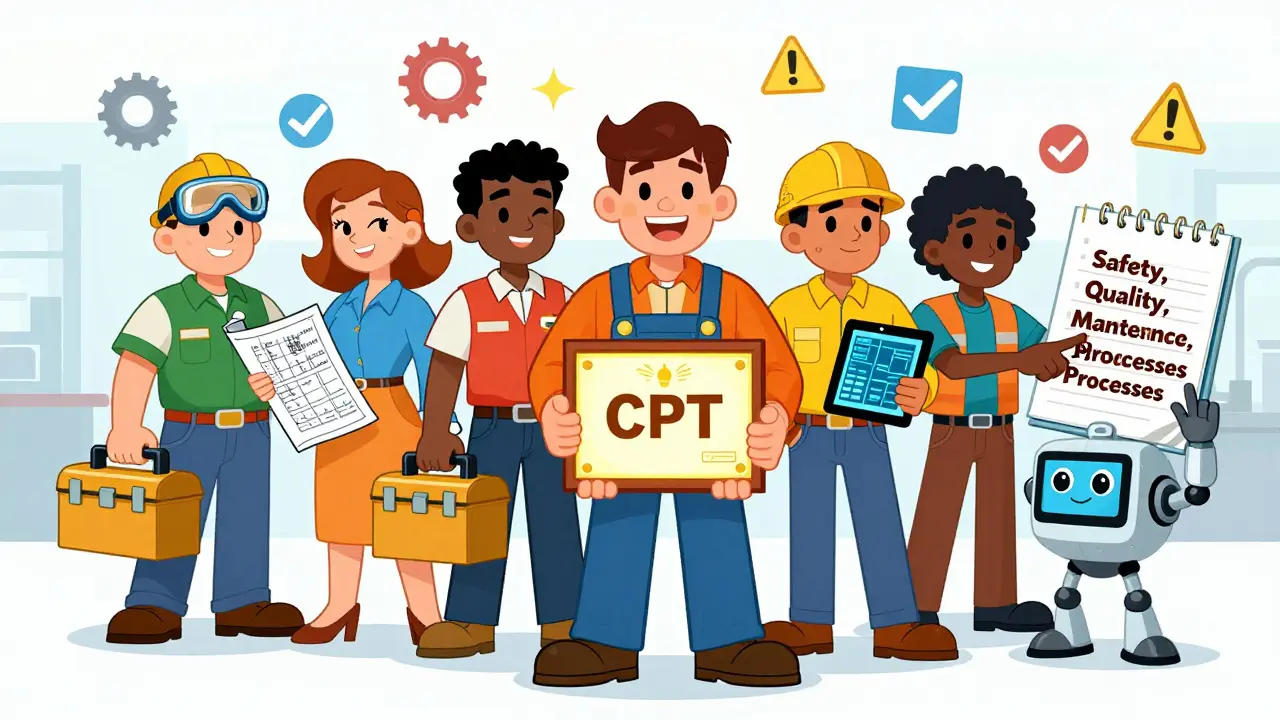
What’s changing? Employers are starting to require the Certified Production Technician (CPT) credential from the Manufacturing Skill Standards Council (MSSC) even for entry-level roles. It’s not a degree. It’s a 4-part certification covering safety, quality practices, manufacturing processes, and maintenance awareness. It takes 40-60 hours of training. And it’s worth it: workers with CPT earn 76% more on average than those without, per U.S. Department of Labor data.
Technical Roles Demand More Than Experience
If you’re operating CNC machines, welding structural components, or maintaining automated assembly lines, you’re not just a “machine operator.” You’re a technical specialist. And that demands more than on-the-job learning.
Most manufacturers now require 1-2 years of post-secondary training for these roles. That means certificates or diplomas from community colleges in programs like:
- Welding Technology
- Mechanical Engineering Technology
- Electromechanical Systems
- Industrial Maintenance
These programs cost between $3,000 and $8,000 a year-and they deliver results. The National Center for Education Statistics reports a 91% job placement rate for graduates. These aren’t just theory classes. They include hands-on labs with real equipment, simulations, and industry-standard tools like calipers, micrometers, and PLC trainers.
And here’s what’s new: digital literacy is no longer optional. You need to know how to use HMIs (Human-Machine Interfaces), scan QR codes for part tracking, and interpret data from IoT sensors. If you can’t navigate a touchscreen control panel, you’re already behind.
Why Certifications Like Six Sigma Are Becoming Essential
Quality isn’t just about catching bad parts. It’s about preventing them before they’re made. That’s where Six Sigma comes in.
Started by Motorola in the 1980s, Six Sigma is now the gold standard for reducing defects and improving efficiency. It’s not one certification-it’s a ladder:
- White Belt: 1-2 days. Basic awareness. Often free for employees.
- Yellow Belt: 1-2 weeks. Supports projects.
- Green Belt: 100-160 hours. Leads small projects. Median salary: $85,000/year.
- Black Belt: 200-240 hours. Leads major initiatives. Median salary: $110,000/year.
- Master Black Belt: 500+ hours. Trains others. $3,000-$5,000 in fees.
ASQ (American Society for Quality) is the main provider. But here’s the catch: certification alone doesn’t work. ASQ’s own data shows retention rates jump from 57% to over 85% when certifications are paired with mentorship and real-world projects.
And in 2025, ASQ updated its requirements: Green Belt and above now require basic knowledge of Python and SQL. Why? Because modern quality control isn’t done with clipboards anymore-it’s done with data dashboards.
Safety Training Isn’t Optional-It’s the Law
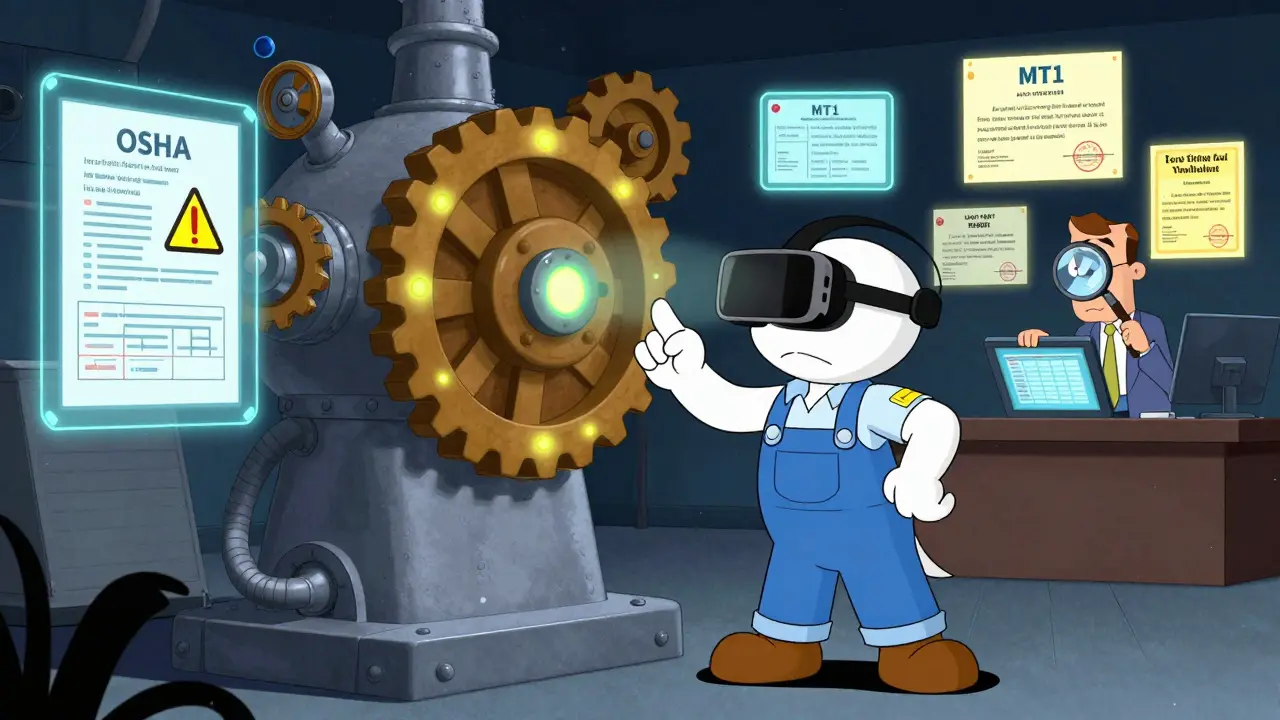
OSHA’s General Industry Standards (29 CFR 1910) aren’t suggestions. They’re federal law. And they’re non-negotiable.
Every manufacturing worker must be trained in:
- Proper use of PPE (gloves, goggles, ear protection, hard hats)
- Lockout/tagout procedures for machinery
- Hazard communication (reading SDS sheets)
- Emergency response and first aid
Companies that do this right see a 52% drop in workplace injuries, according to Vector Solutions. But only 38% of small manufacturers require regular safety recertification. That’s a ticking time bomb.
Training isn’t a one-time event. It’s annual. And it’s documented. If you’re audited and can’t show records of training, you’re looking at fines-and worse, liability if someone gets hurt.
The MT1 Certification: A Hidden Gem for Career Growth
Most people haven’t heard of the Manufacturing Technician Level 1 (MT1) certification-but they should.
Run by the Manufacturing Skills Institute, MT1 is designed for frontline workers who need to prove they can handle modern manufacturing tasks. It covers:
- Reading technical drawings
- Using precision measurement tools
- Following standard operating procedures
- Basic troubleshooting
What makes MT1 special? It’s recognized in 42 states. It’s integrated into high school career programs. And in Virginia, the state pays $2,200 for teachers to get certified so they can train students. That’s how seriously they take it.
Trainers need recertification every three years-either by retaking the test or completing professional development. That keeps the credential fresh. And it’s growing: 63% of manufacturers plan to adopt stackable micro-credentials like MT1 by 2025, according to Deloitte.
What Big Companies Know That Small Ones Don’t
Fortune 500 manufacturers don’t wing it. They use blended training: on-the-job coaching, formal certifications, digital learning modules, and mentorship-all tracked through digital skills matrices.
They see ROI in 14 months. Why? Fewer defects. Less downtime. Lower turnover.
Small manufacturers? They still rely on informal training-“Just watch me do it.” That’s risky. A 2022 NAM survey found 63% of small manufacturers can’t afford structured programs. But here’s the fix: use free resources.
The Manufacturing Extension Partnership (MEP) has over 1,400 centers across the U.S. offering free training consultations. Reddit’s r/manufacturing community has real workers sharing tips-like using augmented reality glasses to guide complex assembly steps, which reduces errors by 39%.
What’s Coming Next: AI, VR, and Micro-Credentials
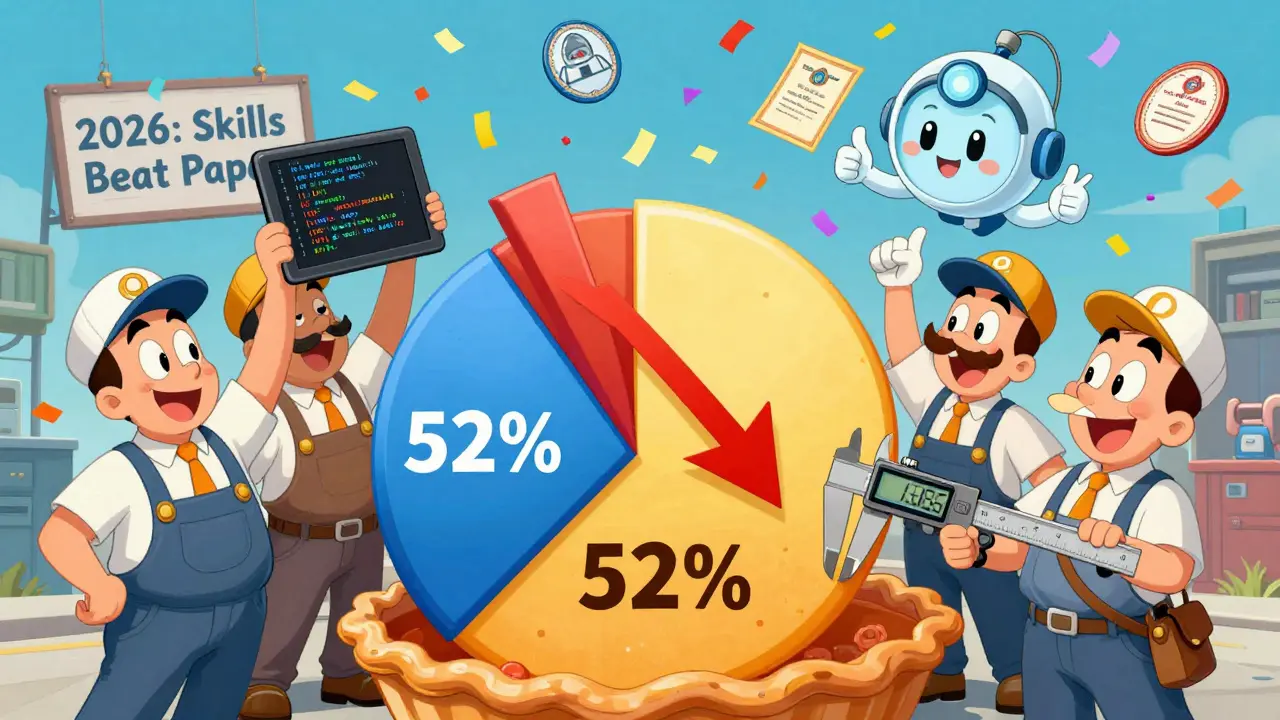
The future of manufacturing training is modular, digital, and personalized.
AI-powered learning platforms now adapt to your pace. If you struggle with interpreting sensor data, the system gives you extra modules. If you master welding quickly, you skip ahead. Pilot programs show 22% faster skill mastery.
Virtual reality is replacing costly physical setups. Trainees now practice machine shutdowns, emergency evacuations, and complex repairs in VR-no risk, no downtime.
And instead of waiting years for a degree, workers are earning micro-credentials: a badge for safety, another for PLC basics, another for data entry. These stack up. You don’t need a four-year degree to move up-you just need the right certifications, at the right time.
But Don’t Fall for Credential Overload
There are over 247 manufacturing certifications out there. That’s not helpful-it’s confusing.
MIT Professor David Autor warns that 43% of certifications don’t actually predict job performance. Some are marketing tools. Others are outdated.
Focus on the ones that matter:
- CPT for entry-level roles
- MT1 for technical operators
- Six Sigma Green/Black Belt for quality and process roles
- OSHA 10/30 for safety compliance
Ignore the rest. Your time and money are better spent mastering these.
Final Thought: Skills Beat Paper
Manufacturing isn’t about who has the fanciest diploma. It’s about who can keep the line running, spot a defect before it’s shipped, and stay safe doing it.
Whether you’re a worker looking to advance, a manager building a team, or a school counselor guiding students-focus on real skills. Certified skills. Measurable skills. Skills that matter on the floor.
The factories of 2026 aren’t just automated. They’re skilled. And the people who thrive? They’re the ones who never stopped learning.
Do I need a college degree to work in manufacturing?
No, a college degree isn’t required for most manufacturing roles. Entry-level positions accept a high school diploma or GED. Technical roles typically need a 1-2 year certificate from a community college. Only engineering or management roles usually require a bachelor’s degree in industrial engineering or a related field.
What’s the best certification for a beginner in manufacturing?
The Certified Production Technician (CPT) from MSSC is the best starting point. It’s nationally recognized, covers safety, quality, and basic operations, and costs under $300. Workers with CPT earn 76% more on average than those without it, according to U.S. Department of Labor data.
Is Six Sigma worth the time and money?
Yes-if you’re aiming for a career in quality control, process improvement, or management. Green Belt certification opens doors to higher-paying roles ($85K median) and leads to Black Belt ($110K+). But don’t get certified without a real project to apply it to. Retention and impact drop sharply without hands-on use.
How often do manufacturing certifications expire?
Most don’t expire-but they need renewal. CPT and MT1 require recertification every 3-5 years through continuing education or retesting. Six Sigma certifications don’t expire, but staying relevant means keeping up with new tools like Python and SQL. OSHA training must be renewed every 3-5 years depending on state rules.
Can I get manufacturing training for free?
Yes. The Manufacturing Extension Partnership (MEP) offers free training consultations nationwide. Many community colleges offer low-cost programs with state funding. Some employers pay for certifications. And platforms like Reddit’s r/manufacturing and YouTube have free tutorials on everything from reading blueprints to using digital gauges.
What skills are in shortest supply in manufacturing today?
The biggest shortages are in mechatronics (combining mechanical and electrical systems) and data analytics. Workers who can read sensor data, interpret dashboards, and troubleshoot automated systems are in high demand. Digital literacy is now as important as mechanical skill.
Why do some manufacturing jobs have high turnover?
High turnover often happens when workers aren’t trained properly or don’t see a path forward. Employees with only a high school diploma and no certification have a 37% higher turnover rate. Those who earn certifications like CPT or MT1 stay longer, feel more valued, and earn more. Investing in training reduces turnover and builds loyalty.
Comments (11)
Stephen Tulloch
16 Jan, 2026Bro, CPT is literally the only thing that matters anymore. 🚀 I got mine in 3 weeks while working nights and now I’m making 22/hr instead of 14. No degree, no debt, just certs. If you’re still doing ‘just watch me’ training, you’re already obsolete. 💥
Melodie Lesesne
17 Jan, 2026This is so refreshing to read! I’ve been telling my niece who’s in high school that manufacturing isn’t just welding pipes anymore-it’s coding, data, and precision. She’s already signed up for her school’s MT1 program. So proud of where this field is headed! 🌱
Corey Sawchuk
18 Jan, 2026I work at a small shop in Alberta and we just started using VR sims for lockout/tagout training. No more paperwork nightmares. Workers actually remember it now. Took us 6 months to get funding but worth every penny. Still no one’s doing Six Sigma here though…
Joie Cregin
18 Jan, 2026I used to think certifications were just corporate buzzword bingo… until I got my Green Belt and realized I was the only one who could fix the line when the AI flagged a defect. Now I train new hires. It’s wild how one badge changed my whole life. I’m not just a machine operator anymore-I’m a problem solver. 🙌
Allen Davidson
19 Jan, 2026If you’re not learning Python or SQL by now, you’re falling behind. I’ve seen guys with 20 years on the floor get passed over because they couldn’t read a dashboard. It’s not about being techy-it’s about being useful. Start with free MOOCs. You’ve got nothing to lose.
john Mccoskey
19 Jan, 2026Let’s be brutally honest: 90% of these certifications are marketing ploys designed to extract money from desperate workers while corporations offload training costs. The real value is in mentorship, not badges. And don’t get me started on ‘stackable micro-credentials’-that’s just corporate speak for ‘we’re not paying you enough to learn properly.’ The system is rigged. You’re being sold a dream while the machines get smarter and your wage stagnates.
Ryan Hutchison
21 Jan, 2026Canada’s got it easy with their free training programs. Over here in the US, you’re lucky if your employer doesn’t make you pay for your own OSHA card. We’re supposed to be the world’s top manufacturer? More like the world’s top sucker for cheap labor. Fix your damn infrastructure before you lecture us on certifications.
Samyak Shertok
21 Jan, 2026So you’re telling me the future of manufacturing is… more paperwork? 🤔 I thought robots were supposed to free us from this nonsense. Now we need 7 badges just to turn on a lathe? I’m starting to think the real automation is the system itself-designed to keep us busy chasing ghosts while the owners get richer. Maybe we should just burn the clipboards.
Rob Deneke
21 Jan, 2026I’ve been hiring for 15 years and the best people I’ve ever had? They didn’t have a single certification. Just showed up early, asked questions, and never quit. Certs help but they don’t replace character. Don’t let the hype fool you.
evelyn wellding
23 Jan, 2026OMG YES to VR training!! I tried it last month and I cried 😭 I was so scared of the CNC machine before… now I feel like I’ve done it 100 times. My boss even gave me a bonus for finishing the module. You guys are changing lives!!! 💪✨
Chelsea Harton
24 Jan, 2026CPT is free at my local library. Just sign up. No excuses. I did it in 2 weeks while my kid napped. Now I make 2x. Simple.