
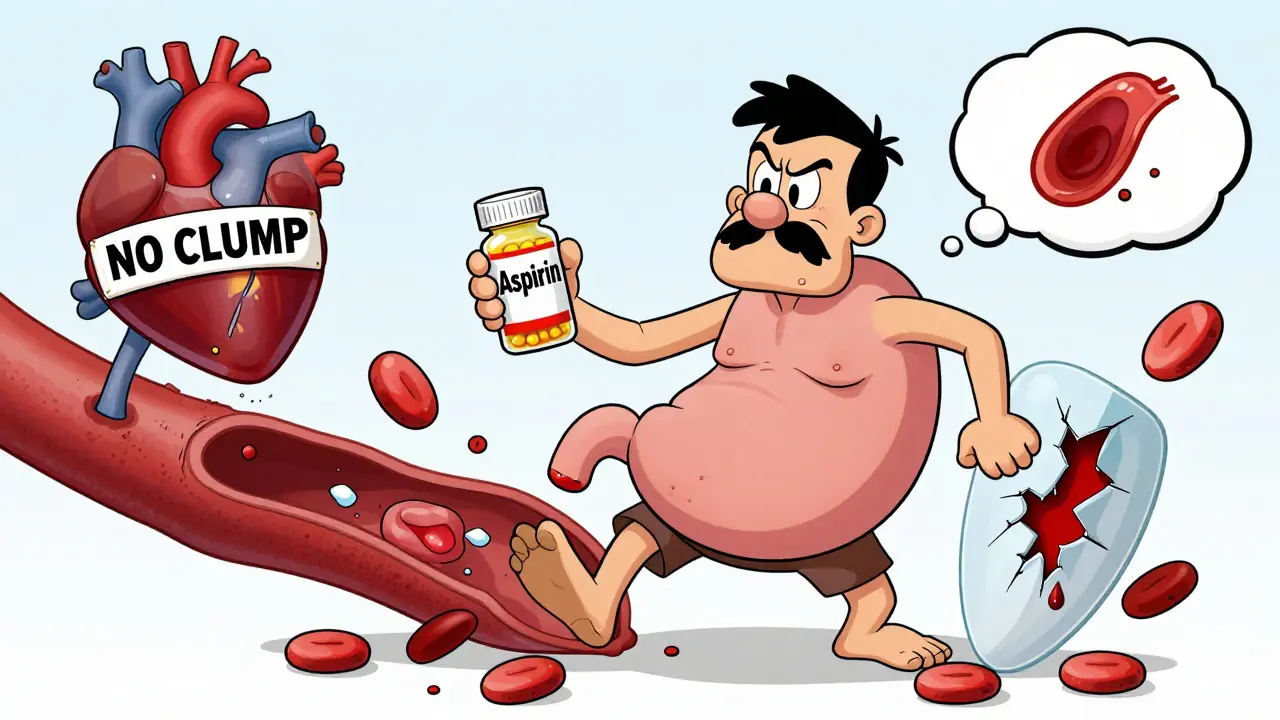
When you take an antiplatelet drug like aspirin or clopidogrel, you're not just preventing a heart attack or stroke-you're also putting your stomach at risk. These medications stop your blood platelets from clumping together, which keeps clots from forming in your arteries. But that same effect can turn a small stomach irritation into a serious bleed. About 1% of people on these drugs experience noticeable gastrointestinal bleeding within the first month, and for those with prior ulcers or other risk factors, the numbers climb even higher.
Why Antiplatelet Drugs Hurt Your Stomach
Aspirin has been around for over a century, but its antiplatelet use became standard in the 1980s after studies showed it cut heart attack risk by nearly half. It works by permanently disabling the COX-1 enzyme in platelets, which stops them from producing thromboxane A2-a chemical that makes platelets sticky. The problem? COX-1 also helps protect the stomach lining by producing protective mucus and reducing acid. When aspirin blocks it, your stomach loses its natural shield. Enteric-coated aspirin was created to delay absorption until the pill passes through the stomach. Sounds smart, right? But here’s the catch: once absorbed into your bloodstream, it still affects platelets everywhere-including your gut. Studies show enteric coating doesn’t reduce bleeding risk. It just delays the damage a bit. P2Y12 inhibitors like clopidogrel, prasugrel, and ticagrelor work differently. They block a receptor on platelets called P2Y12, stopping them from responding to ADP-a signal that tells them to clump. But here’s what many don’t realize: clopidogrel doesn’t just prevent clots. It also slows down healing in existing ulcers. Platelets release growth factors that help repair damaged tissue. When clopidogrel shuts down that signal, even minor erosions can turn into deep, bleeding ulcers.Who’s at Highest Risk?
Not everyone on antiplatelet therapy will bleed. But some people are far more vulnerable. The ACG guidelines point to five key risk factors:- Age 65 or older
- History of peptic ulcer or GI bleeding
- Use of NSAIDs (like ibuprofen or naproxen)
- Infection with H. pylori bacteria
- Taking more than one antiplatelet drug (dual therapy)
Which Drug Is Safest for Your Stomach?
Not all antiplatelets are created equal when it comes to GI risk.- Aspirin: Highest overall use, moderate GI risk. Still the go-to for long-term use after bleeding because stopping it increases death risk by 25%.
- Clopidogrel: 80% higher risk of GI injury than aspirin. Slows ulcer healing. Cheaper, widely used, but not safer.
- Prasugrel: More powerful at preventing clots, but 20-30% higher bleeding risk than clopidogrel.
- Ticagrelor: Fast-acting, reversible, but linked to more bruising and GI bleeds. Also causes shortness of breath in about 15% of users.

Proton Pump Inhibitors: The Shield You Need
PPIs like esomeprazole, omeprazole, and pantoprazole are the gold standard for protecting your stomach. They work by turning off the acid pumps in your stomach lining. Less acid = less damage to exposed tissue. The data is clear: if you’re on antiplatelet therapy and have a history of ulcers, PPIs cut your risk of rebleeding by 70%. A 2019 survey of 1,247 gastroenterologists found that 89% routinely prescribe PPIs for these patients. For those with no prior history but multiple risk factors (like age + NSAID use), 62% still recommend them. The standard dose is esomeprazole 40mg once daily. After an active bleed, IV doses are used first, then switched to oral. Guidelines say keep PPIs going for at least 8 weeks after an ulcer heals-and for life if you’ve had a complicated ulcer (bleeding, perforation, or obstruction).The Clopidogrel-PPI Interaction: Real or Overblown?
Here’s where things get messy. Around 2010, researchers noticed that some PPIs might reduce clopidogrel’s effectiveness. The theory? Both are metabolized by the same liver enzyme, CYP2C19. If a PPI blocks it, clopidogrel can’t activate properly. But here’s the truth: the clinical impact is small. The FDA reviewed this in 2010 and said the evidence was uncertain. Later studies showed a 20-30% higher risk of heart attacks in patients taking both-but those were mostly observational, not randomized trials. In real-world practice, the benefit of preventing a bleed far outweighs the tiny potential increase in clot risk. The bottom line? Don’t stop your PPI because you’re worried about clopidogrel. If you’re at high GI risk, you need the PPI. If you’re concerned, ask your doctor about pantoprazole or dexlansoprazole-these have less interaction with CYP2C19 than omeprazole or esomeprazole.What to Do If You Bleed
If you notice black, tarry stools, vomiting blood, or sudden dizziness, get help immediately. But here’s something most people don’t know: don’t stop your aspirin. A landmark 2017 Lancet trial found that stopping aspirin during GI bleeding didn’t help stop the bleed-it actually increased the chance of death by 25%. Your heart is still at risk. The guidelines now say: keep aspirin going. Hold the clopidogrel or prasugrel for 5-7 days, then restart as soon as you’re stable. Platelet transfusions? Avoid them unless you’re actively bleeding out. A small study showed transfused patients had 27% mortality versus 12% in those who weren’t transfused. Why? Transfused platelets get immediately inhibited by the drug anyway, and they can trigger more clotting elsewhere.
What If PPIs Don’t Work for You?
About 15-20% of people on long-term PPIs develop side effects: bloating, diarrhea, headaches, or nutrient deficiencies (like magnesium or B12). Some develop a condition called rebound acid hypersecretion-where stopping the PPI makes heartburn worse. If you can’t tolerate PPIs, here’s what works:- H2 blockers like famotidine (Pepcid) can help, but they’re less effective than PPIs for ulcer healing.
- Misoprostol (Cytotec) rebuilds stomach mucus, but it’s not used much because of side effects like cramping and diarrhea.
- Stopping NSAIDs is critical. Even occasional ibuprofen can undo all your protection.
- Treating H. pylori if present. Eradication cuts ulcer recurrence by 80%.
What’s Next? The Future of Safer Antiplatelets
Researchers are working on drugs that block platelets without hurting the stomach. One promising candidate, selatogrel, is in Phase III trials. In animal models, it caused 35% less stomach damage than ticagrelor. It’s designed to act only on clotting pathways in blood vessels-not the stomach lining. Another frontier is personalized medicine. Some people have a genetic variant (CYP2C19 loss-of-function) that makes clopidogrel useless for them. Testing for this can help doctors choose a better drug upfront-like ticagrelor or prasugrel-which may have lower GI risk in these patients. Doctors are also testing blood markers like pepsinogen and gastrin-17 to predict who’s likely to bleed before it happens. In five years, we may have simple blood tests that tell you if you’re a high-risk patient-and then give you targeted protection before you even start the drug.Bottom Line: Balance Is Everything
Antiplatelet drugs save lives. But they don’t come without cost. The key is knowing your risk and matching your protection to it.- If you’ve had a heart attack or stent, don’t stop your meds without talking to your doctor.
- If you’ve had a GI bleed, aspirin alone is safer than combo therapy.
- If you’re over 65 or on NSAIDs, ask for a PPI.
- If you’re on clopidogrel, don’t fear the PPI-use one that minimizes interaction.
- If you’re bleeding, keep aspirin going. Call for help. Don’t panic.
Can I take ibuprofen with antiplatelet drugs?
No, combining ibuprofen or other NSAIDs with antiplatelet drugs like aspirin or clopidogrel greatly increases your risk of serious gastrointestinal bleeding. NSAIDs damage the stomach lining directly, and antiplatelet drugs prevent your body from repairing that damage. Even occasional use can trigger a bleed. If you need pain relief, talk to your doctor about acetaminophen (paracetamol) instead-it doesn’t affect platelets or the stomach lining.
Is enteric-coated aspirin safer for my stomach?
No. Enteric-coated aspirin was designed to reduce direct stomach irritation, but it doesn’t lower your risk of bleeding. Once absorbed into your bloodstream, it still blocks the COX-1 enzyme that protects your stomach lining. Studies show no meaningful difference in bleeding rates between regular and enteric-coated aspirin. If you’re at risk, you need a PPI-not a special coating.
How long should I take a PPI with clopidogrel?
If you have a history of ulcers or GI bleeding, take a PPI indefinitely. For those without prior bleeding but with risk factors like age over 65 or NSAID use, guidelines recommend at least 8 weeks after starting clopidogrel. After that, your doctor will reassess based on your ongoing risk. Don’t stop it just because you feel fine-ulcers can return silently.
Can I stop my antiplatelet meds if my stomach hurts?
Never stop aspirin or clopidogrel on your own. Stopping these drugs after a stent or heart attack can trigger a life-threatening clot within days. If you have stomach pain, nausea, or black stools, contact your doctor immediately. They may adjust your meds, add a PPI, or do an endoscopy-but stopping without guidance could kill you.
Do I need genetic testing before starting clopidogrel?
Not routinely-but it’s worth considering if you’ve had a stent and still had a clot, or if you’re a poor responder to clopidogrel. About 30% of people have a gene variant that makes clopidogrel less effective. Testing for CYP2C19 can help your doctor choose a better drug like ticagrelor or prasugrel, which don’t rely on that enzyme. Some hospitals now test automatically for high-risk patients.
Comments (11)
Carolyn Benson
18 Dec, 2025So let me get this straight-we’re giving people drugs that turn their blood into water just to avoid a heart attack that might never come, while ignoring the fact that their stomach is basically a bleeding wound waiting to happen? And we call this medicine? This isn’t prevention-it’s calculated risk with a side of denial. They’ll sell you a PPI like it’s a magic shield, but the real problem is the damn drug itself. Why not just stop forcing everyone into this toxic binary? We’re medicating normal aging into a disease.
Chris porto
19 Dec, 2025I’ve been on aspirin for 12 years after my stent. Took PPIs for a while, then stopped because I felt weird-like my body was forgetting how to be normal. Turns out, I didn’t bleed. Maybe my stomach just got used to it. I don’t know if science has all the answers, but I know my body better than any study. Listen to yours.
Aadil Munshi
21 Dec, 2025Oh wow, another ‘medical authority’ article that reads like a pharmaceutical ad with footnotes. Let’s break this down: Aspirin blocks COX-1 → stomach loses mucus → PPIs fix it. But wait-PPIs also cause nutrient deficiencies, C. diff, and kidney damage. And clopidogrel? Yeah, it’s worse than aspirin for GI bleeds, but somehow we’re still pushing it because ‘it’s better for clots.’ Funny how ‘better for clots’ always means ‘more profitable.’ Meanwhile, H. pylori is the elephant in the room-treat that first, and you might not need half these drugs. But hey, why treat a root cause when you can sell lifelong meds? 🤷♂️
Danielle Stewart
22 Dec, 2025If you're on antiplatelet meds and haven't talked to your doctor about PPIs, please, for the love of your gut, do it. I had a silent ulcer for 8 months because I thought ‘stomach burn’ was just stress. Ended up in the ER with a hemoglobin of 6. PPI saved my life. Don't wait until you're vomiting blood to ask questions. Your doctor isn't judging you-they're trying to keep you alive. 💪
jessica .
23 Dec, 2025They want you to take PPIs forever? HA. That's the big pharma playbook. They make the drug, then make you need another drug to fix the first drug. And the FDA? Totally bought. Ever wonder why enteric-coated aspirin is still sold if it does NOTHING? Because they make more money selling it. They don't care if you bleed-they care if you keep buying. Wake up. This isn't medicine-it's a racket. 🇺🇸
Ryan van Leent
25 Dec, 2025Why are we even talking about this? Just don't take the drugs if you're scared of bleeding. If you're old and have a heart problem, tough. Maybe you shouldn't have eaten all that junk. I'm not gonna feel bad for someone who chose to live like a greasy burger. And PPIs? Yeah, they're just a crutch for bad habits. Stop blaming the medicine and start blaming yourself. 🤷♂️
Adrienne Dagg
25 Dec, 2025Aspirin + PPI = my new BFFs 😌❤️ I used to take ibuprofen for headaches and felt like a hero… until I started pooping tar. Now I take Tylenol and my PPI like a queen. My stomach is happy. My heart is happy. My life is happy. Don’t be like me before-be like me now. 🙌
Matt Davies
26 Dec, 2025This is the kind of post that makes you feel like you’re getting a private lecture from your wisest uncle who’s read every medical journal since 1987. Honestly? It’s rare to see a piece that doesn’t just dump facts but weaves them into a story about survival. The part about not stopping aspirin during a bleed? Mind blown. I used to think bleeding meant ‘stop everything.’ Turns out, your heart’s still screaming for help. Thanks for the clarity.
Mike Rengifo
27 Dec, 2025My dad took clopidogrel for 5 years after his stent. Never had a problem. Then he started taking OTC ibuprofen for his knees. Two weeks later, he was in the hospital. Turned out he had a 3cm ulcer. Doc said if he’d been on a PPI, it wouldn’t have happened. He’s on esomeprazole now. No more pain. No more drama. Just a quiet life. Point is: don’t be the guy who thinks ‘a little NSAID won’t hurt.’ It will.
Ashley Bliss
29 Dec, 2025Let’s be real-this whole system is designed to keep you dependent. They don’t want you healed. They want you managed. You think they care if you live? No. They care if you keep buying pills. PPIs? They’re a lifelong sentence disguised as care. And don’t get me started on genetic testing-why are we turning people into lab rats? We used to trust doctors. Now we’re told to test, track, tweak, and never stop. I’m done. I’m going off everything. My body knows better than Big Pharma. 🚫💊
Connie Zehner
30 Dec, 2025Wait wait wait-so if I’m on clopidogrel AND I take a PPI, I might get a heart attack? But if I don’t take the PPI, I’ll bleed out? So I’m supposed to choose between dying of a clot or bleeding into my toilet? That’s not a medical decision-that’s a horror movie plot. And now you want me to get a blood test to see if my genes hate me? I’m just trying to survive my 70s, not play Russian roulette with my liver. 😭