
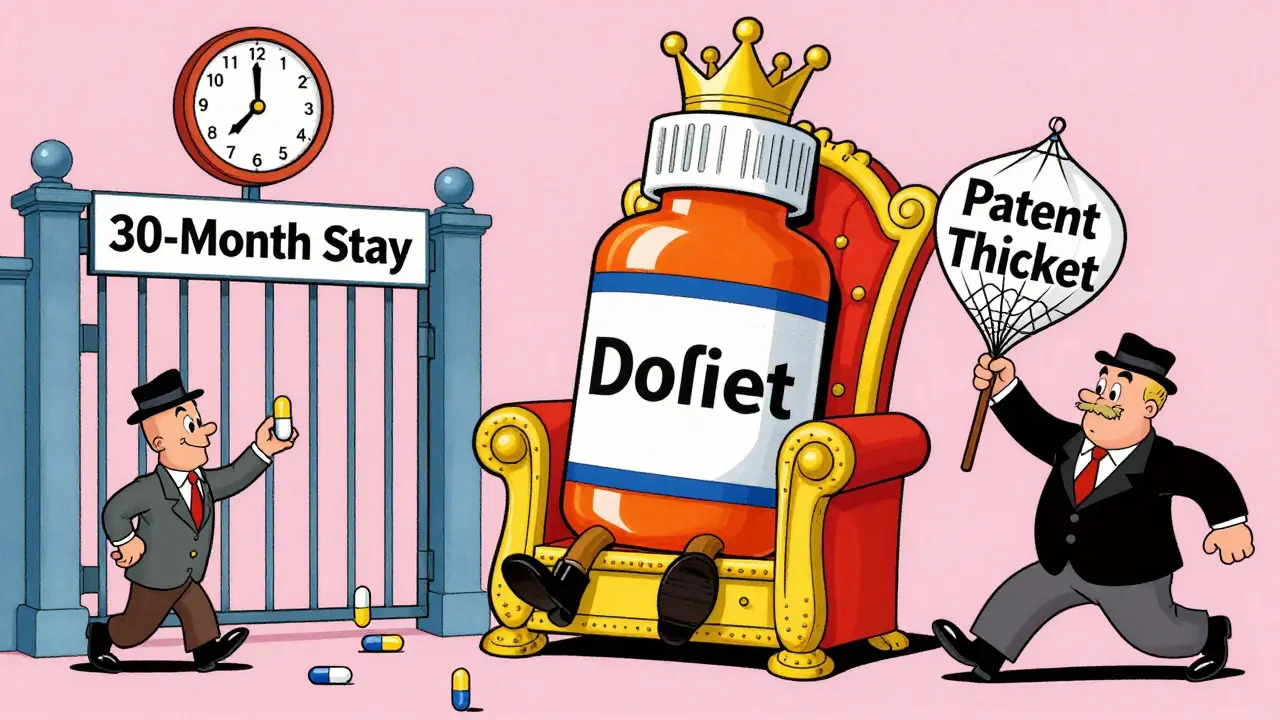
When a new brand-name drug hits the market, it comes with a patent that gives the company exclusive rights to sell it-usually for 20 years. But here’s the catch: by the time the drug gets approved by the FDA, years have already passed in clinical trials. That means the real clock on market exclusivity starts ticking after launch, not when the patent is filed. And that’s where things get messy.
How the system was meant to work
The Hatch-Waxman Act of 1984 was supposed to fix this. It created a balance: let brand-name companies recoup their R&D costs with patent protection, but also let generic makers enter the market faster by letting them copy the drug without repeating expensive clinical trials. The key tool? The Paragraph IV certification. When a generic company files an Abbreviated New Drug Application (ANDA), they can challenge a patent by saying it’s invalid or won’t be infringed. That triggers a 45-day window for the brand-name company to sue. If they do, the FDA can’t approve the generic for up to 30 months. That’s not a court decision-it’s an automatic pause.This wasn’t meant to be a delay tactic. It was a buffer, giving both sides time to resolve the dispute without letting the generic sit on the shelf indefinitely. But over time, the buffer became a wall.
The 30-month stay isn’t the end-it’s just the beginning
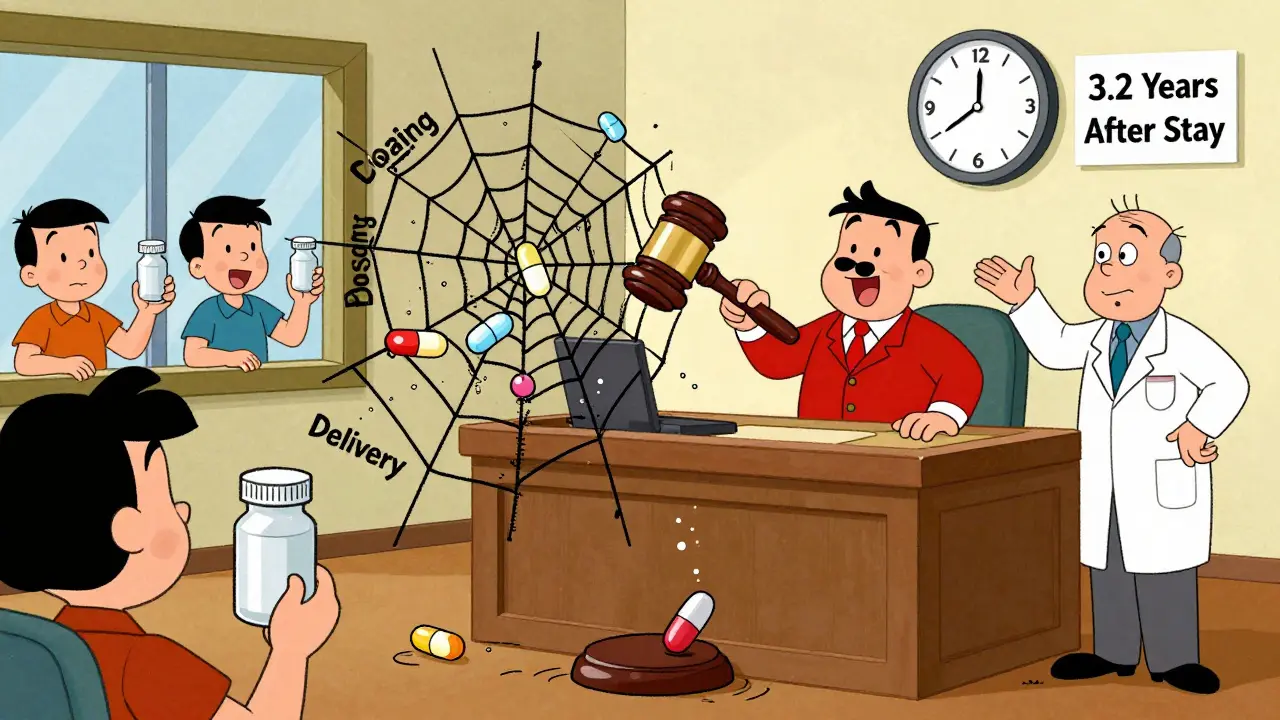
Here’s what actually happens: a generic company files its challenge. The brand sues. The 30-month clock starts. The FDA approves the generic during that time-but doesn’t let it launch. When the 30 months are up, the generic still can’t hit shelves. Why? Because the lawsuit hasn’t been settled. Courts move slowly. Appeals take years. On average, it takes 3.2 years after the 30-month stay ends before the generic actually reaches patients.That means the median time between a brand-name drug’s approval and its first generic is 11.5 years. The patent may have expired, but the generic still can’t sell. Patients pay full price for years longer than they should.
Patent thickets: the hidden game
Brand-name companies don’t just rely on one patent. They build patent thickets-a maze of secondary patents on things like pill coatings, dosing schedules, or delivery devices. These patents often come out after the original drug is approved. A 2023 study found that 72% of patents used to block generics were filed after FDA approval.Each new patent triggers a new 30-month stay. One company might file three or four of these over five years. Each one resets the clock. The generic company has to file a new Paragraph IV challenge for each one. The result? A single drug can be locked down for 15 years or more-even if the original compound patent expired long ago.
Pay-for-delay: when competitors pay to stay out
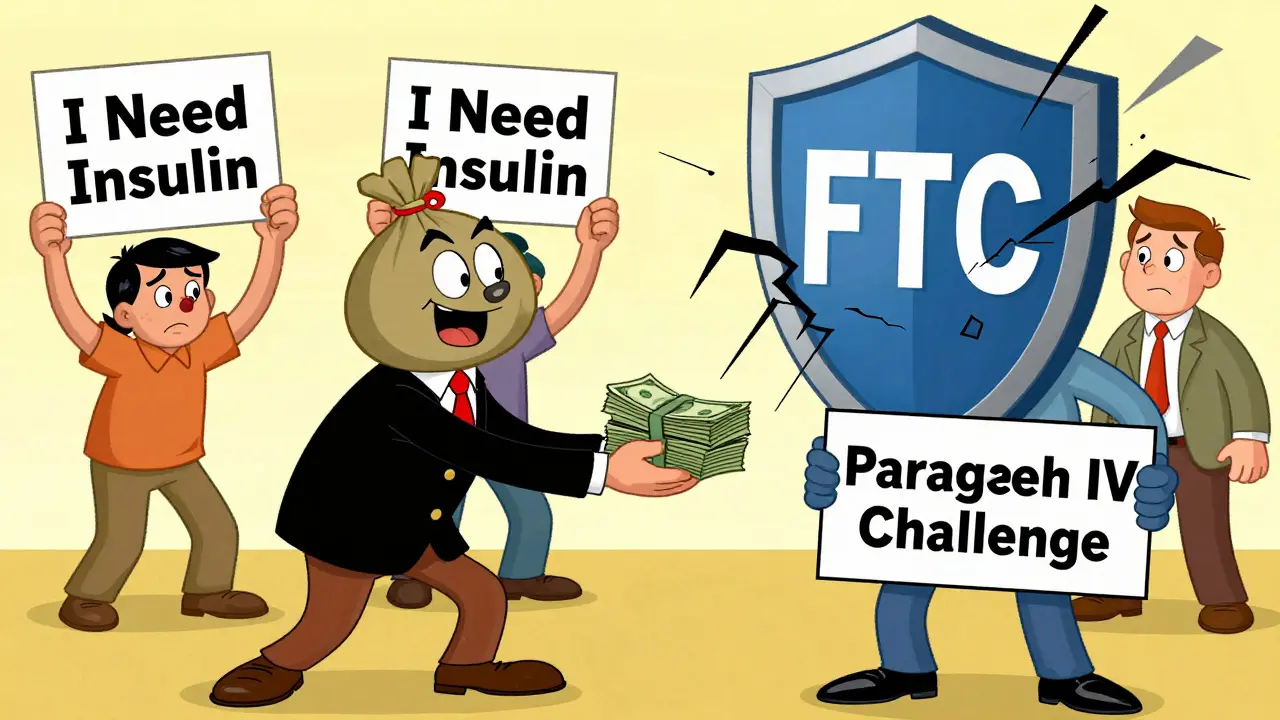
Sometimes, the brand-name company doesn’t fight in court. Instead, they pay the generic maker to stay away. These are called pay-for-delay agreements. The FTC calls them anticompetitive. In these deals, the generic gets millions in cash or other perks-and agrees not to launch for years. In return, the brand keeps its monopoly.Only about 24% of patent cases end this way, but they’re the most damaging. A 2010 FTC report estimated these deals cost consumers $3.5 billion a year in higher drug prices. In 2023, the FTC challenged over 100 such cases involving companies like AbbVie and GlaxoSmithKline. Courts are starting to crack down, but the practice still happens.
Who pays the price?
It’s not just the system that’s broken-it’s the people. Patients ration insulin because the generic was approved in 2022 but still can’t be bought in 2024. Employers pay an extra $1.2 billion in 2023 just because Humira’s generic was delayed. Teva, one of the biggest generic makers, lost $850 million in projected revenue because of litigation delays.On Reddit, pharmacists share stories: “My patient couldn’t afford the $1,200/month brand drug. The generic was approved two years ago. Still waiting.” Doctors report patients skipping doses or splitting pills. Insurance companies now build 24- to 36-month delay windows into their forecasts. They know the system is rigged.
The cost of fighting back
Generic companies aren’t innocent bystanders. They need teams of 50+ patent lawyers just to navigate the system. Defending a single patent case costs $3-5 million. A full appeal? Over $10 million. That’s why only the biggest generic players-like Teva, Mylan, and Sandoz-can afford to play. Smaller companies get pushed out.And even when they win? They still lose. A 2023 study found that generics win 73% of cases that go to court. But winning a lawsuit doesn’t mean the drug launches right away. The brand can appeal. The FDA can still delay. The clock keeps ticking.
What’s being done?
The CREATES Act of 2023 tried to stop brand companies from blocking generic companies from getting samples needed to test their drugs. The FTC is pushing harder. Lawmakers are proposing bills like the Protecting Consumer Access to Generic Drugs Act, which would limit how many patents can be listed in the FDA’s Orange Book and ban serial litigation.But progress is slow. The Orange Book still has errors in 15% of listings. Courts are overloaded. And new tactics keep emerging-like patenting delivery pens or digital monitoring features for pills. The goal? Keep generics out as long as possible.
The future: more complexity, not less
Biosimilars-generic versions of biologic drugs-are the next frontier. But they’re even harder to challenge. Patent litigation for biosimilars takes 25% longer than for regular generics. With biologics making up a growing share of drug spending, these delays could cost billions more.Some experts predict a 15-20% drop in delays over the next five years due to regulatory pressure. But without real legislative reform, the average delay will stay at 3.2 years per drug. That’s $15-20 billion a year stuck in the pockets of brand-name companies instead of in patients’ wallets.
At its core, this isn’t about patents. It’s about power. The system was designed to encourage innovation and competition. Today, it’s being used to protect profits at the cost of access. And until that changes, the cheapest medicine in the world will still be out of reach for millions.
Comments (14)
kabir das
29 Jan, 2026So let me get this straight: we're paying $1,200 a month for insulin because some lawyer figured out how to patent the color of the pill?!
This isn't innovation-it's extortion with a white coat.
I've seen patients split pills in half just to make them last… and the company still profits.
It's not capitalism. It's feudalism with a FDA stamp.
Megan Brooks
30 Jan, 2026The structural imbalance here is staggering. The Hatch-Waxman Act was a compromise-but over time, the balance has been weaponized.
What was designed to incentivize innovation has become a legal labyrinth designed to suppress competition.
It’s not just about patents; it’s about who controls access to health itself.
When the cost of litigation exceeds the profit margin of a generic drug, the market fails-not because of inefficiency, but because the rules were rewritten to favor power over public good.
And yet, we still call this a free market.
Perhaps the real innovation isn’t in the drug-but in the legal strategy to keep it expensive.
It’s tragic that the most effective solution-legislative reform-is the least likely to happen.
Because who lobbies harder: patients needing insulin, or shareholders expecting quarterly returns?
It’s not even a fair fight.
Doug Gray
31 Jan, 2026Patent thickets = legal obfuscation 101. 🤡
They file 17 patents on the same damn pill-coating, shape, packaging, delivery mechanism, app integration (yes, really)-and each one resets the 30-month clock.
It’s not litigation. It’s litigation theater.
And the FDA? They’re stuck playing referee with a broken stopwatch.
Meanwhile, patients are rationing.
And we wonder why trust in pharma is at an all-time low.
DHARMAN CHELLANI
1 Feb, 2026USA so dumb. Pharma own everything. India make cheap drugs. You pay more for same pill. Sad.
rajaneesh s rajan
1 Feb, 2026Let’s be honest-the system isn’t broken. It’s working exactly as intended.
It was never about health. It was about extracting value from human vulnerability.
Every patent extension, every pay-for-delay deal, every 30-month stay? That’s not a loophole-it’s a feature.
The real question isn’t how to fix it.
It’s: who benefits from keeping it broken?
And why do we still pretend this is medicine and not a hedge fund with a pharmacy license?
paul walker
2 Feb, 2026Bro this is wild. I work in a clinic and I see it every day.
Patients crying because they can’t afford the brand even though the generic is approved.
One lady told me she’s been taking half a pill for 2 years just to make it last.
And the company? They just bought a new yacht.
It’s not capitalism. It’s cruelty with a business plan.
Someone needs to burn this whole system down.
Robin Keith
3 Feb, 2026There’s a philosophical abyss here, one that reflects the ontological collapse of American healthcare: when the right to life becomes contingent on the ability to pay, and when the mechanism designed to protect innovation becomes the engine of monopolistic extraction, we are no longer in a market economy-we are in a necro-economy, where life itself is commodified, digitized, and held hostage by legal fictions masquerading as intellectual property.
The 30-month stay is not a buffer; it is a gurney rolled into a courtroom, where the patient lies unconscious while lawyers debate the semantics of a pill coating.
Each Paragraph IV certification is a whisper in a hurricane of corporate litigation, drowned out by the roar of shareholder meetings and quarterly earnings calls.
And yet we call this justice?
When the FDA approves a generic but refuses to authorize its release-not due to safety, not due to efficacy, but because a judge hasn’t yet ruled on whether the delivery pen’s angle infringes on a patent filed three years after the drug’s original approval-we are not witnessing legal procedure.
We are witnessing the institutionalization of moral bankruptcy.
The fact that generics win 73% of cases and still can’t launch? That’s not a flaw in the system.
That’s the system.
And the CREATES Act? A Band-Aid on an arterial bleed.
Until we dismantle the Orange Book’s sacred cow and declare that patents on pill shapes, colors, and digital apps are not innovation but obstruction, we are not curing disease-we are monetizing despair.
And if you think this is just about insulin or Humira, you’re missing the point.
This is the blueprint for how capital transforms human need into extractive architecture.
And we are all just patients in the waiting room.
Kristie Horst
3 Feb, 2026It is deeply concerning that a system ostensibly designed to balance innovation with access has, in practice, become a mechanism for the prolonged denial of essential medicines.
The notion that a company can legally delay the market entry of a generic drug for over a decade-despite patent expiration-is not merely a regulatory failure; it is an ethical one.
One cannot help but note the irony: while the pharmaceutical industry touts its commitment to healing, its most profitable strategies involve the strategic prolongation of suffering.
The FTC’s efforts are commendable, yet they remain reactive, not systemic.
Legislative reform is not merely advisable-it is imperative.
When a patient must ration insulin because a legal maneuver prevents a generic from launching, the moral calculus becomes undeniable.
And yet, we continue to applaud the companies that profit from this, while vilifying those who dare to challenge it.
It is not the generic manufacturers who are the villains.
It is the architecture of the system itself.
And perhaps, the most tragic part is that we have known this for decades-and still, we do nothing.
Paul Adler
4 Feb, 2026I’ve read through this a few times.
It’s not that I’m surprised-it’s that I’m exhausted.
This isn’t about patents.
This is about who gets to decide who lives and who doesn’t.
And it’s not the doctors.
It’s not the pharmacists.
It’s not even the patients.
It’s lawyers, lobbyists, and balance sheets.
It’s a system that rewards delay, punishes transparency, and celebrates profit over people.
And the worst part? We’ve normalized it.
We shrug and say, ‘That’s just how it is.’
But it doesn’t have to be.
It’s just been made that way.
Frank Declemij
5 Feb, 2026The 30-month stay was never meant to be a permanent barrier. It was a procedural pause, not a strategic weapon.
Now it’s used to extend monopolies beyond patent expiration, effectively rewriting the social contract between innovation and access.
Secondary patents on delivery devices or coatings are not innovation-they are legal fiction.
The FDA’s Orange Book errors and the lack of transparency in patent listings only deepen the crisis.
Legislative action is overdue.
Limiting patent listings, banning serial litigation, and eliminating pay-for-delay are not radical ideas.
They are basic corrections to a broken system.
Patients are not collateral damage.
They are the reason the system exists.
Andy Steenberge
6 Feb, 2026It’s heartbreaking to see pharmacists on Reddit sharing stories of patients splitting pills or skipping doses.
That’s not healthcare-that’s triage with a prescription pad.
And the worst part? The generic companies aren’t even winning-they’re just surviving.
They spend millions to litigate, win in court, and still can’t launch because the brand appeals.
It’s like running a marathon where the finish line keeps moving.
And the people paying the price? They don’t even know why.
They just know their copay is too high.
We need to stop pretending this is about patents.
It’s about power.
And until we treat access to medicine as a right, not a privilege, nothing will change.
Laia Freeman
6 Feb, 2026OMG I just had a patient cry in my office today because she couldn’t afford her Humira even though the generic was approved in 2022!!!
She’s been taking half doses for 2 years and now her joints are killing her.
And the company? They just released a new ad about how they ‘care about patients’.
Like… what???
This is so messed up.
Why are we still letting this happen???
Someone needs to do something.
LOUIS YOUANES
8 Feb, 2026Let’s be real: the entire pharmaceutical industry is a pyramid scheme disguised as science.
You don’t cure diseases-you monetize dependency.
Patents? Just the legal glitter on a coffin.
And the fact that we still call this ‘innovation’?
That’s the real scam.
Megan Brooks
10 Feb, 2026Paul Adler, your point about normalization is crucial.
But I’d add: we’ve also normalized the idea that patients should be grateful for any access at all.
That’s the deepest wound.
Not the delay.
Not the cost.
But the quiet resignation that this is just how things are.
And if we stop being angry about it, we’ve already lost.