
Anticoagulation Risk Calculator
Compare your stroke risk versus bleeding risk to understand if anticoagulation is appropriate for you or your patient.
This tool uses data from major clinical guidelines to help inform decisions.
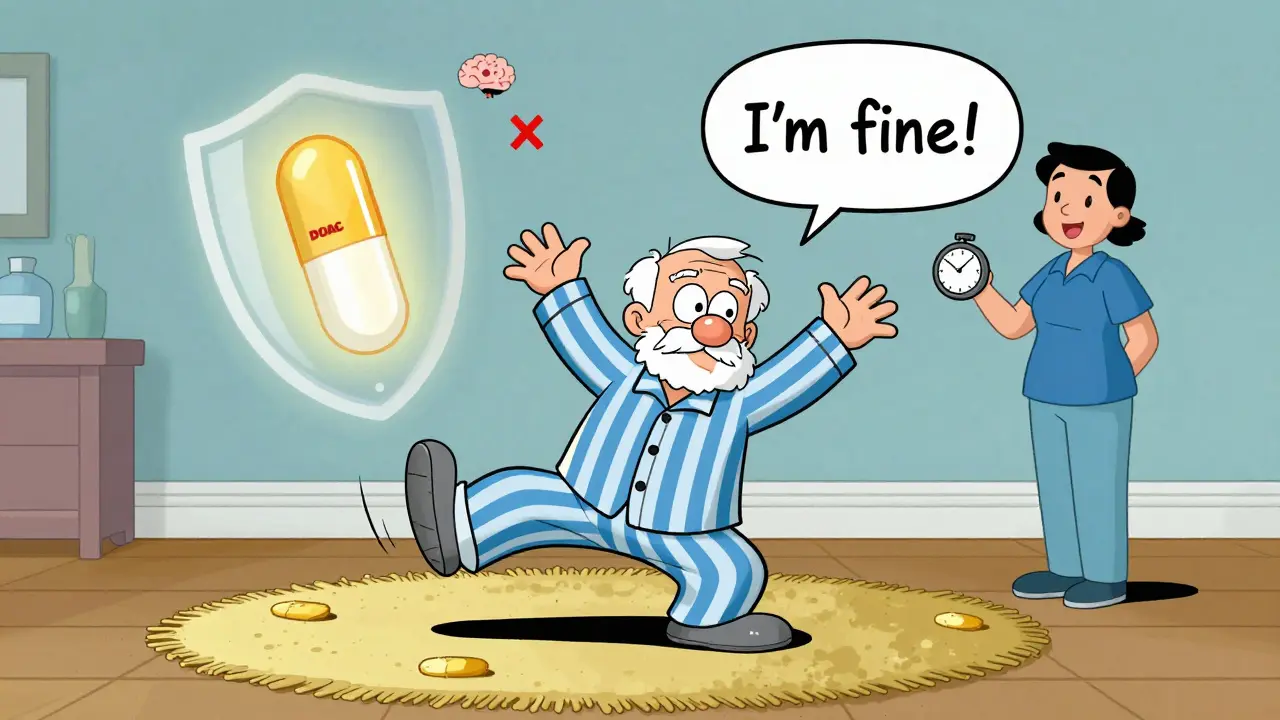
When someone is on blood thinners - like warfarin or one of the newer DOACs - and they’re also at risk of falling, doctors often face a tough question: Should we keep the medication? Many assume that if an older adult falls often, stopping anticoagulants is the safer choice. But the truth is, falling alone should never be reason enough to stop blood thinners. The real danger isn’t the fall - it’s the stroke you could prevent by staying on the right treatment.
Why Fall Risk Doesn’t Mean Stop Anticoagulation
It’s easy to see why this confusion exists. Older adults fall. A lot. About 30% to 40% of people over 65 fall at least once a year. In nursing homes, that number jumps to over 50%. When someone on a blood thinner takes a tumble, the fear of a brain bleed is real. But here’s what the data says: the chance of a serious brain bleed from a fall while on anticoagulants is very low - just 0.2% to 0.5% per year. Meanwhile, if you have atrial fibrillation with a CHA₂DS₂-VASc score of 2 or higher (which most older adults do), your risk of stroke without anticoagulation is 1.5% to 3% per year. That’s three to fifteen times higher than the risk of a bleed from falling.Let that sink in: you’d need to fall nearly 300 times in one year for the bleeding risk to outweigh the stroke prevention benefit of warfarin. That’s not just unlikely - it’s practically impossible. And with newer drugs like apixaban or rivaroxaban, that risk drops even further. DOACs cut the chance of brain bleeds by 30% to 50% compared to warfarin. So if you’re worried about falls, switching to a DOAC might be smarter than stopping the drug entirely.
What Actually Matters: Stroke Risk, Not Just Falls
Doctors don’t decide whether to start anticoagulants based on how many times someone has fallen. They use two tools: the CHA₂DS₂-VASc score and the HAS-BLED score. The first tells you how likely someone is to have a stroke. The second tells you how likely they are to bleed. But here’s the key: a high HAS-BLED score doesn’t mean avoid anticoagulation. It means you need to manage the risks - not abandon the treatment.For men, a CHA₂DS₂-VASc score of 2 or more means anticoagulation is recommended. For women, it’s 3 or more. That’s because even if someone has high blood pressure, diabetes, or a past stroke, their stroke risk goes up - and so does the benefit of taking a blood thinner. The American College of Physicians, the American Heart Association, and the European Society of Geriatric Medicine all agree: do not withhold anticoagulation just because someone falls. This isn’t just opinion - it’s a formal recommendation backed by clinical trials and real-world data.
DOACs Are the New Standard - Especially for Fall Risks
If you’re starting anticoagulation today, especially if you’re older or have a history of falling, you should be on a DOAC unless you have a mechanical heart valve or severe kidney disease. DOACs - apixaban, rivaroxaban, dabigatran, and edoxaban - are easier to use than warfarin. No weekly blood tests. Fewer food interactions. And most importantly, they’re safer for people who fall.Warfarin has been around for decades, but it’s messy. It needs constant monitoring. Its effects can swing wildly if you eat more greens, drink alcohol, or start a new antibiotic. DOACs? They’re steady. They don’t need INR checks. And because they’re less likely to cause brain bleeds, they’re the top choice for older adults. In fact, about 80% of new anticoagulant prescriptions in the U.S. now go to DOACs. That’s not because they’re trendy - it’s because they work better for the people who need them most.
What to Do Instead of Stopping Medication
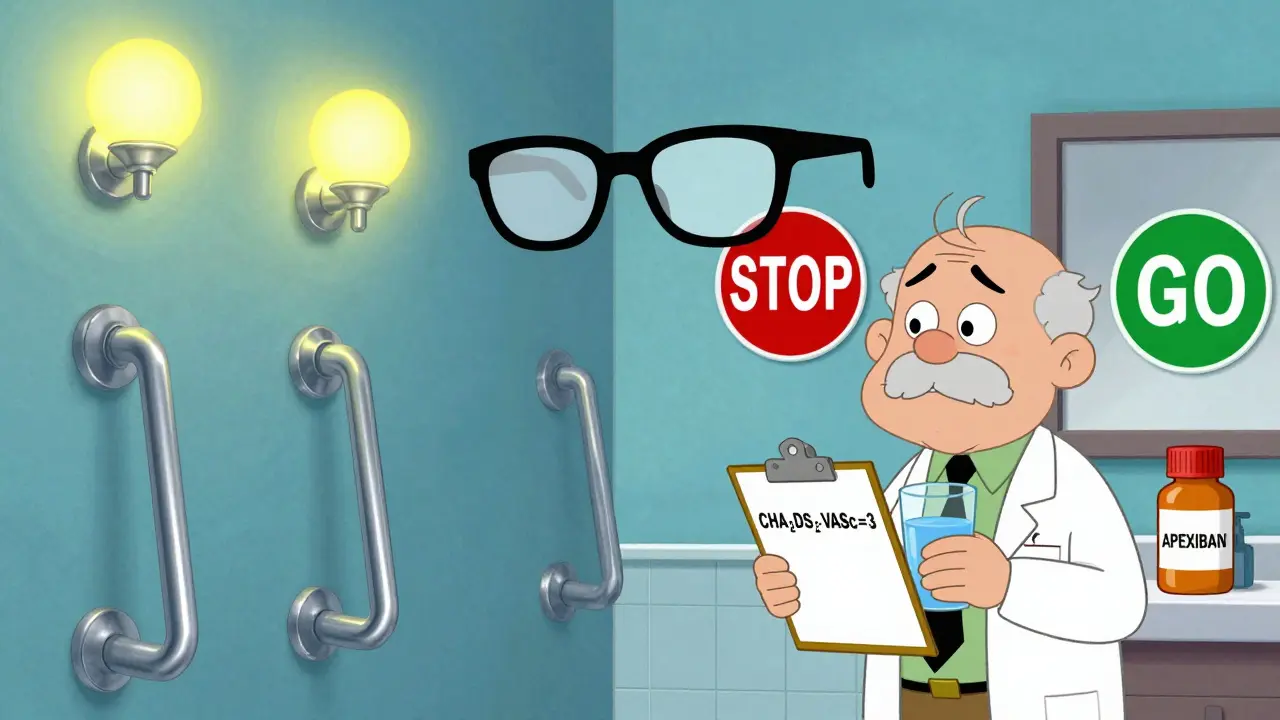
So if you’re on anticoagulants and you’re worried about falls - or your doctor is - what should you do? Don’t stop the pill. Fix the fall risk. This isn’t a one-time conversation. It’s a plan. A real, step-by-step plan.- Review all medications. Sedatives, sleep aids, blood pressure pills, and even some antidepressants can make you dizzy or unsteady. A pharmacist or geriatrician can help you cut what you don’t need.
- Test your balance. The Timed Up and Go test takes less than a minute. You sit in a chair, stand up, walk 3 meters, turn, walk back, and sit down. If it takes more than 12 seconds, you’re at higher risk of falling. Physical therapy can help.
- Check your vision. Cataracts, glaucoma, or outdated glasses can make you trip over a rug. Get your eyes checked yearly - more often if you’re having trouble.
- Make your home safer. Remove loose rugs. Install grab bars in the bathroom. Add nightlights. Keep cords out of walking paths. These cost little but prevent big falls.
- Treat low blood pressure on standing. If you get dizzy when you stand up, you’re at risk. Simple changes - like drinking more water, avoiding hot showers, or adjusting meds - can fix this.
These aren’t suggestions. They’re proven strategies. The American Medical Directors Association recommends a four-phase approach: recognize the risk, assess it fully, treat the causes, and monitor progress. That process takes 30 to 60 minutes the first time - but it can prevent dozens of falls over the next year.
What Not to Do: Don’t Lower the Dose
Some doctors, trying to be extra careful, will reduce the dose of a DOAC in older adults or those who fall often. They think less drug = less bleeding. But that’s a myth. Studies show that underdosing DOACs doesn’t lower bleeding risk - it just makes them less effective at preventing strokes. You’re trading safety for danger. The European Geriatric Medicine review says this clearly: off-label dose reduction is not recommended. Stick to the approved dose. If you’re worried, talk about switching to a safer drug - not lowering the dose.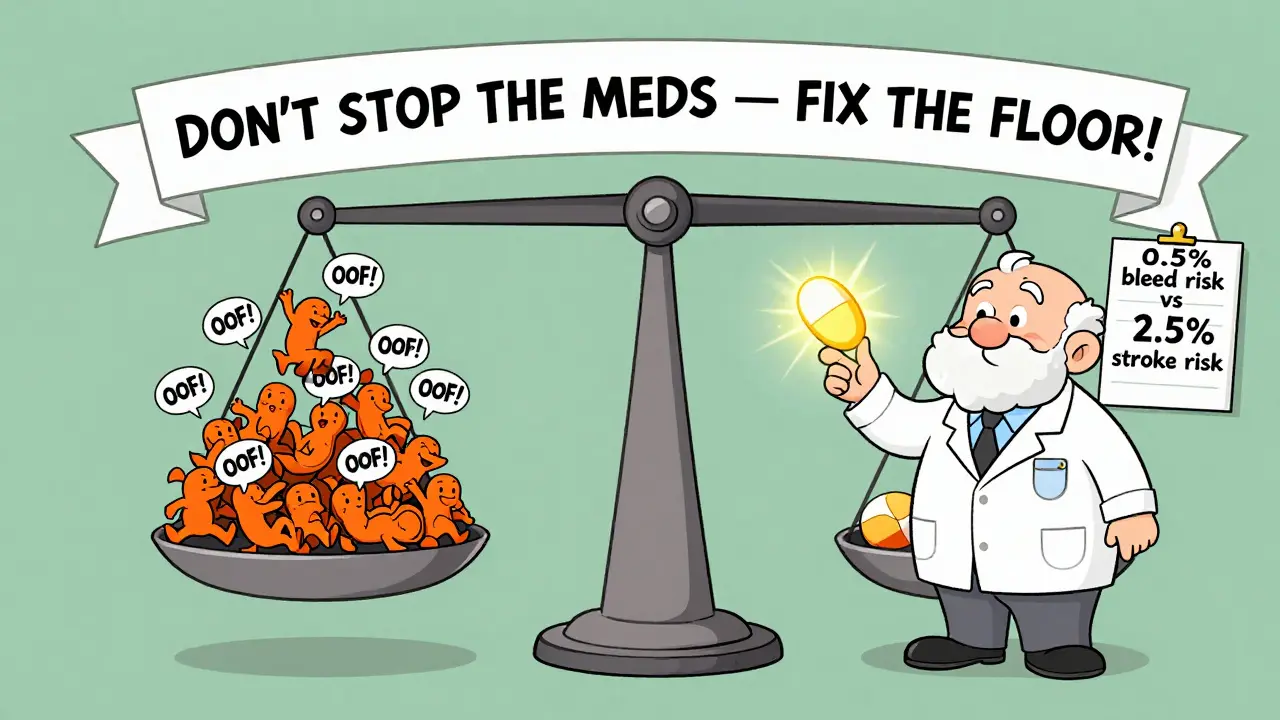
When Anticoagulation Might Not Be Right
There are exceptions. Anticoagulation should be stopped if someone has active bleeding, a bleeding disorder, or uncontrolled high blood pressure (systolic over 180 mmHg). But for most older adults, even those who’ve fallen before, the benefits still win.One gray area is for people who are very frail, with life expectancy under a year. If someone is near the end of life and their stroke risk is low, the benefit of anticoagulation fades. But this isn’t about falls - it’s about overall prognosis. A 90-year-old with no history of stroke, good mobility, and strong family support? Still a candidate for DOACs. A 90-year-old with dementia, weight loss, and multiple hospitalizations? Then it’s time to have a different conversation - about goals, not just scores.
Why This Matters: Real Consequences
Underusing anticoagulants because of fall fears isn’t just outdated - it’s dangerous. Studies show that 20% to 30% of older adults with atrial fibrillation who should be on blood thinners aren’t getting them - mostly because doctors are afraid of falls. That’s leaving people vulnerable to strokes that could have been prevented. In fact, Medicare now penalizes hospitals for under-prescribing anticoagulants in eligible patients. This isn’t just about medical guidelines - it’s about accountability.And the cost? Not just strokes. It’s death. One study found that among patients who bled while on anticoagulants, there were 146 excess deaths per 1,000 compared to those who didn’t take anticoagulants. But here’s the twist: those same patients had a 60% to 70% lower risk of stroke. So the real problem isn’t the bleeding - it’s the stroke you didn’t prevent.
Final Takeaway: Keep the Medication. Change the Environment
If you’re on anticoagulants and you’re worried about falling - or if you’re a caregiver or clinician trying to decide - remember this: fall risk is not a reason to stop blood thinners. It’s a reason to act. Act on the environment. Act on medications. Act on balance. Act on vision. But don’t act by stopping the drug.The goal isn’t to avoid all falls - it’s to prevent strokes. And for most older adults, staying on a DOAC while fixing the fall risks around them is the safest, smartest path forward. Don’t let fear of a fall keep you from the protection you need.
Comments (13)
Lebogang kekana
2 Mar, 2026This is exactly why we need to stop treating older people like fragile glass. You don’t stop their heart meds because they trip over the cat. You fix the damn cat’s toys and install grab bars. I’ve seen too many patients get dropped off anticoagulants just because someone got scared. The stroke doesn’t care if you fell yesterday. It just shows up. And then you’re gone.
DOACs are the answer. Period. Stop overthinking it.
Jessica Chaloux
2 Mar, 2026OMG YES. I’ve been saying this for YEARS. 😭 My grandma was taken off her rivaroxaban because she ‘fell once’ in the bathroom. She had a stroke 3 months later. They said ‘it was just a fall’ like that’s some kind of excuse. It’s not. It’s a sign we need to do better. 🙏
Mariah Carle
4 Mar, 2026There’s a deeper philosophical layer here. We fear the fall because it’s visible - a body on the floor, blood on the tile. But the stroke? It’s silent. Invisible. A slow erasure. We’re wired to fear what we can see. But medicine must transcend instinct. The real tragedy isn’t the fall - it’s the quiet, unspoken death we choose to avoid by doing nothing. We’re not afraid of stroke. We’re afraid of responsibility.
Justin Rodriguez
5 Mar, 2026I’m a geriatric nurse. This post nails it. We see this every day. The real problem? Time. No one has 45 minutes to sit down with a 92-year-old and go through their meds, vision, and bathroom layout. But if you skip it? You’re gambling with their life. The fix isn’t harder - it’s just not prioritized. Start with the Timed Up and Go. It takes 60 seconds. Do it. Then do the rest.
Raman Kapri
6 Mar, 2026I must object. The data you cite is cherry-picked. Studies from 2018-2021 show that in frail elderly populations, even DOACs carry elevated intracranial hemorrhage risk. The CHA2DS2-VASc score is not a license to prescribe. Many patients have multiple comorbidities that alter risk profiles. You’re oversimplifying a complex clinical decision into a binary choice. That’s dangerous.
Megan Nayak
6 Mar, 2026Oh please. Let’s be real. This is just another medical industry propaganda piece. DOACs make billions. Hospitals get paid more for prescribing them. Insurance companies love them because they’re ‘predictable.’ Meanwhile, families are left holding the bag when Grandpa bleeds out on the bathroom floor. The ‘evidence’ is written by people who own stock in Bristol-Myers Squibb. You think this is about patient safety? It’s about profit. Always.
Tildi Fletes
7 Mar, 2026The clinical guidelines referenced in this post are accurate and evidence-based. The American College of Physicians, American Heart Association, and European Society of Geriatric Medicine have all issued formal position statements supporting anticoagulation in the presence of fall risk, provided that modifiable fall risk factors are addressed. Off-label dose reduction of DOACs is associated with increased thromboembolic events and is not supported by any major clinical trial. Adherence to labeled dosing regimens remains the standard of care.
Betsy Silverman
8 Mar, 2026I love how this post doesn’t just say ‘don’t stop the meds’ - it gives you the steps. That’s rare. Most articles just scare you. This one says: here’s what you can actually do. My mom’s been on apixaban for 3 years. We did the home safety checklist. Installed a shower chair. Got her glasses updated. She walks like a queen now. No falls in 2 years. It’s not magic. It’s just action.
Zacharia Reda
9 Mar, 2026So let me get this straight - you’re telling me that if my 88-year-old aunt falls 17 times this year, we should just double down on the rivaroxaban? And not even think about reducing the dose? What if she’s also on 6 other meds? What if she lives alone? What if her ‘home safety’ is a pile of laundry and a broken step? This isn’t a flowchart. It’s real life. And real life doesn’t follow guidelines.
Jeff Card
11 Mar, 2026I’ve been on warfarin for 8 years. My INR used to swing like a pendulum. Then I switched to apixaban. No more finger pricks. No more broccoli guilt. I fell last winter - cracked my hip. Didn’t bleed. Didn’t need a transfusion. Just a surgery and a walker. My doctor said: ‘You’re lucky you didn’t stop the pill.’ I didn’t. I fixed the floor. That’s all.
Deborah Dennis
12 Mar, 2026So... you're saying that if someone falls, you just... keep giving them blood thinners? And then you blame the environment? What about the fact that the body ages? The vessels weaken? The brain gets more vulnerable? You're ignoring biology for convenience. This isn't prevention - it's denial dressed up as science.
Diane Croft
14 Mar, 2026This is hope in action. Every single point here is a lifeline. Fix the environment. Don’t stop the medicine. DOACs save lives. And you? You can help. Start today. One grab bar. One eye exam. One conversation. That’s how you win.
Donna Zurick
16 Mar, 2026I’m a nurse and this is spot on. My mom was taken off her DOAC because she fell. She had a stroke. I’m still mad. Don’t stop the pill. Fix the floor. Simple.