
When you pick up a prescription for a common medication like atorvastatin or amoxicillin, the price tag is often just a fraction of what it would be if you bought the brand-name version. You might assume this savings comes simply from cheaper ingredients or less marketing. The reality is far more complex. The generic drug supply chain is a high-stakes, global network that moves raw materials across continents, navigates strict regulatory hurdles, and balances razor-thin margins to get life-saving medicines into your local pharmacy.
This system isn't just about moving boxes; it's about managing risk, quality, and economics in an environment where transparency is low and pressure is high. Understanding how these medicines reach your counter helps explain why shortages happen, why prices fluctuate, and who actually benefits from the low cost of generics.
The Global Journey of Raw Materials
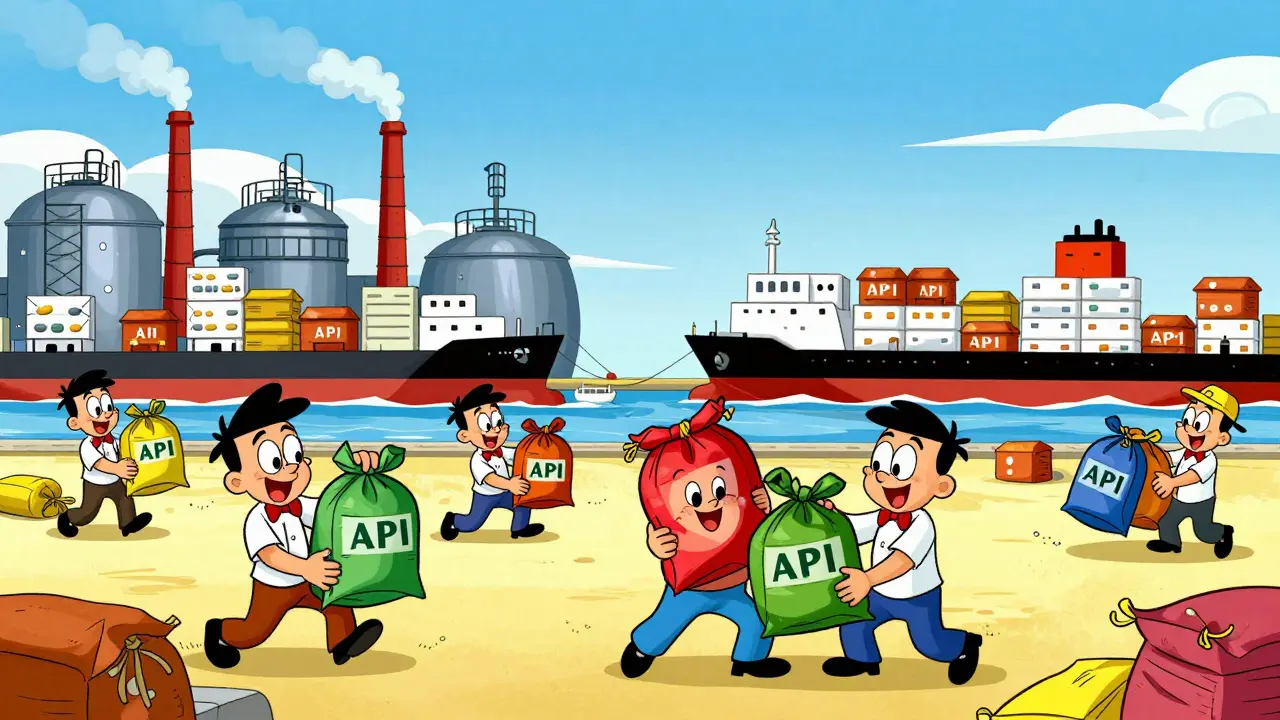
Every pill starts with chemistry, specifically with something called Active Pharmaceutical Ingredients (APIs). These are the biologically active components that produce the intended effect within the body. For generic drugs, the story begins long before a tablet is pressed. In fact, the vast majority of these critical starting materials do not come from the United States.
According to research published in PubMed Central (PMC) in 2021, approximately 88 percent of API manufacturing occurs outside the U.S., primarily in countries like China and India. Only about 12 percent of this production happens domestically. This globalization was driven by lower labor costs and established chemical infrastructure abroad, but it introduces significant vulnerabilities. When geopolitical tensions rise, natural disasters strike, or pandemics disrupt logistics, the entire U.S. supply can feel the pinch.
Once the APIs are produced, they must meet rigorous standards. They aren't just shipped as-is. Manufacturers perform extensive testing to ensure purity and potency. However, monitoring overseas facilities remains a challenge for regulators. Dr. David Ridley, a former FDA official and professor at Duke University, has noted that the distance between regulators and production sites creates 'significant quality control challenges.' The FDA has responded by increasing inspections of foreign facilities, jumping from 248 in 2010 to 641 in 2022, according to their 2023 annual report. Despite this increase, the sheer volume of imports means oversight is always playing catch-up.
From Lab to Pill: Manufacturing and Approval
After the APIs arrive in the U.S. or other manufacturing hubs, they undergo formulation. This is where the active ingredient is mixed with inactive ingredients-like binders, fillers, and coatings-to create the final dosage form, whether it’s a tablet, capsule, or liquid.
Before any of this product can be sold, the manufacturer must prove to the Food and Drug Administration (FDA) that their generic version is therapeutically equivalent to the original brand-name drug. This process relies on the Abbreviated New Drug Application (ANDA) framework, established by the Hatch-Waxman Act of 1984. Unlike brand drugs, which require costly clinical trials to prove safety and efficacy, generics only need to demonstrate bioequivalence-that the drug enters the bloodstream at the same rate and extent as the brand.
Manufacturing itself is governed by Good Manufacturing Practices (GMP). These are not optional guidelines; they are legal requirements enforced by the FDA. GMP ensures that products are consistently produced and controlled according to quality standards. This involves multiple stages of quality control testing during production. As highlighted in Drug Patent Watch's 2023 best practices report, adherence to GMP is critical because any deviation can lead to recalls, shutdowns, or worse, patient harm. In an industry where profit margins are already thin, the cost of compliance is a major factor in the final price.
The Middlemen: Distributors and Wholesalers
Once the pills are manufactured and approved, they don't go straight to your pharmacist. They enter a distribution network dominated by a few large players. Wholesale distributors purchase drugs in bulk from manufacturers. This step is crucial for logistics, as it consolidates shipments from hundreds of different manufacturers into manageable loads for pharmacies.
The financial dynamics here are tricky. Manufacturers offer 'prompt payment discounts' to wholesalers, meaning if the distributor pays quickly, they get a better price. According to Avalere Health's 2023 analysis, these contracts often include provisions for bulk-purchasing discounts. However, these deals are typically negotiated case-by-case, adding a layer of opacity to the supply chain.
Wholesalers then sell these drugs to pharmacies. But they don't sell them at the price they paid. They add a markup. For generic drugs, this markup is often larger than for brand-name drugs, even though the base cost is lower. The HHS ASPE 2022 report notes that pharmacies acquire generic drugs with a 'larger distributor markup, albeit off of a typically smaller basis.' This means while the absolute dollar amount might be small, the percentage added by the middleman can eat significantly into the pharmacy's potential margin.
| Factor | Generic Drugs | Brand-Name Drugs |
|---|---|---|
| Manufacturer Revenue Share | ~36% of expenditure | ~76% of expenditure |
| Reimbursement Method | Maximum Allowable Cost (MAC) | Percentage of List Price |
| PBM Rebates | Rarely negotiated | Frequently negotiated |
| Distributor Markup | Larger percentage, smaller base | Smaller percentage, larger base |
| Market Concentration | Top 10 makers hold 65% | More fragmented by therapeutic area |
The Role of Pharmacy Benefit Managers (PBMs)
If distributors move the product, PBMs manage the money. Pharmacy Benefit Managers act as intermediaries between insurance companies, drug manufacturers, and pharmacies. They handle claims processing, develop formularies (lists of covered drugs), and negotiate rebates.
Three giants-CVS Caremark, OptumRX (UnitedHealth Group), and Express Scripts (Cigna)-control approximately 80 percent of the PBM market. This concentration gives them immense power. For brand-name drugs, PBMs negotiate hefty rebates from manufacturers in exchange for placing those drugs favorably on formularies. Generic manufacturers, however, rarely engage in these rebate negotiations. Instead, payers use a Maximum Allowable Cost (MAC) methodology for reimbursement.
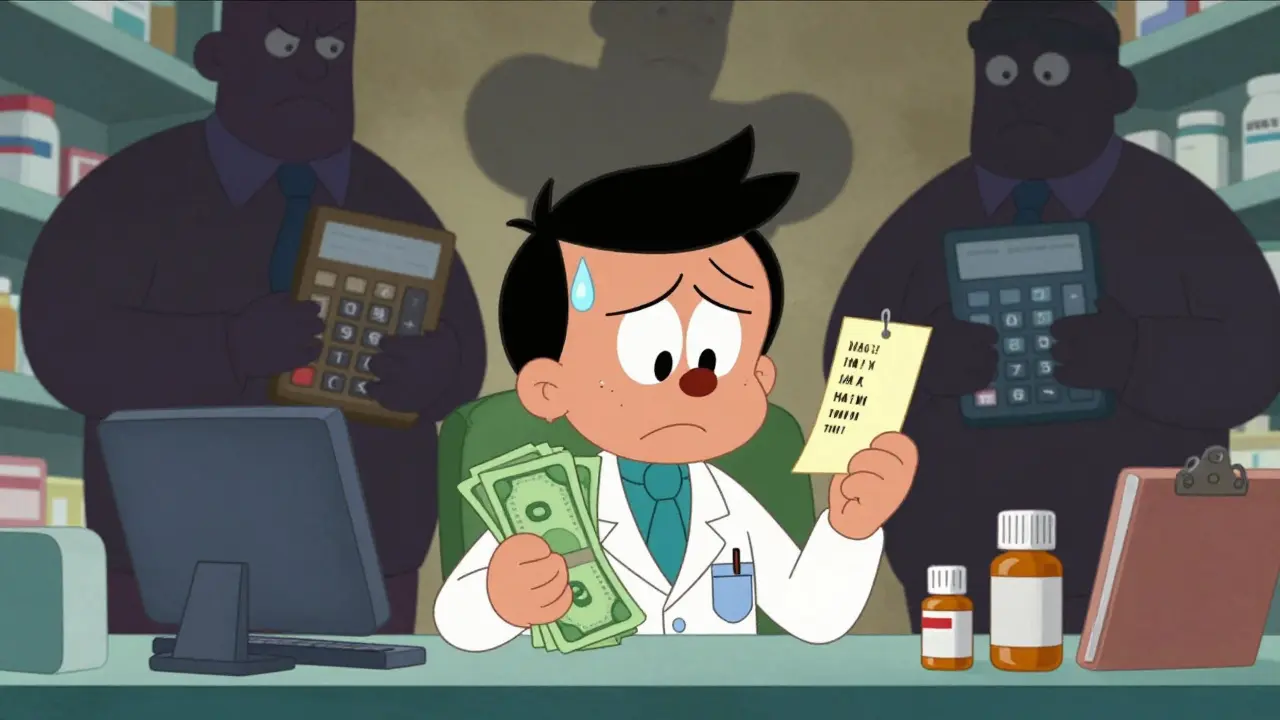
MAC sets a ceiling for what a payer will reimburse a pharmacy for a specific generic drug, regardless of which manufacturer made it. For example, the MAC might set the reimbursement for a 10 mg atorvastatin tablet at $0.50 per unit. If the pharmacy acquired that drug for $0.45, they make a profit. If they paid $0.55 due to a shortage or distributor markup, they lose money on every pill dispensed. This system shifts the pricing risk entirely onto the pharmacy, forcing them to constantly hunt for the lowest acquisition cost from wholesalers.
The Pharmacy: The Final Bottleneck
Your local pharmacy is the last stop in this chain, but it faces some of the toughest pressures. Community pharmacists must maintain ample stock to meet demand, yet they operate on incredibly thin margins for generics. A 2023 survey by the American Pharmacists Association found that 68 percent of independent pharmacy owners cited 'MAC pricing below acquisition cost' as a major financial pressure.
Large retail chains have more leverage to negotiate with both PBMs and distributors, but independents often struggle. They may try to negotiate discounts based on volume sales or market share, but without the scale of a national chain, their bargaining power is limited. Additionally, pharmacies must adhere to strict inventory management protocols. With real-world data analytics becoming more common, as noted by Purple Lab in 2023, pharmacies are using sophisticated tracking systems to pinpoint bottlenecks and respond to delays. However, when a drug shortage hits-which affected 170 generic medications during the pandemic-no amount of software can create supply out of thin air.
The pharmacy also handles the final adjudication. When you present your insurance card, the PBM processes the claim instantly, determining your copay and the pharmacy's reimbursement. This seamless experience hides the complex backend calculations involving MAC limits, contract rates, and potential shortages.
Why Shortages Happen
Despite the efficiency of this system, shortages are frequent. Why? Because the economic incentives are misaligned. Generic manufacturers capture only 36 percent of the total expenditure on generic drugs, compared to 76 percent for brand manufacturers, according to the USC Schaeffer Center. When prices drop too low, there is no financial buffer to invest in capacity expansion or backup suppliers.
The 'race to the bottom' pricing dynamic means that if one manufacturer lowers their price, others must follow to remain competitive. This erodes profits further. If a factory inspection fails, or a raw material shipment is delayed, the manufacturer may simply choose not to restart production because it isn't profitable enough to justify the risk. The PMC 2021 study warns that as the supply chain lengthens and extends outside the U.S., these vulnerabilities multiply. Geopolitical disruptions, trade tariffs, or environmental issues in key API-producing regions can ripple through the entire system, leaving patients waiting for essential medications.
Future Trends and Solutions
The industry is aware of these fragilities. Emerging technologies like AI-driven demand forecasting and blockchain for supply chain transparency are being adopted to reduce uncertainty. Blockchain, for instance, could provide an immutable record of a drug's journey from API source to pharmacy shelf, enhancing trust and speed during recalls or shortages. Diversified sourcing strategies are also gaining traction, with manufacturers seeking to reduce reliance on single geographic regions for critical APIs.
Regulatory changes, such as the Inflation Reduction Act of 2022, introduce new variables. While aimed at lowering Medicare drug costs, provisions affecting the 340B program and pricing models could indirectly impact generic reimbursement structures. The FDA's 2023 Drug Competition Action Plan aims to streamline approvals and improve communication with manufacturers to prevent shortages. However, structural reforms addressing the imbalance between manufacturer revenue and supply chain costs remain elusive. Without policy interventions that stabilize margins, the trend toward market consolidation and periodic shortages is likely to continue.
Why are generic drugs so much cheaper than brand-name drugs?
Generic drugs are cheaper primarily because manufacturers do not incur the billions of dollars spent on research, development, and clinical trials required for brand-name drugs. Instead, they only need to prove bioequivalence through the ANDA process. Additionally, intense competition among generic manufacturers drives prices down, although this also results in very thin profit margins for the companies producing them.
What is the role of a PBM in the generic drug supply chain?
Pharmacy Benefit Managers (PBMs) act as intermediaries between insurers, pharmacies, and manufacturers. They process insurance claims, determine which drugs are covered (formularies), and set reimbursement rates. For generics, PBMs often use Maximum Allowable Cost (MAC) pricing, which sets a cap on what pharmacies are reimbursed, shifting pricing risks to the pharmacy level.
Where do most Active Pharmaceutical Ingredients (APIs) come from?
Approximately 88 percent of API manufacturing occurs outside the United States, with China and India being the primary sources. This globalization reduces production costs but introduces supply chain vulnerabilities related to geopolitics, transportation, and regulatory oversight.
Why do generic drug shortages occur frequently?
Shortages often result from thin profit margins, which leave manufacturers with little financial buffer to handle disruptions. Issues like raw material delays, failed facility inspections, or increased demand can make it unprofitable for manufacturers to maintain or restart production. The lack of redundancy in the supply chain exacerbates these issues.
How does MAC pricing affect pharmacies?
MAC pricing sets a fixed reimbursement ceiling for generic drugs. If a pharmacy's acquisition cost for a drug exceeds this MAC limit, the pharmacy loses money on every prescription filled. This forces pharmacies to constantly negotiate lower prices with wholesalers and can lead to financial strain, especially for independent pharmacies.