
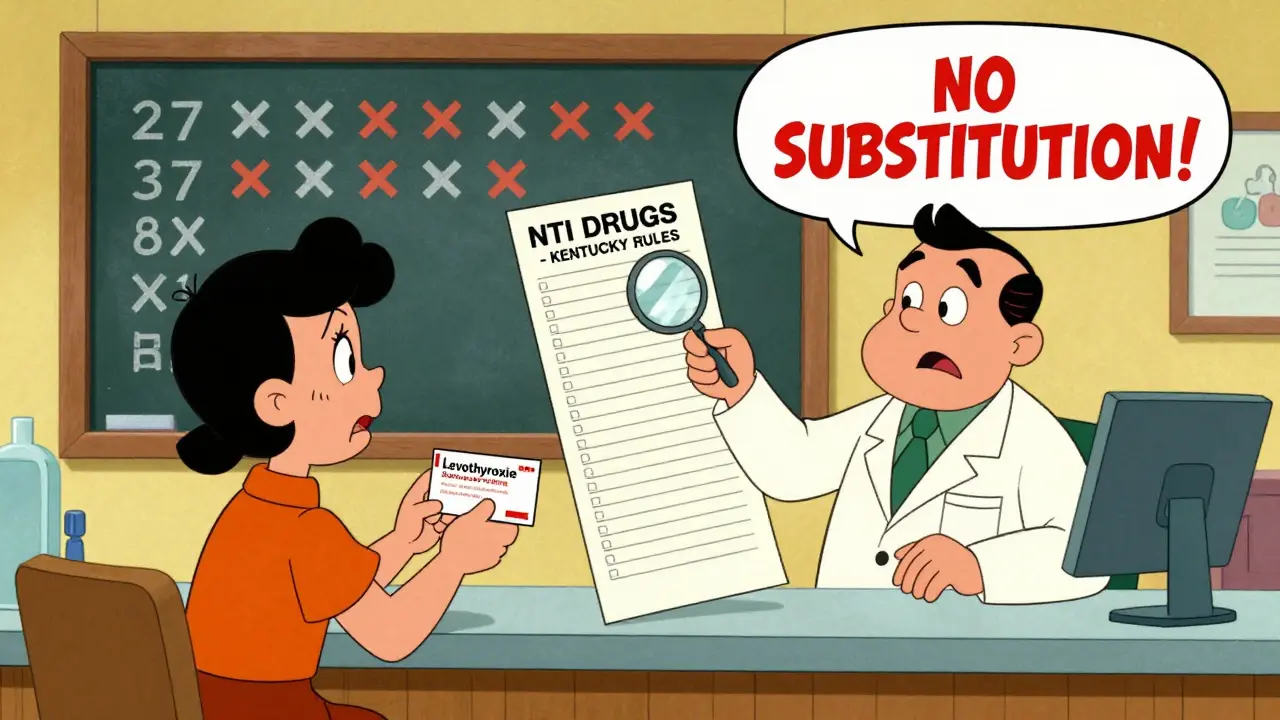
When you pick up a prescription for a drug like warfarin, levothyroxine, or phenytoin, you might assume the pharmacy can swap the brand name for a cheaper generic version. But in 27 states, that’s not allowed - not without extra steps. These states have special rules for drugs with a narrow therapeutic index (NTI), where even tiny differences in dosage can lead to serious side effects or treatment failure. While the FDA says approved generics are just as safe and effective as brand-name drugs, state laws tell a different story. And if you’re a patient, pharmacist, or prescriber, you need to know which rules apply where.
What exactly is an NTI drug?
NTI stands for narrow therapeutic index. These are drugs where the difference between a safe, effective dose and a toxic one is very small. Think of it like walking a tightrope - a slight slip can mean disaster. Common examples include:
- Warfarin (blood thinner)
- Levothyroxine (thyroid hormone)
- Lithium (for bipolar disorder)
- Phenytoin and carbamazepine (anti-seizure meds)
- Digoxin (heart medication)
The FDA doesn’t officially label drugs as NTI in its Orange Book, which lists approved generics. But state pharmacy boards took notice when reports started coming in about patients having seizures, clots, or thyroid crashes after switching to a generic. Even if the difference in blood levels is just 5%, for these drugs, that’s enough to matter.
How states handle NTI substitution
There’s no national standard. Instead, you’ve got a patchwork of 27 state laws that fall into three main categories:
- Carve-outs - The drug is automatically excluded from substitution. No swap allowed unless the prescriber writes "Do Not Substitute" on the script.
- Dual consent - Both the doctor and patient must give written permission before a generic can be used.
- Notification-only - The pharmacist can substitute, but must notify the prescriber and patient in writing within 72 hours.
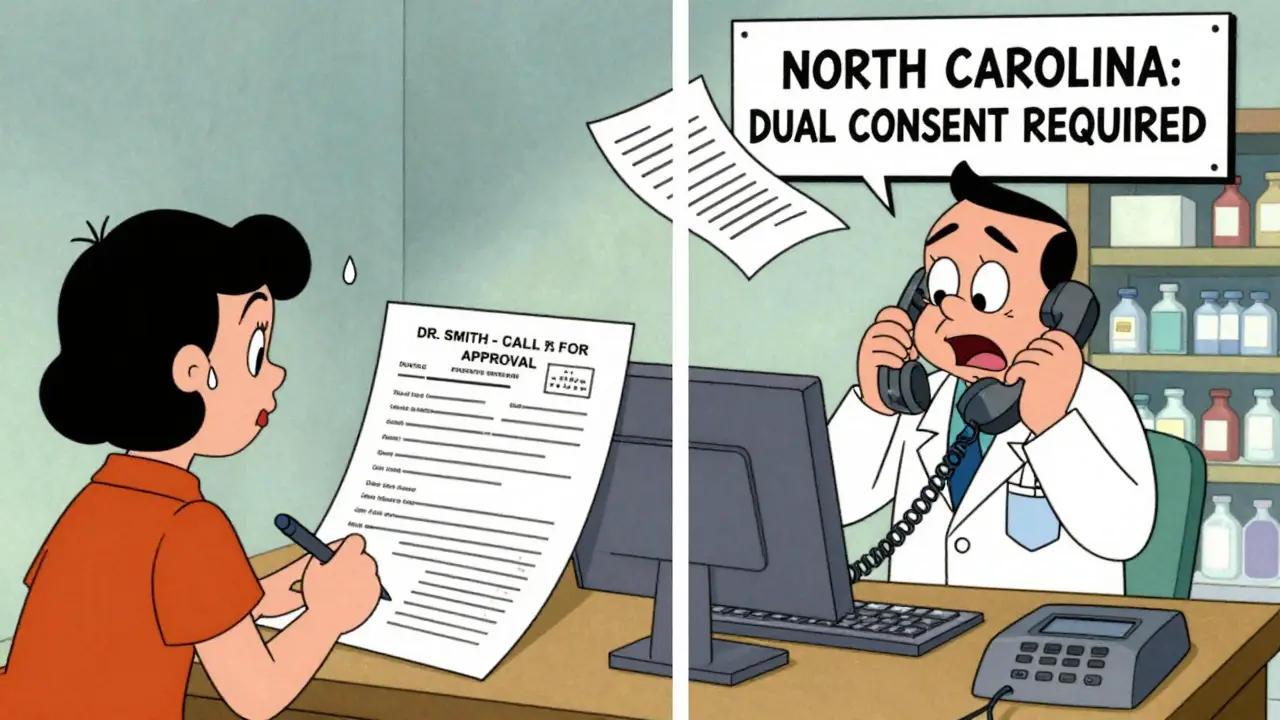
States like Kentucky, North Carolina, and Connecticut are the strictest. Kentucky bans substitution for 27 specific NTI drugs, including all strengths of levothyroxine and digoxin. North Carolina requires both the doctor and patient to sign a consent form before any generic swap. Connecticut adds a twist: if you’re on an anti-seizure drug, the pharmacist must notify both parties - and if either objects within 14 days, the swap is canceled.
On the other end, states like California, Texas, and Virginia follow the FDA’s lead. They treat NTI drugs like any other - if the generic is rated therapeutically equivalent, it can be swapped without extra steps.
Why the patchwork exists
The conflict started after the 1984 Hatch-Waxman Act made it easier to approve generic drugs. The FDA assumed bioequivalence - meaning the generic delivers the same amount of active ingredient into the bloodstream - was enough. But clinicians noticed something: patients on warfarin who switched generics sometimes had dangerous spikes in their INR levels. Same with thyroid patients who went from brand to generic and suddenly felt exhausted, anxious, or gained weight.
States responded. Kentucky’s Board of Pharmacy compiled its list in 1995 after reviewing 120 patient reports of adverse events tied to generic substitution. Connecticut’s law followed a 2016 study showing a 19.2% drop in seizure-related ER visits after requiring consent for anti-epileptic drug swaps.
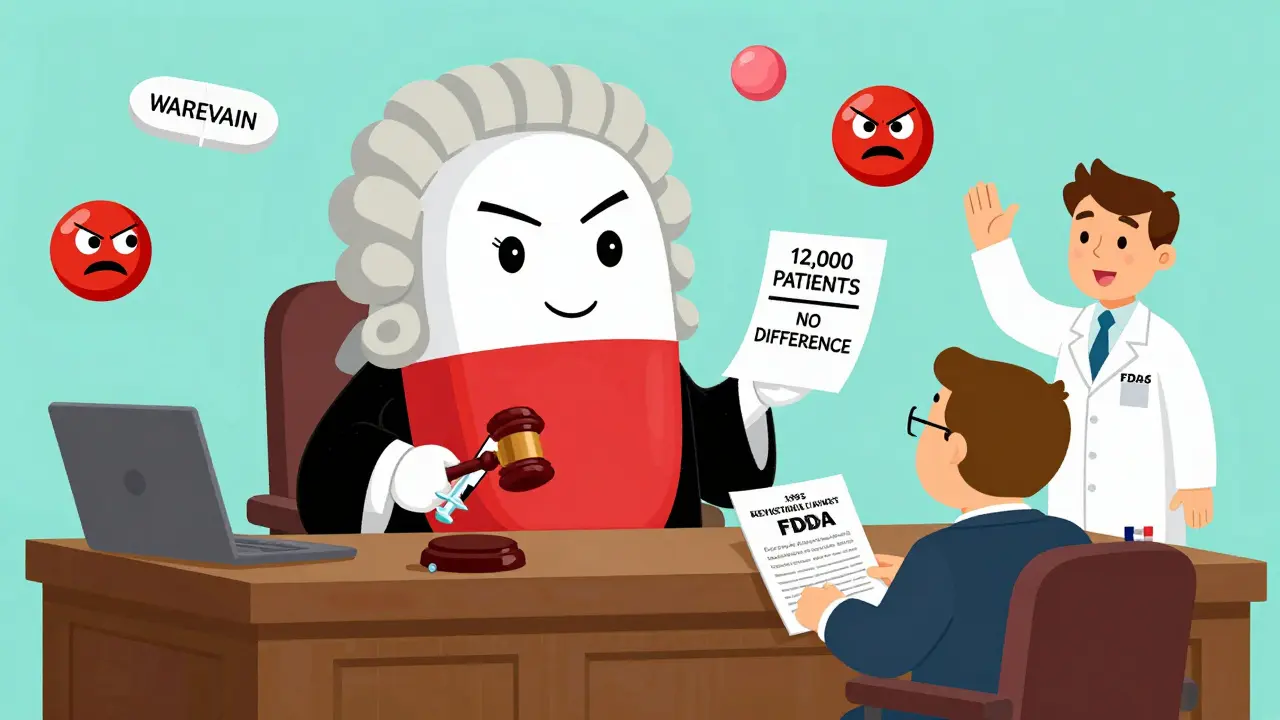
Meanwhile, the FDA stands by its position. In a 2022 statement, officials said: "All approved generics, including for NTI drugs, meet the same rigorous standards." A 2020 study in Circulation: Cardiovascular Quality and Outcomes found no meaningful difference in INR stability between brand and generic warfarin in over 12,000 Medicare patients. But that didn’t stop states from acting.
Real-world impact on pharmacies
For pharmacists, the rules mean extra work. In states with carve-outs, the median time to check if a drug is on the NTI list is 3.2 minutes per prescription. In states without restrictions? Just 0.8 minutes. That’s a 4x difference.
Pharmacists in Kentucky say they manually check each script against a 27-drug list. One told a forum: "It adds 5 to 7 minutes per prescription. We’re falling behind." Chain pharmacies use software that auto-blocks substitutions based on state rules - 82% of them do. But small independent pharmacies? Many still use paper lists or call prescribers.
And it’s expensive. Pharmacists in restrictive states spend an average of 8.7 extra hours per month just on compliance. That’s time not spent counseling patients or managing inventory.
Who’s winning? Who’s losing?
The numbers tell a story. States with strict NTI rules have 12.4% lower generic usage for these drugs. That means patients pay more - often hundreds of dollars extra per year. A 2021 RAND analysis found that in Kentucky, the average monthly cost for levothyroxine was $48 with no substitution allowed. In Virginia, where substitution is routine, it was $11.
But patient safety isn’t just about cost. The Epilepsy Foundation supports Connecticut’s rules. The American Heart Association, however, opposes restrictions on warfarin, pointing to the 12,000-patient study showing no difference in outcomes.
And here’s the irony: a 2021 study in Pharmacotherapy found that only 12 of the 47 drugs on state NTI lists actually have strong clinical evidence of a narrow therapeutic index. That means some states are blocking substitutions for drugs where the risk is unproven - like certain formulations of insulin or statins - simply because they’ve always been on the list.
What’s changing in 2026?
The FDA released draft guidance in 2023 suggesting a new way to define NTI drugs: if the ratio of toxic dose to effective dose is 2.0 or less, it qualifies. Nine states - including New York and Ohio - are now reviewing their lists using this standard. California passed a law in 2022 requiring all NTI designations to be based on systematic reviews, not tradition.
Meanwhile, the Association for Accessible Medicines sued Kentucky in 2023, arguing its list violates the Dormant Commerce Clause by creating barriers for generic manufacturers. A ruling is expected in late 2026.
The National Association of Boards of Pharmacy is working on a model framework to bring some consistency. But don’t expect uniformity soon. States see this as a public health issue - not a drug pricing one.
What you should do
If you’re a patient on an NTI drug:
- Ask your pharmacist: "Is this drug on my state’s substitution restriction list?"
- If you switch from brand to generic, monitor for changes in how you feel - fatigue, dizziness, mood swings, or unusual bleeding.
- Keep your INR or thyroid levels checked more frequently after a switch.
If you’re a prescriber:
- Know your state’s rules. Some require you to sign a consent form. Others just need "Do Not Substitute" written on the script.
- Don’t assume your electronic prescribing system auto-blocks NTI drugs - check its settings.
If you’re a pharmacist:
- Use software with updated state-specific NTI lists. If you don’t have it, keep a printed copy of your state’s current list.
- Document every NTI substitution - even if it’s just notification. You need proof you followed the law.
Which states have the strictest NTI substitution rules?
Kentucky, North Carolina, and Connecticut have the strictest rules. Kentucky bans substitution for 27 specific NTI drugs without prescriber authorization. North Carolina requires written consent from both the prescriber and patient. Connecticut mandates written notification and allows either party to block substitution within 14 days - especially for anti-epileptic drugs.
Can I get a generic version of levothyroxine in any state?
In 27 states, levothyroxine is on the NTI substitution restriction list, so it can’t be swapped without special approval. In states like California, Texas, and Virginia, substitution is allowed if the generic is rated therapeutically equivalent. Always check your state’s pharmacy board website for the current list.
Why does the FDA say NTI drugs don’t need special rules?
The FDA says all approved generics - including those for NTI drugs - must meet the same bioequivalence standards as brand-name drugs. They argue that differences in blood levels are within acceptable limits and that clinical studies haven’t proven harm from substitution. However, state boards point to real-world patient reports and argue that small differences can still matter for drugs with steep dose-response curves.
Do NTI substitution laws increase drug costs?
Yes. States with strict substitution rules have 12.4% lower generic use for NTI drugs. For example, levothyroxine costs about $48 per month in Kentucky (no substitution) versus $11 in Virginia (substitution allowed). Patients in restrictive states pay more out-of-pocket, and insurers often see higher overall spending.
Is there evidence that NTI substitution rules prevent adverse events?
Some studies suggest yes. A 2021 study in the Journal of the American Pharmacists Association found states with carve-out provisions had 28.7% fewer NTI-related adverse event reports. But correlation isn’t causation. Other factors like better monitoring or lower patient turnover could explain the drop. The FDA and generic drug industry argue that the evidence isn’t strong enough to justify the cost and complexity.
Comments (12)
Michael FItzpatrick
23 Feb, 2026Man, I’ve seen this play out in my clinic-patients on levothyroxine switching generics and showing up with heart palpitations and weight gain like it’s some kind of horror movie. Not every generic is the same, even if the FDA says they are. It’s like saying all BMWs are the same because they’re all cars. Nah. The devil’s in the fillers, the coating, the dissolution rate. Pharmacists in my state have to call the prescriber for every single NTI script. It’s a pain, sure, but I’d rather lose 10 minutes a day than lose a patient to a thyroid crash.
Brandice Valentino
24 Feb, 2026so like… i was reading this and i just… like… *sigh* i mean, the FDA is just sooo corporate and i feel like they’re just trying to save money and not think about real people? like, my aunt had a seizure after switching to a generic phenytoin and now she’s on a 12-hour watchlist. it’s not just about numbers, it’s about LIVES. also, i spelled ‘phenytoin’ wrong the first time lol oops
Larry Zerpa
25 Feb, 2026Let’s be brutally honest: this entire NTI debate is a regulatory theater piece. The FDA’s 12,000-patient study on warfarin showed zero clinical difference. The ‘adverse events’ cited by states? Anecdotal, poorly controlled, often conflated with non-compliance, diet changes, or alcohol use. And yet, we’ve got states like Kentucky clinging to a 1995 list like it’s sacred scripture. Meanwhile, the cost burden on patients is grotesque. $48 vs $11 for levothyroxine? That’s not healthcare policy-that’s price gouging disguised as safety. Also, 12 out of 47 drugs on state lists lack evidence? That’s not precautionary-it’s bureaucratic inertia. The FDA is right. The states are clinging to fear.
Maranda Najar
26 Feb, 2026My heart aches for the patients caught in this bureaucratic quagmire. Imagine being told you can’t switch to a cheaper version of your life-sustaining medication because of a paper list written decades ago by people who never met you. You’re not a statistic-you’re someone who wakes up every morning wondering if today will be the day your body betrays you. The cost differential isn’t just financial-it’s emotional, psychological, existential. And yet, we call this ‘patient safety’? No. This is institutionalized cruelty wrapped in the language of care.
Matthew Brooker
27 Feb, 2026Real talk-pharmacists are the unsung heroes here. They’re the ones reading the fine print, calling doctors, double-checking lists, and still smiling when you walk in. We need to support them, not bury them under 5-minute checks per script. Also, if you’re on an NTI drug, don’t just accept the swap-ask for the lot number and keep it. If something goes sideways, that paper trail could save your life. And hey, if your state lets you swap? Celebrate it. Savings are real, and so is safety when done right.
Anil bhardwaj
1 Mar, 2026hmm interesting. in india we dont really have this problem. generics are the norm, even for critical meds. maybe because we dont have big pharma pushing brands here. also, patients are used to switching. i think the u.s. system is just too fragmented. but yeah, if it works, dont fix it. unless it costs too much.
lela izzani
2 Mar, 2026As a pharmacist in a state with dual consent rules, I can confirm: the paperwork is relentless. But I also see patients who panic when their medication changes-even if it’s bioequivalent. The psychological comfort of staying on the same brand is real. That’s why I always take 10 extra minutes to explain the switch, show them the FDA’s bioequivalence data, and ask how they’re feeling. Sometimes safety isn’t just chemical-it’s emotional. And yes, I’ve had patients cry because they were scared. That’s why I do this job.
Joanna Reyes
4 Mar, 2026I’ve spent the last three months researching this for a policy paper, and the data is more nuanced than either side admits. Yes, there are documented cases of adverse events tied to NTI substitutions-especially in elderly patients on multiple meds. But those cases are rare, and many occur in settings with poor monitoring. The real issue is access to follow-up care. In states with strict rules, patients are less likely to get their INR or TSH checked regularly because the drug is too expensive. So the safety benefit is undermined by the financial barrier. It’s not an either/or-it’s a systems problem. We need better monitoring infrastructure, not more legal barriers. And we need to stop treating pharmacists like gatekeepers and start treating them as clinical partners.
Nerina Devi
4 Mar, 2026As someone from India who now works in a U.S. pharmacy, I’ve seen both sides. In India, generics are trusted because they’re the only option-and the system is built around them. Here, the fear of generics comes from marketing, not science. I’ve had patients refuse generics because they think brand = better. I explain: it’s like buying the same coffee from Starbucks vs. a local shop. Same beans, same roast, different label. But it takes time. Patience and education, not legislation, will change minds.
Dinesh Dawn
4 Mar, 2026cool post. i think the real problem is not the drugs but how we talk about them. if we say ‘this generic might be dangerous’ instead of ‘this drug needs careful monitoring’ we create fear. pharmacists should be trained to have calm conversations, not just follow rules. also, why not just make all NTI drugs available as generics with a warning label? simple. no forms. no calls. just info.
Vanessa Drummond
6 Mar, 2026Ugh. I’m so tired of this. My mom’s on warfarin. She switched to generic. Her INR spiked. She almost bled out. Now she’s stuck paying $500/month for brand. And the FDA says ‘it’s fine’? Like, what the actual fuck. You think money matters more than her life? You think data matters more than a woman nearly dying in her kitchen because some bureaucrat decided ‘close enough’ was good enough? Wake up. This isn’t science. This is greed in a lab coat.
Nick Hamby
6 Mar, 2026The deeper question here is not whether substitution is safe-it’s whether our healthcare system is designed to prioritize equity or efficiency. We’ve created a regulatory patchwork because we lack a unified clinical infrastructure. If every patient had access to real-time therapeutic drug monitoring, if every prescriber had access to comprehensive pharmacogenomic data, if every pharmacy had AI-driven decision support-we wouldn’t need state-by-state lists. We’d need a system that adapts to the individual. The current model treats patients as categories. The future must treat them as persons. Until then, we’re just rearranging deck chairs on a sinking ship.