
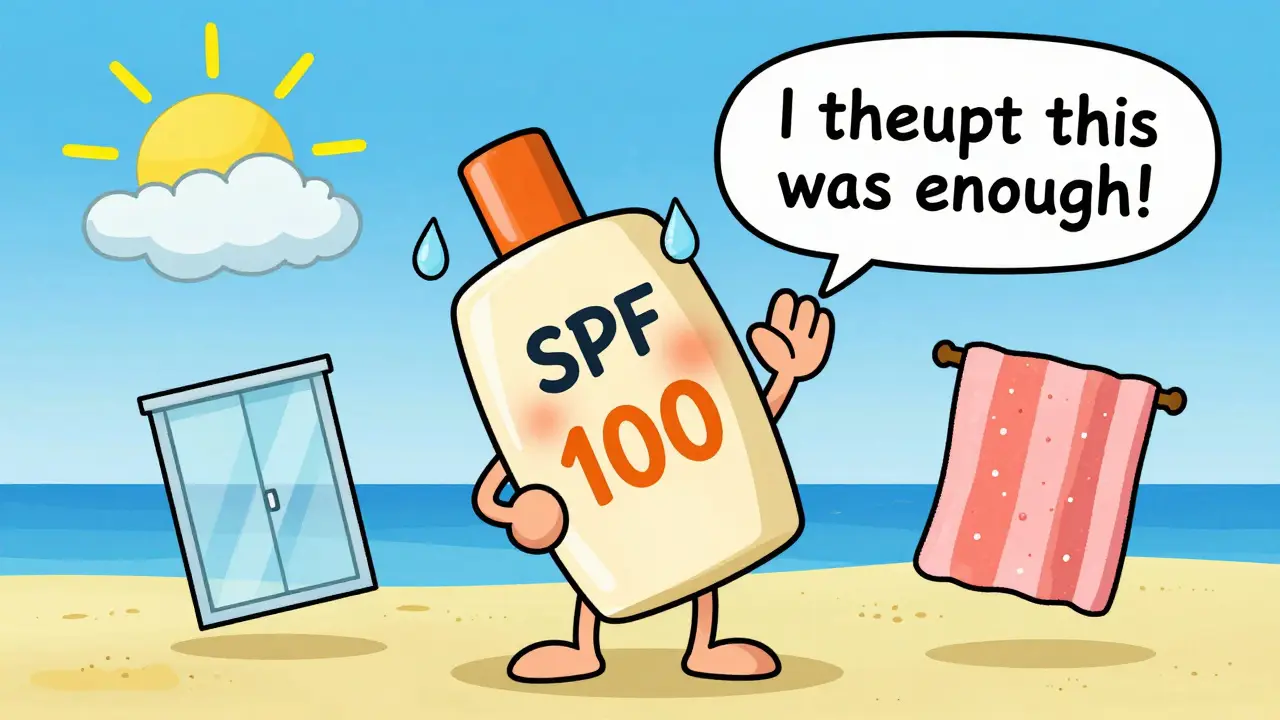
Every year, millions of people buy sunscreen without really knowing what they’re getting. You see "SPF 50" on the bottle, think you’re covered, and head out for the day. But here’s the truth: SPF doesn’t tell the whole story. And if you’re not reapplying correctly, you might as well not be wearing it at all.
What SPF Actually Means (And What It Doesn’t)
SPF stands for Sun Protection Factor. It measures how well a sunscreen blocks UVB rays - the ones that cause sunburns. But it’s not a percentage. SPF 30 doesn’t mean 30% protection. It means it takes 30 times longer for your skin to burn compared to wearing no sunscreen at all.Here’s the math: SPF 15 blocks about 93% of UVB rays. SPF 30 blocks 97%. SPF 50 blocks 98%. SPF 100? Just 99%. That extra 1% doesn’t mean you can stay out four times longer. The difference between SPF 30 and SPF 50 is tiny - but the price jump? Not so much. Most dermatologists agree: SPF 30 is the sweet spot for daily use. Anything higher gives you a false sense of security.
The FDA requires all OTC sunscreens to be tested using 20 human subjects with fair skin (Fitzpatrick types I-III). That’s the standard. But real life? You’re sweating, swimming, rubbing your face with a towel. That’s why SPF numbers can be misleading. A product labeled SPF 50 might only deliver SPF 35 in real-world conditions if it’s not applied thickly enough.
Broad Spectrum Isn’t Just Marketing
UVB burns your skin. UVA ages it. UVA rays go deeper, damage collagen, and contribute to skin cancer. That’s why "broad spectrum" matters more than you think.The FDA requires sunscreens to pass a critical wavelength test to earn the "broad spectrum" label. That means they must protect against UVA rays up to 370 nanometers. Not all sunscreens do. Some cheap brands test at SPF 50 but barely block UVA. Consumer Reports tested over 100 sunscreens in 2025 and found some mineral sunscreens labeled SPF 50 actually delivered only SPF 13 - and even worse UVA protection.
Two types of active ingredients handle this:
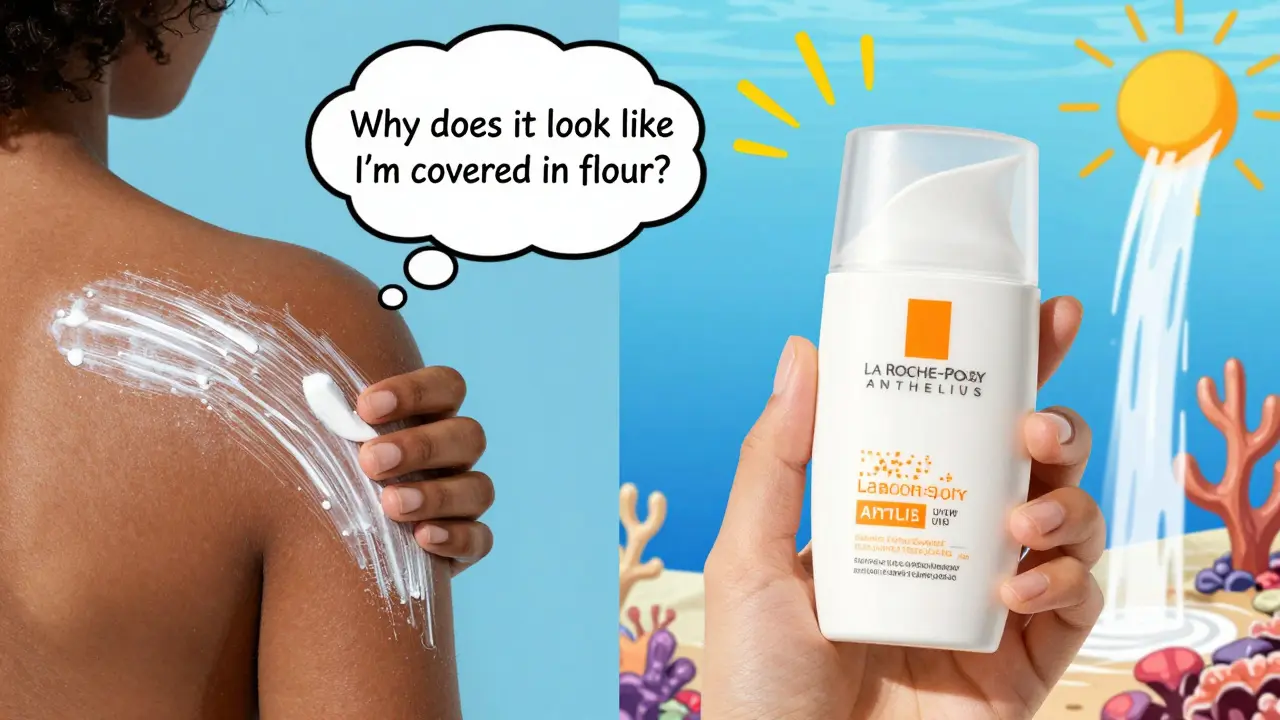
- Mineral (physical) filters: Zinc oxide and titanium dioxide. They sit on top of your skin and reflect UV light. They work immediately. Great for sensitive skin, eczema, or melasma. But many leave a white cast - especially on darker skin tones.
- Chemical filters: Avobenzone, octinoxate, oxybenzone. They absorb UV rays and convert them into heat. They blend better, feel lighter, and often offer stronger UVA protection. But some, like oxybenzone, are linked to coral reef damage and can irritate sensitive skin.
La Roche-Posay Anthelios Melt-in Milk SPF 60 scored 92/100 in Consumer Reports’ 2025 testing. Why? It uses a stable form of avobenzone with octocrylene to block both UVA and UVB effectively. Meanwhile, Blue Lizard Sensitive SPF 50 (mineral) scored 55/100 - not because it’s bad, but because its zinc oxide concentration was too low to match the protection.
Reapplication: The Most Ignored Rule
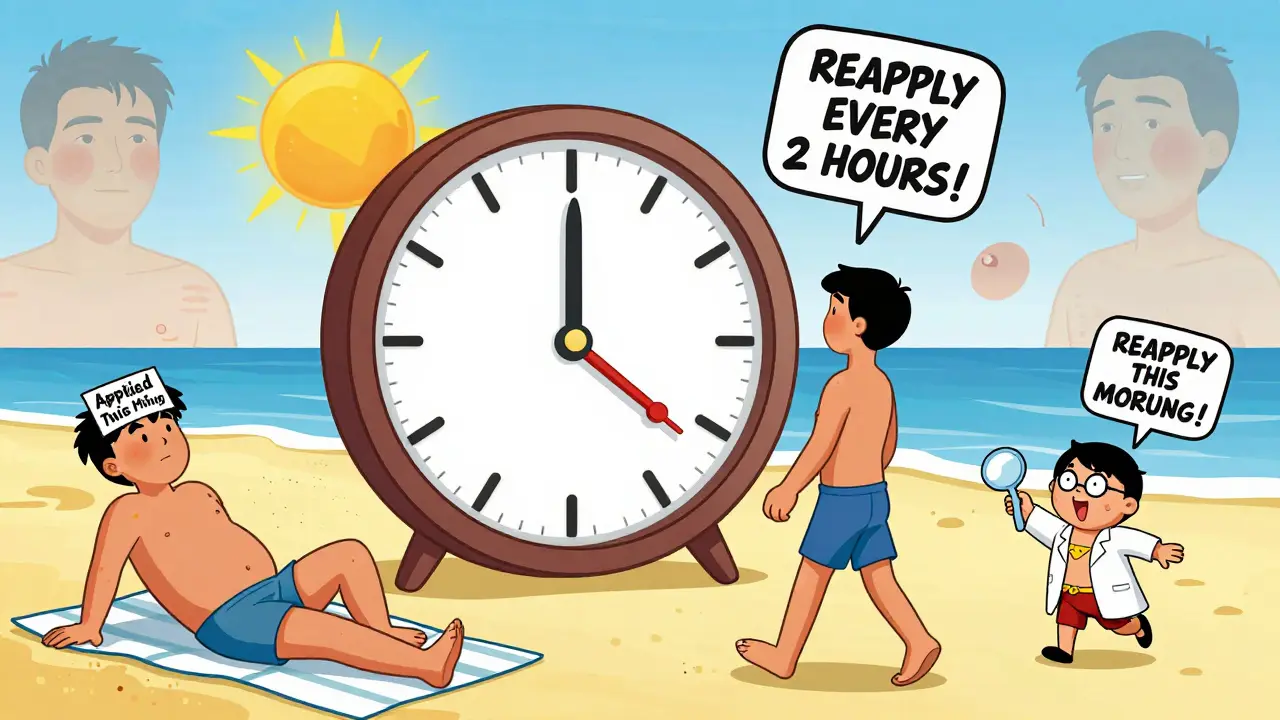
You don’t need to reapply because the sunscreen "wears off." You reapply because it’s being rubbed, sweated, or washed away - and your skin is still getting hit by UV rays.The American Academy of Dermatology says: reapply every two hours. And right after swimming, sweating, or towel-drying. Even "water-resistant" sunscreens only last 40 or 80 minutes in water - not all day.
Here’s what really happens: a 2024 study in the Journal of the American Academy of Dermatology found only 14.3% of people at the beach reapplied sunscreen as recommended. Most think they’re fine because they "put it on this morning." But sunscreen doesn’t last. It breaks down under sunlight. And you’re not applying enough.
How much should you use? Two milligrams per square centimeter of skin. That’s about one-quarter teaspoon for your face. Most people use half that. If you’re using a spray, you need to spray until it glistens - then rub it in. Spraying once and walking away gives you maybe SPF 10.
And don’t forget: sunscreen pilling under makeup? That’s not a flaw - it’s a sign you didn’t wait. Let it sit for 15 minutes before applying foundation. Otherwise, you’re just smearing a thin layer of protection around.
Mineral vs. Chemical: Which Should You Choose?
There’s no one-size-fits-all. It depends on your skin, your lifestyle, and what you care about.Choose mineral if:
- You have sensitive skin, rosacea, or melasma
- You’re pregnant or nursing
- You’re in the water often and want immediate protection
- You’re worried about coral reefs (oxybenzone and octinoxate are banned in Hawaii, Key West, and Palau)
EltaMD UV Clear SPF 46 is a top pick here. It uses 9% zinc oxide and niacinamide - which calms redness and strengthens the skin barrier. But it can leave a slight white cast on deeper skin tones. Some brands like Black Girl Sunscreen have improved this, but testing still shows many mineral formulas underperform on UVA protection.
Choose chemical if:
- You want invisible wear
- You’re active, sweat a lot, or need long-lasting protection
- You’re on a budget - chemical sunscreens are often cheaper and more effective
Supergoop! Unseen Sunscreen SPF 40 is a favorite among users with darker skin. It disappears completely. La Roche-Posay and Neutrogena dominate this category. But watch out: avobenzone can break down in sunlight unless stabilized with octocrylene or other filters. That’s why some formulas degrade faster than others.
What You’re Probably Getting Wrong
- "I don’t need sunscreen on cloudy days." Up to 80% of UV rays penetrate clouds. Daily use reduces melanoma risk by 50%, according to the AAD.
- "I have dark skin, so I’m safe." Skin cancer rates are rising in Black and Brown communities - often diagnosed later because people assume they’re immune. UVA damage still happens.
- "SPF 100 lasts longer." No. All sunscreens need reapplication every two hours. SPF 100 just blocks 1% more UVB than SPF 50.
- "I only apply it once." That’s like taking one aspirin and expecting it to work all day.
- "I don’t need it indoors." UVA rays go through windows. If you sit by a window all day - at home, in the car, at your desk - you’re getting exposure.
And here’s a brutal truth: many sunscreens on the market don’t deliver what they promise. In 2025, Consumer Reports found that 1 in 5 sunscreens failed basic protection tests. One mineral sunscreen labeled SPF 30 delivered SPF 4. Another claimed SPF 50 but only gave SPF 13. These aren’t outliers - they’re common.
How to Pick the Right One
You don’t need to spend $55 on a celebrity-branded sunscreen. The median price is $14.75 per ounce. Here’s how to cut through the noise:- Look for "broad spectrum" - not just SPF 30.
- Check the ingredients - zinc oxide 5-25% or avobenzone 3%+ for real UVA protection.
- Avoid oxybenzone if you’re near oceans or have sensitive skin.
- Test texture - if it stings your eyes, leave it. If it leaves a white cast you hate, try a tinted version.
- Read reviews - look for patterns. "Chalky residue," "pills under makeup," "stings eyes" - these are red flags.
Top performers in 2025: La Roche-Posay Anthelios, EltaMD UV Clear, Supergoop! Unseen, and CeraVe Hydrating Mineral Sunscreen. Budget winners: CVS Health SPF 50 spray ($2.99) and Neutrogena Ultra Sheer Dry-Touch SPF 55.
What’s Coming Next
The FDA is expected to finalize new rules in late 2025. They’ll likely ban 12 chemical filters (including PABA and trolamine salicylate) and require stricter UVA testing - matching European standards. That means fewer products on shelves, but better ones.Startups are also rolling out tech: Shade Smart, a wearable UV monitor launching in Q2 2025, will alert your phone when it’s time to reapply. But until then, the best tool is still your eyes - and your hand.
Use a quarter teaspoon. Reapply every two hours. Don’t skip because it’s cloudy. Don’t trust the number on the bottle. And if your sunscreen doesn’t feel like protection - it probably isn’t.
Is SPF 30 enough for daily use?
Yes. SPF 30 blocks 97% of UVB rays - which is all you need for daily exposure. Higher SPFs like 50 or 100 only add 1-2% more protection. The real issue isn’t the number - it’s how much you apply and how often you reapply. Most people use too little and never reapply, making even SPF 100 ineffective.
Do I need to wear sunscreen indoors?
If you’re near a window, yes. UVA rays - the ones that cause aging and skin cancer - pass through glass. Sitting by a window all day, whether at home, in your car, or at your desk, adds up. Daily sunscreen use reduces skin aging by 90%, according to the Journal of the American Academy of Dermatology. Even if you’re not getting sunburned, you’re still getting damage.
Why does my mineral sunscreen leave a white cast?
Mineral sunscreens use zinc oxide or titanium dioxide, which are white powders. If the formula doesn’t have enough emollients or pigments to blend, it leaves a visible layer - especially on medium to dark skin tones. Look for "tinted" versions or brands like Black Girl Sunscreen or Caravee, which use iron oxides to match deeper skin tones. Some newer formulations use micronized particles that blend better.
Are chemical sunscreens safe?
The FDA says yes - but they’re still reviewing long-term effects. Oxybenzone has been linked to hormone disruption in animal studies, but human evidence is limited. The bigger concern is environmental: oxybenzone and octinoxate damage coral reefs. That’s why Hawaii banned them. If you’re swimming in oceans or have sensitive skin, mineral sunscreens are a safer bet. For everyday use, chemical sunscreens are effective and widely used without major issues.
How much sunscreen should I use on my face?
One-quarter teaspoon - about the size of a nickel or five small peas. Most people use half that, which cuts protection in half. Use a mirror to check: you should see a thin, even sheen across your face. If it looks invisible right away, you haven’t used enough. Wait 15 minutes before applying makeup so it absorbs properly.
Can I rely on makeup with SPF?
No. Most makeup with SPF has less than SPF 15, and you’d need to apply 15 times the normal amount to reach the labeled protection. A foundation with SPF 30 only works if you use a full teaspoon on your face - which no one does. Use sunscreen underneath. Makeup with SPF is a bonus, not a replacement.
Comments (12)
Michael FItzpatrick
23 Feb, 2026Let’s be real - SPF 30 is the unsung hero of skincare. Nobody talks about how much better it is than the hype around SPF 100. I’ve been using La Roche-Posay for years, and honestly? My skin looks younger than my coworkers who think they’re invincible with that thick white paste they slather on like it’s a face mask. The real win? Reapplying. I keep a mini bottle in my bag. Every two hours. Rain or shine. Even when I’m just scrolling on the couch by the window. UVA doesn’t care if you’re indoors. It’s sneaky. And yeah, I’ve tried the tinted mineral ones - finally found one that doesn’t look like I’m moonwalking in chalk. Game changer.
Also, makeup with SPF? Please. That’s like saying a Band-Aid is a bulletproof vest. Use sunscreen first. Then your foundation. If you skip the first step, you’re not protecting - you’re performing.
And to anyone who says ‘I don’t need it in winter’ - your skin remembers every single UV hit. Even the tiny ones. Don’t be that person who wakes up at 40 looking like a dried prune because they thought sunscreen was optional.
Pro tip: If it stings your eyes, ditch it. Your skin deserves better than chemical warfare.
Brandice Valentino
25 Feb, 2026OMG I’m so glad someone finally said this. Like, I literally cried reading this because I’ve been trying to explain to my roommate that SPF 50 isn’t magic. She uses this ‘natural’ sunscreen that smells like a yoga retreat and leaves a ghostly halo on her face. And then she wonders why she’s getting wrinkles? Honey, the zinc oxide is sitting there like a tiny white moon landing. And she doesn’t reapply. At all. Like, ever. I swear she thinks sunscreen is a one-time ritual, like lighting a candle before a Zoom meeting. I keep trying to tell her: it’s not a spiritual practice. It’s science. And science doesn’t forgive laziness. Also - oxybenzone? I don’t care if it’s ‘safe’ - I’m not poisoning the ocean for my face. #CoralKiller
Larry Zerpa
25 Feb, 2026You’re all missing the point. SPF is a marketing scam designed by dermatologists and corporations to sell you overpriced lotion. The real issue? You’re not getting enough UV exposure to build natural melanin. Sunscreen is a crutch for people who refuse to adapt. The FDA tests are done on Fitzpatrick I-III - that’s less than 20% of the population. So what about the rest of us? You’re applying a formula designed for pale Scandinavians to people with melanin-rich skin and expecting it to work. That’s not science - that’s colonialism in a tube. And don’t get me started on ‘broad spectrum.’ The term is meaningless unless you’re testing against the full UV spectrum, which no one does. Consumer Reports? They’re funded by sunscreen manufacturers. The real data? Buried. The truth? You’re being manipulated into buying a product that doesn’t match your biology. Stop trusting labels. Start trusting your skin.
Maranda Najar
25 Feb, 2026Oh my GOD. This. This. This. I’ve been screaming into the void for YEARS about sunscreen reapplication. I work in a glass-walled office. I sit by the window. Every. Single. Day. And I’ve watched my coworkers - bright, beautiful women - develop hyperpigmentation, fine lines, even suspicious moles… and they all say, ‘But I didn’t burn!’ No, sweetie. You didn’t burn. You aged. Slowly. Quietly. Invisibly. Like a slow-motion tragedy. I carry a tiny SPF 30 stick in my purse. I reapply before lunch. After coffee. After walking to the subway. I even have a reminder on my phone. Because if you think sunscreen is a morning ritual - you’re living in a fantasy. The sun doesn’t take breaks. Neither should you. And if you’re using makeup with SPF? Darling. That’s not protection. That’s a decorative glaze. Please. For the love of all things holy - use actual sunscreen. And don’t be cheap. Your skin is not a discount bin.
Christopher Brown
27 Feb, 2026SPF 30 is enough. End of story. Anyone who buys SPF 100 is wasting money. And don’t even get me started on mineral sunscreens. They’re for people who don’t want to sweat. If you’re active, go chemical. That’s why we have innovation. And if you’re worried about coral reefs - go swim somewhere else. America doesn’t need to ban oxybenzone because some fish are sensitive. We have better things to do. Also - sunscreen isn’t a daily thing. Only if you’re outside for more than 15 minutes. Stop turning this into a cult. You’re not a vampire. You’re just paranoid.
Sanjaykumar Rabari
28 Feb, 2026They are lying about sunscreen. The FDA is controlled by big pharma. They want you to buy expensive lotions so they can profit. Real protection is shade. Or a hat. Or staying inside. The UV index is a scam. I tested my sunscreen with my phone camera - it shows nothing. No protection. They are using chemicals to make you sick slowly. I stopped using sunscreen. My skin is better now. They are hiding the truth. You think you are protected but you are being poisoned. Watch out.
Khaya Street
2 Mar, 2026Interesting breakdown. I’ve been using Neutrogena Ultra Sheer for years - cheap, doesn’t feel greasy, and honestly, it’s held up fine. I don’t reapply religiously, but I do toss on another layer after swimming or if I’m out past 2 PM. I’ve never burned. I’m not saying it’s perfect - but it’s practical. I’m not going to spend $40 on a tube of sunscreen when I can get a decent one at CVS for $3. I don’t need a celebrity brand. I need something that works without drama. Also - tinted mineral? I tried one. Looked like I had a layer of flour on my face. No thanks. I’ll stick with the invisible stuff.
Christina VanOsdol
2 Mar, 2026YES. YES. YES. I just got my first melanoma scare last year - thank god it was benign - and now I’m OBSESSED with sunscreen. I use SPF 30. I reapply every 90 minutes. I have a tiny bottle in my purse, my car, my desk, my gym bag. I even have a reminder app. And I NEVER skip it - even on cloudy days. I used to think I was safe because I had dark skin. WRONG. I had a spot on my ankle that looked like a freckle. Turned out it was a pre-cancerous lesion. I didn’t even know. So now? I’m the sunscreen police. If you’re not reapplying? You’re playing Russian roulette with your skin. And makeup with SPF? Pfft. That’s like wearing a thong and calling it a swimsuit. Use the real stuff. And if it pills? You didn’t wait. Let it sit. 15 minutes. Don’t rush your protection. Your future self will thank you. 💅🌞
Emily Wolff
4 Mar, 2026SPF 30 is fine. Reapplication is mandatory. Mineral sunscreens are for people who can’t handle chemistry. If you want invisible protection, chemical filters are superior. Stop romanticizing zinc oxide. It’s not ‘natural’ - it’s a mineral. And yes, it leaves a white cast. That’s not a feature - it’s a flaw. And if you’re worried about coral reefs? Stop swimming in them. There are 7 billion people. One sunscreen won’t save the ocean. Focus on real threats.
Joseph Cantu
5 Mar, 2026You know what’s worse than not using sunscreen? Using it and thinking you’re safe. The truth is, no sunscreen blocks 100%. Not even SPF 100. And the chemicals? They get into your bloodstream. The FDA says it’s okay - but they also said asbestos was fine. I’ve stopped using chemical sunscreens. I wear hats. I stay in the shade. I avoid the sun between 10 and 4. And I eat more antioxidants. That’s real protection. Not some lotion that gets absorbed into your blood and might mess with your hormones. I don’t trust corporations. I don’t trust the FDA. I trust nature. And I trust my body. You should too.
Jacob Carthy
6 Mar, 2026Just use SPF 30 and reapply. No need to overthink it. I’ve been doing this for 15 years. Never burned. Never had a problem. I use Neutrogena. It’s cheap. It works. I don’t care about UVA vs UVB. I don’t care about coral reefs. I care about not getting sunburned. And I don’t need a 10-step routine. Just slap it on. Every two hours. Done. Stop making it a science project.
Lisandra Lautert
8 Mar, 2026One sentence: If you're not reapplying sunscreen every two hours - you're not protected. Period.