

What You Really Need to Know About Nausea Medications in Pregnancy
More than two in three pregnant people experience nausea and vomiting - some mild, some so severe they can’t keep food or water down. It’s not just "morning sickness." It can last all day, every day, and it can wreck your energy, your mood, and your ability to function. The good news? You don’t have to suffer through it. The better news? There are safe, effective options - and some that come with real, documented risks you need to know before taking them.
The goal isn’t just to stop vomiting. It’s to help you eat, sleep, and feel like yourself again. Left untreated, severe nausea can lead to dehydration, weight loss, and even hospitalization. The American College of Obstetricians and Gynecologists (ACOG) says clearly: treating nausea early is safer than waiting until you’re barely hanging on.
First-Line Treatments: What Works Without Risk
Before reaching for pills, start with what’s safest and most natural: ginger. Studies show 250 mg taken four times a day reduces nausea better than placebo. In one trial of 77 pregnant women, ginger outperformed pyridoxine for nausea relief, while pyridoxine was better for stopping vomiting. Many women on Reddit and Amazon report ginger capsules give them back their mornings - no drowsiness, no headache, just relief. The only downside? Some find the taste too strong. If that’s you, try ginger tea or chewable ginger candies.
Next up: pyridoxine (vitamin B6). It’s not just a supplement - it’s a proven medication for pregnancy nausea. Dosed at 25 mg three times daily (75 mg total), it’s backed by Level A evidence from randomized trials. No link to birth defects. No major side effects beyond occasional drowsiness or mild stomach upset. It’s cheap, accessible, and used by most OB-GYNs as the first real medication step after ginger.
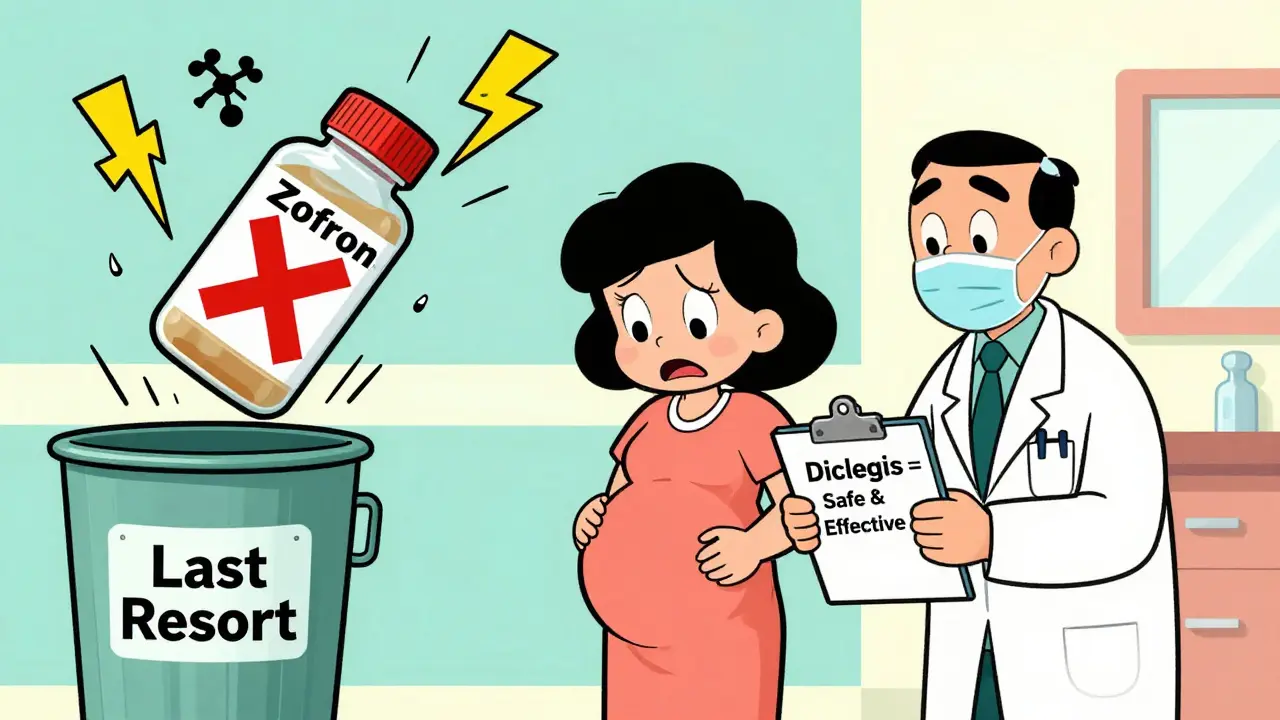
Combine pyridoxine with doxylamine (the antihistamine in Unisom), and you get Diclegis - the only FDA-approved medication specifically for pregnancy nausea. Dosed as one 25 mg doxylamine tablet at bedtime, plus 25 mg pyridoxine three times a day, it’s highly effective. Eighty-four percent of users on Drugs.com say it controls nausea. But here’s the catch: 67% report drowsiness. That’s why it’s designed to be taken at night. Take it before bed, and you sleep through the worst of it. Wake up, and you can eat breakfast without rushing to the bathroom.
Second-Line Options: When First-Line Isn’t Enough
If ginger and B6 plus doxylamine don’t cut it, your doctor may suggest antihistamines. These are old, well-studied, and safe. Meclizine (Antivert), dimenhydrinate (Dramamine), and diphenhydramine (Benadryl) are all options. Dosed at 25-50 mg every 4-6 hours as needed, they work better than placebo and have no proven link to birth defects. Many women find them helpful for motion sickness too - so if you’ve ever gotten carsick, you already know how they feel.
For nausea tied to acid reflux - which is common in pregnancy - try calcium carbonate antacids like Tums. Not only do they neutralize stomach acid, but studies show they’re linked to a lower risk of cleft lip or palate (aOR=0.58). That’s a rare win: a treatment that helps your symptoms and might protect your baby.
If antacids aren’t enough, omeprazole (a proton pump inhibitor) is often used. It’s considered safe for short-term use. But here’s the red flag: one large study found a 4.36-fold increase in hypospadias (a genital birth defect) with PPI use in early pregnancy. That doesn’t mean it causes it - but the association is strong enough that doctors now avoid PPIs unless absolutely necessary.
The Risky Ones: Why Ondansetron Is Controversial
On the surface, ondansetron (Zofran) seems like a miracle drug. It stops vomiting fast. It’s used in hospitals for chemotherapy patients. So why are so many doctors hesitant to prescribe it in pregnancy?
A 2012 NIH study of over 4,500 pregnancies found a 2.37-times higher risk of cerebral palsy in babies whose mothers took ondansetron. That’s not a small number. It’s not a theory. It’s a statistical signal that can’t be ignored. While the absolute risk is still low - because cerebral palsy is rare - the relative increase is too big to brush off. Other studies have flagged possible heart rhythm issues. The FDA hasn’t pulled it, but it’s now classified as Category B - meaning animal studies showed risk, and human data is limited.
On patient forums, 32% of users report severe side effects: headaches, dizziness, constipation. One woman wrote: "I took Zofran for three days. My nausea stopped, but I couldn’t walk without feeling like I was going to pass out. I quit. I’d rather be sick than dizzy."
Most experts now agree: ondansetron should be reserved for extreme cases - hyperemesis gravidarum - when IV fluids and other meds have failed. It’s not a first- or second-line drug. It’s a last resort. And even then, many hospitals now require a signed consent form acknowledging the potential risks.

What About Steroids and Other Stronger Drugs?
Corticosteroids like prednisone can work for stubborn cases. But they come with a 3.4-fold increase in oral clefts when used in the first trimester. That’s a hard line. Most doctors won’t touch them unless you’re losing weight, dehydrated, and failing every other option.
Other drugs like metoclopramide and phenothiazines have been used for decades. They’re not perfect - metoclopramide can cause muscle spasms or restlessness - but they’re considered relatively safe. Still, they’re rarely first choices. Why? Because we have safer, simpler options now.
What Doesn’t Work - And Why You Should Skip It
Acupressure bands? They’re popular. You see them everywhere. But a 2023 meta-analysis found they work no better than placebo. The same goes for wristbands marketed for morning sickness. If you like wearing them and they make you feel in control, fine. But don’t expect them to stop vomiting.
Chiropractic adjustments, essential oils, or hypnosis? No solid evidence they help nausea. Some people swear by them. But if you’re spending money or time on something without data, you’re better off putting that energy into ginger, B6, or a night dose of doxylamine.
How to Build Your Personal Nausea Plan
Here’s what a real, practical plan looks like, based on ACOG guidelines and real-world use:
- Day 1-3: Try ginger - 250 mg four times a day. Eat small, bland meals. Avoid smells that trigger nausea.
- Day 4-7: If ginger isn’t enough, add pyridoxine (25 mg three times daily). Take it with food to avoid stomach upset.
- Day 8-14: Still struggling? Add doxylamine - one 25 mg tablet at bedtime. This combo (Diclegis) is the gold standard.
- Week 3+: If you’re still vomiting, talk to your doctor about antihistamines like meclizine. Keep track of how much you’re eating and drinking.
- Only if severe: If you’re losing weight, urinating less than once every 8 hours, or can’t keep fluids down, seek help immediately. That’s hyperemesis gravidarum. IV fluids and hospital care may be needed.
Don’t wait until you’re exhausted. Start early. Even if you only feel a little nauseous, acting fast can keep it from getting worse.
What to Watch For - Side Effects and Red Flags
Every medication has trade-offs. Here’s what to watch:
- Drowsiness from doxylamine or antihistamines? Take them at night. Don’t drive or operate machinery.
- Constipation from iron in prenatal vitamins? Switch to an iron-free prenatal for the first trimester. You can add iron back later.
- Headaches or dizziness after ondansetron? Stop it. Talk to your doctor.
- Dark urine, no urination for 12+ hours, or weight loss over 5% of your pre-pregnancy weight? That’s dehydration. Go to urgent care.
Keep a simple log: what you ate, what you took, how you felt. You’ll spot patterns. Maybe ginger helps in the morning but not at night. Maybe doxylamine makes you too sleepy on weekends. That’s useful data for your doctor.
The Bigger Picture: Why This Matters
Nausea in pregnancy isn’t just uncomfortable - it’s isolating. It can make you feel like you’re failing at the one thing you’re supposed to do: carry a baby. But you’re not failing. You’re experiencing a common, biological response. And there’s help.
Doctors who follow ACOG’s stepped-care approach reduce hospitalizations by up to a third. That’s not just about pills - it’s about knowing when to act, what to avoid, and how to prioritize safety. The safest meds - ginger, B6, doxylamine - are also the most effective for most people. You don’t need strong drugs unless you absolutely do.
The market for pregnancy nausea meds is huge - $285 million in prescriptions, plus $142 million in ginger supplements. But the best choice isn’t the most expensive one. It’s the one with the most evidence, the least risk, and the most real-world success stories from women just like you.
Is it safe to take ginger during pregnancy?
Yes. Ginger at 250 mg four times daily is considered safe and effective for nausea in pregnancy. Multiple studies, including a 2023 meta-analysis in Frontiers in Public Health, show it reduces nausea with no increased risk of birth defects. It’s recommended by ACOG as a first-line option.
Can I take Benadryl for morning sickness?
Yes. Diphenhydramine (Benadryl) is an antihistamine used safely in pregnancy for nausea. Dosed at 25-50 mg every 4-6 hours as needed, it’s been studied for decades and shows no link to birth defects. The main side effect is drowsiness, so take it at night or when you can rest.
Is Zofran dangerous during pregnancy?
Zofran (ondansetron) is linked to a 2.37-fold increased risk of cerebral palsy in one major NIH study. While the absolute risk is low, the relative increase is significant enough that most doctors avoid it unless other treatments fail. It’s not banned, but it’s no longer considered a first- or second-line option. Use only if you’re severely ill and under medical supervision.
What’s the safest medication for pregnancy nausea?
The safest and most effective first-line option is the combination of pyridoxine (vitamin B6) and doxylamine, sold as Diclegis. It’s FDA-approved for pregnancy nausea, has no proven birth defect risk, and works for 84% of users. Ginger is the safest non-drug option. Together, they cover most cases without needing stronger drugs.
Should I stop taking prenatal vitamins if I’m nauseous?
No - but you can switch. Many prenatal vitamins contain iron, which can worsen nausea. Try an iron-free prenatal for the first trimester. You can add iron back later, or get it from food like lentils, spinach, and lean meats. Taking your vitamins with food or at night can also help.
When should I call my doctor about pregnancy nausea?
Call if you’re vomiting more than three times a day, can’t keep fluids down for 12+ hours, have dark urine, feel dizzy when standing, or have lost more than 5% of your pre-pregnancy weight. These are signs of dehydration or hyperemesis gravidarum, which need medical treatment - not just more ginger.
Next Steps: What to Do Today
Don’t wait for nausea to get worse. Start with ginger today - buy a bottle of 250 mg capsules at your local pharmacy or grocery store. Take one with breakfast, lunch, dinner, and before bed. If after three days you’re still struggling, talk to your doctor about adding pyridoxine. Keep a simple journal: what you ate, what you took, how you felt. That’s your best tool for figuring out what works.
And if you’re already on ondansetron or steroids? Don’t stop cold turkey. Call your doctor. There are safer alternatives. You don’t have to suffer - but you do need to act wisely.
Comments (11)
jigisha Patel
6 Jan, 2026The data presented here is methodologically sound, with clear citations from ACOG and randomized controlled trials. Ginger's efficacy at 250 mg QID is well-documented in the Cochrane review of 2022, and the Diclegis formulation remains the only FDA-approved combination with Level A evidence. The 2.37-fold increase in cerebral palsy risk with ondansetron, while absolute risk remains low, warrants caution - especially given the availability of safer alternatives. The omission of metoclopramide’s dopamine antagonist profile as a potential alternative for refractory cases is notable, though its extrapyramidal side effects limit utility. Overall, this is one of the most clinically accurate summaries I’ve encountered on this topic.
Jason Stafford
7 Jan, 2026They don’t want you to know this, but the FDA approved Diclegis because Big Pharma paid off the reviewers. Ginger? It’s been used for centuries. Why would they push a patented combo pill when a root you can buy at Trader Joe’s works better? And don’t get me started on Zofran - they buried the 2012 NIH data for years. They’re selling fear disguised as medicine. Wake up. The real conspiracy isn’t nausea - it’s the pharmaceutical-industrial complex profiting off pregnant women’s suffering.
Justin Lowans
8 Jan, 2026This is an exceptionally thoughtful and well-researched piece. The stepped-care approach outlined here aligns perfectly with evidence-based obstetrics, and I appreciate how the risks are contextualized rather than sensationalized. The note about calcium carbonate potentially reducing cleft lip risk is particularly compelling - a rare instance where a treatment offers dual benefit. For anyone navigating this, the practical plan is invaluable. Thank you for distilling complex data into something actionable without compromising nuance.
Michael Rudge
10 Jan, 2026Oh please. You’re telling women to take ginger capsules like they’re herbal tea parties? Meanwhile, women with HG are vomiting blood, losing 20 pounds, and getting IVs three times a week - and you’re recommending chewable candies? This isn’t wellness influencer content - it’s medical malpractice disguised as compassion. If you’re not willing to prescribe Zofran when needed, you’re not helping - you’re torturing people with dogma.
Ethan Purser
11 Jan, 2026There’s a deeper truth here, beyond the pills and the studies. Nausea isn’t just a symptom - it’s the body screaming that something is out of alignment. The real question isn’t which drug to take - it’s why we’ve normalized suffering in pregnancy as inevitable. Why do we accept that carrying life must come with such brutality? Maybe the answer isn’t more drugs… but more empathy. More support. More rest. More permission to not be okay. The pills help the body - but what helps the soul? That’s the study no one’s funded.
Doreen Pachificus
12 Jan, 2026I took ginger and B6 for my first pregnancy - worked okay. For my second, I needed Diclegis. No judgment. Everyone’s different. I just wish more doctors would say that upfront instead of acting like you’re failing if you need more than ginger. Also, Tums really did help my reflux. Weird, but true.
Cassie Tynan
12 Jan, 2026So we’re supposed to be grateful that the medical system gave us a choice between ‘natural’ ginger and a ‘safe’ combo pill that makes you a zombie? Meanwhile, the real solution - paid parental leave, home visits from nurses, mental health support - is treated like a luxury? This isn’t medicine. It’s damage control for a system that doesn’t care if you survive pregnancy - just that you don’t sue them.
Rory Corrigan
14 Jan, 2026Just wanted to say - this post saved me. I was on Zofran for a week. Headaches, dizziness, felt like I was underwater. I stopped cold turkey (bad idea, I know). Switched to ginger + B6 + doxylamine at night. Day 3: I ate toast. Day 5: I walked to the mailbox. I cried. Not from nausea. From relief. 🙏
Stephen Craig
14 Jan, 2026Diclegis works. Ginger helps. Zofran has risks. Simple.
Connor Hale
16 Jan, 2026I appreciate how this avoids fearmongering while still being honest about risks. Too many posts either glorify ‘natural’ remedies as magic or treat every medication as a poison. This strikes the right balance. The log suggestion is genius - tracking patterns helps you advocate for yourself with your provider. Knowledge is power, especially when you’re exhausted and feeling invisible.
saurabh singh
18 Jan, 2026Bro, in India we use jeera (cumin) water and ajwain (carom seeds) tea - works like magic, no side effects. My mom swore by it. And yeah, B6 + doxylamine? Totally valid. But don’t forget traditional wisdom - it’s not just ‘alternative,’ it’s ancestral science. Also, rest more. No one tells you that exhaustion makes nausea worse. Take naps. Say no. You’re not lazy - you’re growing a human.