
When you’re prescribed a medication that costs $800 a month, and your insurance only covers $100, what do you do? For millions of Americans, the answer isn’t waiting for a miracle - it’s turning to prescription assistance programs directly from the drug manufacturers. These aren’t charity handouts or government subsidies. They’re structured programs run by companies like Pfizer, Merck, and Eli Lilly to help people actually get the drugs their doctors ordered.
Two Types of Help: Copay Cards and Free Medications
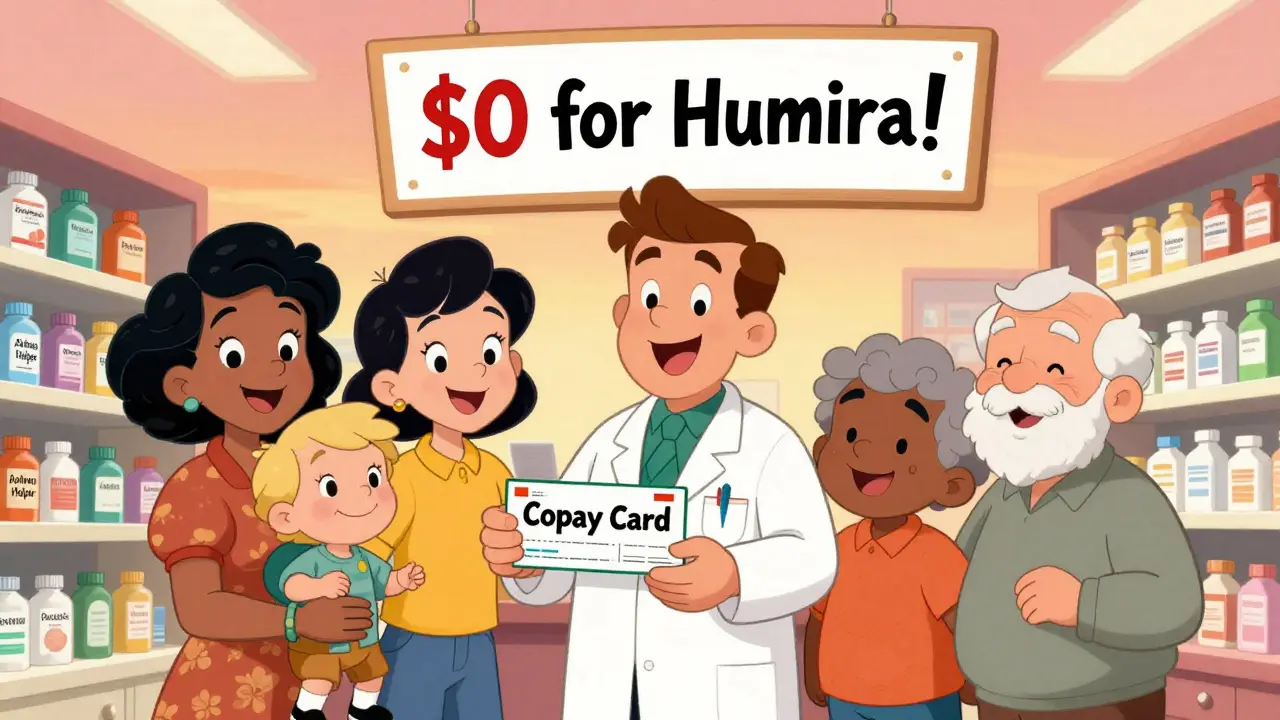
There are two main ways drug makers help patients. The first is copay assistance programs. These are usually cards or coupons you show at the pharmacy. If your copay is $150 but your insurance says you owe $200, the manufacturer pays the extra $50. This cuts your out-of-pocket cost instantly. These programs target brand-name drugs - especially specialty ones used for conditions like rheumatoid arthritis, multiple sclerosis, or rare cancers. About 85% of specialty drugs now offer some kind of manufacturer copay card, according to KFF’s 2023 analysis. The second type is Patient Assistance Programs (PAPs). These are for people who don’t have insurance or can’t afford even the reduced price. PAPs give you the medication for free or at a very low cost - sometimes just $5 or $10 per prescription. To qualify, you usually need to prove your income is below 200% to 400% of the Federal Poverty Level. For a family of four in 2023, that meant earning less than $60,000 a year. Some programs, like Teva’s Cares program, even cover generic versions of drugs if you meet the criteria.Who Gets Help - And Who Doesn’t
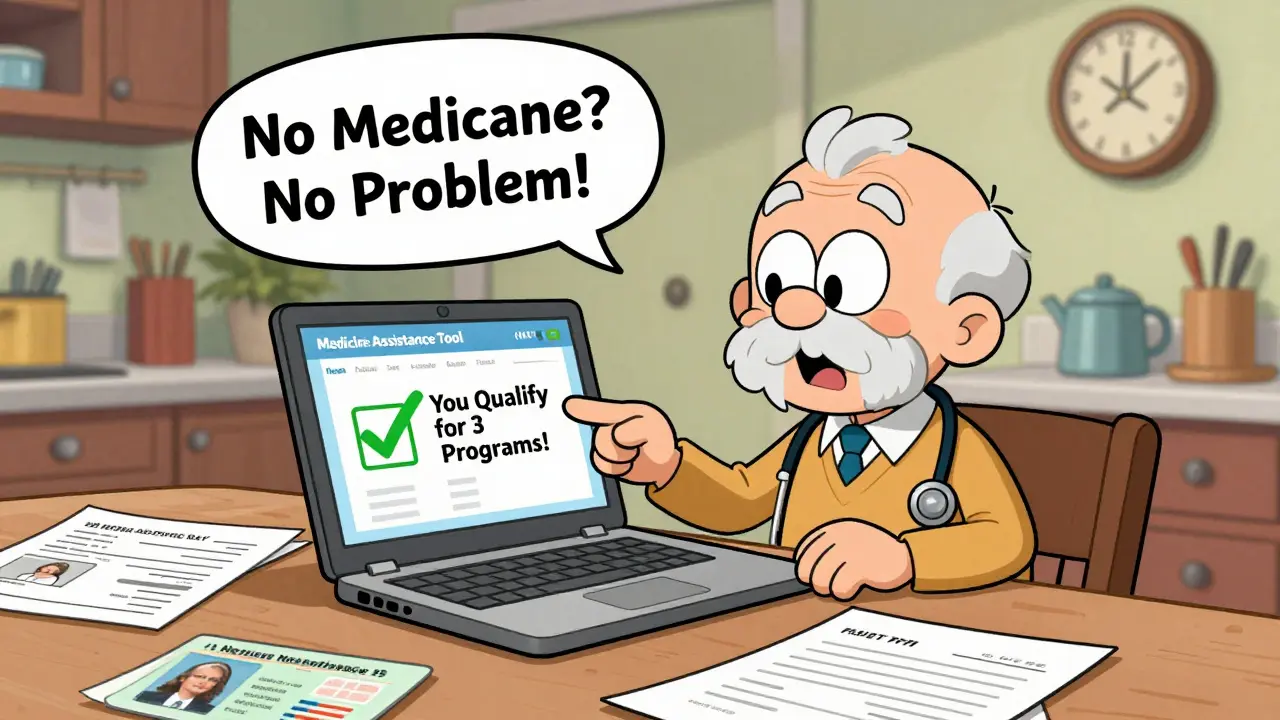
It sounds simple, but eligibility is messy. Copay cards are great if you have private insurance. But if you’re on Medicare or Medicaid, you might be locked out. Why? Because many state Medicaid programs ban copay assistance. They worry it pushes doctors to prescribe pricier brand-name drugs instead of cheaper generics. In fact, 78% of state Medicaid programs don’t allow it, according to the National Academy for State Health Policy. Medicare Part D is another tricky area. Even if you get a copay card, that money doesn’t count toward your out-of-pocket maximum. That means you stay stuck in the coverage gap longer. PAPs can’t be used with Medicare Part D at all - if you’re on Medicare, you can’t get free drugs from manufacturer PAPs. That leaves millions of seniors in a bind. The Centers for Medicare & Medicaid Services (CMS) says PAPs must operate “outside the Part D benefit,” meaning they can’t be layered on top of your insurance. And if you’re uninsured? You’re in the sweet spot for PAPs. But here’s the catch: only 37% of eligible people even know these programs exist, according to the Patient Advocate Foundation. Many don’t realize they qualify because they think they’re “too well off” or “have some insurance.”How to Apply: It’s Not as Hard as You Think
Applying for a PAP takes work. You’ll need:- Proof of income (last two pay stubs or tax return)
- Proof of residency (driver’s license or utility bill)
- Doctor’s letter confirming the prescription is medically necessary
Real Examples: What You Could Save
Take Dulera, a common asthma inhaler. Through Asthma and Allergy Foundation of America’s program, eligible patients pay as little as $15 per prescription - saving up to $90 per fill. That’s $1,080 a year saved just on one inhaler. For a drug like Humira, used for autoimmune diseases, the manufacturer’s copay card can reduce a $7,000 monthly bill to $5. Some patients pay nothing at all after applying. Teva’s PAP offers over 70 generic medications at no cost. That includes blood pressure pills, antidepressants, and diabetes meds - drugs many people take every day.The Big Debate: Are These Programs Helping or Hurting?
Supporters say these programs save lives. PhRMA reports that in 2022 alone, drug makers gave $24.5 billion in assistance to 12.7 million people. Dr. Jane Smith from the Brookings Institution estimates that without these programs, 2.3 million more people would skip doses or stop taking their meds entirely. But critics have serious concerns. A 2022 study in JAMA Internal Medicine found copay assistance pushes people toward expensive brand-name drugs - even when cheaper generics exist. That drove up total drug spending by $1.4 billion that year. And since insurers now use “copay accumulators” to block manufacturer discounts from counting toward deductibles, patients are stuck paying full price after the card runs out. Worse, there’s no national tracking system for PAPs. The NIH says no one knows how many people actually get help, how long they stay enrolled, or whether they’re getting better health outcomes. That’s a huge blind spot.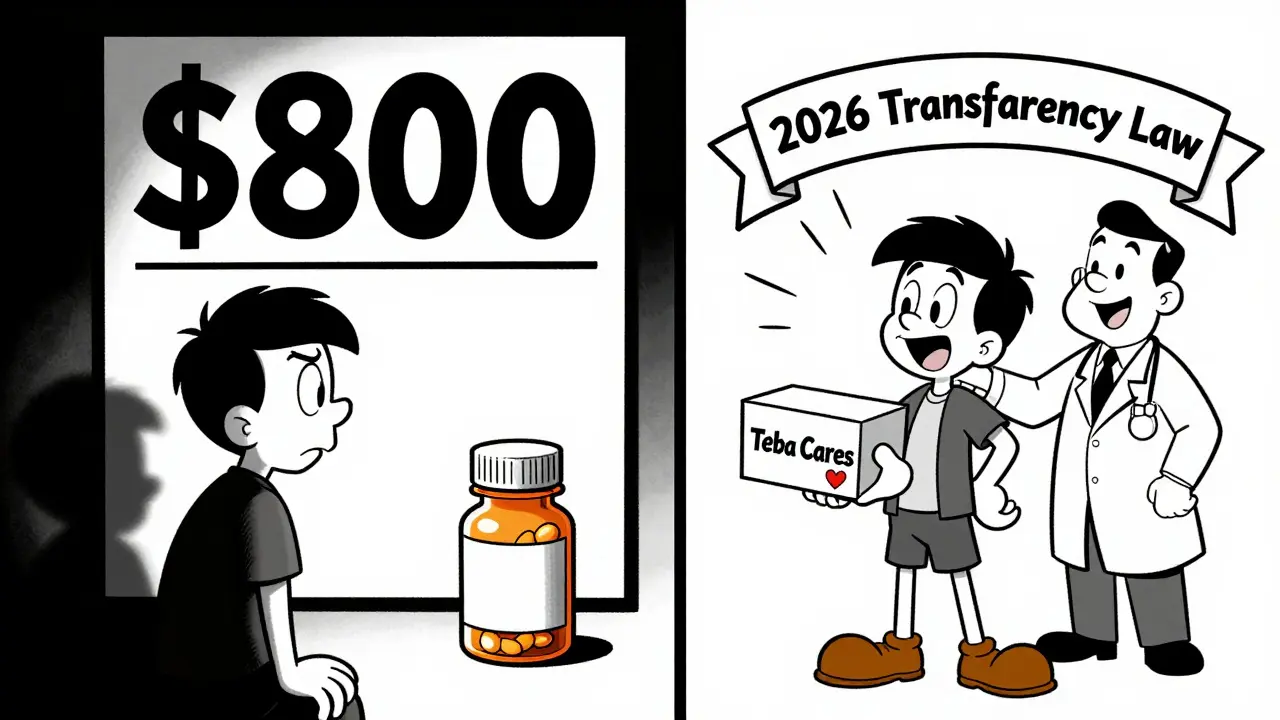
What’s Changing in 2026
The rules are shifting fast. As of January 2024, 22 states have passed laws to regulate or limit copay assistance. California now requires drug makers to publicly report how much they spend on these programs. The federal government is also stepping in - HHS proposed new transparency rules in late 2023. Pharmacies are getting smarter too. MAT now connects directly with major pharmacy systems. When you show your card, the system auto-applies the discount. No more manual processing. But the big question remains: are these programs fixing the problem - or just covering it up? With 28 million Americans still uninsured and drug prices rising 5-10% every year, PAPs are filling a gap created by a broken system. They’re not a long-term solution. But right now, for many, they’re the only thing standing between a person and a life-saving medication.What You Should Do Right Now
If you’re struggling to pay for prescriptions:- Ask your doctor if your drug has a copay card or PAP. Most do.
- Go to medassistancetool.org (PhRMA’s free tool) and search your medication.
- Have your income documents ready - pay stubs, tax returns, or a letter from a government aid program.
- If you’re on Medicare or Medicaid, ask if the program allows PAPs. Some do, even if most don’t.
- Don’t give up after one rejection. Try another manufacturer. Some drugs have multiple assistance options.
Can I use manufacturer assistance if I have Medicare?
You cannot use Patient Assistance Programs (PAPs) if you’re enrolled in Medicare Part D. These programs are designed to operate outside of Medicare benefits. However, you may still qualify for copay assistance cards if your Medicare plan allows it - but those payments won’t count toward your out-of-pocket maximum. Some private Medicare Advantage plans do allow copay assistance, so check with your plan.
Do I need to reapply every year for PAPs?
It depends on the program. Some require annual reapplication with updated income proof. Others provide continuous coverage as long as you stay eligible. Always check the program’s terms. If you’re approved, you’ll usually get a letter or email explaining renewal rules.
Can I use copay cards with Medicaid?
In most cases, no. As of 2024, 78% of state Medicaid programs prohibit the use of manufacturer copay assistance. They believe it encourages the use of more expensive brand-name drugs over generics, which can raise overall program costs. Some exceptions exist, but they’re rare. Always check with your state’s Medicaid office before applying.
Are these programs only for U.S. residents?
Yes. Nearly all manufacturer assistance programs in the U.S. are only available to U.S. residents. They’re designed to comply with U.S. healthcare laws and drug pricing structures. If you live outside the U.S., you won’t qualify for these programs. Some countries have their own government-based assistance systems.
What if I’m denied assistance?
Don’t stop there. Many people are denied for small reasons - a missing signature, an outdated pay stub, or not checking the income cutoff for their household size. Call the program directly and ask why. You can often fix the issue and reapply. Also, try another manufacturer - the same drug may be sold under different brand names by different companies, each with its own program.
Can I use multiple copay cards for the same drug?
No. You can only use one copay card per prescription at a time. Pharmacies will reject multiple cards. But you can use different cards for different drugs. For example, if you take three medications, you can use a separate card for each one - as long as each drug has its own manufacturer program.
Do these programs work with generic drugs?
Most copay assistance programs are for brand-name drugs only. But some Patient Assistance Programs (PAPs) do cover generic medications - especially if the brand-name version is too expensive. Teva’s Cares program, for example, offers dozens of generics at no cost. Always check the program details before assuming it’s only for brand names.
Comments (13)
Lexi Karuzis
27 Jan, 2026So let me get this straight: drug companies are *charitable*? 😂 They’re just avoiding lawsuits and keeping their stock prices up while you’re stuck paying $200 for insulin because they ‘can’t afford’ to lower the price without a coupon. And don’t get me started on how they use these programs to lock you into brand-name drugs forever-because if you ever stop using the card? Boom. Back to $7,000/month. They’re not helping you-they’re hooking you.
Brittany Fiddes
27 Jan, 2026Honestly, this whole system is a joke. In the UK, we have the NHS-meds are either free or £9.35. You people are so obsessed with ‘personal responsibility’ that you’ve turned healthcare into a rigged casino where the house always wins. And now you’re patting yourselves on the back for using corporate coupons like they’re some kind of moral victory? Please.
Robert Cardoso
29 Jan, 2026The data here is misleading. Copay assistance doesn’t reduce overall spending-it shifts it. Insurers absorb the cost, then raise premiums to compensate. The $24.5 billion in assistance? That’s just a drop in the bucket compared to the $500+ billion in drug spending annually. And the fact that Medicare patients are excluded? That’s not a flaw-it’s a feature. The system is designed to funnel money to private insurers and pharma, not patients.
James Dwyer
30 Jan, 2026I know someone who was on Humira and couldn’t afford it-until they got the copay card. They’re alive today because of it. I don’t care if it’s a corporate tactic. If it keeps people alive, it’s worth it. Don’t let the perfect be the enemy of the good.
jonathan soba
31 Jan, 2026Interesting how the article glosses over the fact that copay cards are essentially a form of price discrimination. They’re only available to those with private insurance-meaning the uninsured and Medicaid recipients are left behind. The real problem isn’t access to coupons-it’s that the entire pricing structure is broken. These programs are just Band-Aids on a severed artery.
matthew martin
1 Feb, 2026I’ve been helping folks navigate these programs for years. The MAT tool? Life-changing. I had a guy on dialysis who was paying $400/month for a blood pressure med-turned out Teva’s PAP gave him it for free. He cried. Not because he was ‘poor’-he made $52k, worked two jobs, had insurance-but because the math didn’t add up. These programs aren’t perfect, but they’re the only thing standing between people and death. Don’t hate the players-hate the game.
Mindee Coulter
3 Feb, 2026Just applied for my dad’s diabetes meds using MAT. Took 20 minutes. Got approved in 3 days. Paying $5 instead of $180. Thank you for this info. Seriously.
Rhiannon Bosse
4 Feb, 2026Ohhh so now we’re supposed to be grateful that Big Pharma lets us have our meds at 95% off? Like, wow, thanks for not letting my kid die! 🙄 Meanwhile, the same companies spent $1.2 billion lobbying last year to block price caps. They’re not your friends. They’re predators with a PR team. And yes, I’m mad. And no, I won’t stop being mad.
Sue Latham
6 Feb, 2026I mean, I get it. I used to work in pharma marketing. These programs are *designed* to make you feel like you’re getting a break, but really, they’re just keeping you dependent. And the fact that they don’t count toward your deductible? That’s not an oversight-that’s a business model. You’re being played. But hey, at least you’re not dead, right?
Mel MJPS
8 Feb, 2026I’m so glad this exists. My mom has MS and we were drowning in costs. The copay card saved us. I don’t care if it’s a corporate tactic-what matters is she’s still here. Thank you for sharing the info. I wish more people knew.
Katie Mccreary
9 Feb, 2026You’re all being manipulated. These programs are a distraction. Stop celebrating coupons. Demand price controls.
SRI GUNTORO
10 Feb, 2026In India, we don’t have these programs. We just pay out of pocket or go without. You people have it so easy. Stop complaining and be grateful you have *any* options.
Kevin Kennett
11 Feb, 2026Look, I’m not naive. I know these programs are corporate spin. But I also know a woman who skipped her chemo because she couldn’t afford it. Then she got a PAP. She’s alive now. That’s not a loophole-that’s a lifeline. We can fight the system *and* use the tools that keep people alive. Why does it have to be one or the other?