
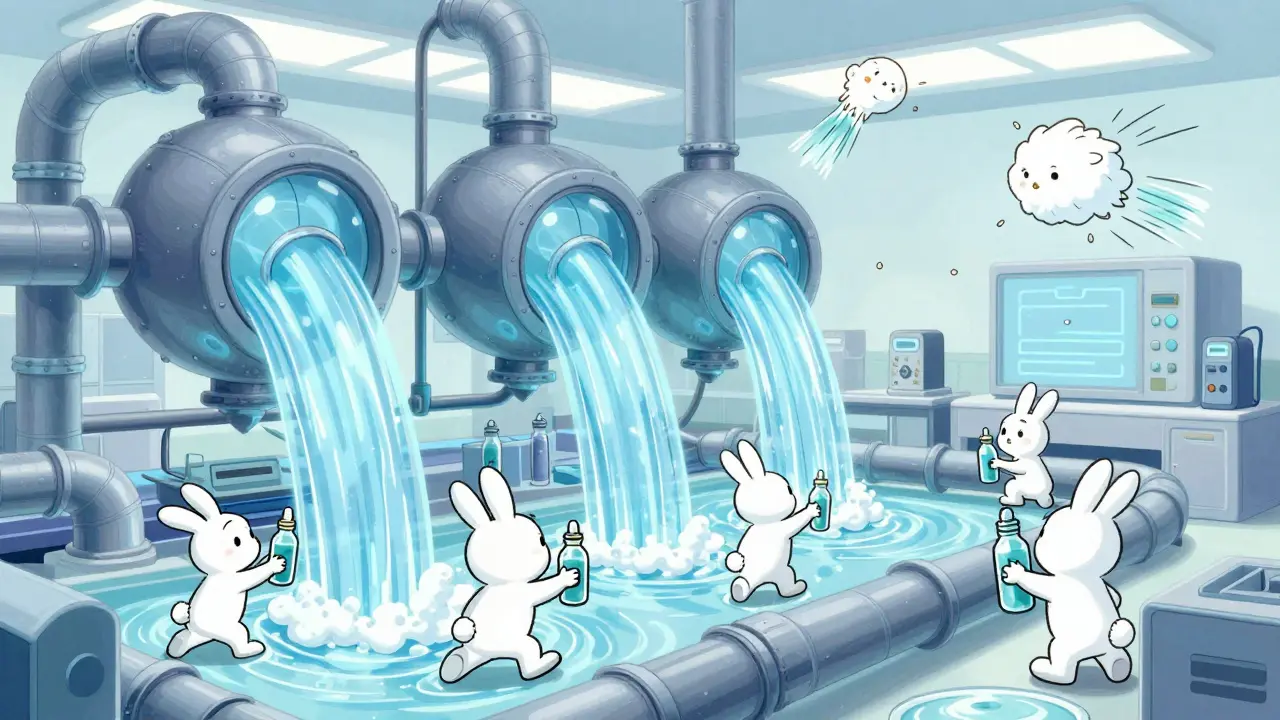
When you take a generic pill, you expect it to work just like the brand-name version. But behind that simple promise is a complex, tightly controlled environment - a cleanroom - where every particle, breath, and movement is monitored to ensure the drug is safe and effective. For generic drug manufacturers, cleanroom standards aren’t just about following rules. They’re the difference between a product that saves lives and one that could put them at risk.
Why Cleanrooms Matter More for Generics
Generic drugs make up over 90% of prescriptions filled in the U.S. But unlike brand-name companies, generic manufacturers don’t get to start from scratch. They must prove their product is bioequivalent to the original - meaning it behaves the same way in the body. That’s not just about chemistry. It’s about environment. If a sterile injectable generic contains even a single extra particle or microbe, it can cause infections, allergic reactions, or worse. The 2012 New England Compounding Center outbreak, which killed 64 people and sickened over 750, wasn’t caused by bad ingredients. It was caused by a dirty room. That’s why regulators treat cleanrooms like a pharmacy’s first line of defense. For innovators, cleanrooms are part of the R&D investment. For generics, they’re a non-negotiable cost. And with profit margins often under 20%, the pressure is intense. But cutting corners isn’t an option. The FDA issued 228 warning letters in 2022 for cGMP violations - and 63% of those were tied to environmental controls.The Four Grades of Cleanrooms Explained
Cleanrooms aren’t all the same. They’re divided into four levels, called Grades A through D, based on how clean the air must be. These aren’t arbitrary numbers. They’re backed by science and enforced by law.- Grade A (ISO Class 5): This is where sterile products are filled. Think IV bags, eye drops, or injectables. The air must have no more than 3,520 particles per cubic meter that are 0.5 microns or larger. That’s like having just 3.5 grains of sand in a small car. Air moves in a smooth, unidirectional flow - like a silent waterfall - to push contaminants away from the product. Temperature stays between 18-26°C, humidity at 30-60%.
- Grade B (ISO Class 5 at rest, ISO Class 7 during operation): This is the background area for Grade A. It’s where operators prepare materials before they enter the critical zone. Particle limits jump to 3.5 million during operation, but continuous monitoring is required.
- Grade C (ISO Class 7 at rest, ISO Class 8 during operation): Used for less critical steps like mixing non-sterile ingredients or packaging. Particle limits hit 35 million during operation. At least 20 air changes per hour are needed.
- Grade D (ISO Class 8 at rest): The lowest level. Used for storage or preliminary preparation. Only 10 air changes per hour are required. No operational particle limits - just a baseline.
Regulatory Differences: FDA vs. EU vs. Global
The U.S. FDA doesn’t always spell out ISO classes in its rules. Instead, it says: “Design your facility to prevent contamination.” That sounds vague, but it’s intentional. The agency focuses on outcomes - not just numbers. The European Union, through EudraLex Volume 4, is much more specific. Their 2023 revision of Annex 1 demands continuous particle monitoring, real-time microbial detection, and a full contamination control strategy. It’s not enough to pass a test once a week. You have to prove you’re always in control. Japan’s rules match ICH standards but add a twist: they require monitoring at 1.0 micron particle size, not just 0.5. India and China are catching up fast, but many older facilities still struggle to meet even basic Grade C standards. The cost to upgrade a facility in India averages $4.2 million - nearly 50% more than in the U.S. because of outdated infrastructure. And then there’s USP Chapter <797>, which governs compounding pharmacies. It allows ISO Class 7 buffer rooms - far less strict than the ISO Class 5 required for manufacturing sterile injectables. That’s fine for a hospital pharmacy mixing a single dose. Not for a factory producing millions.
The Real Cost of Cleanrooms
Building a Grade A cleanroom isn’t like building a lab. It’s like building a spaceship. A single ISO Class 5 room can cost between $250 and $500 per square foot to install. For a medium-sized facility, that’s tens of millions. HVAC systems alone can cost $2 million and take over a year to install. And that’s just the start. Then there’s ongoing costs: HEPA filters replaced every 2-3 years, continuous monitoring systems ($50,000-$100,000 per room), staff training (40-60 hours just to gown properly), and daily validation logs. A Pfizer facility that upgraded from Grade C to Grade B spent $2.3 million and lost 14 months of production - but saved $8.5 million a year by preventing out-of-spec batches. For small generic manufacturers, this is brutal. One Reddit user shared that maintaining Grade A for a $0.50-per-unit heparin syringe made the business unprofitable after the third FDA inspection flagged minor particle spikes. That’s the reality: cleanrooms protect patients - but they can break small companies.Where Cleanroom Standards Are Failing - and Where They’re Working
Not everyone agrees that stricter is always better. Dr. Paul K. S. Shin, editor of the PDA Journal, argues that Grade C requirements for oral tablets are excessive. A 2020 study showed no difference in dissolution rates between products made in Grade D versus Grade C environments. So why spend $1 million extra? But for sterile products? There’s no debate. The FDA found that 42% of complete response letters for sterile generics in 2022 cited environmental monitoring failures - up from 31% in 2018. That’s not coincidence. Regulators are watching closer. Success stories prove it’s possible. Teva’s generic version of Copaxone was rejected twice before they installed advanced isolators in their Grade A area. Contamination events dropped from 12 per year to 2. Approval followed. Failures are louder. In 2022, Aurobindo Pharma paid a $137 million recall bill after inadequate Grade B monitoring led to contaminated injectables. The FDA issued a consent decree - meaning they now monitor the company’s every move.
What Manufacturers Need to Do Now
If you’re running a generic drug facility, here’s what you need to focus on:- Know your grade. Are you making sterile products? Then you need Grade A/B. Oral solids? Grade C may be enough - but check your product’s specific guidance.
- Monitor continuously. One-time air tests aren’t enough. Real-time particle and microbial sensors are now mandatory under EU Annex 1 and expected by the FDA.
- Train like it’s life or death. 68% of generic manufacturers say personnel gowning is their top source of deviations. That’s not a technical issue - it’s a human one. Invest in hands-on training, not just videos.
- Document everything. You need 15-20 SOPs covering everything from gowning to filter replacement. If you can’t prove you did it, the FDA assumes you didn’t.
- Plan for climate. In tropical regions, humidity control can add 30% to HVAC costs. Special dehumidifiers aren’t optional - they’re essential.
The Future: Automation, Biosimilars, and AI
Cleanroom standards aren’t staying the same. The EU’s 2023 Annex 1 update is just the beginning. The FDA is expected to align with it soon. New technologies are changing the game. Single-use systems (like disposable bioreactors) are cutting contamination risks. Robotics are replacing human movement in Grade A zones. AI-powered monitoring can predict contamination before it happens. McKinsey predicts automation will cut cleanroom operating costs by 25-30% by 2028. That’s huge for generics. But the rise of biosimilars - complex biologic drugs - means even stricter controls are coming. By 2025, half of all new generic applications will require Grade A/B environments, up from 35% today. The message is clear: cleanrooms are no longer a cost center. They’re a quality engine. The companies that treat them as such will survive. The ones that see them as a burden? They’ll be the next recall headline.What happens if a generic drug facility fails a cleanroom inspection?
Failure can trigger an FDA Form 483 (observation), a warning letter, or even an import alert that blocks shipments. Repeated violations lead to consent decrees - court-enforced oversight - and costly recalls. In 2022, Aurobindo Pharma paid $137 million in recalls after Grade B monitoring failures. The FDA may also delay or reject new product applications until the issues are fully resolved.
Do all generic drugs need Grade A cleanrooms?
No. Only sterile products like injectables, eye drops, and inhalers require Grade A and Grade B environments. Oral tablets, capsules, and creams typically only need Grade C or D. But product-specific FDA guidance can override general rules - always check the agency’s official recommendations for your drug type.
Is ISO 14644-1 the same worldwide?
Yes, ISO 14644-1 is the global standard for cleanroom classification by particle count. The U.S., EU, Japan, and most other countries use it as the technical basis. However, regulatory agencies like the FDA and EMA add their own operational requirements - like continuous monitoring or microbial limits - that go beyond the ISO standard.
Can a generic drug be approved without meeting EU Annex 1 standards?
For markets like the U.S., FDA cGMP rules apply. But if you want to sell in Europe, you must comply with EU GMP Annex 1. Many global manufacturers build facilities to meet the stricter standard so they can export worldwide. The FDA has signaled it will harmonize with Annex 1, so even U.S.-only facilities are moving toward these requirements.
How often should cleanroom air be tested?
Continuous monitoring is now expected for Grade A and B areas under EU Annex 1 and FDA guidance. For routine checks, particle counts should be sampled at least daily during operations. Viable air (microbial) sampling should occur at least weekly, and more often during high-risk activities like sterilization or maintenance. Documentation of every test is mandatory.
Comments (8)
Kishor Raibole
26 Dec, 2025The adherence to ISO 14644-1 standards in generic pharmaceutical manufacturing is not merely a regulatory formality; it is an ontological imperative for the preservation of public health. The notion that cost-cutting can be rationalized in the context of sterile production environments is not only economically myopic but ethically indefensible. The 2012 NECC tragedy remains a stark reminder that microbial integrity is non-negotiable, irrespective of profit margins or market pressures. To equate cleanroom classification with operational expense is to fundamentally misunderstand the nature of pharmaceutical quality assurance.
John Barron
27 Dec, 2025Let’s be real - the FDA’s ‘design to prevent contamination’ approach is just bureaucratic vagueness dressed up as flexibility. 😒 Meanwhile, the EU is out here requiring real-time microbial sensors like it’s 2050. 🤖🧫 If you’re still doing weekly air sampling for Grade A, you’re one inspection away from a consent decree. The future isn’t ‘compliant’ - it’s continuous, automated, and data-driven. No exceptions.
Chris Garcia
29 Dec, 2025In the heart of Lagos, where power outages last for hours and water quality remains a daily struggle, the dream of Grade A cleanrooms feels like a distant constellation. Yet, the global pharmaceutical supply chain does not pause for infrastructure gaps. We must ask: Is equity in medicine possible when compliance costs eclipse the GDP of entire nations? The answer lies not in replication of Western standards, but in innovation - modular, solar-powered, low-maintenance cleanroom systems designed for the Global South. The world does not need more FDA warnings - it needs accessible solutions.
James Bowers
30 Dec, 2025Anyone who thinks Grade C is sufficient for oral solids hasn’t read the 2020 PDA study in full. The study explicitly stated that ‘no difference was observed under controlled, short-term conditions.’ Real-world manufacturing involves humidity swings, personnel turnover, and maintenance windows - all of which introduce variability. What passes as ‘acceptable’ in a lab setting collapses under production volume. This isn’t theory - it’s liability waiting to happen.
Will Neitzer
31 Dec, 2025Let me say this with absolute clarity: cleanrooms are not an expense - they are the foundation of trust. Every time a patient swallows a generic pill, they are placing their life in the hands of a facility they will never see. That trust is built not through marketing, but through rigorous environmental control. The $2.3 million investment by Pfizer? That wasn’t a cost - it was an insurance policy against catastrophe. And the return? Not just in dollars, but in lives preserved. Let us not mistake efficiency for economy when human health is the currency.
Janice Holmes
1 Jan, 2026Okay but let’s talk about gowning. 😩 Like, 68% of deviations? That’s not a process failure - that’s a cultural one. People are not robots. You can’t train someone to wear a bunny suit for 8 hours and expect them to move like a ballet dancer. We need better materials, better designs, and better psychology. No more 40-hour video lectures. We need immersive sims, VR gowning labs, and real-time feedback. This isn’t compliance - it’s behavioral engineering.
Alex Lopez
3 Jan, 2026So we’re spending $4.2 million in India to upgrade to Grade C… and the FDA still flags them? 😅 Classic. Maybe instead of forcing every developing nation to replicate U.S. infrastructure, we should just accept that some products don’t need ISO Class 5. If it’s an oral tablet, let it be Grade D. Save the spaceship-level tech for injectables. Otherwise, we’re just pricing out the world’s access to medicine. Efficiency isn’t about perfection - it’s about proportion.
Gerald Tardif
4 Jan, 2026One small manufacturer in Ohio told me they got hit with a warning letter because a technician sneezed during a fill. No one was sick. No contamination found. But the log showed a momentary spike. They spent $180K on new gowning protocols and a real-time particle counter. Got approved six months later. The system’s broken - not because of bad intent, but because it punishes micro-moments, not macro-outcomes. We need risk-based thinking, not checklist tyranny.