
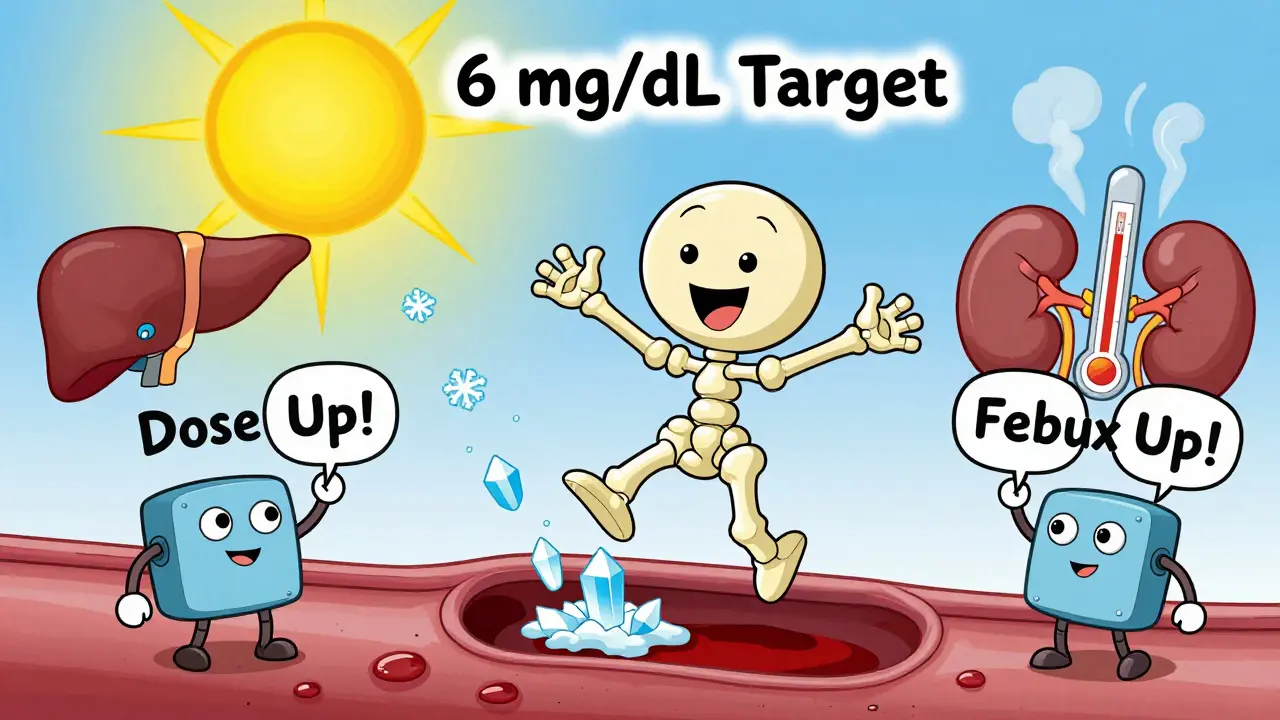
Most people think gout is just about painful toes and late-night flare-ups. But if you’ve been told you need to lower your urate levels, you’re not just treating pain-you’re stopping the disease before it destroys your joints. The goal isn’t to feel better for a few weeks. It’s to keep your serum urate below 6 mg/dL, long term. And that’s where allopurinol and febuxostat come in.
What Does "Urate Target" Even Mean?
Your body makes uric acid when it breaks down purines-found in meat, seafood, and even some veggies. When there’s too much, it forms sharp crystals in your joints. That’s gout. But here’s the key: those crystals don’t just appear out of nowhere. They form when your blood urate level hits 6.8 mg/dL or higher. That’s the saturation point. So the target? Stay below 6 mg/dL (that’s 360 micromol/L). That’s not a suggestion. It’s the minimum. At this level, crystals stop forming. Over time, they even start to dissolve. For some people-with tophi (those lumps under the skin), frequent flares, or joint damage-the target drops to 5 mg/dL (300 micromol/L). Why? Because those crystals are stubborn. You need to push harder to make them disappear. And no, you don’t want to go too low. Below 3 mg/dL, there’s no extra benefit. It just increases risk without reward.Allopurinol: The Workhorse of Gout Treatment
Allopurinol has been around since the 1960s. It’s cheap. Generic versions cost $4 to $12 a month in the U.S. And it’s still the first choice for most guidelines, including the 2020 American College of Rheumatology (ACR) and 2023 EULAR recommendations. How it works: allopurinol blocks the enzyme that makes uric acid. Simple. Effective. But here’s the catch-most people don’t take enough. Doctors often start at 100 mg a day. For someone with kidney issues, maybe 50 mg. But that’s not enough for most. Real-world data from New Zealand shows 30-50% of patients need more than 300 mg daily. Some need 600 mg. Even 800 mg. And guess what? When you dose right, 75-80% of people with normal kidneys hit the 6 mg/dL target. The problem? Too many patients stop because they get a flare right after starting. That’s not a reason to quit. That’s a sign you’re on the right track. As crystals dissolve, they stir up inflammation. It’s temporary. Keep going. Your doctor should have you on a plan: check your urate every 4 weeks. Increase the dose by 50-100 mg each time until you’re at target. Don’t wait three months. Don’t just assume “it’s working.” Test it.Febuxostat: The Alternative When Allopurinol Isn’t Enough
Febuxostat works the same way-blocks uric acid production-but it’s stronger per milligram. It’s also easier on the kidneys. That’s why NICE guidelines in the UK say it’s just as good as allopurinol as a first-line option. And in patients with severe kidney disease, a 2023 meta-analysis found febuxostat helped 15% more people reach their target. It starts at 40 mg a day. If urate doesn’t drop after a few months, bump it to 80 mg. That’s it. No need to titrate up slowly like allopurinol. But it’s pricier: $30 to $50 a month. And it’s not for everyone. The FDA has a warning about heart-related risks in people with existing heart disease. If you’ve had a heart attack or stroke, allopurinol is still safer. One thing both drugs share: they don’t work overnight. It takes months to see the real benefit. That’s why so many people give up. They feel worse at first. They don’t get tested. They think the medicine isn’t working. But if you stick with it, your flares will drop by 74%-that’s what pooled data from four major trials showed.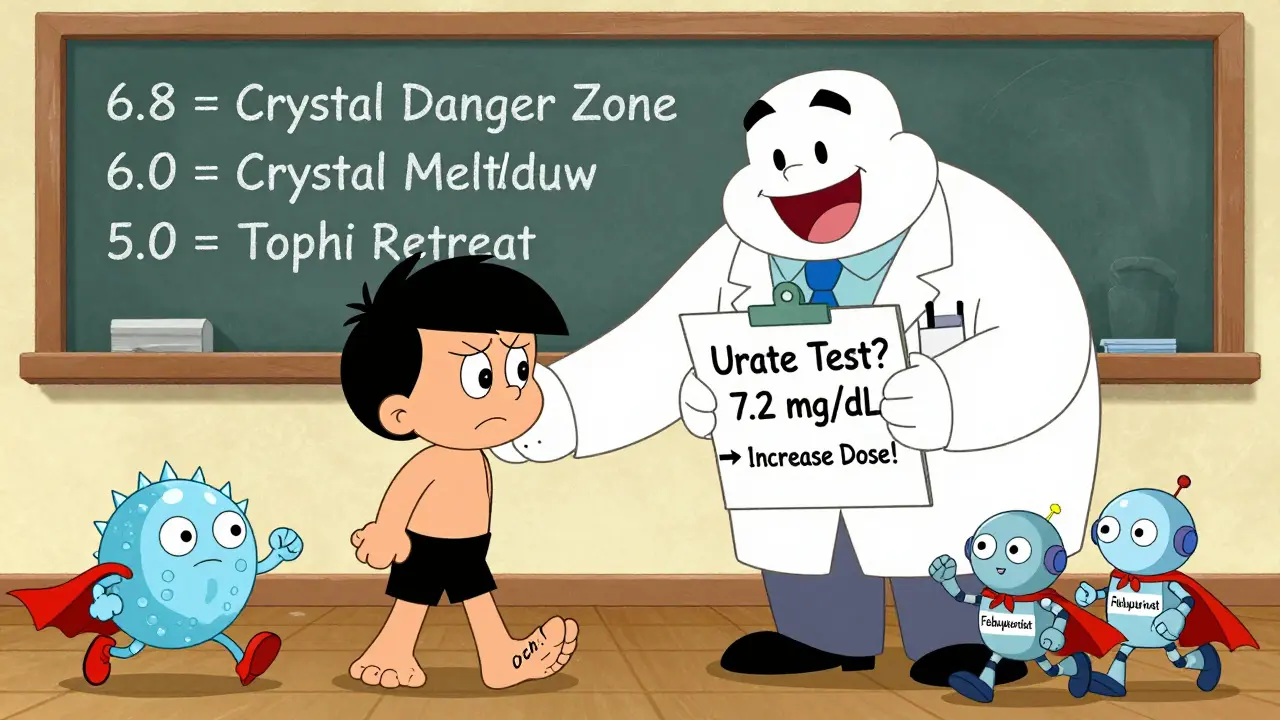
Why Most People Fail
Here’s the hard truth: only 42% of gout patients in New Zealand hit their urate target within a year. In the U.S., it’s even worse. Only 28% get the right dose. Why? Three big reasons:- Under-dosing. Doctors start too low and never increase. They think 300 mg is enough. It’s not for most.
- Missing tests. Only 54% of patients get their urate checked monthly during dose adjustments. You can’t manage what you don’t measure.
- Fear of side effects. Allopurinol hypersensitivity syndrome is rare-0.1-0.4% of users. But it’s deadly. And if you’re HLA-B*5801 positive (common in Asian, African, and Māori populations), your risk jumps 25-fold. Testing for that gene before starting allopurinol is now recommended in high-risk groups.
The New Science: Personalizing Treatment
We’re moving beyond one-size-fits-all. In March 2024, the GOUT-PRO study showed something revolutionary: using genetic testing to guide allopurinol dosing boosted target achievement from 61% to 83% in just six months. Why? Because some people’s bodies clear allopurinol too fast (ABCG2 gene) or don’t absorb it well (SLC22A12 gene). If you’re one of them, standard doses won’t work. But if you know your genes, you can start higher. No trial and error. No flares. Just results. And it’s not just genes. Dual-energy CT scans can now show exactly where urate crystals are hiding-even before they cause pain. The 2023 EULAR guidelines now talk about “treat-to-dissolve.” If your tophi are gone, you might be able to relax your target from 5 mg/dL back to 6 mg/dL. That’s huge. It means treatment can be tailored, not just forced.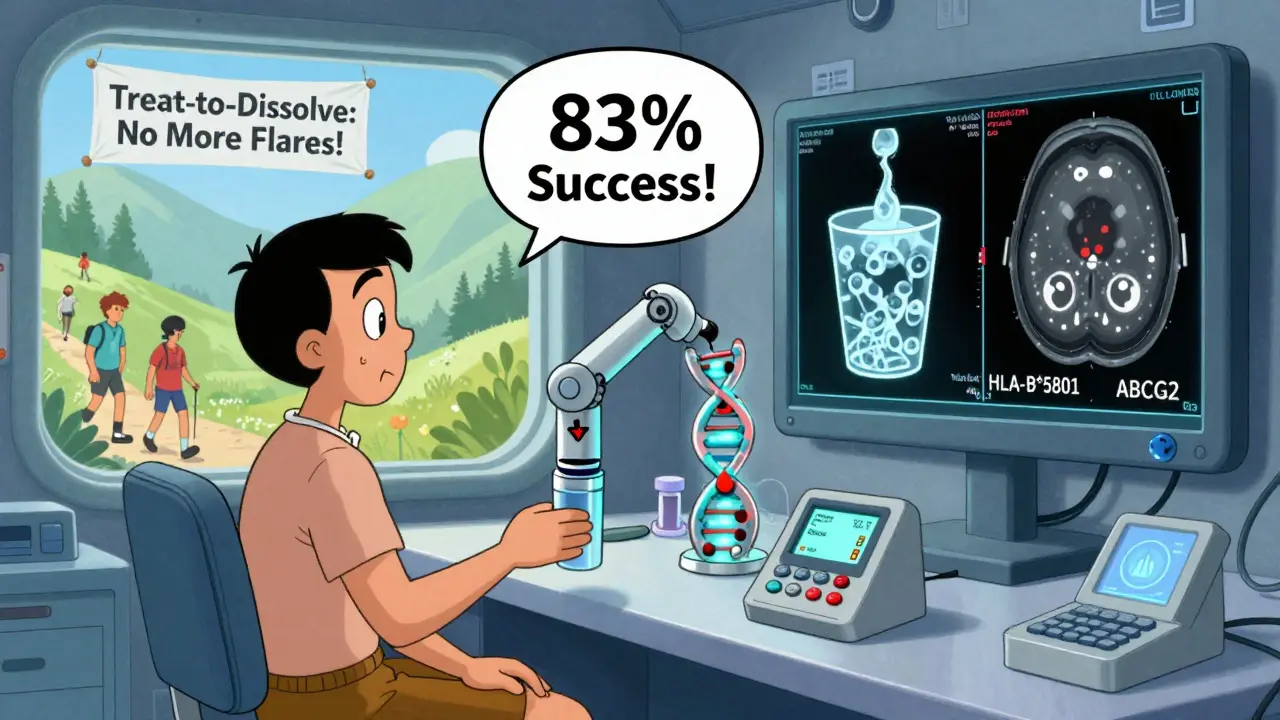
What You Need to Do Right Now
If you have gout and are on urate-lowering therapy:- Ask for your latest serum urate level. If you don’t know it, you’re not in control.
- If it’s above 6 mg/dL, ask if your dose can be increased. Don’t accept “it’s fine” if you’re still flaring.
- Request monthly urate checks during titration. That’s how you know you’re on track.
- If you’re Māori, Pacific, or of African/Asian descent, ask about HLA-B*5801 testing before starting allopurinol.
- If you have tophi or joint damage, ask if you should aim for 5 mg/dL instead.
Comments (13)
cara s
18 Mar, 2026So let me get this straight-we’re telling people with gout to take a daily pill for months before they see results, and we’re surprised they quit? I mean, who in their right mind sticks with a drug that makes them feel worse before it makes them better? No wonder compliance is trash. It’s not that people are lazy-it’s that the system doesn’t respect how human bodies actually work. We’re not robots. We need feedback. We need wins. Not a 6-month waiting game with flares as the only reward.
Suchi G.
19 Mar, 2026I’ve been on allopurinol for 3 years. First 4 months? Flares every week. I thought I was being poisoned. My doctor said, ‘It’s the crystals coming out.’ I didn’t believe him. Then one day, I woke up and my big toe didn’t scream when I stepped on the floor. I cried. Not because it was pain-free-but because I realized I’d been fighting myself the whole time. Stop blaming patients. Start teaching them this isn’t a cure. It’s a slow undoing. And you need patience like you need oxygen.
Laura Gabel
21 Mar, 2026Why are we still using 1960s drugs? Allopurinol? Really? We’ve got CRISPR and AI, but gout treatment is still ‘take this pill and hope it works.’ I get it’s cheap, but that’s not a virtue-it’s a failure. We’re treating a chronic disease like it’s a cold. We need better tools. Not just more pills.
Melissa Stansbury
22 Mar, 2026Also-why is no one talking about how the FDA warning on febuxostat is being used to scare people away from it? I’m a woman with kidney issues. My nephrologist said febuxostat was my best shot. But my rheumatologist refused to prescribe it because of ‘heart risks.’ Meanwhile, my urate stayed at 8.5. I switched anyway. My levels are at 5.8 now. And no heart attack. So maybe the warning is real-but maybe it’s also being weaponized by doctors who don’t want to think.
jerome Reverdy
22 Mar, 2026Let’s talk about the ABCG2 gene. I got tested after my third flare in 6 months. Turns out, I clear allopurinol 3x faster than average. My doc had me on 300 mg. I needed 800. I was told I was ‘non-compliant.’ I was just genetically misinformed. Now I’m crystal-free. Genetic testing isn’t luxury-it’s standard care. Why isn’t it covered? Why isn’t it automatic? This isn’t sci-fi. It’s 2024.
Andrew Muchmore
24 Mar, 2026Target is 6 mg/dL. If you’re still flaring at that level, you’re not trying hard enough. Simple. Stop making excuses. Get your numbers. Increase the dose. Test monthly. If your doc won’t do it, find a new one. This isn’t complicated. It’s arithmetic.
MALYN RICABLANCA
25 Mar, 2026Okay, but what if the crystals aren’t even the problem? What if the real issue is systemic inflammation from processed food, sugar, and stress? What if we’re all just walking around with leaky guts and our joints are the canary? Allopurinol doesn’t fix that. It just masks the symptom. And now we’re treating gout like a math problem when it’s actually a symptom of a broken system. We need to look upstream. Not just at the urate. At the soul.
Andrew Mamone
25 Mar, 2026My doc put me on colchicine for 6 months after starting allopurinol. Didn’t even ask. Just said, ‘This prevents flares.’ I thought it was a mistake. Turns out it was genius. 🤝 No more flares. No more fear. Just a pill and a peace of mind. Why isn’t this routine? Why do we still act like flares are ‘normal’? We’re not in the 1980s anymore.
Justin Archuletta
26 Mar, 2026My urate was 8.1. I hit 5.9 in 4 months. I didn’t change my diet. I just took 600mg allopurinol and got tested every 4 weeks. Done. It’s not magic. It’s math. And people who say ‘it didn’t work’? They stopped too soon. Or didn’t test. Or got scared. This isn’t rocket science. It’s basic.
becca roberts
27 Mar, 2026So… we’ve got a drug that costs $4/month and a drug that costs $50/month, and the cheaper one works better if you dose it right… but doctors don’t? And we’re still surprised people give up? 🤡
gemeika hernandez
28 Mar, 2026I tried allopurinol. Flared. Quit. Then tried febuxostat. Flared. Quit. Now I just eat celery and pray. I’m fine. Maybe the whole thing is overhyped. Maybe gout is just a punishment for eating too much steak. Who knows?
Amadi Kenneth
29 Mar, 2026Wait… so the FDA warns about heart risks with febuxostat… but the NIH says allopurinol is safe? But then they say HLA-B*5801 increases risk 25x? And they don’t test for it unless you’re Asian? What if this is all a Big Pharma scheme to sell more drugs? What if the real target isn’t urate… but profits? I’m not taking anything until I see the full clinical trial data. And I’m not sure I ever will.
Stephen Habegger
30 Mar, 2026You got this. It’s hard. But you’re not alone. Keep testing. Keep pushing. One day, you’ll wake up and forget what a flare feels like. And then you’ll realize-you did it.