

If you or someone you care about uses an inhaler, you’ve probably wondered: What’s the difference between a rescue inhaler and a maintenance inhaler? It’s not just about the shape or color-it’s about life and death. Mixing them up can land someone in the ER. Using the wrong one at the wrong time doesn’t just waste time-it delays critical treatment. And yet, thousands of people do it every year.
Rescue Inhalers: Your Fast-Acting Emergency Tool
Rescue inhalers are your go-to when your airways suddenly tighten. Think of them like a fire extinguisher: you don’t use them every day, but when you need them, you need them now.
These inhalers contain short-acting beta agonists (SABAs), most commonly albuterol (sold as Ventolin, ProAir, Proventil) or levalbuterol (Xopenex). They work by relaxing the muscles around your bronchial tubes within 1 to 5 minutes. That’s faster than most painkillers kick in. Peak relief usually hits around 10 minutes, and the effect lasts 4 to 6 hours.
They’re not designed to prevent symptoms. They don’t touch the inflammation deep in your lungs. That’s why using a rescue inhaler daily doesn’t make your asthma better-it just masks the problem. If you’re using your rescue inhaler more than twice a week (not counting exercise), your asthma isn’t under control. That’s a red flag from the American Lung Association.
Proper technique matters. Breathe in slowly for 5 to 7 seconds, then hold your breath for 10 seconds. Do that right, and you get 30-40% of the medicine into your lungs. Do it wrong? You might only get 10-15%. That’s why your doctor should watch you use it at least once.
Maintenance Inhalers: The Daily Shield
Maintenance inhalers are the quiet heroes. You don’t feel them working. You won’t notice immediate relief. But over weeks, they quietly reduce swelling and mucus in your airways-keeping flare-ups from happening in the first place.
These are mostly inhaled corticosteroids (ICS) like fluticasone (Flovent) or budesonide (Pulmicort). Some also include long-acting beta agonists (LABAs), like formoterol or salmeterol, in combination inhalers such as Symbicort or Advair.
Unlike rescue inhalers, these take time. You won’t feel better after the first puff. It takes 24 to 48 hours for the anti-inflammatory effect to start. Full benefit? That usually takes 1 to 3 weeks of daily use. That’s why people stop taking them-they think they’re not working. But skipping doses is like turning off your smoke detector because you haven’t had a fire yet.
Studies show consistent use cuts asthma attacks by 40-60%. One Cochrane Review of over 15,000 patients confirmed this. But here’s the catch: if you miss just 20% of your doses-say, 3 days out of 15-you lose nearly half the protection.
Why Mixing Them Up Is Dangerous
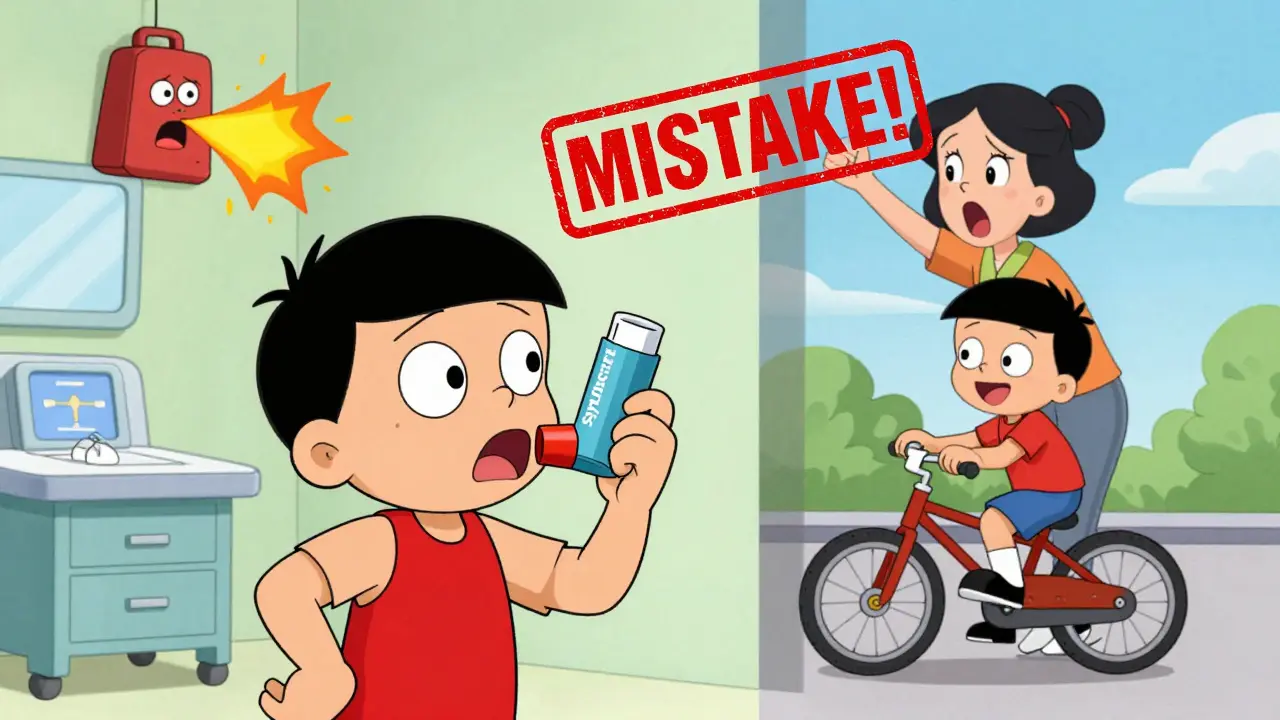
Here’s a real case: a 9-year-old boy at summer camp had an asthma attack. He grabbed his red inhaler-the one he saw his mom use every morning. It was Symbicort, a maintenance inhaler. He puffed it for 12 minutes while his breathing got worse. By the time he got to the nurse, he was in distress. He needed albuterol. He got anti-inflammatory medicine instead.
This isn’t rare. The Institute for Safe Medication Practices logged over 1,200 mix-ups in 2022 alone. Many inhalers look identical-same size, same color, same plastic casing. Some are even labeled the same way.
Doctors have seen patients use their maintenance inhaler as a rescue inhaler for months before ending up in the hospital. One Reddit user, ‘WheezingWalter,’ admitted he used his Symbicort like albuterol for three months. He thought it was helping. It wasn’t. His asthma was spiraling.
And the reverse is just as dangerous. Relying only on rescue inhalers means your lungs are constantly inflamed. Over time, that damages airway structure. You end up needing higher doses of medicine just to keep breathing. That’s why 38% of near-fatal asthma cases involve people who never used maintenance therapy.

What’s Changing: The New Single-Inhaler Approach
The rules are shifting. For years, the standard was two inhalers: one for daily use, one for emergencies. But new guidelines from GINA (Global Initiative for Asthma) and the American Thoracic Society now recommend a different path for many people.
For mild asthma, the best option might be just one inhaler: Symbicort (budesonide + formoterol). Formoterol works fast-like a rescue inhaler-and budesonide works long-term, like a controller. You use it only when you need relief. That’s called SMART therapy (Single Inhaler Maintenance and Reliever Therapy).
This approach cuts confusion. It reduces the chance of someone grabbing the wrong device. It also means you’re getting anti-inflammatory medicine every time you use it-even if you’re only using it occasionally. Studies show this leads to fewer flare-ups than using a separate rescue inhaler.
By 2027, experts predict 60% of new asthma patients will start with a single-inhaler regimen. The FDA has already started requiring distinct color-coding on new inhalers-red for rescue, blue for maintenance-to help prevent mix-ups.
How to Tell Them Apart
Don’t rely on memory. Use clear, physical cues:
- Color: Rescue inhalers are usually red or orange. Maintenance inhalers are often blue, purple, or brown. (But always check the label-colors vary by brand.)
- Label: Look for words like “for daily use,” “controller,” or “preventer.” Rescue inhalers say “as needed,” “reliever,” or “emergency.”
- Expiration: Rescue inhalers last about 12 months after opening. Maintenance inhalers last 3-6 months, depending on the type. Write the opening date on the device.
- Storage: Keep both below 30°C (86°F). Don’t leave them in a hot car or by the window.
Some pharmacies offer color-coded caps or stickers. Ask for them. If you’re unsure, ask your pharmacist to show you the difference.
Cost and Access: The Hidden Barrier
Here’s the ugly truth: many people skip their maintenance inhaler because it’s too expensive.
Generic albuterol rescue inhalers cost $35-$50 without insurance. But maintenance inhalers like Symbicort or Advair can run $300-$350 a month. Even with insurance, copays often exceed $50. A 2024 Kaiser Family Foundation survey found 42% of asthma patients skip doses because of cost.
That’s not just bad for your health-it’s bad for the system. People who skip maintenance end up in the ER, where one visit can cost over $5,000. Preventive care is cheaper. Ask your doctor about patient assistance programs. Many drugmakers offer free or low-cost options if you qualify.
What You Should Track
Keep a simple log. Use your phone, a notebook, or a printed asthma action plan from the American Lung Association. Track:
- How many times you use your rescue inhaler per week
- Any nighttime symptoms (waking up wheezing)
- Any activity you had to skip because of breathing trouble
If you’re using your rescue inhaler more than twice a week, it’s time to talk to your doctor. That’s the universal sign your asthma isn’t controlled.
And if you’re using your maintenance inhaler and still need rescue puffs often? That’s not normal. It means your dose might be too low-or you’re not using it right.
What’s Coming Next
Researchers are testing ultra-fast corticosteroid inhalers that work in under 90 seconds. If approved, they could blur the line between rescue and maintenance even further.
Meanwhile, digital inhalers with sensors are being rolled out. These track when and how you use your device-and send reminders to your phone. Some even sync with your doctor’s system.
But the biggest change isn’t technological. It’s awareness. More people are learning that asthma isn’t about reacting to attacks-it’s about preventing them.
Rescue inhalers save lives in the moment. Maintenance inhalers save lives over time. You need both-unless your doctor says you don’t.
Comments (9)
Layla Anna
1 Jan, 2026My grandma uses two inhalers and still mixes them up 😅 I put a red sticker on hers and wrote 'EMERGENCY ONLY' in big letters. She laughs now but she used to get mad when I 'meddled' 🙃
Heather Josey
1 Jan, 2026This is an exceptionally clear and vital explanation. The distinction between rescue and maintenance inhalers is not merely medical-it’s a matter of long-term pulmonary health and quality of life. I appreciate how the article highlights both clinical data and real-world misuse patterns. Healthcare providers must prioritize patient education on this topic, especially for elderly and non-native English-speaking populations. The color-coding initiative by the FDA is a necessary step forward.
Olukayode Oguntulu
2 Jan, 2026Let’s deconstruct the epistemology of inhaler utility. The binary paradigm of rescue vs. maintenance is a colonial construct of biomedical hegemony. Why must we reduce pulmonary resilience to pharmacological binaries? The body is not a machine with two switches. The real issue is systemic neglect-the pharmaceutical-industrial complex profits from perpetual crisis management. Symbicort as SMART therapy? That’s just repackaged capitalism with a nebulizer. We need a phenomenological approach to breath, not a pill schedule dictated by corporate formularies. The real emergency is capitalism, not asthma.
jaspreet sandhu
4 Jan, 2026You people talk too much about colors and stickers but the truth is most of you dont even know how to use the inhaler properly even if you have it for 10 years. I seen my cousin use his inhaler like a spray bottle and he thought he was fine. No one teaches you how to breathe right. You just get the thing and go. That’s why people end up in hospital. You think color helps? No. You need to watch someone do it and then do it yourself in front of them. No videos no apps just real person watching you. That’s how it was done in India 30 years ago and it worked.
Alex Warden
4 Jan, 2026Why are we letting Big Pharma dictate how we breathe? In America we have the best medicine in the world but people still die because they can't afford the blue inhaler. This is a national disgrace. If you can't afford your maintenance inhaler you should get it free. End of story. We spend billions on wars but people are gasping for air because of a $300 copay? That's not healthcare. That's cruelty with a prescription.
LIZETH DE PACHECO
5 Jan, 2026I’m a respiratory therapist and I can’t tell you how many times I’ve had patients tell me they stopped their maintenance inhaler because ‘it didn’t do anything.’ I always say: You didn’t feel it working because it was doing its job-preventing the attack you didn’t have. That’s the win. Keep going. You’re doing better than you think.
Lee M
6 Jan, 2026The real problem isn’t the inhalers-it’s the idea that asthma is something you can control with pills. Breathing is a spiritual act. When you rely on chemicals to stay alive, you’re surrendering your autonomy to a system that doesn’t care if you live or die as long as you keep buying. The body knows how to heal. The inhalers just mask the truth.
Kristen Russell
6 Jan, 2026My kid’s inhaler case has a little heart sticker on the red one. She points to it before she uses it. Simple. Works. We also have a chart on the fridge with stickers for each week she doesn’t need rescue puffs. She thinks it’s a game. It’s not. It’s saving her lungs.
Bryan Anderson
6 Jan, 2026Thank you for this thorough and compassionate overview. I’ve shared this with my elderly patients who often struggle with the distinction between their inhalers. Many have visual or cognitive impairments that make labeling difficult. The suggestion about color-coded caps from the pharmacy is brilliant-I’ll be requesting those for my next clinic visit. Also, the cost barrier point is critical. I’ve written letters to several pharmaceutical companies on behalf of patients for assistance programs. It’s not perfect, but it helps. Let’s keep pushing for accessibility.