
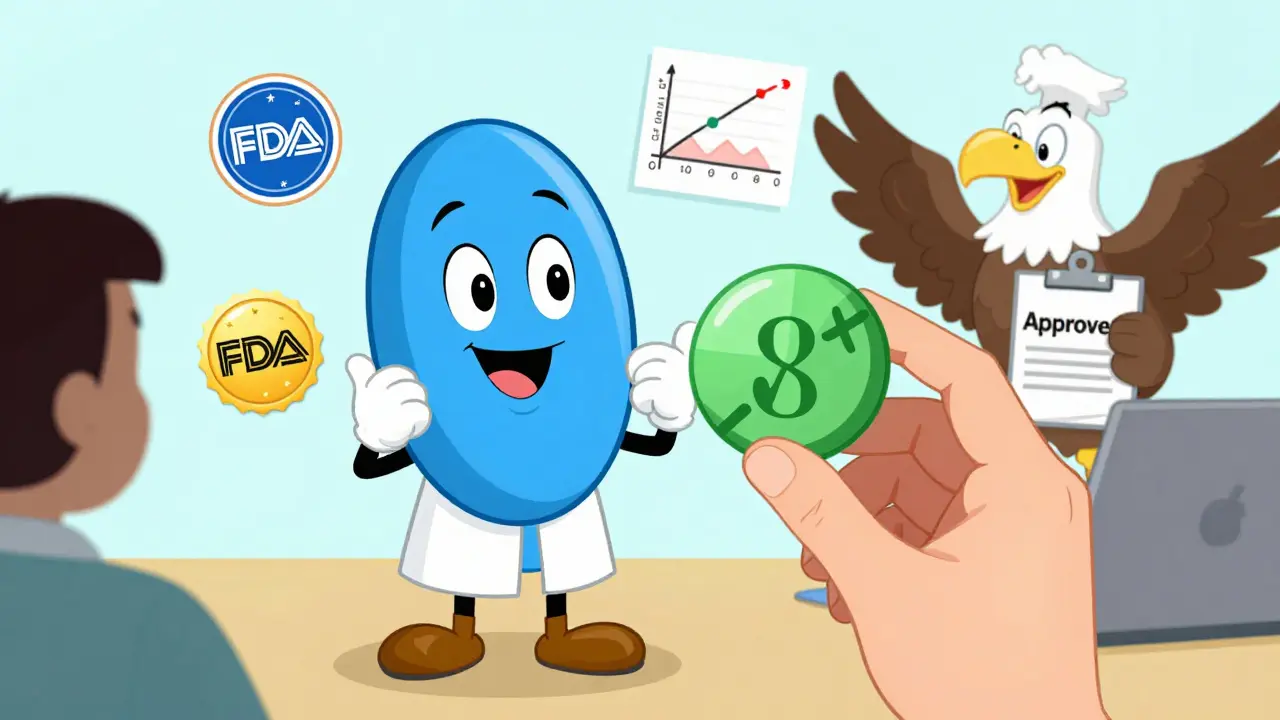
When you pick up a prescription, you might see two options: the brand-name pill you recognize from TV ads, or a cheaper generic version with a different color and shape. Many people wonder - is the generic just as safe? The answer isn’t just yes, it’s backed by a detailed, science-driven system run by the FDA the U.S. Food and Drug Administration, a federal agency responsible for protecting public health by ensuring the safety, efficacy, and security of drugs. Generics aren’t just cheaper copies. They’re required to be exact matches in how they work inside your body - and the FDA holds them to the same safety bar as brand-name drugs.
What Makes a Generic Drug Equivalent?
For a generic drug to get approved, it must pass a strict set of tests called the Abbreviated New Drug Application, or ANDA. This isn’t a shortcut because the FDA is being lazy - it’s a smart system built on decades of research. The brand-name drug, called the Reference Listed Drug (RLD), already went through years of testing. The generic doesn’t need to repeat all that. Instead, it has to prove one key thing: it behaves the same way in your body.
The FDA looks at two main measurements: Cmax and AUC. Cmax is the highest amount of the drug in your bloodstream after you take it. AUC measures how much of the drug your body is exposed to over time. For the generic to be approved, these numbers must fall within 80% to 125% of the brand-name drug’s values. That’s not a wide range - it’s a tight window designed to ensure you get the same effect. For example, if the brand drug gives you a Cmax of 100 ng/mL, the generic must land between 80 and 125 ng/mL. This applies to every single dose you take.
And it’s not just about how much gets into your blood. The generic must also have the same active ingredient, strength, dosage form (pill, injection, cream), and route of administration (oral, topical, etc.) as the brand. If the brand is a 10mg extended-release tablet taken by mouth, the generic has to be identical in all those ways. Even the way the pill breaks down in your stomach - called dissolution - must match the brand unless the manufacturer can prove a scientifically valid alternative.
Manufacturing Rules: No Compromises
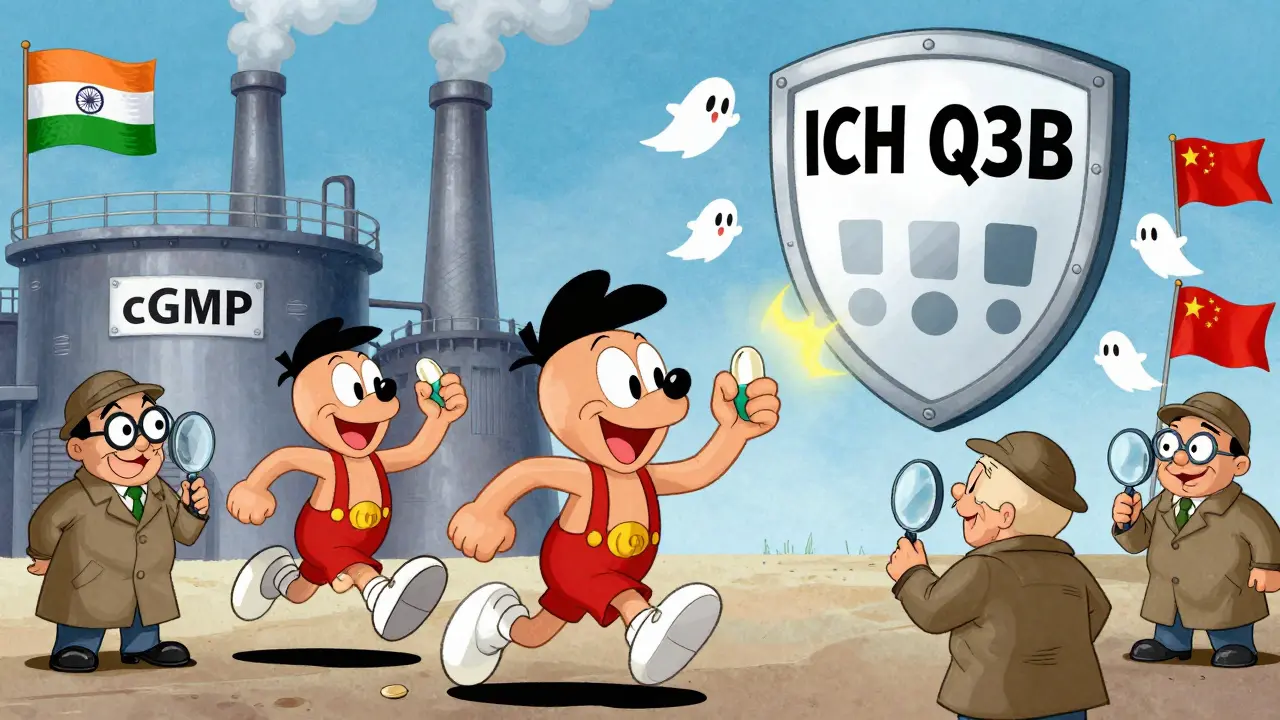
Generics aren’t made in basements or unregulated factories. Every facility that makes generic drugs - whether in the U.S., India, or China - must follow Current Good Manufacturing Practices, or cGMP. This means every step of production is documented: how machines are cleaned, how ingredients are weighed, how batches are tested. The FDA inspects these sites regularly, and about 40% of inspections now target overseas plants. In 2022, the FDA increased inspections of foreign facilities by 22% compared to 2020.
Impurities are tightly controlled. Even tiny amounts of leftover chemicals from the manufacturing process can be dangerous. The FDA uses international guidelines (ICH Q3B and ICH M7) to set limits. For example, a potentially carcinogenic impurity can’t exceed 1.5 micrograms per day - that’s less than a grain of salt. The FDA’s own 2021 review found that 15% of generics with safety concerns were linked to drugs with narrow therapeutic indexes, meaning the difference between a safe dose and a harmful one is very small. For these drugs - like warfarin or levothyroxine - the acceptable range is even tighter: 90% to 111% instead of 80% to 125%.
Labeling, Packaging, and What’s Left Out
Generic labels must match the brand’s exactly - except for a few allowed differences. You’ll see different company names, package sizes, or inactive ingredients (like dyes or fillers). That’s why your generic pill might be blue instead of green, or oval instead of round. These changes don’t affect how the drug works. But if the brand updates its safety label - say, adding a new warning about liver damage - the generic must update its label too. Before 2022, generics had to wait for the brand to update first. Now, under a new FDA rule, generics can update safety labeling independently. This closes a major gap that left patients at risk for years.
Complex Drugs: The Harder Cases
Not all drugs are created equal. Simple pills - like metformin or atorvastatin - are easy to copy. But inhalers, eye drops, creams, and injectables? They’re much harder. A generic inhaler must match the brand’s particle size, spray pattern, and how deeply the medicine reaches your lungs. A generic cream must spread and absorb the same way. The FDA reports that 25% more ANDAs for these complex products get rejected on first try compared to regular pills. In 2022, nearly 40% of complex generic applications were refused outright because manufacturers couldn’t prove equivalence.
That’s why the FDA launched the Complex Generic Drug Products Initiative in 2018. It’s a $50 million program funded by user fees to develop better testing methods. Some generics now require not just bioequivalence studies, but clinical endpoint studies - meaning real patients are monitored for outcomes. For example, a generic version of a multiple sclerosis drug might need to prove it reduces relapse rates just as well as the brand.
Real-World Evidence: Do Generics Work?
Over 90% of prescriptions in the U.S. are filled with generics. That’s over 8 billion prescriptions in 2022. And the data backs it up. A 2022 study in JAMA Internal Medicine looked at 38,000 Medicare patients taking statins. It found no difference in heart attack or stroke rates between brand and generic versions. Another analysis of 12,500 patient reviews on Drugs.com showed 87% reported no difference in effectiveness for cardiovascular meds.
But there are exceptions. A Reddit thread from January 2023 with over 1,200 comments revealed that 32% of users taking generic levothyroxine felt their symptoms returned - even though the FDA’s bioequivalence range for this drug is stricter than usual (90-110%). Pharmacists often see this too. Some patients report feeling different, even when tests show the drug levels are perfect. Why? It might be the inactive ingredients. A person allergic to a dye, or sensitive to a filler, might feel off - not because the active drug changed, but because their body reacted to something else in the pill.
Neurologists are split. A 2021 survey of 500 specialists found 68% had full confidence in generic antiseizure drugs. But only 42% felt the same about complex biologics like those used for MS. That’s not because the FDA’s standards are weak - it’s because the science for these drugs is still catching up.
Why Generics Save Billions Without Sacrificing Safety
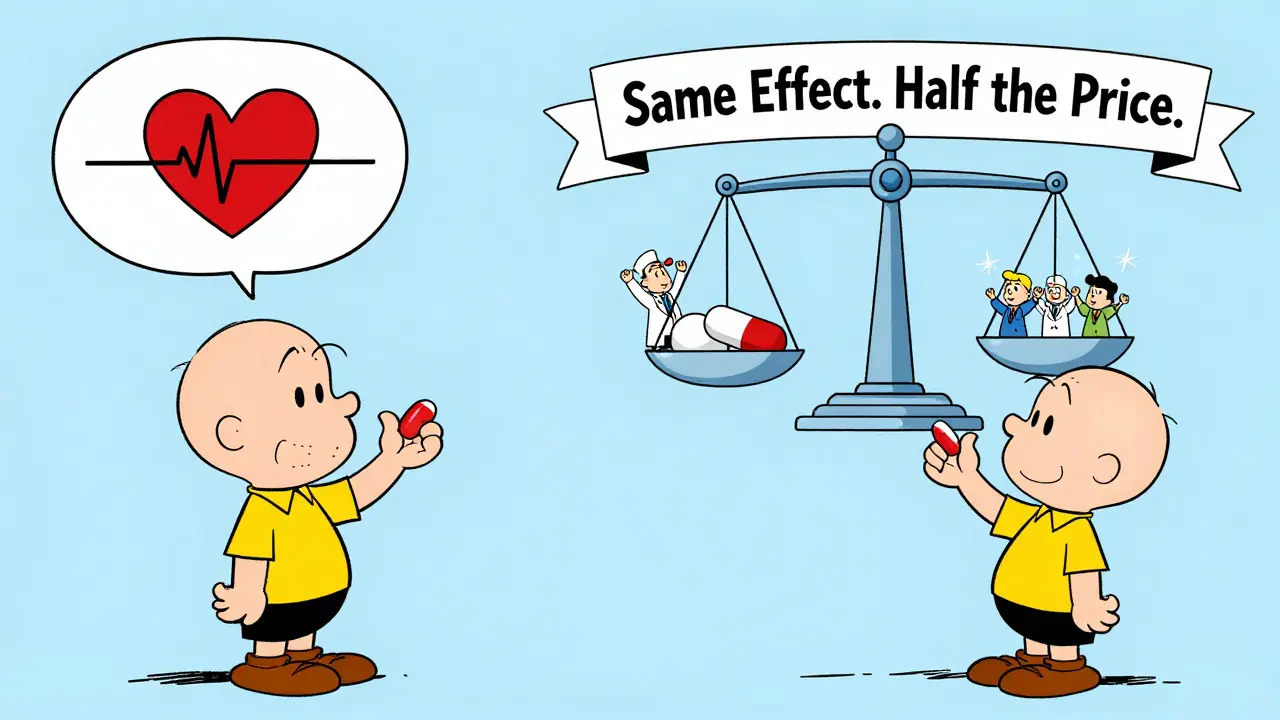
Generics make healthcare affordable. They make up 90% of prescriptions but only cost 23% of total drug spending. In 2022, that saved U.S. patients over $370 billion. Without generics, many people would skip their meds - or go bankrupt. The FDA’s system lets companies enter the market quickly without repeating costly clinical trials. The average ANDA takes 18 to 36 months to approve - but that’s still faster and cheaper than developing a new drug from scratch.
The FDA reviews about 1,000 ANDAs every year. Since 1984, over 20,000 generic products have been approved. The Office of Generic Drugs now offers more than 1,800 product-specific guidances - updated as recently as October 2023 for drugs like semaglutide injection. These documents tell manufacturers exactly what tests to run, down to the last detail. This transparency keeps the system fair and predictable.
What’s Next for Generic Drug Safety?
The FDA is investing in new tools. A pilot program with MIT is testing artificial intelligence to predict harmful impurities before they even appear in a batch. This could cut down on recalls and speed up approvals. The agency is also using advanced modeling to simulate how a drug behaves in the body - instead of always relying on human studies.
But the biggest challenge remains funding. The Congressional Budget Office warned in February 2023 that without a 15% increase in GDUFA funding by 2027, the FDA won’t be able to keep up with the growing number of complex generics. That’s not just about speed - it’s about safety. If reviewers are overwhelmed, standards slip.
For now, the system works. Generics are safe. They’re effective. And they’re held to the same standards as the drugs you see advertised on TV. The difference isn’t in quality - it’s in price. And that’s exactly what the FDA designed it to be.
Are generic drugs as safe as brand-name drugs?
Yes. The FDA requires generic drugs to meet the same safety, strength, quality, and performance standards as brand-name drugs. They contain the same active ingredient, work the same way in the body, and are made under the same strict manufacturing rules. The only differences allowed are in color, shape, flavor, or inactive ingredients - none of which affect how the drug works.
How does the FDA ensure generics are bioequivalent?
The FDA requires generics to prove bioequivalence through studies in healthy volunteers. These studies measure how quickly and completely the drug enters the bloodstream. The generic’s results must fall within 80% to 125% of the brand-name drug’s results for both peak concentration (Cmax) and total exposure (AUC). For drugs with narrow therapeutic indexes - like warfarin or levothyroxine - the range is tighter: 90% to 111%.
Can inactive ingredients in generics cause problems?
Yes, but rarely. While the active ingredient is identical, generics can use different fillers, dyes, or preservatives. For most people, this makes no difference. But some individuals may have allergies or sensitivities - for example, to lactose or a specific dye. If you notice side effects after switching to a generic, talk to your pharmacist or doctor. They can check if a change in inactive ingredients might be the cause.
Why are some generics rejected by the FDA?
Complex generics - like inhalers, eye drops, or injectables - often get rejected because it’s harder to prove they work the same way. The FDA may find that the drug doesn’t dissolve properly, doesn’t reach the right part of the body, or has inconsistent dosing. About 25% more ANDAs for these products get rejected on first review compared to simple pills. Manufacturers must then fix the issue and resubmit.
Do generics take longer to work than brand-name drugs?
No. If a generic is approved by the FDA, it works just as fast and just as long as the brand-name version. The bioequivalence tests ensure that the drug reaches the same peak level in your blood at the same time. Any delay you notice is likely due to individual factors - like what you ate before taking it - not the drug itself.
Is it safe to switch between different generic brands?
Yes. All FDA-approved generics for the same drug must meet the same bioequivalence standards. Switching between different generic manufacturers (say, from Teva to Mylan) is safe and common. The FDA monitors this closely, and there’s no evidence that switching between approved generics causes harm. If you have concerns, ask your pharmacist - but don’t assume one generic is better than another just because it’s made by a different company.
What to Do If You’re Concerned About Your Generic
If you feel your generic isn’t working like the brand did, write down your symptoms. Talk to your pharmacist. They can check if the inactive ingredients changed, or if your insurance switched you to a different manufacturer. Your doctor can also request the brand if medically necessary - though many insurers require prior authorization. Don’t stop taking your medication. Most of the time, the issue isn’t the drug - it’s your body adjusting to a new pill shape or a different filler. But if something feels wrong, speak up. The FDA’s reporting system for adverse events is there for a reason.
Comments (9)
Scott Conner
9 Feb, 2026i always thought generics were just knockoffs but this actually makes sense. like, if the body absorbs it the same way and the FDA checks every batch, why pay extra? my insurance pushes generics anyway, and i’ve been on the same one for years with no issues.
Alex Ogle
10 Feb, 2026you know what’s wild? the fact that the FDA lets generics use different dyes and fillers but still demands perfect bioequivalence. it’s like saying, ‘hey, your car’s engine has to perform exactly like a Ferrari, but the upholstery can be from a discount store.’ and somehow, it works. i’ve switched generics three times and never noticed a difference - except for the price, which is why i keep doing it. the system’s not perfect, but it’s way more rigorous than most people assume.
Brandon Osborne
11 Feb, 2026this is all a scam. the FDA is in bed with big pharma. they let these foreign factories pump out generics with sketchy ingredients because they’re too lazy to inspect them properly. i read a guy on Reddit who had a stroke after switching to a generic blood thinner - and the FDA didn’t even flag it. they don’t care about you. they care about profits. you think they’d let a generic drug pass if it was made in a basement in Bangladesh? they do. every day. and they call it science.
Marie Fontaine
12 Feb, 2026this is so cool!! i had no idea the FDA had such tight rules 😍 i just switched to a generic for my thyroid med and was nervous but now i feel way better knowing the science behind it 🙌 also, my pharmacist said the filler changed but it’s still safe!! so happy i didn’t panic 🥰
Lyle Whyatt
13 Feb, 2026i’m from Australia, and we’ve got a similar system here - the TGA, our version of the FDA. what’s fascinating is how much more transparent the U.S. process is. we don’t publish nearly as much data on bioequivalence thresholds. the fact that the FDA releases product-specific guidances for every single drug? that’s next-level. i’ve been following this for years, and honestly, the U.S. system is one of the few places where generic regulation feels like it’s actually designed to protect people, not just cut costs. i wish more countries adopted this level of detail.
Ryan Vargas
14 Feb, 2026the 80%–125% bioequivalence window is statistically absurd. if you’re measuring pharmacokinetics in a population of healthy volunteers, the variance alone should invalidate that range. you’re allowing a 45% deviation in peak concentration and a 45% deviation in total exposure - that’s not equivalence, that’s a gamble. and yet, we’re told to trust this because ‘the data shows no difference.’ but correlation isn’t causation. what about subpopulations? elderly patients? those with renal impairment? the FDA’s model assumes homogeneity where none exists. this isn’t science - it’s regulatory convenience dressed up as rigor.
Tasha Lake
15 Feb, 2026the ICH Q3B and M7 impurity thresholds are actually really impressive. 1.5 micrograms/day for carcinogens? that’s like saying ‘you can’t have more than 0.0000015% of a known mutagen in your daily dose.’ the analytical methods to detect that? insane. and the fact that they’re applying the same standards to generics made in India or China? that’s global harmonization at its best. most people don’t realize how much chemistry, statistics, and regulatory science goes into this. it’s not just ‘copy the pill’ - it’s precision engineering at the molecular level.
Sam Dickison
15 Feb, 2026i work in pharmacy, and honestly, the biggest issue isn’t the active ingredient - it’s the inactive ones. i’ve had patients come in saying, ‘my generic makes me nauseous’ - turns out it’s a new dye or filler they’re sensitive to. we keep a list of common culprits: lactose, FD&C dyes, magnesium stearate. switching brands sometimes fixes it. the FDA lets that slip through because it’s not ‘bioequivalence,’ but it’s real. so yeah, the science is solid - but the human factor? that’s where the real work happens.
Brett Pouser
17 Feb, 2026i’ve been on levothyroxine for 12 years. switched generics 5 times. felt weird once - like my energy dropped. didn’t stop taking it. called my pharmacist. they checked the batch. new filler. switched back to the old one. felt fine. point is: if you notice something off, don’t ignore it. talk to your pharmacist. they’re the ones who see this every day. the system works, but you gotta be your own advocate. no one else will.