
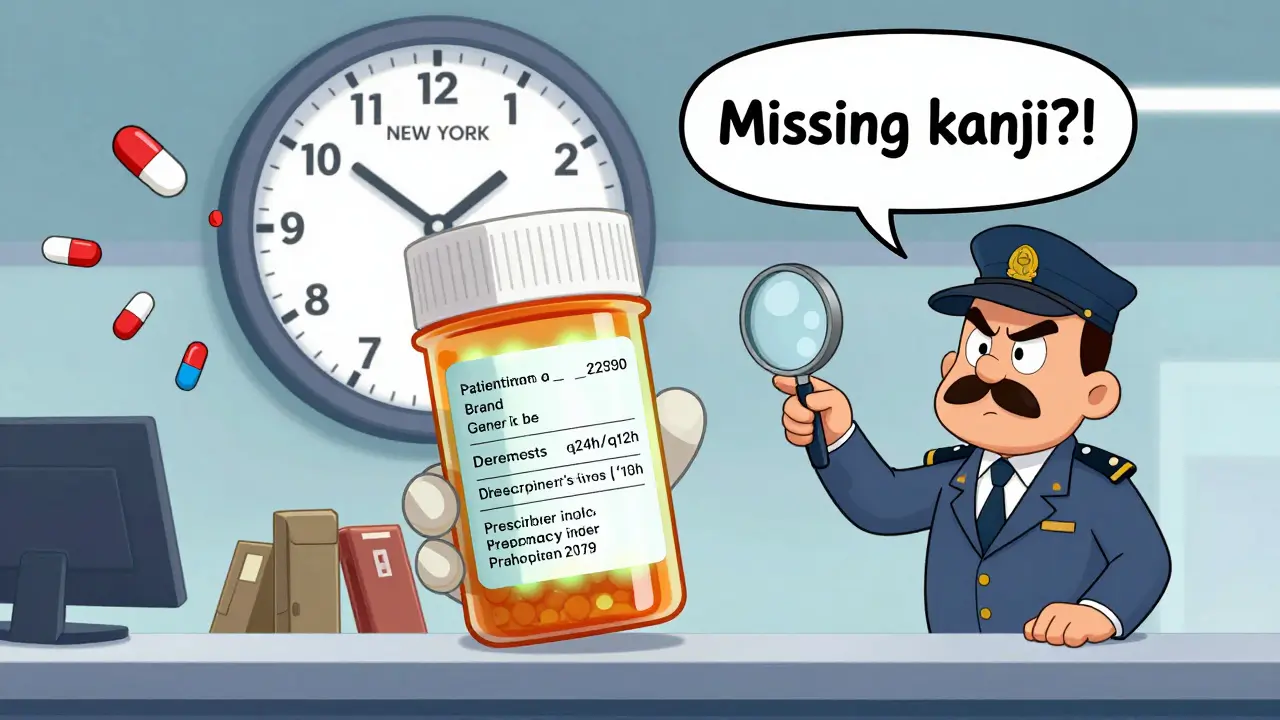
When you’re flying across time zones, your medication schedule doesn’t just shift-it can go dangerously wrong. Taking a pill at 8 a.m. in New York and then again at 8 a.m. in Tokyo means you’ve dosed yourself twice in six hours. That’s not a mistake you can afford with blood thinners, insulin, or seizure meds. The problem isn’t just confusion-it’s risk. According to International SOS, medication errors during travel contribute to over 70% of preventable medical evacuations, which can cost between $15,000 and $250,000. The fix isn’t complicated, but it requires knowing exactly what’s on your prescription label-and what’s missing.
What’s on Your Prescription Label? Seven Critical Pieces
Your prescription label isn’t just a receipt. It’s your medical passport. Before you pack your bag, check for these seven elements:- Patient name - Must match your passport exactly. Even a middle initial mismatch can trigger customs delays.
- Medication name - Both brand and generic names must appear. In Japan, for example, 68% of medications are identified by their generic name. If your label says "Advil" but not "ibuprofen," you might get stopped at customs.
- Dosage strength - Look for numbers like "5 mg" or "100 IU." Liquid meds should list concentration per milliliter (e.g., "2 mg/mL").
- Directions for use - This is the most important part. Avoid AM/PM. Look for terms like "q24h" (every 24 hours), "q12h" (every 12 hours), or "ac" (before meals). These use 24-hour time, not local clock habits.
- Prescriber info - Your doctor’s name and contact info. Some countries require this to verify legitimacy.
- Pharmacy details - Address and license number. This helps customs confirm the prescription is real.
- Prescription number - For tracking if questions arise.
If any of these are missing, ask your pharmacist to print a supplemental label. Many U.S. pharmacies now offer this for free-78% do, according to a 2023 Pharmacy Times audit.
Time Zones Don’t Care About Your Sleep Schedule
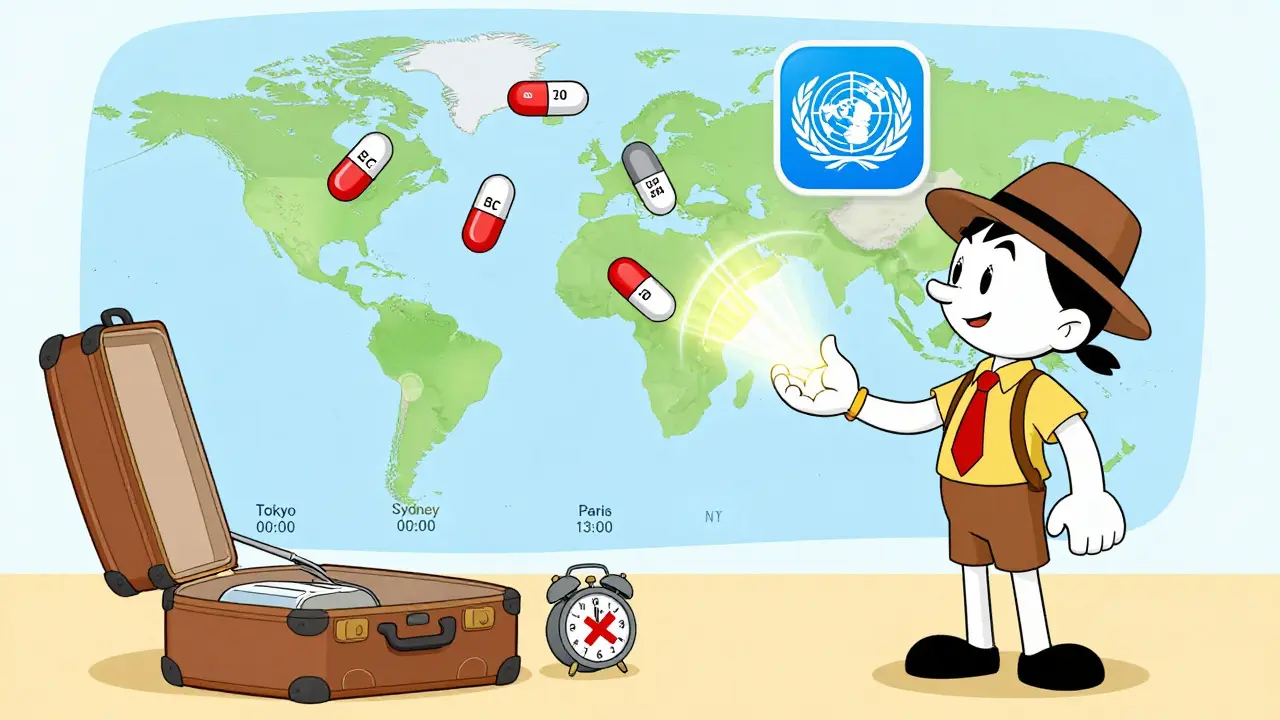
The biggest mistake travelers make? Trying to stick to home time. If you’re on a 12-hour time difference and take your blood pressure pill at 8 a.m. New York time, you’ll be taking it at 8 p.m. local time. That’s fine-if your body’s rhythm matches. But for time-sensitive meds like insulin, warfarin, or antibiotics, your body’s internal clock matters more than your watch.The best solution? Convert everything to Coordinated Universal Time (UTC). Why? Because UTC doesn’t change. It’s the same in Tokyo, Paris, or Santiago. Your pill schedule becomes a fixed point in time, not a moving target.
For example:
- Your label says: "Take 1 tablet at 8 a.m. daily."
- Convert 8 a.m. EST to UTC: 13:00 UTC.
- When you land in Sydney (UTC+11), take your pill at 13:00 UTC = 00:00 Sydney time.
Use the WHO’s free Medication Time Zone Converter app (downloaded over 287,000 times since 2022). It lets you input your prescription, select your travel route, and outputs a clear UTC schedule.
Dr. Susan Pisani, a pharmacist at Memorial Sloan Kettering, says: "The half-life of your drug tells you how urgently you need to adjust." A drug with a 4-hour half-life (like some antibiotics) needs immediate adjustment. A drug with a 24-hour half-life (like levothyroxine) can wait 2-3 days. Check your label for this info-or ask your pharmacist to add it.
Country Rules Vary-And They’re Not Always Obvious
You can’t assume your U.S. prescription will fly anywhere. Each country has its own rules:- Japan: Requires kanji characters for generic names. If your label only says "ibuprofen," you risk detention. A 2022 study found 43% of American travelers faced delays because of this.
- Thailand: Labels must include Thai text. English-only prescriptions are often confiscated.
- Saudi Arabia: Active ingredient must appear in Arabic. In Q1 2023, 22% of seized meds at Riyadh Airport had no Arabic label.
- European Union: Standardized across 27 countries, but patient name must be in the local language. If you’re traveling to Italy, your name should be printed as "Maria Rossi," not "Maria Ross."
- Caribbean nations (Jamaica, Barbados): Require English and Spanish. Only 37% of U.S. prescriptions meet this standard.
Don’t rely on a doctor’s note. Customs officers aren’t trained to read medical jargon. They need clear, compliant labels. The Universal Medication Travel Card (UMTC), adopted by 47 airlines as of March 2024, helps. It’s a digital card linked to your prescription that auto-checks destination rules. Ask your pharmacist if they can generate one.
What to Do 4-6 Weeks Before You Leave
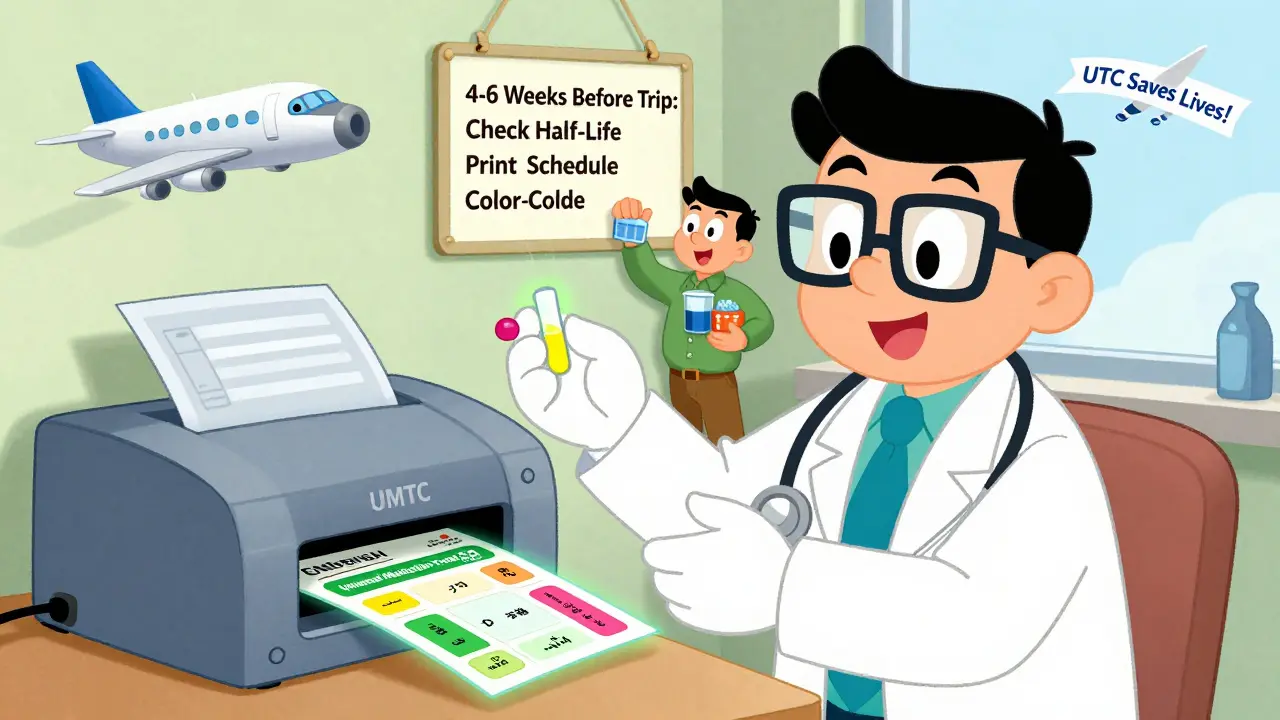
Preparation isn’t optional. Here’s your checklist:- Call your pharmacy and ask for a travel supplement label with UTC timing and multilingual generic names.
- Request a letter from your doctor listing all medications, doses, and medical conditions. Include your prescription numbers.
- Use the WHO Medication Time Zone Converter app to generate your personal schedule.
- Print your schedule and carry it with your prescriptions. Color-code it: red for morning, blue for evening, green for meals.
- For liquid meds, check concentration (mg/mL). IATA requires this for carry-on liquids over 100 mL.
- If you take bisphosphonates (for osteoporosis), you need to take them on an empty stomach with plain water. Work with a travel medicine specialist to plan a transition schedule. Mayo Clinic’s 2022 case study showed a 3-day adjustment protocol reduced adverse events by 65%.
Real Stories, Real Consequences
One Reddit user took double the dose of levothyroxine after landing in Prague because they thought "take on empty stomach" meant "take right after waking up." They didn’t realize the time shift changed their body’s natural fasting window. They ended up hospitalized. Another traveler was detained for 45 minutes at Narita Airport because his label said "ibuprofen" without the kanji for "イブプロフェン." He had a doctor’s note-but customs didn’t accept it. A GoodRx survey of 500 frequent travelers found that 89% who used UTC-based schedules reported zero timing issues. Only 32% of those who guessed based on local time avoided mistakes.What’s Coming Next
By December 31, 2025, the WHO will require all international prescriptions to include a "travel supplement" section with UTC timing and multilingual drug names. Pilot programs are already live in Canada, Australia, Singapore, and Dubai. Augmented reality labels-digital labels that adjust timing based on GPS-are being tested. But until then, you’re your own best advocate.Don’t wait for the system to fix itself. If your label doesn’t have UTC times, ask for it. If your meds aren’t labeled in the destination language, get them rewritten. It takes two hours. It could save your trip-or your life.
Can I carry my prescription meds in a pill organizer?
Yes, but only if you also carry the original labeled prescription bottle or a printed supplement with your name, drug name, dosage, and pharmacy info. TSA and most international customs allow pill organizers-but they need proof the pills are yours. Never rely on a pill organizer alone.
Do I need a doctor’s note for every medication?
Not always, but it’s highly recommended for controlled substances (like opioids, benzodiazepines, or stimulants) and high-dose medications. Some countries, like Japan and the UAE, require them. A simple note stating your diagnosis and that the medication is prescribed for you can prevent delays.
What if my prescription runs out while I’m abroad?
Don’t wait. Contact your doctor before you leave to get a 30-60 day emergency supply. If you run out, visit a local pharmacy with your original prescription label and doctor’s note. Many countries will fill it if the label is clear and matches their regulations. Never buy meds from street vendors or unlicensed online pharmacies-42% of counterfeit drugs come from these sources, according to WHO.
Should I adjust my schedule immediately or wait a few days?
It depends on the drug. For meds with a short half-life (like antibiotics or insulin), adjust immediately. For long-acting meds (like thyroid hormone or blood pressure pills), you can wait 2-3 days. Check your label for "half-life" info or ask your pharmacist. The CDC recommends staying on home time for the first 72 hours for most non-critical meds, while IATA advises immediate adjustment for most drugs. When in doubt, use UTC timing.
Are there apps that help with time zone medication scheduling?
Yes. The WHO’s Medication Time Zone Converter is free and works offline. It’s used by travelers in 147 countries. Other options include Medisafe and MyTherapy, which let you set reminders in UTC and sync across devices. Avoid apps that only use local time zones-they’ll mislead you when you cross borders.
Comments (11)
Ellen Spiers
19 Feb, 2026The article presents a compelling framework, yet it fundamentally misunderstands the pharmacokinetic principles underlying time-sensitive medication regimens. The assertion that Coordinated Universal Time (UTC) is the optimal metric for dosing synchronization is empirically unsound. Chronopharmacology-i.e., the study of circadian rhythm interactions with drug metabolism-is not governed by civil time standards, but by endogenous physiological markers: cortisol troughs, hepatic enzyme activity cycles, and melatonin suppression thresholds. To prescribe UTC as a universal solution is to conflate temporal convenience with biological necessity. Moreover, the WHO app’s reliance on static UTC conversion ignores interindividual variability in absorption kinetics, particularly in elderly patients or those with hepatic impairment. This is not a logistical issue; it is a clinical one, and the article’s reductionism risks patient harm.
Marie Crick
21 Feb, 2026This is why people die traveling.
James Roberts
22 Feb, 2026Wow. Okay, I’ll admit-I was skeptical at first. But this? This is the kind of detailed, life-saving advice that actually makes sense. I’ve been a flight nurse for 12 years, and I’ve seen too many people try to ‘wing it’ with their meds across time zones. The UTC trick? Brilliant. I’ve been telling patients this for years, but no one’s ever put it in a clear, printable format. And the multilingual label requirement? 100% true. I had a patient detained in Dubai because his label said ‘Lisinopril’ but not ‘ليزوبرييل.’ He almost missed his kidney transplant. Please, everyone: print the supplement. Carry the letter. Use the app. This isn’t bureaucracy-it’s survival.
Scott Dunne
23 Feb, 2026As an Irishman who has navigated the absurdities of EU pharmaceutical bureaucracy, I find this article deeply frustrating. The EU’s standardization claim is misleading. While the active ingredients are harmonized, the patient name must be rendered phonetically in the local language? In Ireland, we use English. In Italy, they insist on ‘Maria Rossi’? That’s not standardization-that’s cultural imperialism. And why is the WHO app not available in Gaelic? If this is truly a global standard, then why is it written in the language of colonial powers? I respect the intent, but the execution reeks of Anglo-American hegemony.
Amrit N
24 Feb, 2026thx for this! i just got back from thailand and my med was almost taken. i had the label but no thai text. they made me go to a local pharmacy to get it translated. took 2 hours. so annoying. but i’m alive so it’s all good. also the utc thing is genius. i used it and didn’t mess up my insulin once. highly recommend!!
Liam Crean
24 Feb, 2026I’ve been using the WHO app for two years now. It’s simple, reliable, and works offline-which is critical when you’re on a 14-hour flight with no Wi-Fi. I also print two copies: one taped inside my passport, one in my carry-on. I don’t trust digital-only. And yes, I use color-coding. Red for morning, blue for evening. It’s dumb, but it works. No one’s ever questioned me at customs since I started doing this. Just a little prep saves so much stress.
Chris Beeley
25 Feb, 2026Let me just say, as a globally mobile pharmaceutical consultant with a PhD in clinical pharmacology and a decade of experience advising Fortune 500 executives on international medication compliance, this article is… quaint. The UTC approach? A decent starting point, yes. But it ignores the critical role of chronotype alignment. Your circadian rhythm isn’t dictated by your watch-it’s dictated by your sleep architecture, your light exposure, your melatonin secretion profile. If you’re a night owl taking levothyroxine at 13:00 UTC but your body peaks at 04:00 local, you’re still at risk. What’s needed is not a static UTC schedule, but a dynamic, AI-driven, biometrically-informed dosing algorithm calibrated to your wearable data. The WHO app? It’s like using a compass to navigate a hurricane. We need real-time, IoT-enabled, blockchain-verified prescription tracking. I’ve built a prototype. If anyone wants to fund it, I’m available for consulting. My rates are steep, but so is the cost of a preventable medical evacuation.
Courtney Hain
25 Feb, 2026Did you know that the WHO’s ‘Medication Time Zone Converter’ app is actually a surveillance tool? It tracks your location, your medication intake, and your sleep patterns-and shares it with pharmaceutical corporations and immigration databases. The ‘free’ app? It’s a Trojan horse. The 287,000 downloads? That’s not adoption-that’s data harvesting. I’ve been tracking this since 2022. The real reason they’re pushing UTC? So they can predict when you’ll miss a dose, then sell you an ‘emergency’ refill through their partnered pharmacies. And don’t get me started on the ‘Universal Medication Travel Card’-it’s linked to a private biometric registry. Your DNA, your prescriptions, your travel history-all stored in a single corporate cloud. This isn’t safety. This is control. And they’re selling it as ‘help.’ Wake up.
Michaela Jorstad
25 Feb, 2026This is so important. I’m a nurse, and I’ve helped so many patients prepare for trips. The color-coding idea? Genius. I tell my patients to use sticky notes on their phone case, too. And yes-always carry the original bottle. Even if you’re using a pill organizer. One time, a patient had her meds confiscated in Mexico because she only had the organizer. She had to go to a clinic and pay $400 to get a new prescription. Don’t risk it. Print the supplement. Keep it with your passport. And if you’re on insulin? Bring twice as much as you think you’ll need. Always. You can’t get it everywhere. I’ve seen it too many times.
Danielle Gerrish
25 Feb, 2026Okay, I need to say something. I took my husband to the ER in Bali because he took his blood thinner at 8 a.m. local time-thinking it was the same as home. He didn’t know about the time zone thing. He had a minor bleed. We were stranded for three days. I was terrified. This article? It saved me. I printed the supplement. I used the WHO app. I color-coded everything. Next trip? No more guessing. No more panic. If you’re reading this and you’re scared-don’t be. Just do the work. Two hours of prep. That’s all it takes. You’re not being paranoid. You’re being smart. And you’re not alone. I’m here. We’re all here. You’ve got this.
madison winter
27 Feb, 2026It’s ironic, isn’t it? We’re told to ‘take control’ of our health, to ‘be our own advocates,’ to ‘ask for the supplement label.’ But who has the time? Who has the privilege? The system is designed to exclude. The multilingual labels? The UTC conversions? The digital cards? These are tools for the affluent, the educated, the digitally literate. What about the undocumented immigrant with diabetes, working two jobs, who can’t afford to miss a shift to visit a pharmacist? What about the elderly widow in rural Ohio who doesn’t own a smartphone? This article doesn’t solve the problem-it masks it with corporate jargon and techno-solutions that require infrastructure, literacy, and capital. The real issue isn’t the label. It’s healthcare inequality. And until we fix that, no amount of UTC will save someone who can’t afford to see a doctor in the first place.