

One glass of grapefruit juice might seem harmless-maybe even healthy. But if you’re taking an immunosuppressant after a transplant, that glass could be dangerous. In fact, it could land you in the hospital.
The science behind this isn’t new. Back in 1989, researchers in Canada noticed something strange: patients who drank grapefruit juice while taking a blood pressure medication had drug levels in their blood that were two to three times higher than normal. That discovery opened the door to understanding how grapefruit affects a whole class of medications, especially those used to keep transplanted organs from being rejected.
Here’s the problem: grapefruit doesn’t just interact with some drugs-it can dramatically change how your body handles immunosuppressants. These drugs are designed to keep your immune system from attacking your new organ. But they work in a very narrow range. Too little, and your body rejects the transplant. Too much, and you risk kidney damage, infections, or even organ failure.
How Grapefruit Changes Your Medication
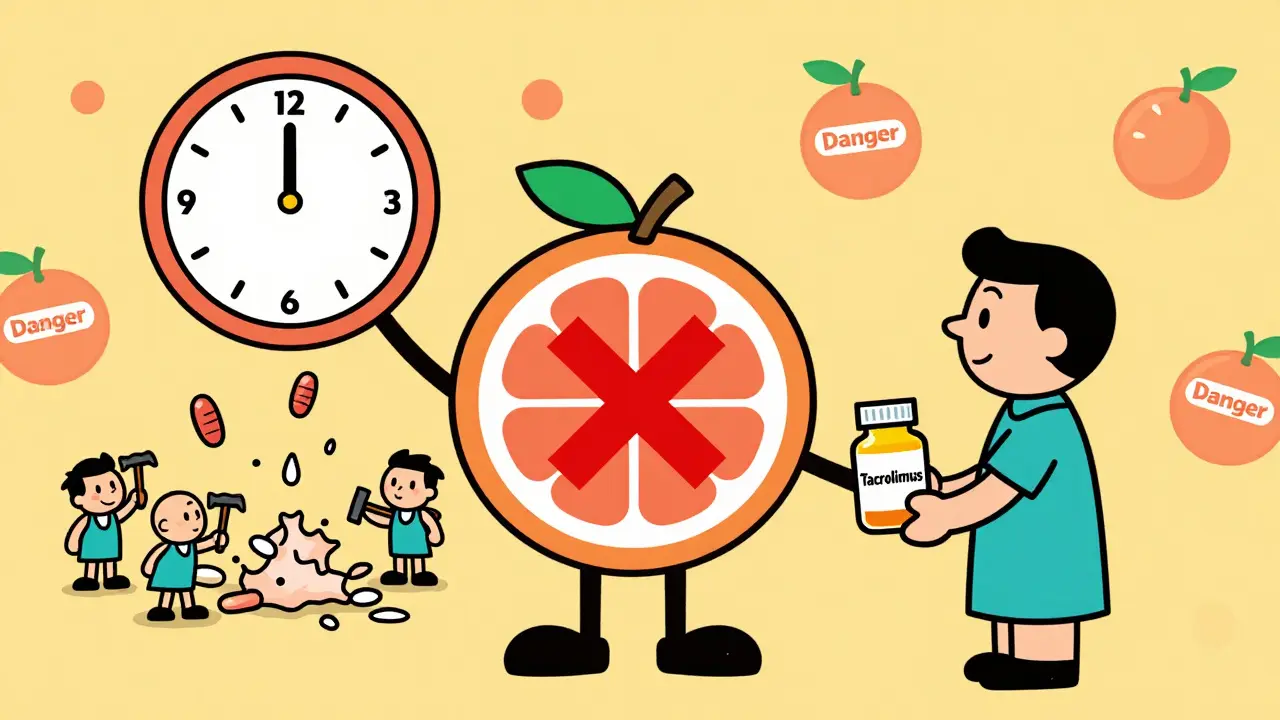
Grapefruit contains chemicals called furanocoumarins-mainly bergamottin and 6',7'-dihydroxybergamottin. These aren’t just flavor compounds. They disable a key enzyme in your gut called CYP3A4. This enzyme normally breaks down about half of all oral medications before they enter your bloodstream. When it’s blocked, your body absorbs way more of the drug than intended.
For immunosuppressants like cyclosporine, tacrolimus, and sirolimus, this means blood levels can spike by 50% to over 300%. That’s not a small change. It’s the difference between a safe dose and a toxic one.
And here’s what makes it worse: this effect isn’t temporary. The enzyme doesn’t just pause-it gets permanently damaged. Your body has to grow new enzymes to replace them. That takes up to 72 hours. So even if you eat grapefruit the night before taking your pill, you’re still at risk.
Which Immunosuppressants Are Affected?
Not all immunosuppressants react the same way. But the most commonly prescribed ones are highly vulnerable:
- Cyclosporine (Sandimmune, Neoral): Grapefruit can raise blood levels by 50-100%. Toxic levels start above 500 ng/mL; normal range is 100-400 ng/mL.
- Tacrolimus (Prograf, Envarsus XR): Levels can jump 30-50%, sometimes doubling. Toxic levels exceed 20 ng/mL; normal is 5-15 ng/mL.
- Sirolimus (Rapamune): One study showed blood levels increasing by 200-300% after grapefruit consumption.
- Everolimus (Zortress): Added to the high-risk list in 2023 by the American Society of Health-System Pharmacists.
These drugs share three dangerous traits: they’re heavily broken down by CYP3A4, they’re poorly absorbed (only 20-50% of the pill actually enters your blood), and they have a very narrow safety window. A little too much can be deadly.
Real Stories, Real Risks
Medical journals don’t always capture the human side. But online transplant communities do.
One kidney transplant recipient on Reddit shared that after having a single glass of grapefruit juice, their tacrolimus level jumped from 8.2 ng/mL to 24.7 ng/mL in just 36 hours. Their doctor told them they were lucky they didn’t suffer kidney failure. Another user described tremors, nausea, and high potassium levels-classic signs of toxicity-after eating half a grapefruit.
Transplant pharmacists at Mayo Clinic reviewed cases from 2021-2022 and found that 15-20% of unexpected drug toxicity cases involved patients who didn’t realize grapefruit was the culprit. Many said they thought it was “just fruit,” or that they’d had it before without problems. But the interaction doesn’t care about your history. One glass is enough.
What About Other Citrus Fruits?
Not all citrus is the same. Regular oranges, tangerines, and lemons are generally safe. But Seville oranges-used in marmalade-contain the same furanocoumarins as grapefruit. So if you’re making toast with orange marmalade, you’re still at risk.
Pomelo, a large citrus fruit related to grapefruit, is equally dangerous. And don’t assume “natural” or “organic” grapefruit is safer. The chemicals causing the interaction are in the fruit itself, not added chemicals or preservatives.
Even grapefruit extract in supplements, smoothies, or skin creams can pose a risk. Some patients don’t realize they’re consuming it at all.
What Should You Do?
If you’re on an immunosuppressant, the advice is simple: avoid grapefruit completely.
- No juice. No fruit. No smoothies. No extracts.
- Check every label. Grapefruit may be listed as “citrus flavoring” or “natural flavor.”
- Don’t assume it’s safe if you’ve had it before. The interaction is cumulative and unpredictable.
- Ask your pharmacist or transplant coordinator for a printed list of safe and unsafe foods.
Some transplant centers require patients to sign a form acknowledging the grapefruit risk. That’s not bureaucracy-it’s protection.
What If You Accidentally Ate It?
If you’ve had grapefruit and you’re on an immunosuppressant, don’t panic-but act fast.
- Call your transplant team immediately. Don’t wait for symptoms.
- They’ll likely order a blood test to check your drug level within 24-48 hours.
- Be prepared to adjust your dose. Some centers recommend reducing your next dose by 25-50% until levels are confirmed safe.
- Don’t skip your next dose unless told to. Under-dosing can trigger rejection.
There’s no antidote. Activated charcoal has shown promise in early studies, but it’s not standard care yet. The only reliable solution is prevention.
Why This Keeps Happening
Despite 35 years of research, 68% of transplant patients still don’t fully understand the risk, according to a 2023 survey by the British Liver Trust. Many think it’s just a “warning” or that they can have it “once in a while.”
Doctors are busy. Pharmacists are overwhelmed. And patients-especially older adults-are often told grapefruit is good for heart health. The American Heart Association even gives it a “heart-check” mark for vitamin C and fiber. But that doesn’t override the drug interaction.
Worse, the population of transplant recipients is aging. About 40% of kidney transplant patients are over 65. Seniors are more likely to eat grapefruit for its health benefits-and more likely to be on multiple medications. The United Network for Organ Sharing predicts a 15% increase in grapefruit-related complications over the next decade.
What’s Being Done?
Pharmaceutical companies are trying to help. Astellas Pharma developed Envarsus XR, a modified-release version of tacrolimus that reduces-but doesn’t eliminate-grapefruit interaction risks. Still, the label warns against grapefruit use.
The FDA has required grapefruit interaction warnings on medication guides since 2010. Cyclosporine’s label now says in bold: “CONCOMITANT USE WITH GRAPEFRUIT IS CONTRAINDICATED.”
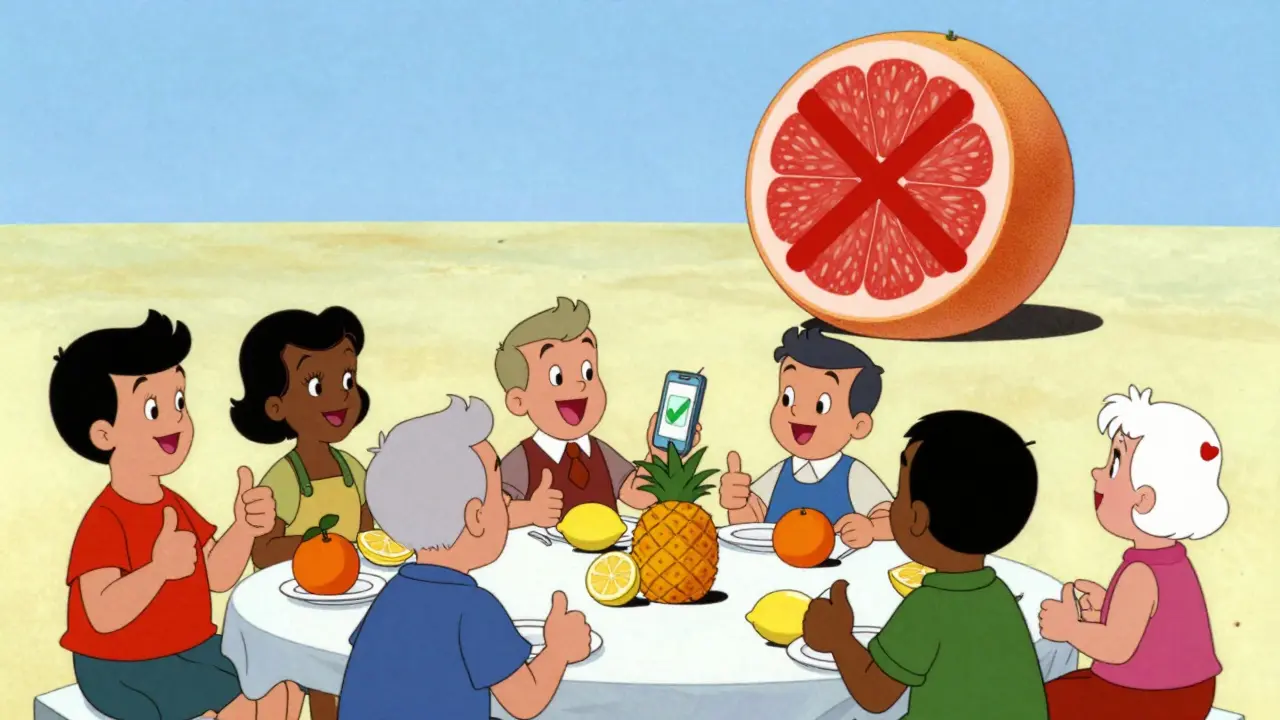
Technology is helping too. Johns Hopkins launched a mobile app in early 2023 that scans your medication barcode and instantly alerts you if grapefruit is a risk. It’s free, easy to use, and available to anyone.
But the most powerful tool remains education. Every transplant center should give patients a clear, written list of foods to avoid. Every pharmacist should review it during counseling. Every family member should know the danger.
Safe Alternatives
You don’t have to give up citrus entirely. Safe options include:
- Oranges (navel, Valencia)
- Tangerines and clementines
- Lemons and limes
- Pineapple, mango, papaya
And if you miss the tartness of grapefruit, try adding a splash of lemon juice to water or using zest in cooking. The flavor can be replicated without the risk.
Final Reminder
This isn’t about being perfect. It’s about being informed. One mistake can undo years of recovery. The fact that grapefruit can turn a life-saving drug into a life-threatening one isn’t theoretical. It’s documented. It’s measured. It’s happened.
If you’re on an immunosuppressant, treat grapefruit like you would a dangerous chemical-not a snack. Avoid it. Talk to your care team. And don’t let anyone convince you it’s okay to take a chance.
Your transplant is too important to risk.
Comments (15)
Teresa Marzo Lostalé
27 Dec, 2025Just had my second kidney transplant last year, and this post saved my life. I used to love grapefruit for breakfast - now I drink lemon water with mint instead. Small change, huge difference. 🌿
sonam gupta
28 Dec, 2025Why do Americans make everything so dramatic? We eat grapefruit with curry in India and no one dies. Your medicine is weak, not the fruit.
Julius Hader
28 Dec, 2025People who ignore this are just asking for trouble. I’ve seen it happen - someone thinks they’re ‘immune’ to the warning because they ‘had it once before.’ Spoiler: your body doesn’t remember your past mistakes. It just kills you slower.
Vu L
30 Dec, 2025Wait, so if I drink grapefruit juice and then take my pill 3 hours later, it’s fine right? I mean, it’s just fruit. 😏
James Hilton
1 Jan, 2026Yup. Another reason to hate modern medicine. You can’t even eat a damn fruit without signing a waiver. Next they’ll ban oxygen.
Mimi Bos
2 Jan, 2026ok so i just ate half a grapefruit like 2 hrs ago and i take tacrolimus… should i panic?? 😬
Payton Daily
3 Jan, 2026It’s not about grapefruit. It’s about control. The system wants you afraid. They want you to trust the pill, not your body. The real danger is blind obedience. The fruit? Just a scapegoat.
Kelsey Youmans
4 Jan, 2026Thank you for this comprehensive and meticulously referenced piece. The clinical data presented is both compelling and necessary for patient safety. I would strongly encourage all transplant centers to implement mandatory educational modules on citrus-drug interactions, as current dissemination methods remain inconsistent and inadequate.
Sydney Lee
4 Jan, 2026Of course the FDA requires warnings. But who reads them? The people who need to know the most? No. They’re the ones scrolling past the tiny print while checking their Instagram. This isn’t a medical issue - it’s a societal failure of attention.
oluwarotimi w alaka
6 Jan, 2026in nigeria we dont even know what grapefruit is. why you americans always make problem from nothing? your body weak. medicine make you weak. eat fruit and be strong.
Debra Cagwin
7 Jan, 2026As a transplant nurse for 18 years, I’ve seen too many patients come in with toxic levels because they thought ‘a little bit won’t hurt.’ One woman drank grapefruit juice because her doctor said citrus was ‘good for immunity.’ She didn’t know her meds were the problem. Please, if you’re on immunosuppressants - don’t guess. Ask. Twice. Write it down. Share it with your family. This isn’t fearmongering - it’s survival.
Hakim Bachiri
7 Jan, 2026Wait - so if I drink grapefruit juice and then take my pill… and then take an activated charcoal pill… does that cancel it out?? I mean, I read a study on Pubmed once…
Celia McTighe
9 Jan, 2026Thank you for sharing this. I’m so grateful for people who take the time to explain things clearly. My mom just had a liver transplant and I’ve already deleted all the grapefruit from our fridge. 🍊🚫 I also downloaded that Hopkins app - it’s a game changer. ❤️
Ryan Touhill
9 Jan, 2026It’s fascinating how a fruit, a product of natural evolution, can so disrupt the carefully calibrated pharmaceutical interventions of modern medicine. One must wonder - is this not a metaphor for humanity’s hubris? We design drugs to control biology, yet nature - in the form of a humble citrus - reminds us that we are not masters of our own physiology. The grapefruit is not the enemy. We are.
Nicole Beasley
10 Jan, 2026Just got my transplant last month. I didn’t know ANY of this. Now I’m scared to eat anything. 😭 Can someone make a list of ALL the fruits I can’t have? Like… what about pomelo? What about limes? What about… orange juice? 😵💫