

Anticoagulant Timing Calculator for Spinal Procedures
Procedure Safety Calculator
Calculate the safe timing for stopping and restarting blood thinners before spinal procedures based on your specific medication, procedure type, and kidney function. Always consult with your healthcare provider before making decisions.
Safety Timing Results
When you’re on blood thinners and need an epidural or spinal procedure - whether for labor, chronic back pain, or surgery - the biggest fear isn’t the needle. It’s the hematoma. A rare but devastating complication that can leave you paralyzed in minutes. And it’s not theoretical. Every year, hundreds of people on anticoagulants suffer spinal cord damage because the timing of their medication wasn’t managed right.
What Exactly Is a Spinal Epidural Hematoma?
A spinal epidural hematoma (SEH) happens when blood leaks into the space between the spinal cord’s protective membrane (the dura) and the spine’s bony structure. This space is tiny - like the gap between two sheets of paper stacked together. Even a teaspoon of blood (1-2 mL) can crush the spinal cord. The result? Sudden back pain, numbness in your legs, loss of bladder control, or weakness so severe you can’t move your feet. This isn’t a slow-developing issue. Symptoms usually show up within 12 hours after the procedure. In fact, studies show 76% of patients with SEH report muscle weakness within the first few hours. The clock starts ticking the moment the needle is removed. If you don’t get surgery to drain the blood within 8 hours, your chances of full recovery drop from 79% to just 9%.Who’s at Risk? The Real Numbers Behind the Fear
Not everyone on blood thinners will get a hematoma. But the risk isn’t equal across all drugs or situations. Warfarin is one of the most dangerous. If your INR (a blood test measuring clotting time) is above 1.4, your risk jumps 8.7 times higher. Even if your INR is normal before the procedure, there are documented cases where patients still developed hematomas - meaning lab numbers alone don’t tell the whole story. Low molecular weight heparins like Lovenox (enoxaparin) are tricky too. If you take a therapeutic dose (used to treat clots, not just prevent them), your risk spikes if the last dose was given less than 24 hours before the procedure. For prophylactic doses (lower, once-daily shots), the window tightens to 10-12 hours. Newer drugs like rivaroxaban (Xarelto) and apixaban (Eliquis) seem safer - but only if timed right. Rivaroxaban carries a 0.42% hematoma risk if taken too close to the procedure. Apixaban is slightly lower at 0.05%. But if you have kidney problems, those windows stretch. For example, if your kidney function is below 30 mL/min, you need to stop rivaroxaban for 72 hours instead of 48. Even aspirin isn’t harmless. While single-dose aspirin carries almost no risk (0.03%), combining it with another antiplatelet drug like clopidogrel increases your risk nearly fourfold. That’s why some doctors now say: if you’re on dual antiplatelet therapy for a stent, delay the spinal procedure by at least 7 days.It’s Not Just the Drug - It’s the Procedure Too
The type of procedure matters just as much as the medication. A simple diagnostic spinal tap? Risk is about 1 in 100,000. An epidural steroid injection for back pain? Around 1 in 15,000. But if you’re getting an epidural catheter placed - like for labor or chronic pain management - your risk doubles. Why? Because the catheter stays in place, creating a longer window for bleeding. Multiple needle attempts? That increases risk more than six times. Traumatic puncture - where the needle hits a blood vessel and you see blood in the spinal fluid? That raises your risk elevenfold. Age and anatomy play roles too. If you’re over 70, your risk is nearly four times higher. If you have spinal stenosis (narrowed spinal canal), your risk jumps 2.8 times. Low hemoglobin? That’s another red flag. Patients with hemoglobin under 10 g/dL are four times more likely to bleed.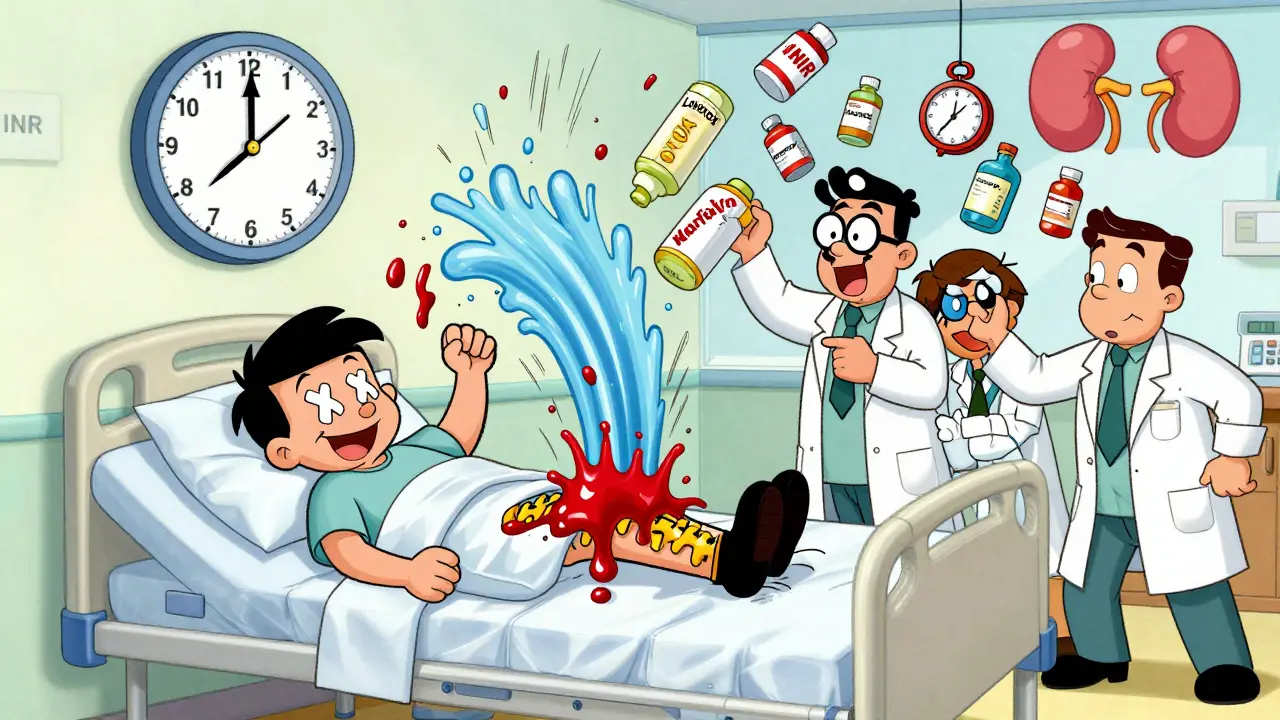
Timing Is Everything - The Exact Windows You Need to Know
There’s no guessing here. You need exact hours.- Warfarin: Check INR within 24 hours before the procedure. Target: below 1.4. Restart 4 hours after a single injection, 6 hours after a catheter.
- LMWH (Lovenox, Fragmin): Hold 10-12 hours for prophylactic doses. Hold 24 hours for therapeutic doses. Restart 2 hours after single injection, 4 hours after catheter removal.
- Rivaroxaban (Xarelto): Stop 48 hours before if kidneys are normal. Stop 72 hours if kidney function is poor (CrCl < 50 mL/min). Restart 6 hours after procedure if no bleeding.
- Apixaban (Eliquis): Stop 48 hours before. Restart 6 hours after.
- Aspirin: Usually safe to continue. But if you’re also on clopidogrel or ticagrelor - stop 7 days before.
What Happens When It Goes Wrong?
A hematoma isn’t just painful - it’s life-changing. In 24% of cases, patients end up permanently paralyzed. In 3-5% of cases, it’s fatal - usually because treatment was delayed. One case from a Reddit thread describes a 68-year-old man who had an epidural for hip surgery. He was on rivaroxaban. Twelve hours after the catheter was pulled, he lost feeling in his groin and couldn’t move his legs. Emergency surgery happened, but it was too late. He lost function in his L5 nerve permanently. Even when surgery is done fast, recovery isn’t guaranteed. There are documented cases where patients had INR levels within normal range, had a single needle stick, and still developed a hematoma. That’s why some anesthesiologists say: if you’re on any anticoagulant, the procedure should only be done if absolutely necessary - and only by someone who knows the guidelines inside and out.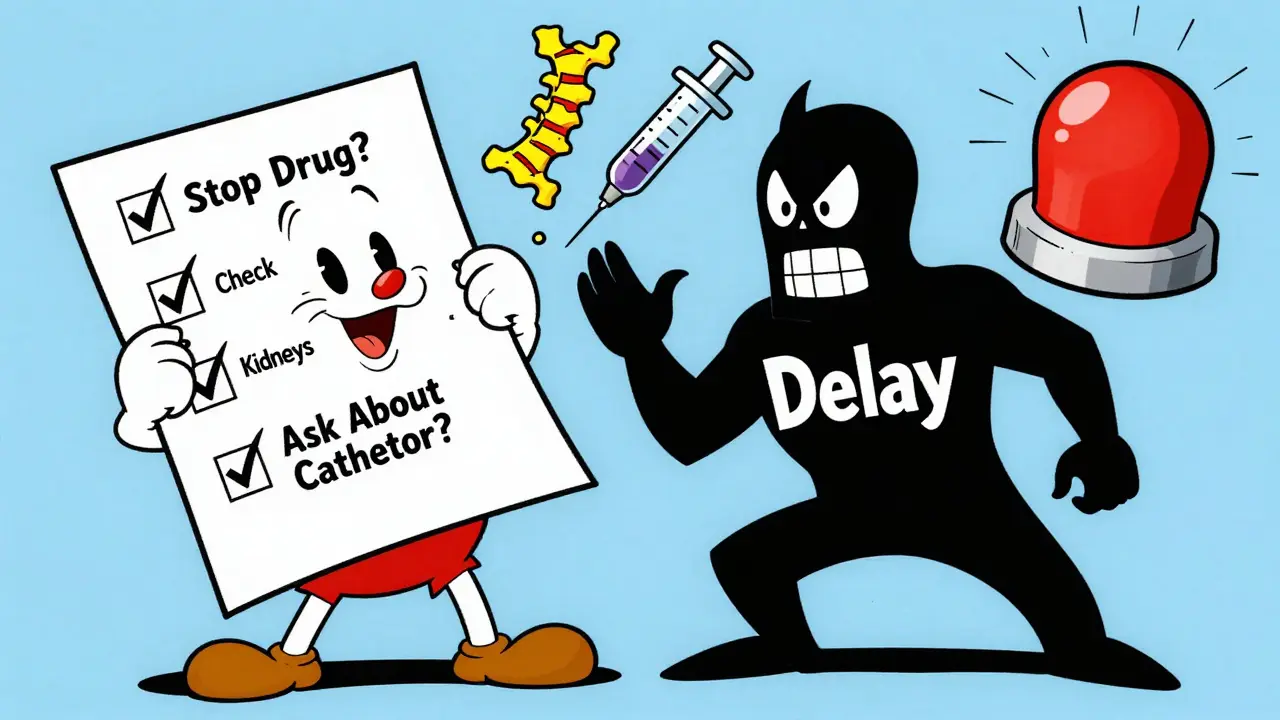
Doctors Are Caught Between Two Dangers
The real challenge isn’t just knowing the rules. It’s balancing two deadly risks. Stop the blood thinner? You might get a stroke, heart attack, or pulmonary embolism. Keep it going? You might get paralyzed. That’s why guidelines stress individualized decisions. A 90-year-old with atrial fibrillation and a history of stroke needs different handling than a 45-year-old with a mechanical heart valve. Some experts argue current guidelines are too cautious - especially around aspirin and single-dose antiplatelets. Others say they’re not cautious enough. The FDA has flagged over 100 confirmed cases tied to Lovenox alone. And malpractice lawsuits? 78 were filed in 2022. 62% of them were settled, with average payouts of $1.2 million. Most were because doctors didn’t follow timing protocols or didn’t document the patient’s anticoagulant status properly.What You Can Do - A Simple Checklist
If you’re scheduled for a spinal or epidural procedure and take blood thinners:- Make a complete list of every medication you take - including over-the-counter aspirin, fish oil, or herbal supplements like ginkgo or garlic.
- Ask your doctor: “Which drug am I on, and what’s the exact time I need to stop it?” Don’t accept vague answers like “a few days.”
- Confirm your kidney function has been checked recently - especially if you’re on a DOAC.
- Ask if your provider has used the ASRA Anticoagulation Checklist. If they haven’t, ask why.
- After the procedure, report any back pain, numbness, or trouble peeing immediately. Don’t wait. This isn’t normal discomfort - it’s an emergency.
The Future Is Changing - But the Rules Still Apply
New tools are coming. In 2023, the FDA mandated a new education program for all prescribers of anticoagulants. In 2024, ASRA will roll out a risk-scoring system that weighs 12 factors - age, kidney function, drug type, procedure type - to give you a single risk number. If it’s over 15, you’ll be flagged as high risk. There’s even new research on a blood biomarker called GFAP. If it’s above 0.72 ng/mL within two hours after the procedure, it’s 94% accurate at predicting a hematoma before symptoms even appear. That could change everything - but it’s not available yet. For now, the best protection is knowing your drugs, knowing the clock, and speaking up. You’re not just a patient. You’re your own best advocate.Can I still get an epidural if I’m on blood thinners?
Yes - but only if your medication is timed correctly and your risk factors are managed. Many people on blood thinners safely receive epidurals every day. The key is stopping the drug at the right time before the procedure and restarting it safely afterward. Never assume it’s safe without checking with your doctor and anesthesiologist.
Is aspirin safe before a spinal procedure?
Single-dose aspirin is generally safe and doesn’t need to be stopped. Studies with over 1,200 procedures show zero hematomas when aspirin was continued. But if you’re on dual antiplatelet therapy - like aspirin plus clopidogrel - you need to stop both for at least 7 days before the procedure. Always confirm your exact regimen with your doctor.
How soon after the procedure can I restart my blood thinner?
It depends on the drug and the type of procedure. For a single-shot epidural, you can usually restart LMWH or DOACs after 2-6 hours, as long as there’s no bleeding. For an epidural catheter, wait 4-6 hours. Warfarin can be restarted 4-6 hours after. Always follow your provider’s exact instructions - never guess.
What are the warning signs of a spinal hematoma?
The top signs are sudden, severe midline back pain, numbness or tingling in your legs or groin, weakness in your legs, and trouble urinating or having a bowel movement. These usually appear within 12 hours of the procedure. If you experience any of these, call for emergency help immediately. Every minute counts.
Can kidney problems affect my risk?
Yes. If your kidneys aren’t working well (creatinine clearance below 30 mL/min), your body clears drugs like rivaroxaban and apixaban much slower. That means the drug stays in your system longer, increasing bleeding risk. Your doctor must adjust the timing - often extending the stop period from 48 to 72 hours. Always get your kidney function checked before the procedure.
Are newer anticoagulants safer than warfarin?
In general, yes - but only if used correctly. DOACs like apixaban and rivaroxaban have lower overall hematoma rates than warfarin when timed properly. But they’re not foolproof. There are documented cases of hematomas even after following the 48-72 hour rule. Unlike warfarin, there’s no quick blood test to check their level, so timing is even more critical. Don’t assume they’re automatically safer - just different.
Comments (10)
Joanna Brancewicz
7 Jan, 2026INR above 1.4? That’s a hard stop. Saw a case last year where a nurse ignored it - patient went from walking to wheelchair in 90 minutes. No one talks about how fast this happens.
Lois Li
9 Jan, 2026I work in labor and delivery and this is exactly why we have checklists. We don’t guess. We verify. Twice. If your OB says 'it’s fine' without checking your meds list, walk out. This isn’t risk management - it’s survival protocol.
Prakash Sharma
10 Jan, 2026Western medicine overcomplicates everything. In India, we just use aspirin and pray. No fancy blood tests. No 72-hour waits. People get epidurals all the time. Maybe the real problem is fear, not the drugs.
Donny Airlangga
11 Jan, 2026My mom had an epidural for hip surgery while on apixaban. They held it 48 hours, checked her kidneys, and restarted 6 hours later. No issues. But she insisted they show her the guidelines. She’s 74 and refused to be a statistic.
Evan Smith
11 Jan, 2026So let me get this straight - if I take fish oil, garlic supplements, and aspirin, I need to stop everything for 7 days… but if I’m on warfarin, I just need an INR test? Sounds like the system is designed to confuse people so they don’t ask questions.
Manish Kumar
13 Jan, 2026Think about it - we live in a world where a teaspoon of blood can paralyze you. A single drop, less than what you lose when you cut your finger. And yet, we treat this like a routine injection. The body is a fragile machine, and we treat it like a car we can just pop the hood on. What does that say about our relationship with medicine? We want control, but we don’t respect the consequences. The hematoma isn’t a complication - it’s a mirror.
Kristina Felixita
14 Jan, 2026OMG I just realized I’ve been taking ginkgo biloba for my memory… and I’m scheduled for a back injection next week. 😳 I’m calling my doctor right now. THANK YOU for this post - seriously, this saved me from a nightmare. I’m sharing this with my entire book club.
Ken Porter
15 Jan, 2026Stop being dramatic. If you can’t follow basic medical instructions, don’t get the procedure. This isn’t rocket science. 48 hours. 24 hours. 6 hours. Write it down. Done. People want hand-holding, not facts.
swati Thounaojam
16 Jan, 2026My aunt had this happen in Delhi. They didn’t even know what an INR was. She’s still in a wheelchair. Please, just ask. Just check. One question can save a life.
Dave Old-Wolf
17 Jan, 2026My anesthesiologist showed me a flowchart with 12 boxes - drugs, kidneys, age, procedure type. I thought it was overkill. Then I saw the 0.42% number for Xarelto. That’s 1 in 238. If I had 238 friends, one would get paralyzed. That’s not rare. That’s unacceptable. I’m printing this checklist and laminating it.