
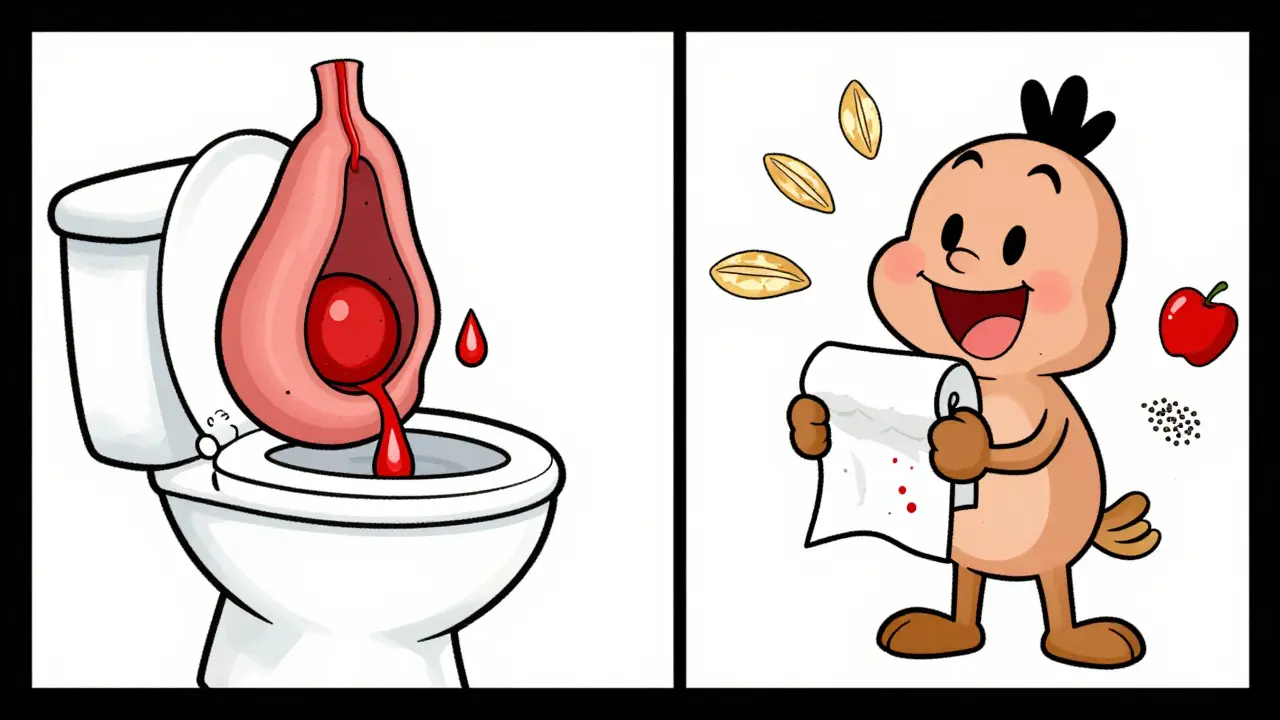
Almost 75% of people will deal with hemorrhoids at some point in their life. That’s not a rare condition-it’s common. But what most people don’t realize is that not all hemorrhoids are the same. There are two main types: internal hemorrhoids and hemorrhoids that form inside the rectum, covered by tissue without pain receptors, so they rarely hurt but often bleed, and external hemorrhoids and those that develop under the skin around the anus, packed with nerve endings, making them painful, itchy, and visible. Knowing the difference isn’t just academic-it changes how you treat them.
What Makes Internal Hemorrhoids Different
Internal hemorrhoids sit above the dentate line, deep inside the rectum. Because that area has no pain sensors, you won’t feel them unless they prolapse-meaning they push out through the anus. The most common sign? Bright red blood. You might see it on the toilet paper, in the bowl, or streaked on your stool. It’s usually painless, which is why many people ignore it. They think, "It’s just a little bleeding, it’ll go away."
But ignoring it can be risky. Internal hemorrhoids are graded on a scale from I to IV:
- Grade I: Bleeds, but doesn’t prolapse at all.
- Grade II: Pops out during bowel movements but slides back in on its own.
- Grade III: Comes out and stays out-you have to push it back in.
- Grade IV: Stays out permanently and can’t be pushed back. This one often causes serious discomfort and constant irritation.
These grades aren’t just labels-they guide treatment. A Grade I hemorrhoid might respond to diet changes. A Grade IV? You’re probably looking at surgery.
What Makes External Hemorrhoids Different
External hemorrhoids are right at the edge of the anus. They’re covered in skin, not mucous membrane. And that skin? Full of nerves. So when they swell, you feel it. Not just a little discomfort-real pain. Sitting becomes torture. Walking feels off. You might notice a soft, skin-colored lump. But the worst case? A thrombosed external hemorrhoid and a blood clot forms inside the swollen vein, turning it into a hard, purple or blue lump that throbs with pain.
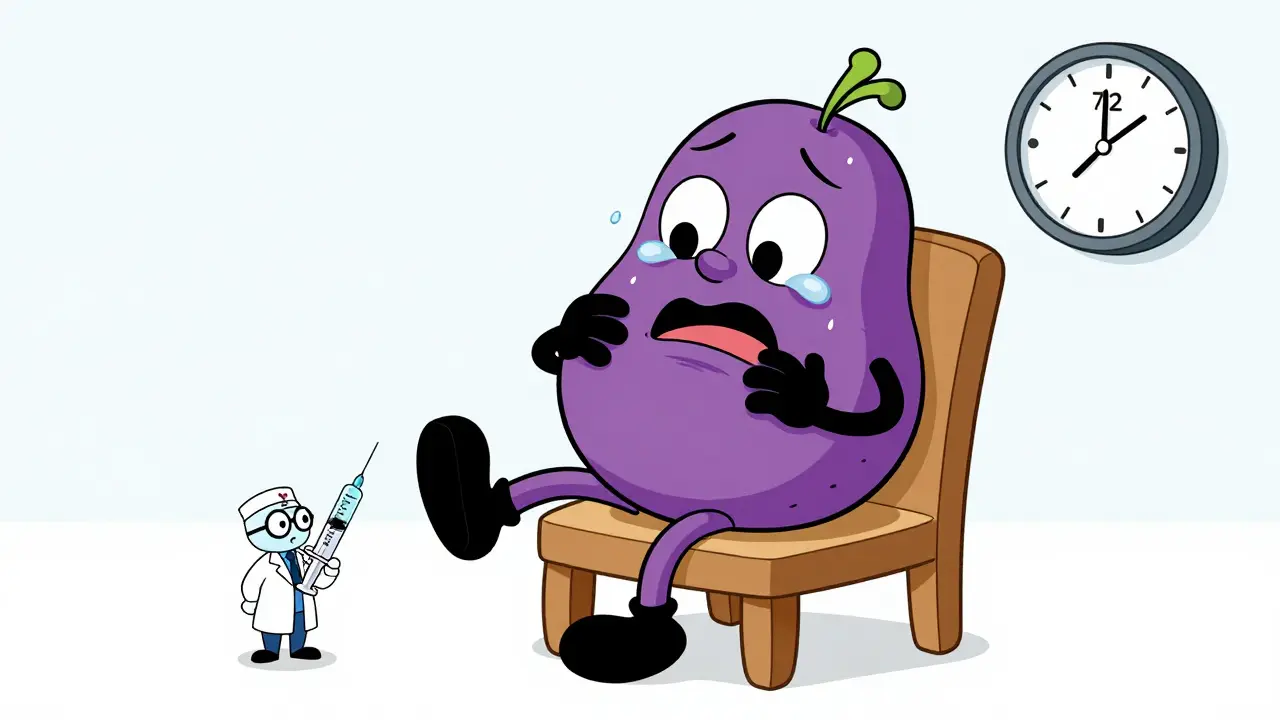
Thrombosed hemorrhoids come on fast. One day, you’re fine. The next, you can’t sit down without wincing. This isn’t something that resolves on its own in a few days. If it’s been less than 72 hours, a quick outpatient procedure-making a tiny cut to drain the clot-can bring immediate relief. After that window, the body slowly reabsorbs the clot, but the pain lingers for weeks.
Why You Might Have Both
It’s not unusual to have both types at once. In fact, many people do. You might have a bleeding internal hemorrhoid and a painful external lump. That makes self-diagnosis tricky. If you’re seeing blood and feeling pain, is it one problem or two? Doctors often find both during exams. The key is not to assume-get checked. Mistaking an anal fissure for a hemorrhoid is common. Fissures cause sharp, tearing pain during bowel movements, not itching or swelling. And while hemorrhoids bleed, fissures rarely do. If your treatment isn’t working, it might be the wrong diagnosis.
What Causes Hemorrhoids?
Hemorrhoids aren’t caused by sitting too long on the toilet-though that doesn’t help. The real culprits are things that increase pressure on the veins in your rectum:
- Chronic constipation or diarrhea
- Straining during bowel movements
- Pregnancy (25-35% of pregnant women develop them)
- Obesity
- Heavy lifting
- Sitting for hours-especially on hard surfaces
It’s not about being "dirty" or "lazy." It’s about mechanics. When you strain, you squeeze the veins in your pelvis. Over time, they stretch, swell, and bulge. That’s hemorrhoids. The good news? You can prevent them.
Home Treatments That Actually Work
For mild cases, you don’t need drugs or surgery. Start here:
- Fiber: Aim for 25-30 grams a day. That’s not just "eat more veggies." Think oats, beans, lentils, chia seeds, and whole fruits like pears and apples with skin.
- Water: Drink 8-10 glasses daily. Fiber without water just makes things harder.
- Sitz baths: Soak in warm water (not hot) for 15-20 minutes, 2-3 times a day. It reduces swelling and soothes irritation.
- Witch hazel pads: These help with itching and inflammation. Keep them in the fridge for extra relief.
- Don’t sit too long on the toilet: Five minutes max. If you’re not going, get up. Use a footstool to raise your knees above your hips-it reduces rectal pressure by 30%.
Over-the-counter creams with hydrocortisone can help with itching, but don’t use them for more than a week. Long-term use can thin the skin. And forget the "miracle cures" you see online. No cream, oil, or supplement has been proven to shrink hemorrhoids permanently.
When You Need Medical Help
Home care works for mild cases. But if you’re still bleeding after a week, or the pain won’t go away, it’s time to see a doctor. Here’s when to act:
- Bleeding that doesn’t stop
- Dizziness or weakness (signs of blood loss)
- Changes in bowel habits (new constipation, diarrhea, or narrow stools)
- Pain that wakes you up at night
- A lump that won’t go away or keeps growing
Rectal bleeding can be a sign of something serious-like colorectal cancer or inflammatory bowel disease. Never assume it’s just hemorrhoids. Get it checked.
Minimally Invasive Procedures
If home care doesn’t work, doctors have several options that don’t require full surgery:
- Rubber band ligation: A tiny rubber band is placed around the base of the internal hemorrhoid. It cuts off blood flow. The tissue shrinks and falls off in about a week. It’s 90% effective for Grades I-III. You might feel pressure or mild cramping for a day or two.
- Sclerotherapy: A chemical solution is injected into the hemorrhoid. It scars the tissue and shrinks it. Less effective than banding, but good for bleeding.
- Infrared coagulation: A brief burst of heat seals the blood vessels. Often used for smaller hemorrhoids.
These are quick, done in the office, and you can usually go back to work the same day. No anesthesia needed.
Surgery: The Last Resort
For severe cases-Grade IV prolapse, recurrent thrombosed hemorrhoids, or when other treatments fail-surgery is the most reliable fix.
- Hemorrhoidectomy: The hemorrhoid is completely cut out. It’s the gold standard. Success rate? 95%. But recovery takes 2-4 weeks. Pain is real, and you’ll need prescription painkillers.
- Stapled hemorrhoidopexy: Instead of removing the tissue, it’s pulled back up and stapled. Less pain than traditional surgery, but higher chance of recurrence. Best for prolapse, not bleeding.
Recovery after surgery isn’t fun. But if you’ve been suffering for months, it’s worth it. And if you follow post-op advice-high fiber, no straining, sitz baths-you’re far less likely to get them back.
Prevention Is the Best Treatment
Studies show that if you stick to healthy habits after treatment, recurrence drops from 50% to just 5-10%. That’s huge. Here’s how:
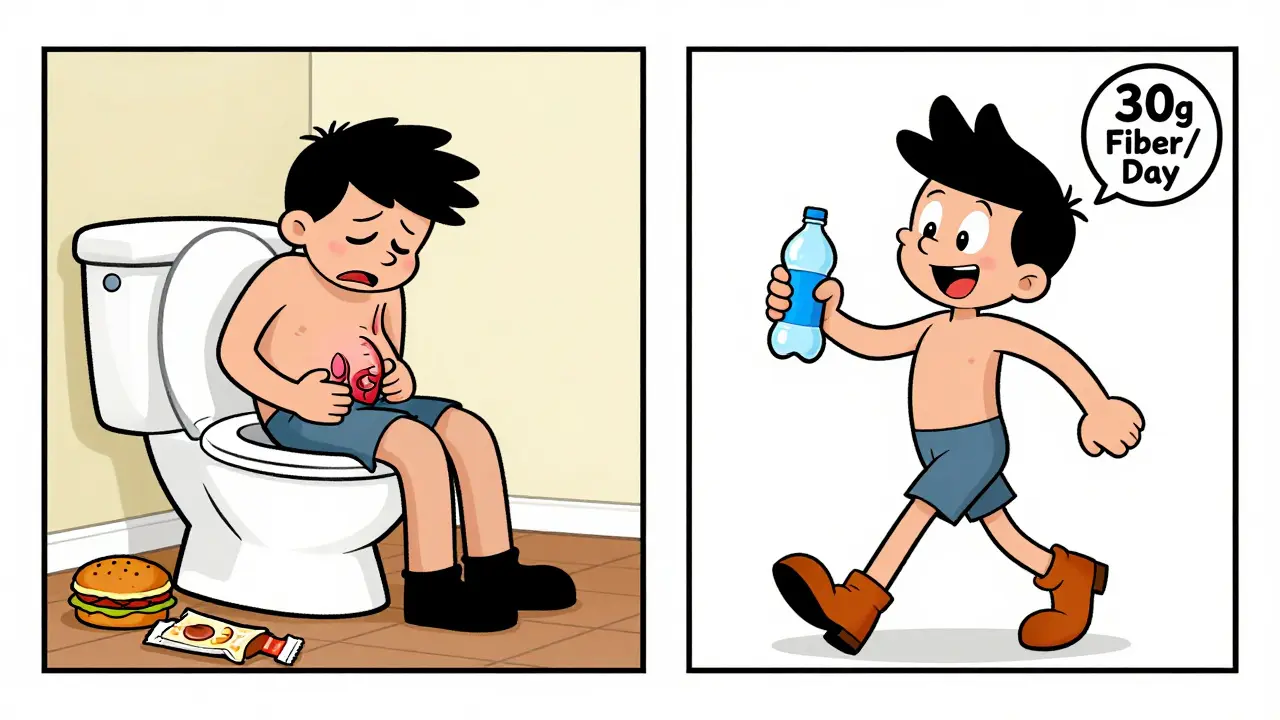
- Keep your fiber intake at 30g/day. That’s your new baseline.
- Drink water before you feel thirsty. Dehydration is a silent trigger.
- Move. Walk daily. Even 20 minutes helps circulation.
- Don’t hold it in. When you feel the urge, go.
- For pregnant women: Sleep on your left side. It takes pressure off major veins.
It’s not about perfection. It’s about consistency. One bad bowel movement won’t ruin you. But months of ignoring your diet? That will.
Can hemorrhoids turn into cancer?
No, hemorrhoids do not turn into cancer. But rectal bleeding-a common symptom of hemorrhoids-can also be a sign of colorectal cancer. That’s why any new or persistent bleeding should be evaluated by a doctor. Don’t assume it’s just hemorrhoids. Get checked.
Do hemorrhoids go away on their own?
Mild hemorrhoids can improve with home care in a few days. Swelling and bleeding from external hemorrhoids often reduce with sitz baths and fiber. But they rarely disappear completely without treatment. If symptoms last more than a week, or keep coming back, you need a better plan.
Is it safe to use witch hazel on hemorrhoids?
Yes, witch hazel is safe and effective for temporary relief of itching and swelling. Use alcohol-free pads or a diluted solution. Don’t use it as a cure-it helps symptoms, but doesn’t shrink the hemorrhoid. Avoid applying it directly with cotton balls if the skin is broken.
Can I exercise with hemorrhoids?
Yes, but avoid heavy lifting and straining. Walking, swimming, and cycling are fine. In fact, movement helps prevent constipation and improves circulation. If you’re doing weightlifting or intense core workouts, you might aggravate them. Adjust your routine until symptoms improve.
Why do hemorrhoids hurt more at night?
At night, blood flow increases to the pelvic area as your body rests. If you’ve been sitting all day, swelling builds up. Lying down can also increase pressure on the area, especially if you sleep on your back. A warm sitz bath before bed and sleeping on your side can help reduce nighttime discomfort.
Are hemorrhoids more common in women?
Yes, especially during pregnancy. Hormonal changes and pressure from the growing uterus increase vein swelling. About 1 in 3 pregnant women develop them. After childbirth, they often improve, but not always. Women are also more likely to delay seeking help due to embarrassment, which can make symptoms worse.
If you’ve been living with hemorrhoids for months, you’re not alone. But you don’t have to live with the pain. Start with fiber and water. See a doctor if it doesn’t improve. And remember-this isn’t something to be ashamed of. It’s a medical condition, not a personal failing. Treat it like one.
Comments (10)
Tobias Mösl
4 Mar, 2026Let me guess - you're one of those people who thinks hemorrhoids are just a 'minor inconvenience.' Wake up. This isn't some rite of passage - it's your body screaming that you've been feeding yourself like a garbage disposal for years. Fiber? Please. You think eating a sad celery stick and calling it 'healthy' is gonna fix what you've done to your colon? I've seen people with Grade IV hemorrhoids who still won't stop eating processed crap because 'it's just how they live.' You're not special. Your butt is not exempt from consequences.
And don't get me started on 'witch hazel pads.' That's like putting a band-aid on a bullet wound and calling it a solution. If you're still bleeding after a week, you're not 'waiting it out' - you're gambling with your health. I've seen people delay care until they needed emergency surgery because they were too embarrassed to say 'my butt hurts.' You think cancer cares about your shame? No. It just eats you from the inside.
Ethan Zeeb
4 Mar, 2026Most of this is accurate, but let’s cut through the fluff. Hemorrhoids aren’t caused by sitting too long - they’re caused by chronic straining, and that’s usually from constipation. And yes, fiber is key - but only if you pair it with water. I’ve had patients on 50g of fiber a day who still got worse because they drank 2 cups of coffee and called it hydration. Water isn’t optional. It’s the foundation.
Also, rubber band ligation isn’t ‘painful.’ It’s uncomfortable for a day. The real pain is living with this for years because you’re too scared to see a doctor. Get it checked. Seriously.
Darren Torpey
5 Mar, 2026Bro, I used to think hemorrhoids were something that happened to grandpas in recliners - until I sat on a concrete bench for 6 hours at a music festival and felt like my ass was being slowly devoured by a angry badger. Sitz baths? Life-changing. Witch hazel in the fridge? Like a cold hug for your butt. I didn’t believe in ‘self-care’ until my hemorrhoids taught me how to love myself again.
Now I eat chia seeds like they’re candy, drink water like it’s my job, and I don’t even sit on the toilet longer than it takes to say ‘I’m not a rock.’ You’re not broken. You’re just out of rhythm. Reset. Breathe. Fiber. Water. Repeat. You got this.
Lebogang kekana
5 Mar, 2026Listen - I’m from Johannesburg, and I’ve seen people ignore this until they couldn’t walk. But here’s the truth: in places where healthcare is a luxury, people suffer longer. This isn’t just about diet - it’s about access. If you’re lucky enough to have a doctor, don’t waste it. If you don’t? Start with boiled water, sitz baths, and psyllium husk. It’s cheap. It’s real. And it works.
Don’t wait for pain to become unbearable. Movement matters. Even if you’re just walking around your yard for 15 minutes a day - you’re fighting back. Don’t let shame silence you. Your body is trying to tell you something. Listen.
Raman Kapri
6 Mar, 2026While the article presents a clinically accurate overview, it ignores the systemic neglect of colorectal health in Western medicine. The normalization of hemorrhoids as a 'common' condition reflects a broader failure to prioritize preventive care. Why is the emphasis on 'fiber' and 'hydration' when the root cause is often sedentary labor, processed food subsidies, and lack of workplace bathroom access? This is not a personal failing - it's a policy failure.
Furthermore, the dismissal of 'miracle cures' is warranted, yet the same medical establishment routinely promotes pharmaceutical interventions with questionable long-term efficacy. The profit-driven model of healthcare incentivizes procedures over prevention. Until we address the structural causes, we're just rearranging deck chairs on the Titanic.
Megan Nayak
6 Mar, 2026Oh, so now we’re treating hemorrhoids like a moral test? Fiber? Water? Walking? As if the solution to decades of industrialized, trauma-filled, capitalist existence is to eat more lentils. You’re telling me the real answer to my pain is to become a wellness influencer? Please. My body didn’t betray me - the system did. The 9-to-5. The lack of paid leave. The inability to take a damn break. You think I don’t want to soak in a sitz bath? I can’t even afford a tub that doesn’t leak.
And don’t get me started on ‘not being ashamed.’ Shame isn’t a feeling - it’s a weapon. They weaponize embarrassment to keep people quiet while the healthcare industry profits off our silence. You want to help? Fix the system. Don’t preach to me about chia seeds.
Tildi Fletes
7 Mar, 2026As a registered nurse with 12 years in gastroenterology, I can confirm the clinical accuracy of this post. However, I must emphasize that patient education is often fragmented. Many individuals receive this information in fragments - a pamphlet here, a Google search there - and never receive a cohesive, personalized plan.
For example, the recommendation for 25–30g of fiber is correct, but most patients don’t know how to distribute it across meals. A sample day: 1 cup oatmeal (8g), 1 pear with skin (6g), 1/2 cup lentils (8g), 1 oz chia seeds (10g) - exceeds 30g. Hydration is non-negotiable; without it, fiber becomes a brick.
Also, the 72-hour window for thrombosed hemorrhoids is critical. Many patients wait weeks because they assume ‘it’ll resolve.’ It won’t. Early intervention prevents chronic pain and scarring. I urge anyone with acute pain to seek care immediately - no stigma, no delay.
Pankaj Gupta
9 Mar, 2026While the article provides a thorough and well-structured overview, it overlooks a critical demographic: individuals with mobility impairments or neurological conditions that affect bowel function. For those who cannot easily increase fiber intake or perform sitz baths due to physical limitations, the recommendations become inaccessible.
Additionally, cultural dietary practices vary widely. In many Asian and Middle Eastern households, staple diets are naturally high in fiber (e.g., lentils, whole grains, fermented foods), yet hemorrhoid prevalence remains high due to sedentary lifestyles and lack of ergonomic support. The advice must be contextualized, not universalized.
Finally, the psychological burden of hemorrhoids is underdiscussed. The fear of social stigma often leads to delayed care, which exacerbates outcomes. A compassionate, non-judgmental clinical approach is as vital as the medical intervention itself.
Zacharia Reda
10 Mar, 2026So you’re telling me the solution to my hemorrhoids is to stop being a human? I’m not a robot. I work 12-hour shifts. I eat when I can. I don’t have time to soak in a tub while chanting mantras about chia seeds. And yet here you are, acting like this is some kind of personal failure.
Here’s what actually works: a stool softener, a cold compress, and a doctor who doesn’t treat me like I’m the 47th person this week to come in with a ‘lumpy butt.’ I don’t need a lecture. I need a solution that fits real life - not a wellness blog.
And yes, I’m still going to lift weights. I’m not giving up my gains because a bunch of people on Reddit think my butt should be a shrine to fiber. You want me to change? Then make it easier. Don’t just tell me to try harder.
Tobias Mösl
12 Mar, 2026Oh, so now you’re the voice of the working class? Funny. You think a stool softener fixes the root? You’re just delaying the inevitable. You lift weights? You’re straining your pelvic floor like a damn jackhammer. You think that’s sustainable? One day, your colon’s gonna throw a tantrum and you’ll be begging for surgery - and then you’ll have time to soak in a tub. Too late.
And don’t act like you’re some rebel. You’re just another guy who thinks he’s too tough for medicine. I’ve seen guys like you. They come in with Grade IV prolapse and cry because ‘it’s too painful.’ Yeah. It is. And it’s your fault.