
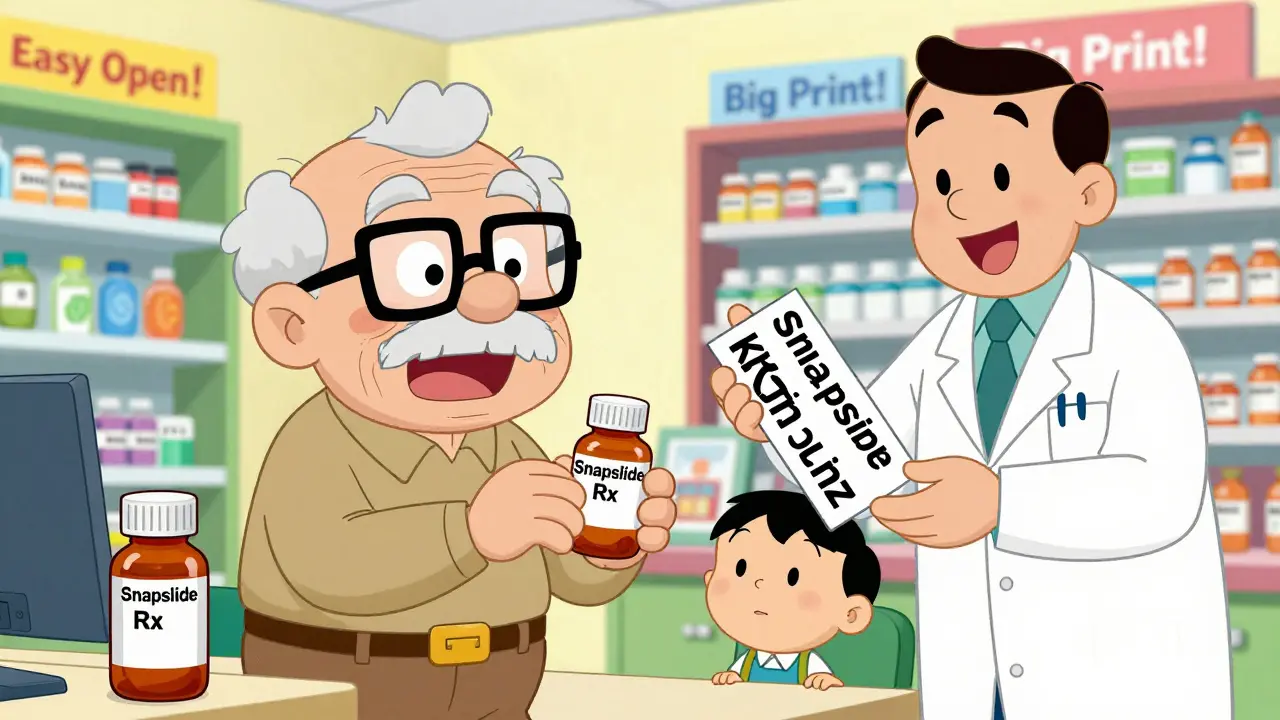
Getting your prescription meds shouldn’t feel like a puzzle. Yet for millions of older adults and people with arthritis, vision loss, or limited hand strength, opening a standard pill bottle can be a daily struggle. Child-resistant caps were designed to keep kids safe-but they often leave seniors locked out of their own medicine. The good news? You have the right to request easier-to-open caps and clearer labels. And pharmacies are legally required to provide them. Here’s how to make it happen-without waiting, arguing, or giving up.
Why Standard Caps Don’t Work for Everyone
Most prescription bottles use a push-and-turn cap. To open it, you need to press down hard while twisting. That requires grip strength, wrist flexibility, and fine motor control. For someone with arthritis, Parkinson’s, or even just stiff hands from aging, this can be impossible. A 2022 FDA report found that nearly 49% of adults over 65 struggle to open these caps. That’s almost half of all seniors. And it’s not just about inconvenience. When people can’t open their meds, they skip doses. Missed doses lead to hospital visits, worse health outcomes, and higher costs. One Kaiser Permanente study showed that switching to easier-to-open packaging boosted medication adherence by 32% in seniors over two years. The problem isn’t that the caps are broken. They’re working exactly as designed-to stop kids from getting into medicine. But they weren’t designed with aging hands in mind. That’s why accessible alternatives exist.What Accessible Packaging Actually Looks Like
Not all easy-open caps are the same. Here are the main types you can ask for:- SnapSlide Rx: This patented design slides open with one hand. No twisting. Just push and slide. It uses less than 2.5 pounds of force-far less than the 6-10 pounds needed for standard caps. Independent testing shows 87% of seniors with arthritis can open it in under 30 seconds. It still blocks 94% of children under five.
- Flip-top caps with large ridges: These have wide, textured edges for better grip. They’re easier to twist than smooth caps, but still need some strength. They’re common and cheaper, but not always child-resistant.
- Soft-touch squeeze-and-turn: These caps give slightly when squeezed, making them easier to twist. They’re common in Europe and gaining traction in the U.S.
- Cold-seal wallet packs: These are blister packs sealed with heat, but the seal is weaker. You peel it open like a candy wrapper. Used mostly for pills, they reduce opening force by 40% while still being child-resistant.
Accessible Labels: More Than Just Big Print
Labels matter just as much as the cap. A bottle with a tiny label is useless if you can’t read it. The Access Board’s 2019 guidelines set clear standards:- Large print: Minimum 16-point font (standard is 10-12). That’s about the size of text on a smartphone screen.
- High contrast: Black text on white background, or white on dark blue. Avoid yellow on light gray.
- Braille: Must follow Grade 2 Braille standards with dots raised 0.5mm. Not all pharmacies offer this-but they can order it.
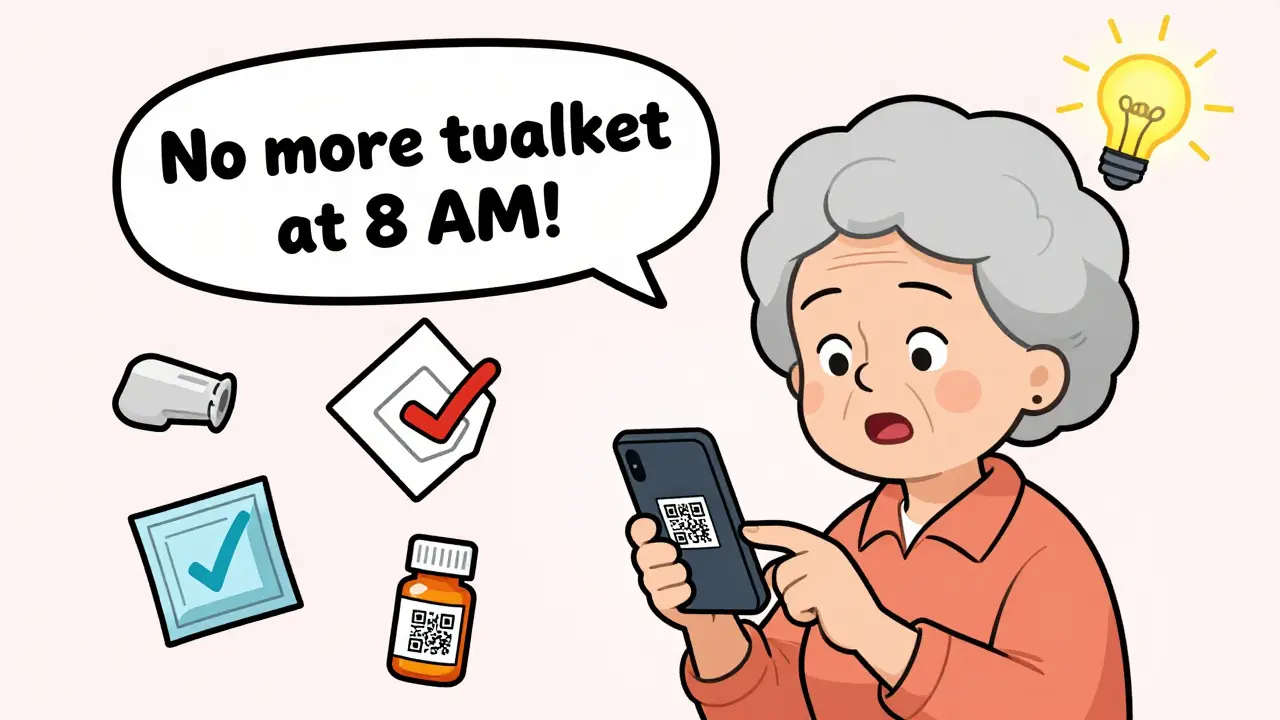
- Audible labels: Some pharmacies now offer QR codes that, when scanned with a phone, play an audio recording of the label info in under 90 seconds.
How to Actually Get These Options (Step by Step)
You don’t need a doctor’s note. You don’t need to prove you’re disabled. You just need to ask. Step 1: Ask at the time of prescription Don’t wait until you’re at the pickup window. Call or message your doctor’s office when they send the prescription. Say: “Can you please request easy-open caps and large print labels for this prescription?” Pharmacies get the prescription electronically. If they know ahead of time, they can order the right packaging. Step 2: Be specific Don’t say “I need easier caps.” Say: “I need SnapSlide caps and 16-point large print labels.” If you don’t know the name, say: “I need caps that slide open, not twist, and labels with big, clear text.” Step 3: Know your rights The Access Board’s 2019 guidelines make it clear: pharmacies must provide accessible packaging upon request. No documentation needed. If they say “we don’t carry that,” respond: “I understand. But under federal guidelines, you’re required to provide it when requested. Can you order it for me?” Step 4: Plan ahead Most pharmacies need 24 to 72 hours to prepare accessible packaging. If you pick up on Monday, ask on Friday. Some chains, like CVS, have it in stock. Others have to order it from their distributor. Step 5: Follow up If you pick up and the packaging isn’t right, call the pharmacy. Say: “I requested SnapSlide caps and large print labels. This is the standard version. Can you replace it or send the correct one?”Which Pharmacies Are Best at This?
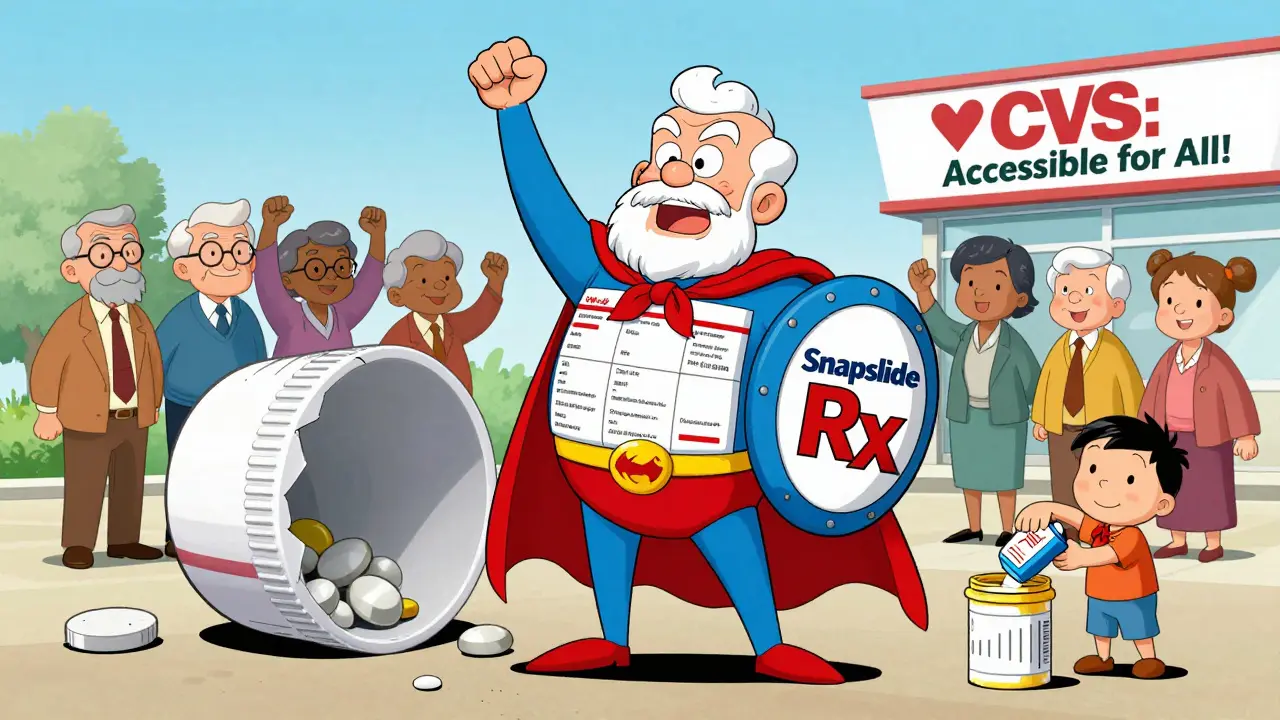
Some chains are way ahead of others.- CVS Health: Since late 2023, all 10,000+ locations offer SnapSlide caps and large print labels as standard options. You can ask for them anytime.
- Walgreens: Offers large print labels at most locations, but SnapSlide caps are only available in about 60% of stores. Call ahead.
- Target Pharmacy: Carries accessible options in most urban stores, but rural locations often don’t stock them.
- Independent pharmacies: Only 37% offer accessible packaging regularly. But they’re more flexible if you ask nicely and give them time.
What to Do If They Say No
Sometimes, pharmacies refuse. Here’s what to do:- Ask to speak to the pharmacist-in-charge. Front-line staff often don’t know the rules.
- Call the National Council on Aging’s Medication Access Hotline: 1-800-555-0123. They’ve helped over 12,500 people in early 2024 and have a 94% success rate in getting pharmacies to comply.
- If you’re still blocked, file a complaint with the FDA’s MedWatch program. They track accessibility complaints and can pressure pharmacies to change.
Cost and Insurance
Accessible packaging costs 15-20% more to produce. But you don’t pay extra. Medicare Part D now covers the cost difference for beneficiaries with documented dexterity or vision issues. Even if you’re not on Medicare, most private insurers will cover it if you ask. Ask your pharmacist: “Is there a cost difference for this packaging?” If they say yes, ask them to bill it under your insurance as a medical necessity.What’s Changing Soon
The FDA is pushing for change. Their May 2024 draft guidance says all new prescription drugs must be tested for senior accessibility before approval. Starting in 2025, pharmacies in the EU will have to meet the same standards. SnapSlide LLC just launched Version 2.0 of their cap-with biometric fingerprint recognition. It opens for you, but locks if a child tries to open it. It’ll be available in early 2025. By 2027, 65% of prescription meds are expected to come with built-in accessibility features. The shift is coming. But you don’t have to wait.Final Tip: Don’t Accept “We Don’t Have It”
Accessible packaging isn’t a luxury. It’s a safety tool. If you can’t open your medicine, you’re at risk. If you can’t read the label, you’re at risk. You’re not asking for special treatment. You’re asking for your rights. Next time you fill a prescription, ask for easy-open caps and large print labels. If they hesitate, say: “I’m not asking for a favor. I’m asking for what I’m legally entitled to.” You’ve got the power. Use it.Do I need a doctor’s note to get easy-open caps or large print labels?
No. Federal guidelines from the Access Board (2019) state that pharmacies must provide accessible packaging upon request-no documentation required. A doctor’s note can help speed things up, but it’s not necessary. If a pharmacy says you need one, they’re misinformed.
Can I get both easy-open caps and large print labels on the same prescription?
Yes. Many people need both. The cap and label are separate components. Pharmacies can order a bottle with SnapSlide caps and 16-point print at the same time. Just ask for both when you request the prescription.
Are easy-open caps less safe for children?
No. All FDA-approved accessible caps still meet child-resistant standards. SnapSlide Rx blocks 94% of children under five. Flip caps block 92%. Even though they’re easier for seniors, they’re still designed to keep kids out. The goal isn’t to remove safety-it’s to add accessibility without losing protection.
How long does it take to get accessible packaging?
Most pharmacies need 24 to 72 hours to prepare it. Some, like CVS, have it in stock and can give it to you the same day. If you need it urgently, call ahead and ask if they can order it in time. Plan your refill a few days early.
What if my pharmacy doesn’t carry SnapSlide caps?
Ask if they can order them. Most pharmacies can get them within a week. If they refuse, call the National Council on Aging at 1-800-555-0123. They’ll help you get the right packaging-even if you’re in a small town. You’re not alone, and you’re not asking for too much.
Comments (10)
Denise Jordan
10 Mar, 2026Okay but like… why are we still doing this? Pharmacies have robots that can assemble pills. Why can’t they just put everything in a pill dispenser with a QR code that texts you when to take it? This whole ‘cap and label’ thing feels like we’re fixing a typewriter with duct tape.
Also, SnapSlide? Sounds like a brand new energy drink. I’m not trusting my heart medicine to something that sounds like a superhero.
Also also-why does this even need a federal guideline? Shouldn’t ‘not dying because you can’t open your pill bottle’ be basic human decency? Not a ‘request’.
Gene Forte
11 Mar, 2026This is one of those rare moments where practicality meets dignity. The fact that we’ve normalized difficulty accessing medicine-because ‘it’s always been this way’-is a quiet tragedy.
Accessibility isn’t a perk. It’s not charity. It’s not a ‘nice to have’ for the elderly or disabled. It’s the bare minimum of care. When a system requires you to fight for the right to take your own medication, that system has failed.
Thank you for laying this out so clearly. Not everyone has the energy to advocate for themselves. This guide? It’s a lifeline.
Kenneth Zieden-Weber
12 Mar, 2026Oh wow. So we’re just supposed to ‘ask nicely’ for basic human functionality? Like, I’m supposed to call my pharmacy and say, ‘Hey, can I get the version that doesn’t require me to be a WWE wrestler to open?’
And if they say no? I’m supposed to call the National Council on Aging? What’s next? Do I have to file a petition to get my insulin to not be in a bottle that requires a crowbar?
Also-SnapSlide? That’s the name? Sounds like a dating app for people who hate their exes. Who names this stuff?
But… I’m glad it exists. And I’m furious it’s not standard. And yes, I’m calling my pharmacist tomorrow. Thanks for the nudge.
Chris Bird
12 Mar, 2026So let me get this straight. We’re spending millions on ‘accessible’ packaging because old people can’t twist a cap? Why not just give them easier-to-use pills? Like, liquid form? Or patches? Or implants? This whole thing feels like a band-aid on a broken leg.
Also, 49% of seniors can’t open bottles? That’s not a packaging issue. That’s a societal failure. We’ve let people age without support. Now we’re handing them a ‘Slide’ cap like it’s a prize.
Real solution: universal healthcare with home delivery. Not better caps.
David L. Thomas
13 Mar, 2026Big data point here: the 32% adherence increase with accessible packaging? That’s not just a ‘nice to have’-that’s a 32% reduction in hospitalizations. That’s billions saved in ER visits. This isn’t accessibility. It’s cost avoidance.
And the QR code audio labels? That’s not ‘innovative’-that’s basic UX. If you can’t read it, audio is the baseline. We do this for apps. Why not for life-saving meds?
Also, SnapSlide’s 87% success rate? That’s a win. The fact that it’s still child-resistant? Even better. This is engineering done right.
Bridgette Pulliam
15 Mar, 2026I’ve been using the cold-seal wallet packs for my diabetes meds for over a year now. I didn’t know it was an option until I asked. My pharmacist looked at me like I’d asked for a unicorn.
It’s not harder to ask. It’s just… you don’t realize you’re allowed to. I wish someone had told me this five years ago. I almost missed a dose last winter because I couldn’t get the cap off. I cried. Not because I was in pain. Because I felt invisible.
Thank you for writing this. I’m sending it to my sister. And my mom. And my neighbor. Everyone needs to know.
Mike Winter
15 Mar, 2026It’s curious how we design systems for the ‘average’ user, then act surprised when the average user doesn’t exist.
Child-resistant caps were never meant to be ‘universal’-they were a compromise. But we’ve let that compromise become the default, without ever asking: ‘Who is being excluded?’
The answer, as you’ve shown, is millions. And the solution isn’t radical. It’s simple. Ask. Specify. Persist.
One hopes that by 2027, this won’t be a ‘guide’-it’ll just be how things are done.
Randall Walker
16 Mar, 2026So… I asked for large print. They gave me ‘bigger’ print. It was 13-point. I said ‘no, 16.’ They said ‘we don’t have that.’ I said ‘I’m not asking. I’m telling you I’m entitled.’ They called the pharmacist. He came out. We stared at each other. He sighed. Said ‘I’ll order it.’
It took 4 days.
Meanwhile, I had to use my phone’s magnifier to read the tiny label.
And now? I scan the QR code. It says ‘Take 1 tablet at 8am.’
It’s not a miracle. It’s not a luxury.
It’s just… being treated like a person.
Thank you. I’m not crying. I’m just… blinking a lot.
Miranda Varn-Harper
17 Mar, 2026While I commend the intent, this entire framework is built on the assumption that pharmacies are rational actors with finite resources. In reality, most are understaffed, underfunded, and under pressure to move patients through the door as quickly as possible.
Asking for accessible packaging? It’s a 10-minute ordeal. It requires paperwork. It delays the next customer. It’s not that they’re malicious. It’s that the system is designed to ignore the marginalized.
And yes, the FDA guidelines are clear. But guidelines ≠ enforcement.
This is a feel-good article. The real solution? Mandate accessibility at the manufacturer level. Not the pharmacy. Not the patient. The manufacturer.
Alexander Erb
17 Mar, 2026OMG YES. I just got my new blood pressure med last week and asked for SnapSlide + large print. The pharmacist said ‘oh, we have those!’ and handed them to me like it was normal. I almost cried. 😭
And the QR code? I scanned it and it said ‘Take one daily at 8am’ in a calm lady voice. I was like… ‘whoa. That’s actually helpful.’
Also, I told my mom. She’s 78. She’s calling her pharmacy today. I sent her this article. She said ‘I didn’t know I could ask.’
So… yeah. Do this. Just do it. It’s not hard. And it changes everything. 💙