
Have you ever picked up a prescription and noticed the pill looks different from the one your doctor originally prescribed? Maybe it’s a different color, shape, or even has a different manufacturer name printed on it. You might wonder if this new pill will work the same way. The answer usually lies in something called Therapeutic Equivalence Codes, often shortened to TE Codes.
These codes are the secret handshake between pharmacists, doctors, and insurance companies that ensures you get a medication that works just as well as the brand-name version, but at a fraction of the cost. Understanding how these codes work can save you money and give you confidence in your healthcare choices.
What Are Therapeutic Equivalence Codes?
Therapeutic Equivalence Codes are a standardized system created by the U.S. Food and Drug Administration (FDA) to identify prescription drugs that can be safely substituted for one another. They tell us whether a generic drug is therapeutically equivalent to its brand-name counterpart. This means the generic delivers the same clinical effect and safety profile when used under the same conditions.
The system was born out of necessity. Before the 1980s, there was no consistent way to determine if a generic drug was truly comparable to the original brand. In 1984, the Hatch-Waxman Amendments changed everything by creating a clear pathway for generic approval. The FDA developed the TE Code system to provide scientific assurance that substituting a generic would not compromise patient health. Today, these codes are the backbone of the generic drug industry, which accounts for more than 90% of all prescriptions filled in the United States.
Where Do TE Codes Live? The FDA Orange Book
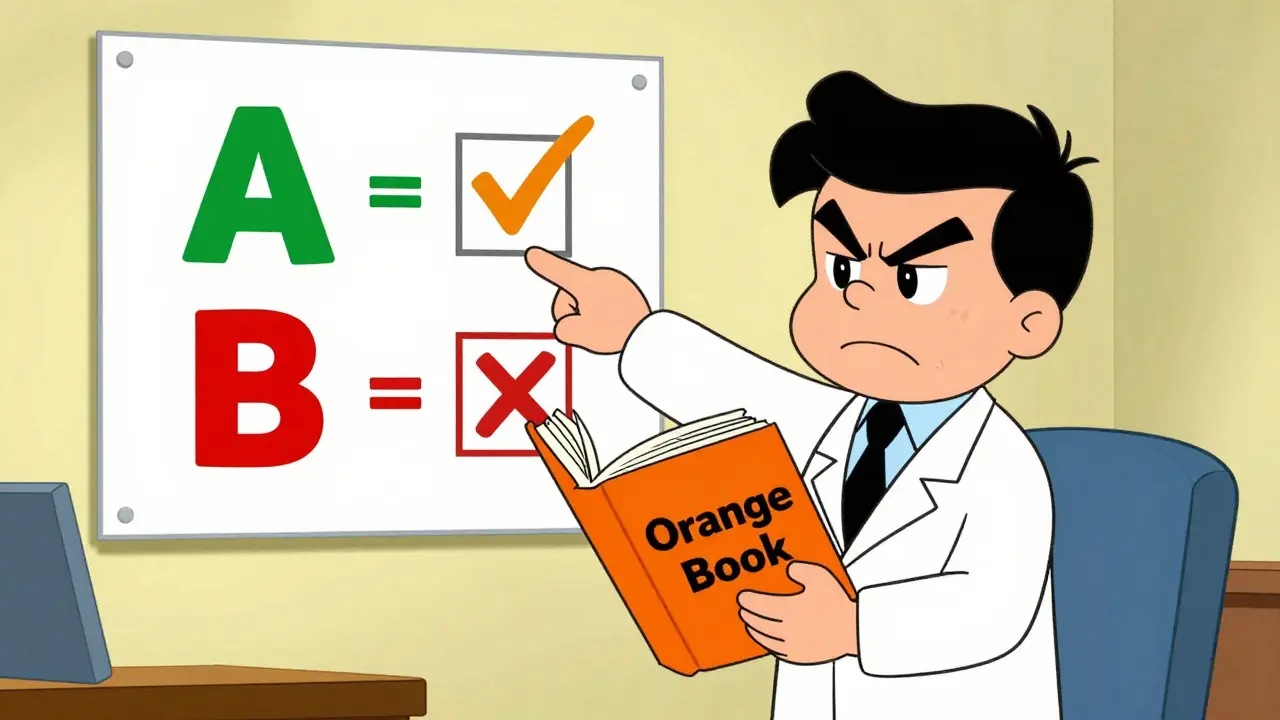
You won’t find TE Codes listed on your pharmacy receipt. Instead, they live in a document known as the FDA Orange Book, officially titled Approved Drug Products With Therapeutic Equivalence Evaluations. This book is the authoritative reference for all multi-source prescription drug products approved under Section 505 of the Federal Food, Drug, and Cosmetic Act.
Every pharmacist with access to a computer system-like Epic or Cerner-can look up a drug in the Orange Book database. When a pharmacist considers swapping a brand-name drug for a generic, they check the TE Code assigned to that specific generic product. If the code indicates equivalence, state laws in all 50 U.S. states generally allow or even require the pharmacist to dispense the cheaper generic option unless the prescriber explicitly forbids it.
Decoding the Alphabet: How to Read a TE Code
TE Codes might look like random letters, but they follow a strict logic. Each code consists of two or three characters. The first character is the most important part of the equation. It tells you immediately whether the drug is considered equivalent.
- First Character 'A': This means the product is considered therapeutically equivalent. You can expect it to perform the same as other pharmaceutically equivalent products.
- First Character 'B': This signifies the product is not considered therapeutically equivalent. There may be differences in performance, safety, or efficacy that prevent safe substitution.
The second character provides more detail about the dosage form or the basis for the evaluation. For example, an 'AA' code often refers to immediate-release oral solid dosage forms, while 'AN' might indicate an injectable solution. Here is a quick breakdown of common combinations:
| Code | Meaning | Example Dosage Form |
|---|---|---|
| AA | Therapeutically Equivalent | Tablets, Capsules |
| AN | Therapeutically Equivalent | Injectable Solutions |
| AO | Therapeutically Equivalent | Oral Solutions |
| B* | Not Therapeutically Equivalent | Various |
If you see a code starting with 'A', you can rest easy. The FDA has determined that the generic meets rigorous standards for pharmaceutical equivalence (same active ingredient, strength, and route) and bioequivalence (same rate and extent of absorption in the body).
Why TE Codes Matter for Your Wallet
The primary reason TE Codes exist is to drive down healthcare costs without sacrificing quality. Brand-name drugs are expensive because manufacturers invest billions in research, development, and marketing. Once a patent expires, generic manufacturers can produce the same drug without those initial R&D costs.
According to FDA data, generic drugs typically cost 80-85% less than their brand-name counterparts. That’s a massive saving. For a family taking multiple daily medications, switching from brand-name atorvastatin (Lipitor) to a TE-rated generic could save hundreds of dollars a month. Over time, these savings add up to trillions of dollars across the U.S. healthcare system. Since 1995, TE Codes have enabled over $2.2 trillion in healthcare savings, according to testimony from former FDA officials.
This economic benefit relies entirely on trust. Patients need to trust that the generic is just as effective. The TE Code system provides that trust by ensuring that every generic labeled as 'A' has undergone extensive testing. Manufacturers must submit bioequivalence studies showing that the generic’s blood concentration levels fall within 80-125% of the brand-name drug’s levels. This narrow margin ensures clinical consistency.
When TE Codes Might Not Be Enough
While the TE Code system is robust, it isn’t perfect for every situation. There are certain categories of drugs where minor differences matter more than usual. These are often referred to as Narrow Therapeutic Index (NTI) drugs. Examples include warfarin (used for blood thinning), levothyroxine (for thyroid issues), and phenytoin (for seizures). For these drugs, even a small change in dosage absorption can lead to serious health consequences.
In these cases, patients and doctors sometimes prefer to stick with a specific manufacturer, even if the generic has an 'A' rating. Some states have specific rules about substituting NTI drugs, requiring pharmacist notification or prescriber consent. Additionally, complex generics like inhalers or topical steroids can present challenges. An inhaler’s effectiveness depends not just on the drug inside but on the device’s mechanics. The FDA has withdrawn TE ratings for certain generic budesonide inhalers in the past due to inconsistent delivery performance, highlighting that formulation matters beyond just chemical composition.
How Pharmacists Use TE Codes Daily
For pharmacists, TE Codes are a daily tool. When you drop off a prescription for a brand-name drug, the pharmacist’s software automatically checks the Orange Book. If a generic with an 'A' rating is available, the system flags it for substitution. In most states, this is automatic unless your doctor writes "Dispense as Written" on the script.
This process takes seconds. According to surveys, 91% of U.S. pharmacists report high confidence in TE-rated substitutions. They know that the science behind the code is solid. However, human factors play a role too. Sometimes patients report feeling different after switching generics, even if the TE Code says they are equivalent. Studies show that while 12.7% of patients perceive a difference, clinical assessments rarely find significant therapeutic changes. Often, the perceived difference stems from inactive ingredients like dyes or fillers, which don’t affect the drug’s action but can cause allergies or sensitivities in some individuals.
The Future of Therapeutic Equivalence
The landscape of drug regulation is evolving. The FDA continues to refine its TE Code system to address modern challenges. Recent guidance released in 2022 standardizes evaluation procedures and introduces new coding conventions for complex products. Looking ahead, the agency plans to extend TE Code concepts to biosimilars-generic versions of biologic drugs derived from living organisms. Biosimilars are more complex than traditional small-molecule generics, so establishing equivalence requires different metrics.
Additionally, the FDA is exploring the use of real-world evidence to supplement traditional clinical trials. This means data from actual patient usage could help validate therapeutic equivalence over time. As the generic market grows, representing over $130 billion annually, the reliability of TE Codes remains critical for maintaining both affordability and safety in healthcare.
Can I ask my doctor to prescribe a specific brand instead of a generic?
Yes, you can. If you have concerns about a generic substitution, talk to your doctor. They can write "Dispense as Written" or "Brand Medically Necessary" on the prescription. However, be aware that insurance plans may charge higher copays for brand-name drugs, or they may require prior authorization to cover the brand.
Are all generic drugs therapeutically equivalent?
No. Only generics with an 'A' TE Code are considered therapeutically equivalent. Those with a 'B' code are not. Additionally, some complex generics, like certain inhalers or extended-release formulations, may have unique considerations that affect their equivalence status.
Why do generic pills look different from brand-name pills?
Generic manufacturers cannot copy the exact appearance of a brand-name drug due to trademark laws. They use different colors, shapes, and markings. They also may use different inactive ingredients (fillers, binders, dyes) as long as these do not affect the drug's performance or safety.
Do TE Codes apply to over-the-counter (OTC) drugs?
Do TE Codes apply to over-the-counter (OTC) drugs?
Generally, no. TE Codes are primarily used for prescription drugs approved via the Abbreviated New Drug Application (ANDA) pathway. OTC drugs are regulated differently, though consumers can look for "Drug Facts" labels and USP verification marks to ensure quality and equivalence.
How can I check the TE Code for my medication?
You can search the FDA Orange Book online. Enter the brand name or generic name of your drug, and the database will list all approved products along with their TE Codes. Your pharmacist can also look this up for you instantly.
Comments (14)
swetha r
10 May, 2026It is fascinating how they want us to believe that the 'generic' version is just as good. They tell you it's cheaper, but have you ever wondered what they leave out? The fillers, the dyes, the subtle changes in absorption rates... it's all part of a grand design to keep us dependent on their system while quietly altering our biology. I switched my thyroid meds once and felt like a different person for weeks. Coincidence? I think not.
Derick Garcia
11 May, 2026The notion that a letter code determines medical efficacy is absurd. You are placing your life in the hands of bureaucrats who likely do not understand the nuances of human physiology. This 'system' is merely a cost-cutting measure disguised as scientific rigor. Do not be so naive as to trust an algorithm over your own body's reaction. The FDA is not a guardian; it is a gatekeeper for corporate interests.
Dat Alexander
12 May, 2026look i get the skepticism but the science behind bioequivalence is actually pretty solid if you take the time to read the studies. the 80-125% range isn't arbitrary it's based on statistical confidence intervals for clinical equivalence. most people worry about the inactive ingredients but those rarely affect the active drug's performance unless you have a specific allergy. it's worth checking the orange book yourself though knowledge is power
Abhimanyu Pandey
13 May, 2026You speak of 'trust' as if it is a commodity freely given! It is not! The pharmaceutical industry operates in shadows, manipulating data to fit their narrative of equivalence. When was the last time you saw a truly independent study on long-term generic substitution effects? Never! Because the truth is inconvenient for the bottom line. We are guinea pigs in a global experiment, and we are too blind to see the cage bars!
Raymond Roberts
15 May, 2026I dont know man i just took my lipitor generic for years and never had an issue. maybe its just me but i feel fine. the doctor said if i start feeling weird i should switch back but honestly the savings were huge for my family budget. i guess everyone has different experiences with these things and its hard to say what works for one person vs another without trying it out first hand.
Nisha Koshti
16 May, 2026Ughhh why does this matter?? :(( I just take whatever pill they give me at the pharmacy because I don't have time to research codes!! If it says A then fine I guess?? But I hate when the color changes it makes me anxious!! Why can't they just make them look the same?? It's so confusing and stressful!!! 😡😡
Jannet Suen
17 May, 2026Oh honey, please don't stress over the color! 🎨 It's literally just trademark law preventing them from copying the brand name's look. As long as the TE code starts with an 'A', you're golden. Trust the process, or at least trust the pharmacist who checks it for you. No need to spiral into anxiety land over a blue vs white pill! ✨
Claire A
18 May, 2026This is such helpful information! I always wondered why my pills looked different every time I went to a new pharmacy chain. Knowing that there is a standardized system gives me peace of mind. I'm going to print this out and keep it in my medical folder just in case I need to reference it later. Thanks for breaking it down so clearly!
andrew iregbayen
19 May, 2026Hey guys, quick question since I'm new to this stuff. Does this apply to supplements too? Or just prescription drugs? I've been buying different brands of vitamins and wondering if they're all the same quality. Would love to know more about how the FDA regulates those compared to actual meds.
Laura ciotoli
20 May, 2026TE Codes do NOT apply to over-the-counter drugs or supplements. The FDA regulates OTC drugs differently, focusing on Drug Facts labels and USP verification marks. Supplements are regulated under DSHEA as food products, not drugs, meaning they do not undergo the same rigorous pre-market approval process. Do not confuse dietary supplements with therapeutic equivalents.
Sarah O'Donnell
20 May, 2026Its so frustrating that we have to fight for basic transparency in healthcare 😤 The system is rigged against the patient. We pay billions and still get confused by codes and acronyms. Where is the accountability?? We deserve better than this chaotic mess of regulations and loopholes. Its time for real change not just more paperwork! 💔
Amelia Vaughan
21 May, 2026If you cant trust the FDA then you cant trust anything. These codes are essential for keeping costs down for American families. Stop complaining and appreciate the savings. Generic drugs are a miracle of modern medicine and economics. Get used to it.
Kevin S
22 May, 2026Great post! 👍 I learned something new today. Its wild how much goes on behind the scenes with prescriptions. Im gonna ask my pharmacist next time if my current meds have an A rating. Seems like a smart move to check. Thanks for sharing this info! 🙌
Madison Jones
23 May, 2026I am so glad someone finally explained this!! I have been worried about my inhaler being swapped out because I heard bad things about generic inhalers. Reading about the NTI drugs and complex generics made so much sense now. I will definitely talk to my doctor about keeping my brand name for that specific medication. Thank you for the clear breakdown!!!! 😊😊