
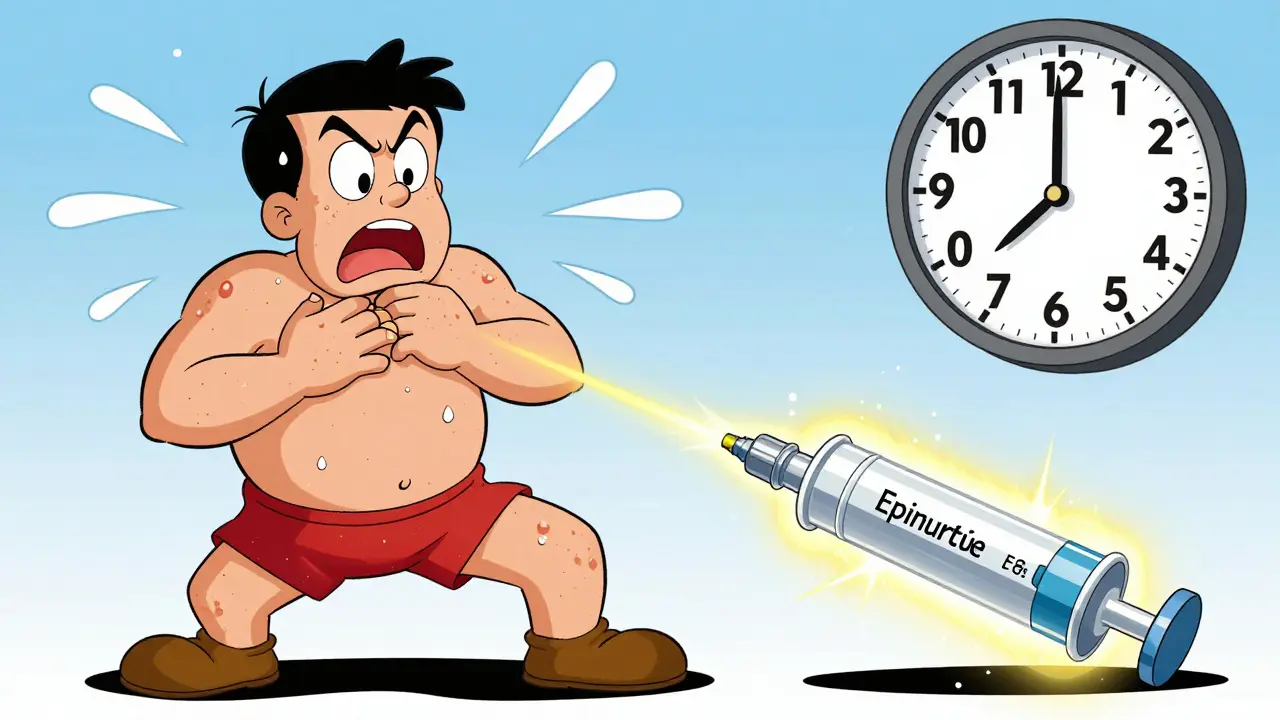
When someone suddenly can’t breathe, their skin breaks out in hives, and their throat feels like it’s closing, time isn’t just important-it’s everything. This isn’t a panic attack. It’s anaphylaxis, a life-threatening allergic reaction that can kill in minutes if not treated right. And the only thing that can stop it? Epinephrine. Not antihistamines. Not steroids. Not waiting to see if it gets worse. Just epinephrine-and fast.
What Exactly Is Anaphylaxis?
Anaphylaxis isn’t just a bad allergy. It’s a full-body emergency. Your immune system goes into overdrive, releasing chemicals that cause your blood vessels to leak, your airways to swell, and your blood pressure to crash. Symptoms can start in seconds or take up to a couple of hours, but they always come on fast. You might see hives or swelling around the lips or eyes. Then comes wheezing, trouble swallowing, dizziness, or vomiting. In severe cases, the person goes pale, feels faint, or loses consciousness.The medical definition is simple: if you have skin symptoms plus trouble breathing or low blood pressure-or two or more of these signs after being exposed to something you’re allergic to-you’re having anaphylaxis. And you need epinephrine now.
What Triggers Anaphylaxis?
Not all allergies lead to anaphylaxis, but some triggers are far more dangerous than others. In the U.S., food causes about 90% of food-related anaphylaxis cases. Peanuts, tree nuts, shellfish, and milk are the big ones. Insect stings-especially from bees, wasps, or fire ants-account for nearly 10% of cases. Medications like penicillin are another major cause, responsible for 75% of drug-induced reactions. Latex, though less common now, still triggers reactions in some people.What’s scary is how unpredictable it can be. Someone might have had a mild reaction once and then have a life-threatening one the next time. There’s no way to know for sure who will react badly. That’s why if you’ve ever had even a moderate allergic reaction, you should be tested and carry epinephrine.
Why Epinephrine Is the Only Real Treatment
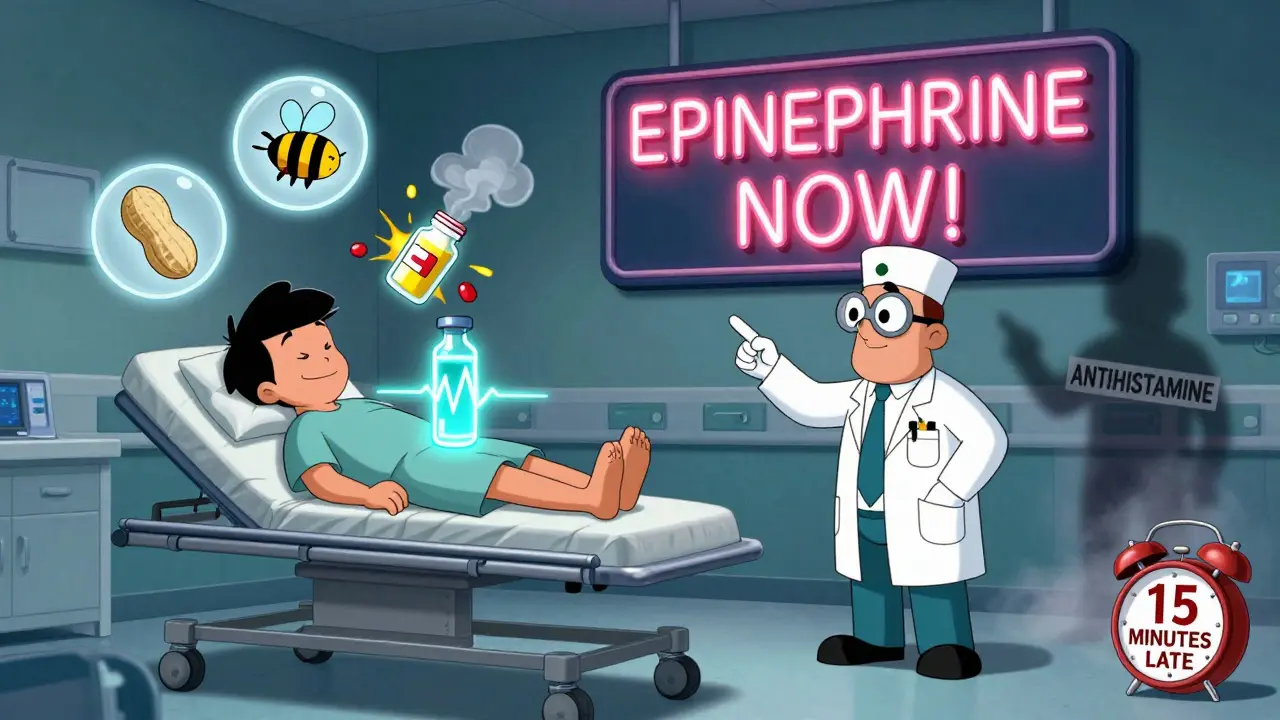
Epinephrine isn’t just a treatment-it’s the only treatment that can reverse anaphylaxis. It works by tightening blood vessels to raise blood pressure, opening up airways so you can breathe, and stopping the release of more dangerous chemicals in your body. It doesn’t just ease symptoms-it stops the reaction from killing you.Other things people try-like antihistamines (Benadryl) or steroids-don’t help at all in the moment. A 2012 Cochrane review found antihistamines have 0% effectiveness as a standalone treatment for anaphylaxis. Steroids might help prevent a second wave of symptoms later, but they do nothing for what’s happening right now. Epinephrine is the only thing that works fast enough.
Emergency medicine specialists agree: 97% say epinephrine is the clear first-line treatment. Delaying it is the biggest reason people die. Studies show that when epinephrine is given within 5 minutes of symptom onset, 85% of patients improve. If it’s delayed past 15 minutes, that number drops to 42%.
How to Use an Epinephrine Auto-Injector
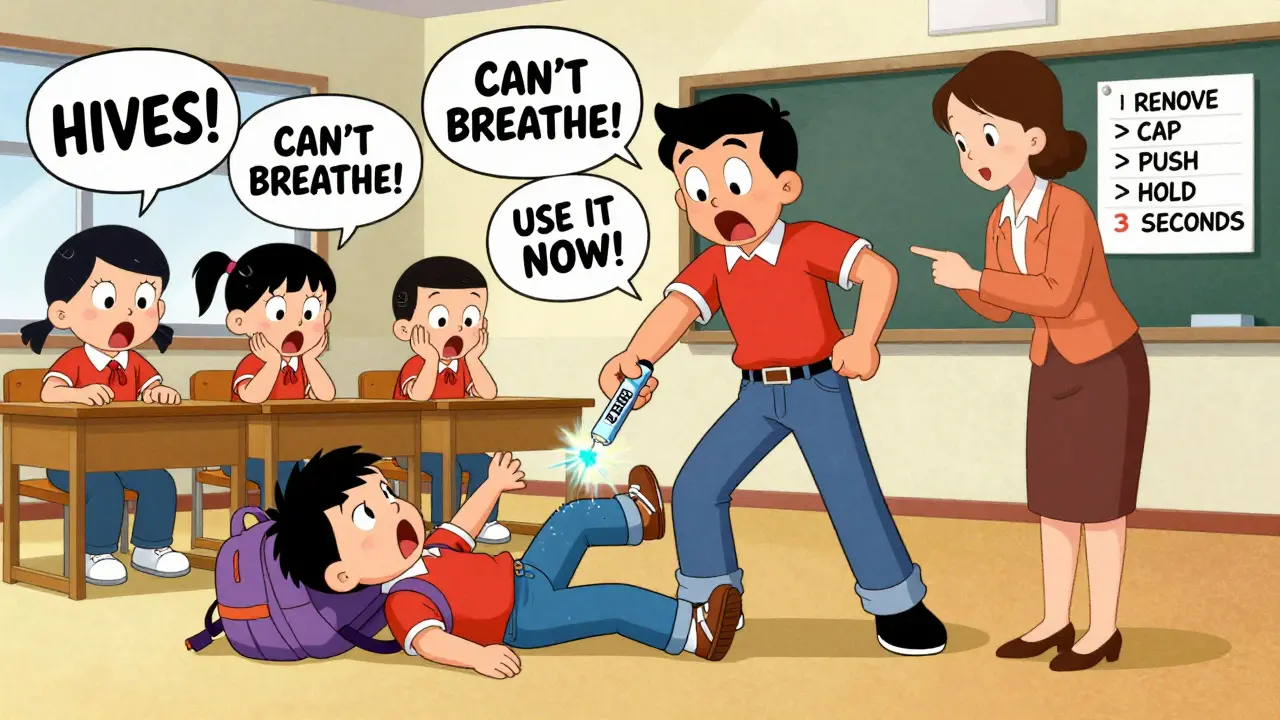
Most people carry epinephrine in a device called an auto-injector. The most common brands are EpiPen, Auvi-Q, and Adrenaclick. They look like pens. You don’t need to be a doctor to use one.Here’s how:
- Remove the safety cap.
- Place the tip against the outer thigh-through clothing if needed.
- Push hard until you hear a click. Hold it there for 3 seconds.
- Remove and massage the area for 10 seconds.
That’s it. The injection goes into the muscle, not under the skin. The vastus lateralis muscle in the thigh absorbs the drug fastest-peak levels hit your bloodstream in 8 minutes. If you inject it into the arm or fat, it takes twice as long.
Two doses? Yes. If symptoms don’t improve after 5 minutes, give a second shot. Don’t wait. Don’t second-guess. More than one dose is safe and often necessary.
And always call 911-even if you feel better. Anaphylaxis can come back hours later (called a biphasic reaction). You need to be watched for at least 12 hours in a hospital if you’ve had a severe reaction.
Common Mistakes and Why They’re Deadly
People don’t die because they don’t have epinephrine. They die because they don’t use it.Here are the biggest mistakes:
- Waiting for “worse” symptoms. 43% of people delay treatment because they think, “It’s just a rash-I’ll wait to see if it turns into breathing trouble.” By then, it’s too late.
- Using antihistamines first. Many keep Benadryl on hand and think it’s enough. It’s not. It takes 30-60 minutes to work. Anaphylaxis doesn’t wait.
- Not practicing. 68% of people who try to use an auto-injector for the first time in a simulation get it wrong. They hold it wrong, don’t press hard enough, or forget to hold for 3 seconds.
- Ignoring expiration dates. Epinephrine loses strength after 12-18 months. If it’s expired, it won’t work. Keep track with phone reminders.
Needle fear? It’s real. 22% of people avoid carrying epinephrine because they’re scared of needles. But the needle is tiny, the injection is quick, and the risk of not using it is death.
Cost, Access, and the Hidden Crisis
Epinephrine auto-injectors cost between $375 and $650 for a two-pack in the U.S. That’s why 30% of people prescribed them don’t fill the prescription. Low-income patients are hit hardest-only 45% maintain their prescriptions, according to a 2021 study.But things are changing. Generic versions now make up 70% of prescriptions. Prices have dropped from an average of $325 out-of-pocket in 2016 to $185 in 2023. Insurance helps, but not everyone has it.
And then there’s the school problem. All 50 states now require schools to keep stock epinephrine. 92% of U.S. schools do. But only 37% of patients discharged from the ER get a written action plan. That means many families don’t know what to do next.
New Options and What’s Coming
In August 2023, the FDA approved Neffy, a nasal spray version of epinephrine. It’s needle-free, easier for kids and needle-phobic people, and works just as fast. It’s not a replacement for injectors yet, but it’s another tool.Smart injectors are coming too-devices that use Bluetooth to alert family members when they’re used. Extended-shelf-life versions (24+ months) are in trials. And for high-risk patients, drugs like Xolair (omalizumab) are showing promise-reducing the need for epinephrine by 67% in clinical trials.
But none of these replace the core truth: if you’re at risk, carry epinephrine. Know how to use it. Use it at the first sign of trouble. No exceptions.
Who Needs to Know This?
About 1.6% of Americans-over 5 million people-have had anaphylaxis. The number is rising. Peanut allergies in kids tripled between 1997 and 2008. More people are being diagnosed every year. That means more parents, teachers, coaches, coworkers, and friends need to know how to respond.If you or someone you care about has allergies, get trained. Practice with a training device every month. Keep your injector in your bag, your car, your desk. Don’t let it sit in a drawer. Teach your kids. Tell your coworkers. Because when seconds count, knowledge isn’t power-it’s survival.
Can you survive anaphylaxis without epinephrine?
Survival without epinephrine is possible but extremely rare and dangerous. Anaphylaxis causes airway blockage, low blood pressure, and organ failure. Without epinephrine, the body can’t reverse these changes. Antihistamines and steroids don’t stop the reaction-they only treat minor symptoms. Delayed treatment leads to death in 0.3% to 1% of cases. Epinephrine is the only treatment proven to prevent fatality.
Is it safe to use epinephrine if you’re not sure it’s anaphylaxis?
Yes. Epinephrine is very safe when used as directed. Side effects like a racing heart, shaking, or anxiety are temporary and far less dangerous than untreated anaphylaxis. Experts agree: when in doubt, use it. The risk of giving epinephrine to someone who doesn’t need it is minimal. The risk of not giving it to someone who does is death.
Why inject into the thigh and not the arm?
The thigh has more muscle and better blood flow than the arm or buttocks. Injecting into the outer thigh (vastus lateralis) gets epinephrine into the bloodstream in about 8 minutes. In the arm, it takes 20 minutes or longer. In an emergency, speed saves lives. The thigh is also easier to reach, even through clothing, making it the safest and fastest option.
Can children use adult epinephrine auto-injectors?
Children under 15 kg (33 lbs) should use the 0.15 mg pediatric dose. Children between 15-30 kg (33-66 lbs) should use the 0.15 mg dose. Adults and adolescents over 30 kg (66 lbs) use the 0.3 mg dose. Using an adult dose in a small child can cause dangerous side effects like high blood pressure or abnormal heart rhythms. Always use the dose appropriate for weight, not age.
Do you need a prescription for epinephrine auto-injectors?
Yes, in the U.S., epinephrine auto-injectors require a prescription. However, many schools, workplaces, and public venues keep stock devices that can be used by anyone in an emergency without a prescription. If you’re at risk for anaphylaxis, talk to your doctor about getting your own. Insurance often covers it, and generic versions are widely available at lower prices.
Comments (9)
Leon Hallal
9 Mar, 2026I saw a guy go into anaphylaxis at a BBQ last summer. No one knew what to do. He had the EpiPen in his pocket but didn't use it. We called 911 and he made it, but barely. This post is dead on. Epinephrine isn't optional. It's the difference between breathing and being dead in 10 minutes.
Judith Manzano
10 Mar, 2026I'm so glad this got shared. My daughter has a severe peanut allergy and we practice with training injectors every month. It's scary how many people think Benadryl is enough. I wish every school nurse, teacher, and coach had to watch a 2-minute video on how to use an EpiPen. Lives depend on this knowledge.
rafeq khlo
11 Mar, 2026The data presented is statistically significant but lacks proper citation of peer-reviewed studies. The 85% improvement rate within five minutes is cited without reference to the original clinical trial. Furthermore, the assertion that antihistamines have zero effectiveness is misleading. While they do not address hemodynamic collapse, they mitigate histamine-mediated symptoms. The article oversimplifies a complex immunological cascade into a binary solution
Jazminn Jones
12 Mar, 2026It's frankly embarrassing that we still need to be told this in 2024. Epinephrine is not a 'treatment'-it's a biological necessity. The fact that people delay because they're 'afraid of needles' is a failure of public health education. I've seen too many parents treat this like a minor inconvenience instead of a medical emergency. This isn't about preference. It's about survival.
George Vou
13 Mar, 2026they say epinephrine saves lives but what if its just a big pharma scam? like why do they make it so expensive? i mean im not saying its fake but why does it cost 600 bucks? i think the real cure is just avoid all allergens and maybe eat more probiotics
Scott Easterling
13 Mar, 2026I'm not saying this isn't important... but why are we acting like this is new news? I've been carrying two EpiPens since I was 12. This post reads like a PSA from 2008. The real issue? People don't refill them. They let them expire. They hide them in the back of a drawer. Knowledge isn't the problem. Compliance is.
Mantooth Lehto
15 Mar, 2026My kid had his first reaction at school and the nurse had to use the stock EpiPen. I cried for an hour. I now carry two in my purse, one in the car, and one in his backpack. I check expiration dates every week. I tell every single person who watches him: IF HE SWELLS, USE IT. NO EXCEPTIONS. I'm not sorry for being loud about this. This isn't a suggestion. It's a lifeline.
Nicholas Gama
16 Mar, 2026Epinephrine works. But the real crisis is access. 30% don't fill prescriptions because of cost. Schools have stock devices. Yet 63% of patients leave the ER without a written plan. This isn't ignorance. It's systemic failure.
Mary Beth Brook
17 Mar, 2026The U.S. leads in anaphylaxis survival rates because we mandate epinephrine access in public spaces. Other countries? They still rely on outdated protocols. This isn't just medical-it's national infrastructure. We don't wait for disasters. We prepare. That's why we're the best.