
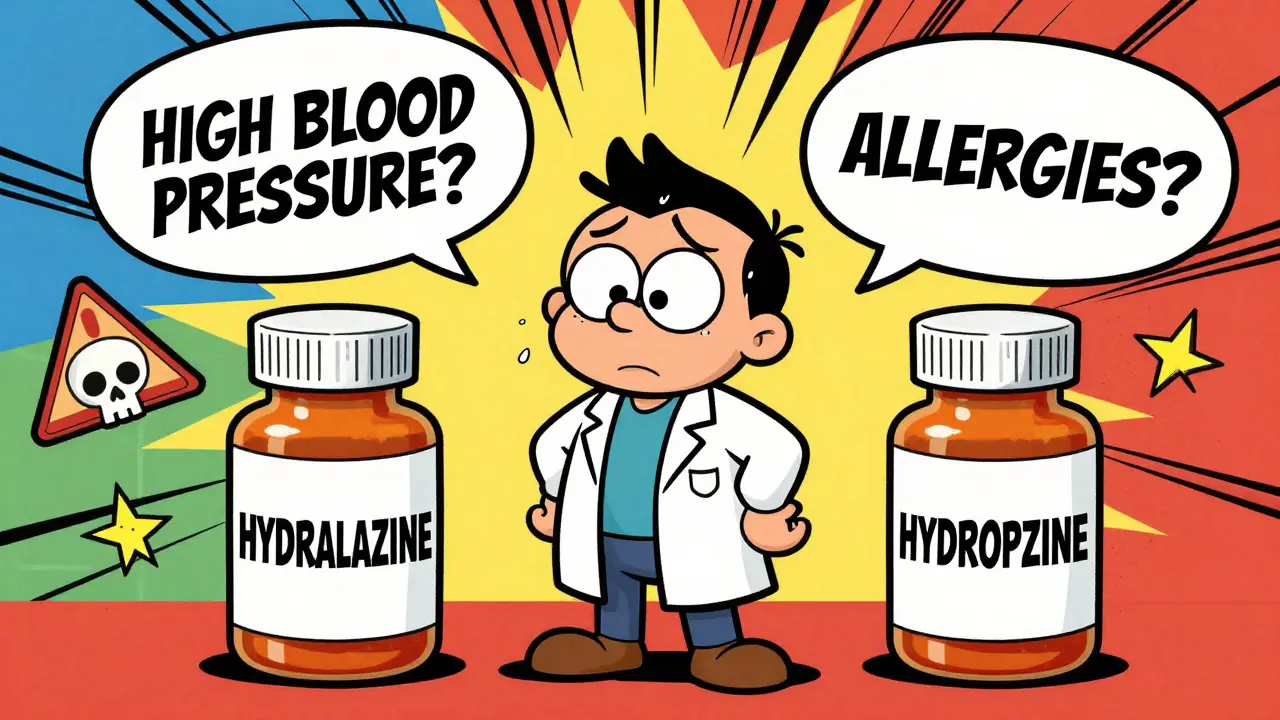
Every year, thousands of people are harmed-not by the medicine they need, but by the one they get by mistake. It’s not a rare glitch. It’s a quiet, systemic problem that happens in hospitals, pharmacies, and even at home. And it’s mostly tied to generic drugs that look too similar or sound too much alike. You’d think a pill’s name would be unique enough to avoid confusion. But in reality, names like hydralazine and hydroxyzine, or quinidine and quinine, are dangerously close. One is for high blood pressure. The other is for allergies. Mix them up, and you could be in serious trouble.
Why Generics Are the Main Culprit
Generic drugs are cheaper copies of brand-name medicines. That’s good for patients and the system. But here’s the catch: when multiple companies make the same generic, they don’t have to follow the same packaging rules. One company’s 10 mg capsule might look almost identical to another’s-even if they’re completely different drugs. The color, shape, size, and even the imprint code can be nearly the same. That’s not an accident. It’s a cost-cutting choice.And it gets worse with names. Generic drug names often borrow the same root. Take valacyclovir and valganciclovir. Both start with “val-.” Both are used for viral infections in transplant or HIV patients. But one treats herpes, the other CMV. If a nurse hears “val” over a noisy intercom, or a pharmacist glances at a screen where the names are listed side by side, the mix-up can happen in seconds. The Institute for Safe Medication Practices (ISMP) has documented nearly 1,000 of these risky pairs. And 25% of all medication errors? They trace back to this exact problem.
How the Confusion Happens
It’s not just one step. It’s a chain. A doctor writes a prescription. The pharmacist reads it. A nurse gives it. Each step is a chance for error.Visual confusion happens when two drugs look alike on the shelf. One study found that over 10% of medication errors were caused by packaging that was too similar. Think of metoprolol and meloxicam. One’s a heart drug. The other’s a painkiller. If both are stored in clear bottles with white caps, and the labels are printed in the same font, it’s easy to grab the wrong one-especially during a busy shift.
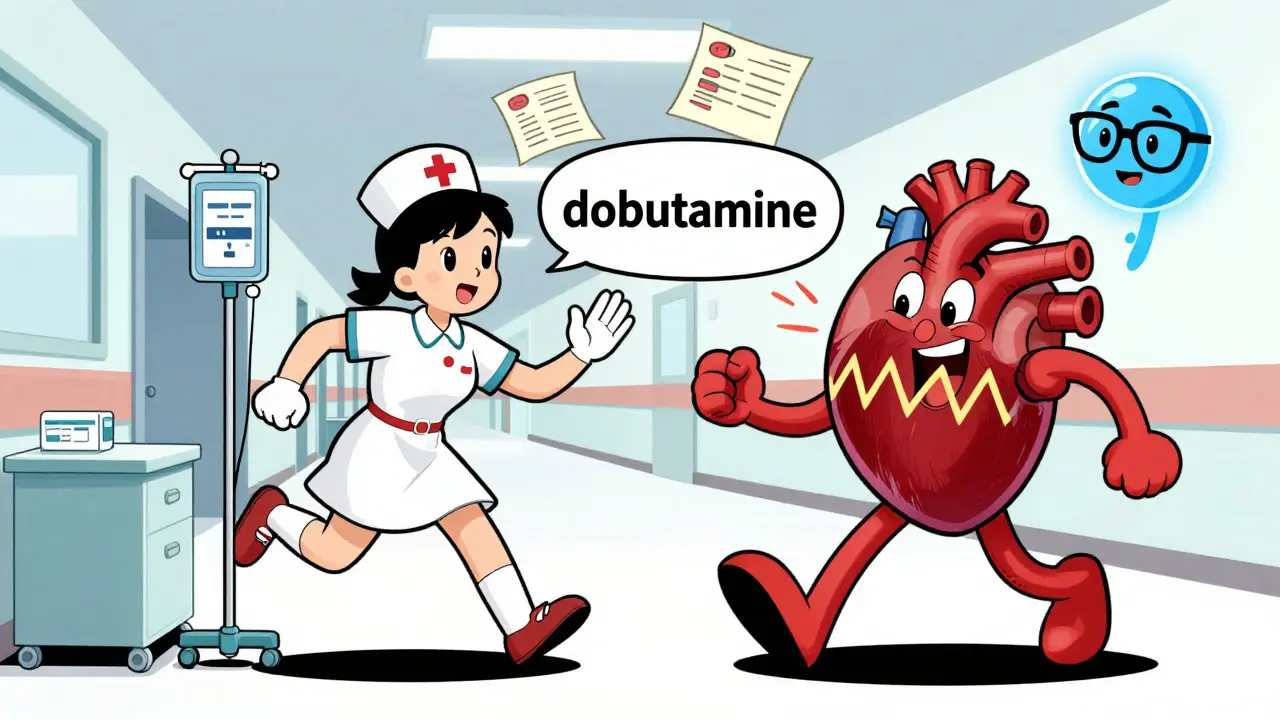
Then there’s sound. Verbal orders are a big risk. In an emergency room, someone yells, “Give me 10 mg of dopamine!” But the nurse hears “dobutamine.” Both are IV drugs used in critical care. Dopamine raises blood pressure. Dobutamine boosts heart output. Give the wrong one, and a patient’s heart can race out of control. A 2022 case study in the American Journal of Nursing showed how this exact mix-up nearly killed a patient. The team caught it just in time.
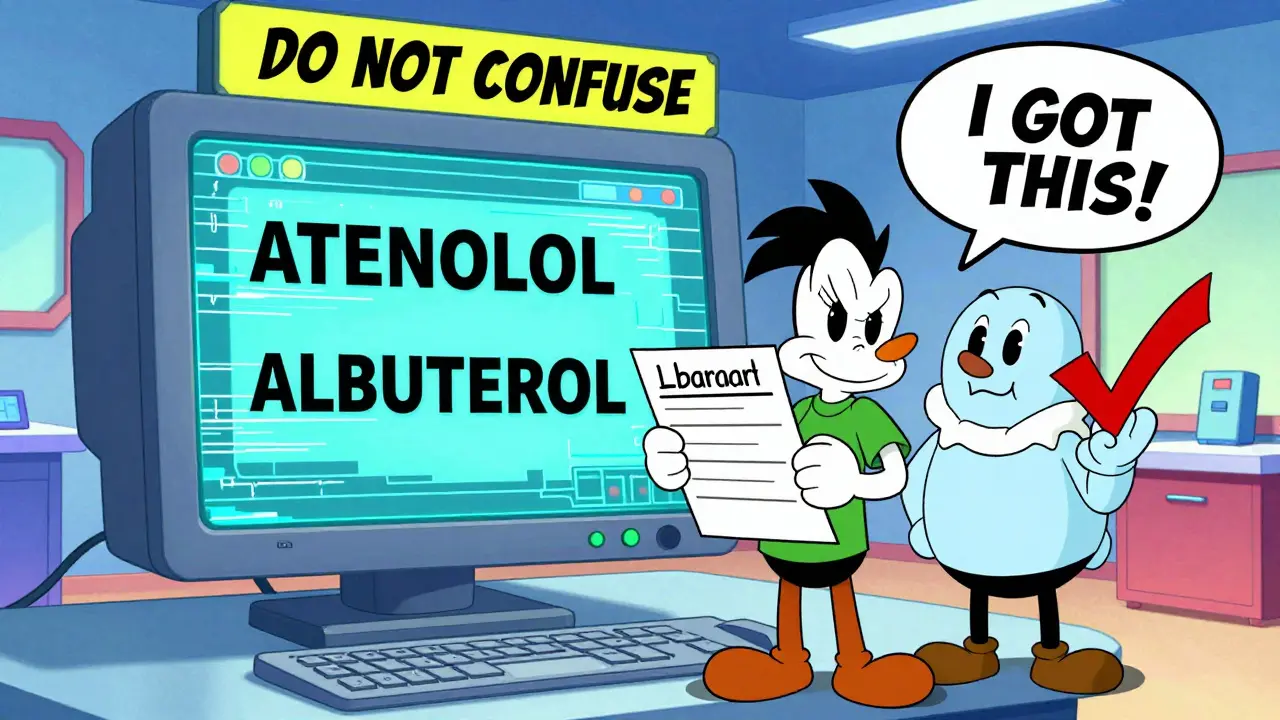
And don’t forget the computer screens. In electronic health records, drug names are often listed alphabetically. If “albuterol” and “atenolol” appear next to each other, and the prescriber clicks too fast, the wrong one gets selected. No one notices-until the patient’s heart rate drops dangerously low.
Who’s Affected the Most
It’s not just elderly patients or those on multiple medications. Children are at risk too. Even though pediatric LASA errors are less frequent-fewer than one per 1,000 prescriptions-the consequences can be deadly. A child given the wrong dose of a heart drug instead of an antibiotic doesn’t just get sicker. They can crash.Patients in intensive care, oncology units, and transplant centers are especially vulnerable. These are the places where drugs with similar names are used most often. A transplant patient on valganciclovir to prevent CMV infection could get valacyclovir instead. That might sound harmless. But valacyclovir doesn’t work against CMV. The infection could spread. The organ could fail. And it all started because two names looked too similar on a screen.
What’s Being Done-And Why It’s Not Enough
There are solutions. But they’re not used everywhere.Tall man lettering is one of the most effective tools. That’s when key parts of a drug name are capitalized to show the difference: predniSONE vs. predniSOLONE. A 2020 study across 12 hospitals showed this cut errors by 67%. Yet, many pharmacies still don’t use it. Why? Because it requires updating labels, training staff, and changing software settings. It’s not hard. But it’s not always a priority.
Barcode scanning helps too. When a nurse scans the patient’s wristband and the drug’s barcode, the system checks if they match. If not, it alerts them. One hospital saw a 45% drop in LASA errors after adding this. But again-only if the system is set up right. Many smaller clinics still rely on paper lists or old computer systems that don’t flag risks.
Some hospitals keep “Do Not Confuse” lists. Pharmacists get training. Labels are color-coded. But these are patchwork fixes. The real problem? There’s no global standard. In the U.S., the FDA has rejected 34 drug names since 2021 just because they were too similar to existing ones. The European Medicines Agency has required name similarity checks since 2019. But in many countries, there’s no rule at all. A drug approved in one place might be banned in another-simply because of its name.
The Tech That’s Actually Working
Artificial intelligence is starting to change the game. A 2023 study in the Journal of the American Medical Informatics Association tested an AI system embedded in electronic health records. It flagged 98.7% of potential LASA errors. False alerts? Just 1.3%. That’s better than any human can do. The system didn’t just look at names. It checked the patient’s diagnosis, allergies, and current meds. If a doctor tried to prescribe atenolol to someone with asthma, it warned them-even if the name wasn’t visually similar.These systems don’t replace people. They support them. They give pharmacists and nurses a second pair of eyes. And they work fast. In an emergency, every second counts. AI doesn’t get tired. It doesn’t miss a name because it’s reading too fast.
But adoption is slow. Many hospitals still rely on outdated systems. Training staff takes time. Budgets are tight. And without leadership pushing for change, it’s easy to ignore.
What You Can Do-As a Patient or Caregiver
You don’t have to wait for the system to fix itself. You can protect yourself.- Always ask: “What is this medicine for?” If the answer doesn’t match your condition, question it.
- Check the label. Does the name match what your doctor told you? If it looks odd, ask the pharmacist to double-check.
- Know the difference between brand and generic. If your doctor prescribes “atenolol,” don’t assume the generic version is the same as the brand. Ask if it’s the right one.
- If you’re on multiple drugs, keep a written list. Bring it to every appointment. Show it to every pharmacist.
- Don’t be afraid to speak up. If something feels wrong, say so. Medication errors are preventable. But only if someone notices.
The Bigger Picture
Medication errors cost the world $42 billion a year. In the U.S., 1 in 10 hospital patients experiences one. And nearly a quarter of those are from look-alike, sound-alike drugs. That’s not just a number. It’s someone’s mother. Someone’s child. Someone’s partner.The World Health Organization calls this a global patient safety crisis. Their goal? Reduce severe harm from medication errors by 50% by 2025. It’s possible. But only if we treat this like a system failure-not a human mistake.
Doctors aren’t careless. Pharmacists aren’t lazy. Nurses aren’t distracted on purpose. The system is designed in a way that makes errors likely. We need better names. Better labels. Better screens. Better rules. And above all, we need to stop blaming individuals and start fixing the design.
Change is coming. Slowly. But it’s coming. And if you’ve ever been prescribed a generic drug-you’re part of the solution. Pay attention. Ask questions. Push for clarity. Because in the end, the right medicine shouldn’t be a gamble.
Comments (13)
Acacia Hendrix
14 Jan, 2026The systemic epistemological failure in pharmaceutical nomenclature is not merely a logistical oversight-it's a structural ontological crisis in patient safety architecture. The FDA's reactive, rather than proactive, stance on LASA drug naming reflects a pathological deference to market-driven cost optimization over biosemiotic precision. Tall man lettering isn't a 'tool'-it's a minimal epistemic safeguard that should be codified in international pharmacopeial law, not left to the whims of hospital administrators with budgetary myopia.
James Castner
15 Jan, 2026Let me be perfectly clear: this isn't about blame. It's about design. We've built a system where human beings are expected to perform flawlessly under conditions that are inherently flawed-overworked staff, poorly designed interfaces, inconsistent labeling, and a regulatory framework that prioritizes profit over precision. We don't need more training. We need better systems. AI is not the silver bullet-it's the first step toward a world where the burden of vigilance is no longer placed on nurses and pharmacists working 12-hour shifts. The real question is: why are we still waiting?
Adam Rivera
16 Jan, 2026Man, I had a cousin who almost got the wrong med last year. She was on some heart stuff and they gave her the painkiller by accident. She ended up in the ER. Scary stuff. But honestly? The pharmacist was super nice and apologized. I just wish more places had those barcode scanners. They're not that expensive, right? Just seems like common sense.
Trevor Davis
18 Jan, 2026It's not just the names. It's the culture. We've normalized chaos in healthcare. We accept that someone might die because a label looked like another label. We call it 'human error'-but it's not. It's systemic neglect dressed up in bureaucratic euphemisms. And yet, we keep giving pharmaceutical companies a free pass because generics 'save money.' What's the cost of a life? $42 billion? That's not a number-it's a moral ledger.
John Tran
19 Jan, 2026okay so like… i was reading this and it made me think about how we all just kinda… accept things? like, why do we let drug names be so close? it’s not like we’re running out of letters. i mean, come on. valacyclovir and valganciclovir? come on. it’s like naming two siblings ‘John’ and ‘Jon’. one has an extra ‘n’ and boom, your whole life changes. also, i think AI is kinda cool but also kinda scary? like, what if the AI gets it wrong? what if it starts refusing meds because it thinks you have asthma but you don’t? also, typo: ‘do not confuse’ should be ‘don’t confuse’ lol
mike swinchoski
20 Jan, 2026People need to stop being lazy. If you can't read a label, don't take meds. Simple. My uncle took the wrong pill and died. He didn't ask questions. Didn't check the bottle. Just swallowed it. That's not the system's fault-that's personal responsibility. Stop blaming hospitals. Start taking charge of your own health. If you're on five meds, write them down. Use a pill organizer. It's not rocket science.
Damario Brown
21 Jan, 2026AI flagged 98.7% of errors? That’s statistically insignificant if the interface still lets you click through warnings. Also, ‘valganciclovir’ and ‘valacyclovir’ are literally the same except for one syllable. Why is this even a debate? The WHO should have banned these names 15 years ago. And don’t get me started on how US pharmacies still use 1990s barcode scanners that don’t even scan the whole label. This isn’t innovation-it’s institutional negligence with a side of corporate greed.
Priyanka Kumari
22 Jan, 2026This is such an important issue, especially in places where access to pharmacists is limited. I’ve worked in rural clinics in India where nurses often rely on visual recognition of pills because labels are faded or in English only. We started using color-coded caps and simple pictograms for common drugs-like a heart for metoprolol, a flame for meloxicam. It’s not fancy, but it works. Small changes, big impact. Let’s not wait for AI to fix what we can fix today with compassion and creativity.
Avneet Singh
22 Jan, 2026Another performative article about 'systemic failure' while ignoring the real issue: the FDA’s complete lack of authority to enforce naming standards. The EMA has teeth. The FDA? They reject 34 names a year and then approve 500 more that are just as bad. This isn’t a patient safety crisis-it’s a regulatory capture failure. The pharmaceutical lobby owns this conversation. And no, AI won’t fix that.
Adam Vella
24 Jan, 2026It is axiomatic that linguistic ambiguity in pharmacological nomenclature constitutes a violation of the principle of non-maleficence as codified in the Hippocratic Oath. The current paradigm, wherein drug names are derived from chemical structure rather than clinical distinction, is fundamentally flawed. A rational nomenclature system would prioritize phonetic and orthographic divergence over cost efficiency. The absence of such a system is not merely an operational shortcoming-it is a bioethical failure of the highest order.
Alan Lin
25 Jan, 2026I’ve seen this firsthand. I worked as a pharmacy tech for seven years. I once caught a mix-up between hydralazine and hydroxyzine because I noticed the patient had no history of allergies. I flagged it. The pharmacist thanked me. But the next day, the same thing happened again-because the system didn’t change. We need to stop treating this like a human error problem. It’s a design problem. And if you’re a patient, yes-speak up. But don’t carry the burden alone. Demand better. Write to your reps. Support hospitals that use tall-man lettering. This isn’t about being ‘careful.’ It’s about demanding dignity in care.
Pankaj Singh
25 Jan, 2026Let’s cut the crap. This isn’t about ‘systems.’ It’s about incompetent people in positions of responsibility. If you can’t tell the difference between two drug names, you shouldn’t be handling meds. Period. AI? Barcode scanners? Those are crutches for people who didn’t pass pharmacy school. Stop outsourcing responsibility to machines. Train people properly. Fire the ones who keep making mistakes. Simple.
Robin Williams
27 Jan, 2026man… i just realized we name drugs like we’re naming our pets. ‘val-thingy’ and ‘meto-something’? come on. why not call them ‘HeartGuard’ and ‘PainBlast’? at least then you’d know what they do. also, i think we need a meme campaign. #NameYourMedRight. i’ll make a poster of a confused cat holding two pills. it’ll go viral. and then maybe someone will fix this.