
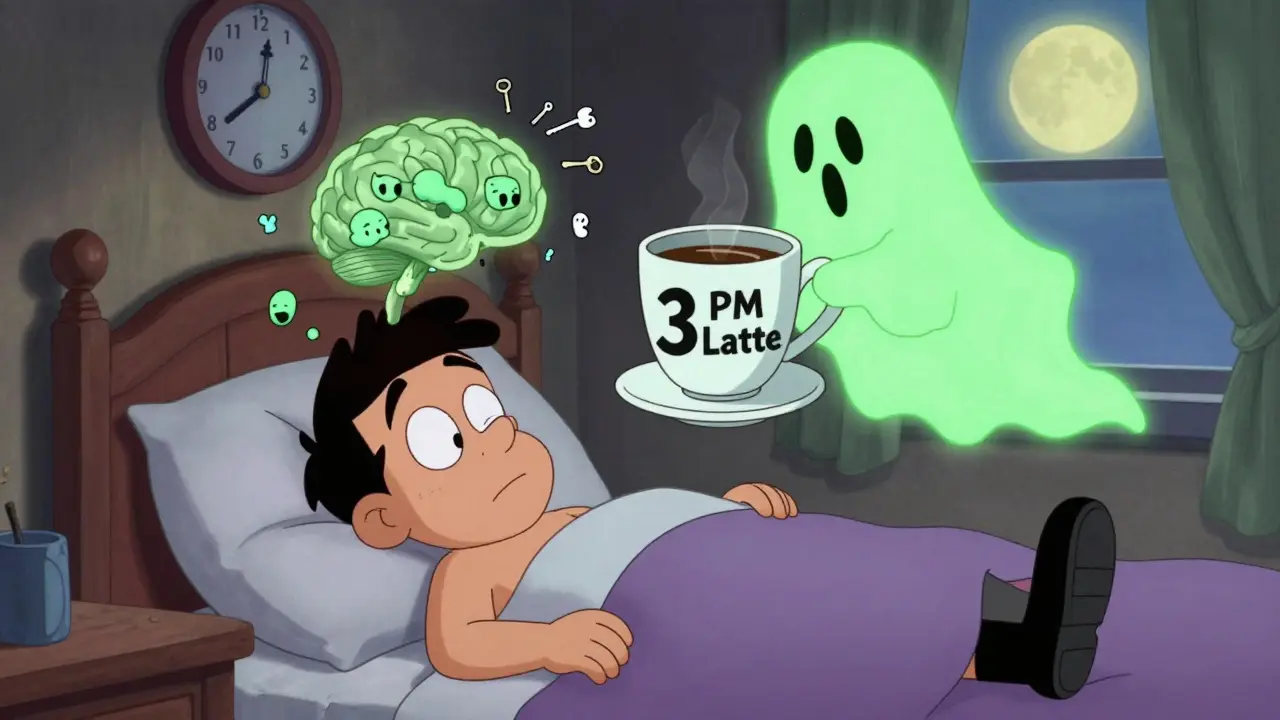
Most people know they shouldn’t drink coffee right before bed. But how late is too late? If you’re tossing and turning at night, even after turning off your phone and dimming the lights, the real culprit might be your afternoon latte. The truth is, caffeine doesn’t vanish when you finish your cup. It lingers-longer than you think-and it’s quietly stealing deep sleep you didn’t even realize you needed.
Why Caffeine Keeps You Awake (Even If You Don’t Feel It)
Caffeine doesn’t just give you energy. It tricks your brain. Your brain has natural sleep signals, mostly driven by a chemical called adenosine. As the day goes on, adenosine builds up and tells your brain it’s time to rest. Caffeine blocks those signals by latching onto the same receptors, like a fake key that won’t let the real one turn. That’s why you feel alert. But when caffeine finally clears, your brain is still buried in adenosine. The result? You fall asleep, but your sleep is shallow, fragmented, and less restorative.
Studies show that even if you fall asleep after drinking coffee, your sleep quality drops. Total sleep time shrinks by about 45 minutes. Sleep efficiency-how much of your time in bed is actual sleep-falls by 7%. And it takes you 9 minutes longer to drift off. You might not notice this. Your body doesn’t scream, “You slept poorly!” It just leaves you tired, irritable, and sluggish the next day.
The 8-Hour Rule: More Than Just a Guess
You’ve probably heard “no caffeine after 2 PM.” That’s a good start. But it’s not based on science alone. The real recommendation? Cut off caffeine at least 8 hours before bedtime. This isn’t arbitrary. A 2021 review of 24 studies published in Sleep Medicine Reviews found that a standard 8-ounce cup of coffee (about 107 mg of caffeine) needs an 8.8-hour window to fully clear from your system before sleep.
Why 8 hours? Because caffeine’s half-life-the time it takes for half of it to leave your body-is 4 to 6 hours for most people. But half-life doesn’t mean “gone.” It means half is still there. After 4 hours, half remains. After 8 hours, about a quarter is still active. And that quarter is enough to interfere with deep sleep.
Let’s say you go to bed at 11 PM. If you drink coffee at 3 PM, you’re still carrying around 25% of that caffeine when you’re trying to sleep. That’s enough to disrupt your brain’s ability to cycle into restorative stages. The Sleep Foundation and sleep physicians like Dr. Dustin Cotliar confirm: even if you fall asleep, you’re not getting the quality sleep your body needs.
Not All Caffeine Is the Same
Not every caffeine source behaves the same. A cup of coffee isn’t the same as a energy drink or a soda. Here’s what you’re really consuming:
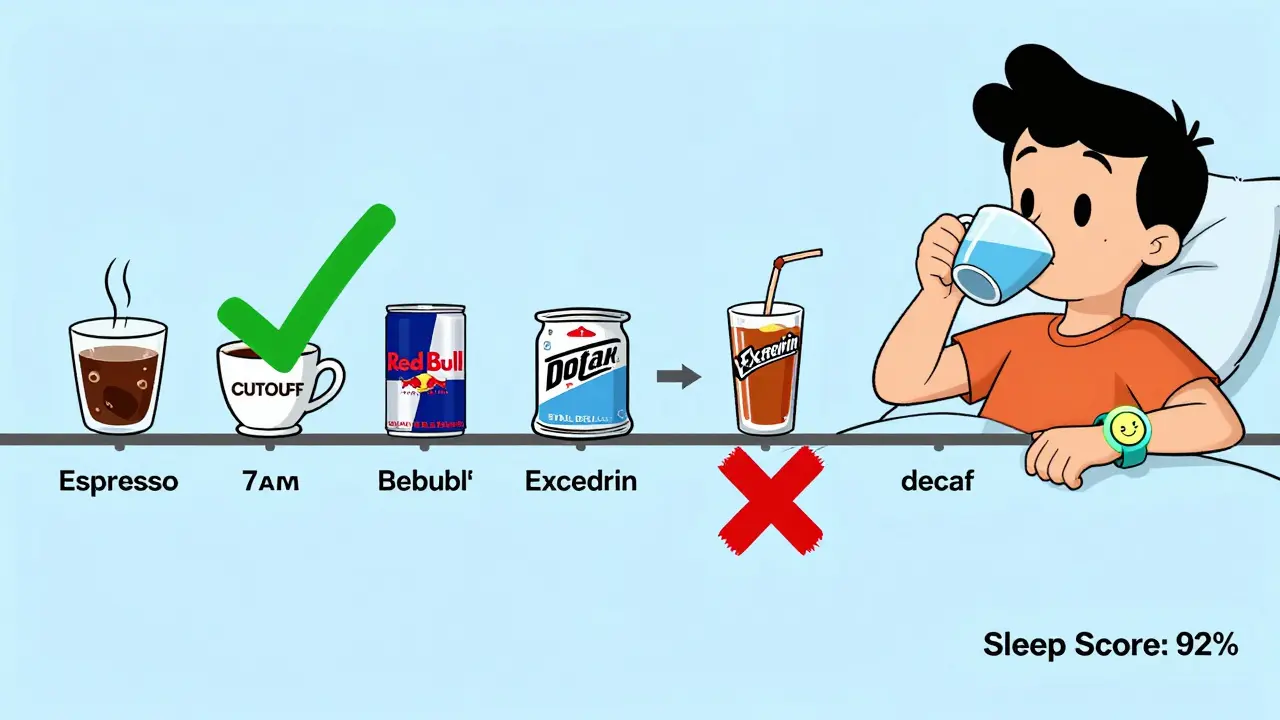
- Regular coffee (8 oz): 107 mg caffeine → 8.8-hour cutoff
- Espresso (1 shot): 63 mg caffeine → 5.2-hour cutoff
- Black tea (8 oz): 47 mg caffeine → no clear cutoff (too low to consistently disrupt sleep)
- Red Bull (8.4 oz): 80 mg caffeine → 7.5-hour cutoff
- Pre-workout supplement: 217.5 mg caffeine → 13.2-hour cutoff
- Excedrin (1 tablet): 65 mg caffeine → 5.5-hour cutoff
Most people don’t realize how much caffeine is in their pain relievers, energy shots, or even chocolate. One Excedrin tablet has nearly as much caffeine as a cup of tea. If you take it at 4 PM, you’re still carrying caffeine into your sleep window. And energy drinks? They’re designed to hit hard and last long. If you’re drinking one after lunch, you’re setting yourself up for a sleepless night.

Age and Genetics: Your Body’s Unique Response
Not everyone metabolizes caffeine the same. A 2025 study in Nature Communications found that people between 41 and 58 years old are more sensitive to caffeine’s sleep-disrupting effects than younger adults. Your brain’s sleep circuits become more vulnerable with age.
Then there’s genetics. About half of us have a gene variant called CYP1A2 that makes us slow metabolizers. For these people, caffeine’s half-life can stretch from 5 hours to 12 hours. That means if you’re a slow metabolizer, a morning coffee might still be active at midnight. You might think you’re fine-you fell asleep, after all-but your brain was working overtime just to filter out the caffeine. Researchers now say that if you’ve had trouble sleeping for years despite “good habits,” you might be a slow metabolizer.
Companies like 23andMe now offer caffeine metabolism tests as part of their health reports. If you’ve ever wondered why your friend can drink espresso at 8 PM and sleep like a baby while you can’t even have tea after noon-you might have different genes.
Real People, Real Results
It’s not just science. Real people are seeing dramatic changes.
A 2022 survey of 2,150 users by Sleepopolis found that those who stopped caffeine by 2 PM (assuming an 11 PM bedtime) gained an extra 47 minutes of sleep per night and improved sleep efficiency by 8%. One Reddit user, u/CaffeineStruggles, wrote: “I switched from my last coffee at 4 PM to 2 PM and gained almost an hour of sleep quality-eye-opening how dramatic the difference was.”
Another analysis of 15,328 sleep logs from the Sleep Cycle app showed that people following the 8-hour cutoff reported 82% satisfaction with sleep quality. Those who only waited 4 hours? Only 47% were satisfied.
The pattern is clear: shifting your cutoff time earlier doesn’t just help you fall asleep. It helps you sleep deeper, longer, and more restfully.
How to Actually Stick to the Cutoff
Knowing the rule isn’t enough. Here’s how to make it stick:
- Track your intake. Use apps like Caffeine Zone or MyFitnessPal to log every cup, pill, or soda. You’ll be shocked how fast it adds up.
- Switch to half-caf after noon. A 2022 review in the American Journal of Managed Care found that switching to half-caffeinated coffee in the afternoon reduced sleep disruption by 32%.
- Watch the hidden sources. Check labels on painkillers, protein bars, and gum. Excedrin, NoDoz, and even some dark chocolates have caffeine.
- Try decaf after 3 PM. Starbucks’ “Evening Brew” decaf line caught on because it works. Decaf still has trace caffeine (2-5 mg), but it’s not enough to affect sleep for most people.
- Use your smartwatch. Oura Ring and Fitbit now include personalized caffeine cutoff reminders based on your sleep patterns. If your device tells you to stop at 2:30 PM, listen.
The Future: Personalized Cutoffs Are Coming
Generic advice like “don’t drink coffee after 2 PM” is fading. The next wave is precision sleep hygiene. A 2024 study in Nature Communications showed that machine learning models combining your genetics, age, and sleep history can predict your ideal caffeine cutoff with 89% accuracy-22% better than standard rules.
The American Academy of Sleep Medicine announced in January 2025 that it will update its guidelines to include beverage-specific cutoffs. No more vague “avoid caffeine late.” Instead: “If you drink a 16 oz latte, stop at 6:30 PM for a 10 PM bedtime.”
Companies are already building this into homes. Philips SmartSleep is testing systems that adjust room temperature and lighting based on when you last had caffeine. Imagine waking up refreshed because your thermostat knew you had a morning espresso.
But until then, stick with the 8-hour rule. It’s the most reliable, science-backed guideline we have today.
What If You’re Already a Night Owl?
What if you sleep at 2 AM? Do you get to drink coffee later? Not exactly. The rule isn’t about your bedtime-it’s about your brain’s sleep cycle. Even if you sleep late, your body still needs deep sleep cycles to recover. If you’re drinking coffee at 10 PM and sleeping at 2 AM, you’re still flooding your brain with caffeine right before your deepest sleep stage. The solution? Move your cutoff to 6 AM. Yes, that’s early. But if you want quality sleep, caffeine needs to be long gone before your body hits its most restorative phase.
Can I have tea instead of coffee in the afternoon?
Yes, black tea is generally safe in the afternoon. It contains about half the caffeine of coffee (47 mg per 8 oz), and studies haven’t found a clear cutoff time for it. Most people can drink black tea up until 6 PM without sleep disruption. But green tea and matcha can have similar or higher caffeine levels, so check the label. Herbal teas like chamomile or peppermint have no caffeine and are a safer choice.
Does decaf coffee have caffeine?
Yes, but very little. Decaf coffee still contains 2-5 mg of caffeine per cup-about 1/20th of regular coffee. For most people, that’s not enough to affect sleep. But if you’re a slow metabolizer or extremely sensitive, even that small amount might add up if you drink 3-4 cups. If you’re trying to eliminate all caffeine, stick to herbal teas.
I stopped caffeine and still can’t sleep. What’s wrong?
Caffeine is just one piece of sleep hygiene. Other factors like screen time before bed, irregular sleep schedules, stress, or sleep apnea can also block deep sleep. If you’ve cut caffeine and still struggle, track your sleep for a week. Note when you go to bed, wake up, and how you feel. You might need to adjust your bedtime routine, reduce blue light exposure, or see a sleep specialist.
Is it okay to have caffeine in the morning?
Yes, and it’s often helpful. Morning caffeine can improve alertness and mood without affecting sleep, as long as you stop at least 8 hours before bed. For most people, having coffee between 7 AM and 10 AM is ideal. It gives your body time to metabolize it before sleep. Avoid drinking it on an empty stomach, though-it can spike cortisol and make you jittery.
Can I drink caffeine if I take melatonin?
No, and it’s not a good idea. Melatonin helps signal sleep, but caffeine blocks the brain’s natural sleep pathway. Taking melatonin after caffeine is like trying to turn off a light switch while someone’s holding the cord. The melatonin might help you feel sleepy, but your brain is still flooded with caffeine. You’ll likely sleep poorly, even if you fall asleep faster. Stick to caffeine cutoffs first-then consider supplements if needed.
Final Thought: It’s Not About Willpower
This isn’t about being disciplined. It’s about chemistry. Your brain doesn’t care how hard you tried to sleep. It just responds to what’s in your bloodstream. If you want to sleep deeply, you need to give your body time to clear caffeine. The 8-hour rule isn’t a suggestion-it’s a biological requirement. Start with cutting off coffee by 2 PM. Track your sleep for a week. You might be surprised how much better you feel, even if you don’t realize how bad it was before.
Comments (8)
Elsa Rodriguez
11 Mar, 2026OMG I JUST REALIZED MY AFTERNOON LATTE WAS RUINING MY SLEEP 😭 I’VE BEEN TAKING IT AT 4 PM FOR YEARS AND WAKING UP FEELING LIKE A ZOMBIE. I SWITCHED TO 2 PM AND NOW I’M ACTUALLY RESTED?? LIKE, I REMEMBER WHAT IT FEELS LIKE TO WAKE UP WITHOUT HATING MY LIFE. THIS POST IS A LIFESAVER. THANK YOU. 🥹☕
Serena Petrie
12 Mar, 2026Stop coffee after 2pm. Done.
Buddy Nataatmadja
13 Mar, 2026I’ve been drinking espresso at 7 PM and sleeping fine. My cousin in Jakarta does the same. Maybe it’s cultural? Or just genetics? I’m not convinced one-size-fits-all. But hey, if it works for you, cool.
mir yasir
15 Mar, 2026The empirical data presented herein is both statistically significant and methodologically rigorous. However, one must temper such conclusions with epistemological humility. The reductionist framing of sleep quality as a function of caffeine half-life neglects the phenomenological dimension of restorative rest. One might argue, contra the Sleep Foundation, that subjective sleep satisfaction is not necessarily contingent upon objective sleep efficiency metrics.
Stephanie Paluch
15 Mar, 2026I switched to decaf after 3pm and I swear I’m sleeping like a baby 🥰✨ I used to think I was fine with coffee late, but my Oura Ring said otherwise 😅 Now I drink chamomile tea and just chill. My partner says I’m nicer to be around too. Who knew caffeine was making me a grump? 🫖💤
tynece roberts
16 Mar, 2026so like i used to think i was just a bad sleeper but then i realized i was drinking 3 energy drinks a day and one was at like 5pm and i was like wow i’m an idiot. i cut it out and now i’m not yawning at 3pm anymore. also i didn’t know excedrin had caffeine?? i take it for headaches like every week. whoops. now i check labels like a hawk. also green tea is sneaky. i thought it was ‘healthy’ but nope. same caffeine as coffee but less? nope. same. 😵💫
Hugh Breen
17 Mar, 2026Bro, this is the most important thing I’ve read all year. I’ve been preaching this to my mates in London since 2022. Caffeine isn’t evil - it’s a timing issue. My mate drank a Red Bull at 8 PM, slept 4 hours, woke up furious. Now he stops at 3 PM. Changed his life. And yes, I’m the guy who asks if you’ve checked your painkillers. You’re welcome. 🇬🇧☕💤
Byron Boror
18 Mar, 2026Why are we all being told what to do? I’m an American. I work hard. I drink coffee when I want. This post is just woke sleep science nonsense. My grandpa drank coffee at midnight and lived to 92. You people are too soft. Stop listening to scientists and start listening to your guts. Coffee is freedom. 🇺🇸