
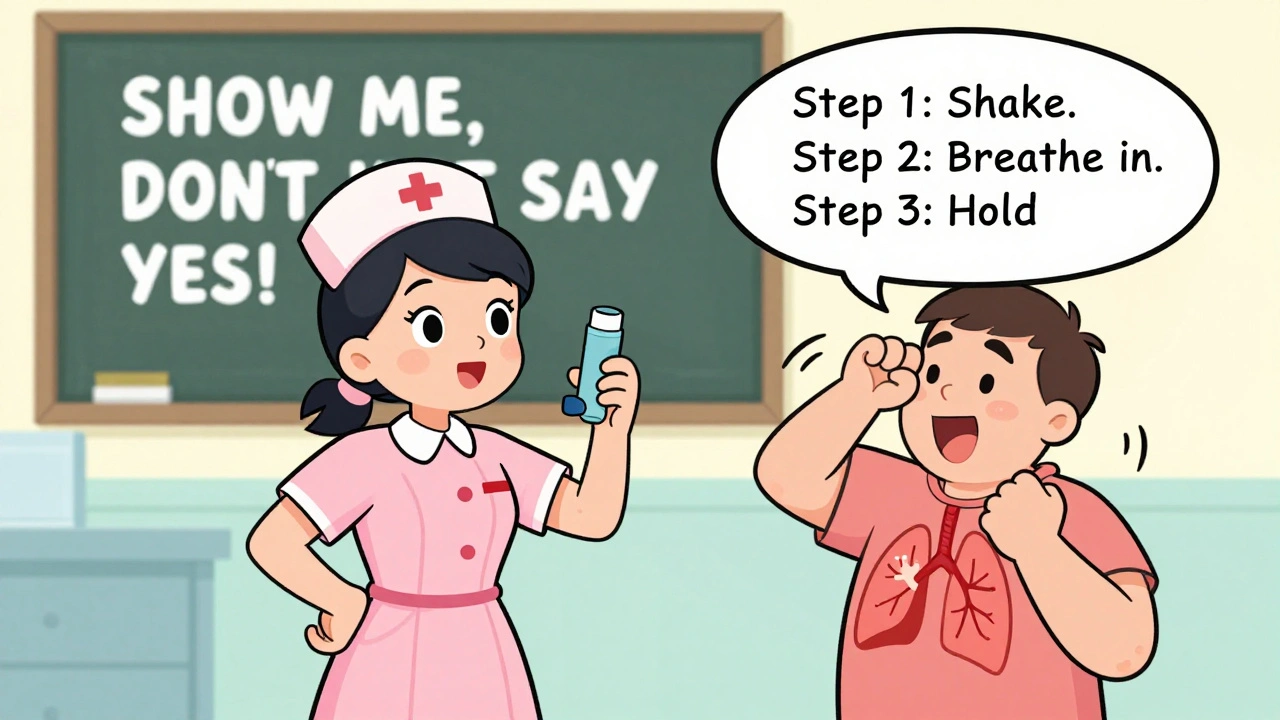
When patients leave the clinic with a prescription, do they really understand what to do with it? Too often, the answer is no. We assume that handing someone a brochure or saying "take this twice a day" is enough. But real education isn’t about information delivery-it’s about generic understanding. That means the patient can apply what they learned to new situations: knowing why to avoid grapefruit with their medication, recognizing warning signs of a reaction, or adjusting their dose if they miss a meal. Measuring this kind of understanding is hard-but not impossible.
Why generic understanding matters more than memorization
Patient education isn’t about testing recall. It’s about whether someone can use what they learned in their real life. A diabetic might memorize that they need to check their blood sugar before meals. But do they know what to do when they’re at a birthday party and the cake comes out? Can they explain to their child why they can’t have soda? That’s generic understanding: the ability to transfer knowledge across contexts. A 2022 study in the Journal of Patient Education and Counseling found that patients who could explain their treatment plan in their own words-without being prompted-were 58% less likely to be readmitted within 30 days. That’s not because they remembered a fact. It’s because they understood the logic behind it.Direct assessment: Watching what patients actually do
The most reliable way to measure understanding is to see it in action. This is called direct assessment. In clinics, that might look like:- Asking a patient to demonstrate how they’ll use their inhaler, step by step
- Having them walk through a mock scenario: "What would you do if you felt dizzy after taking your pill?"
- Reviewing a medication log they’ve kept for a week
Formative assessment: Checking in along the way
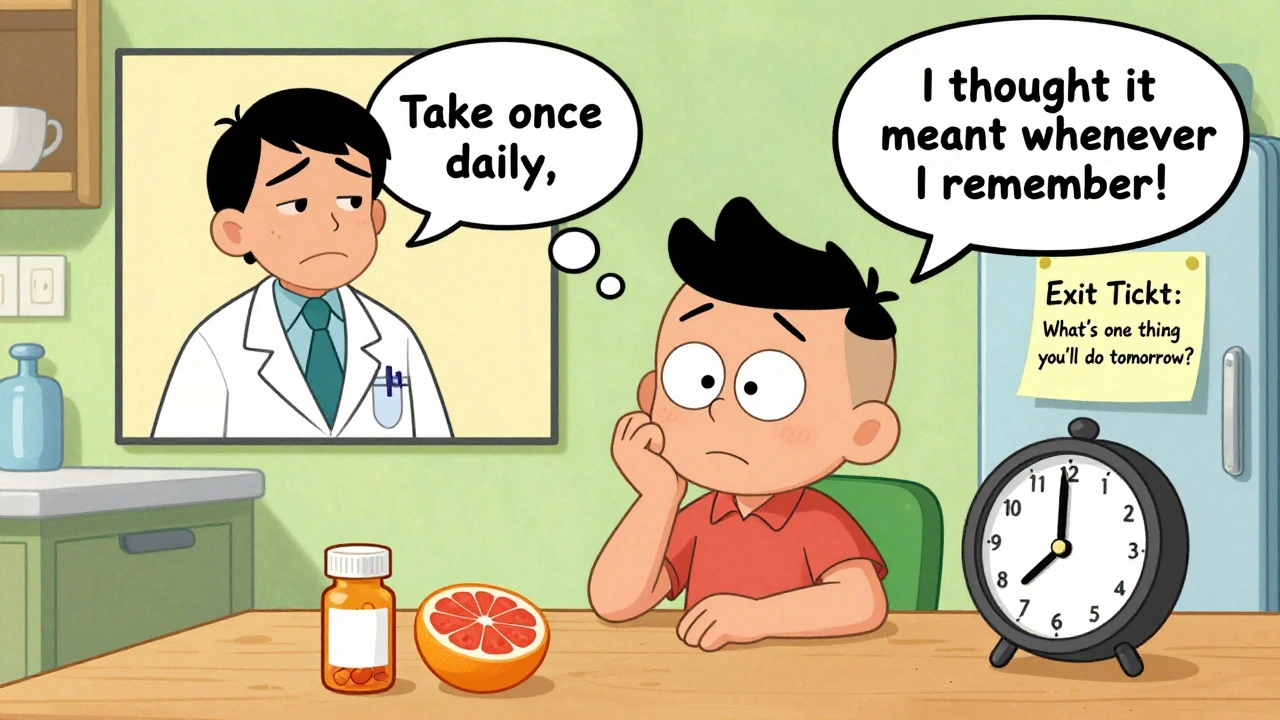
One-time education sessions fail. Understanding builds over time. That’s why formative assessment-small, frequent checks-is critical. Simple tools work best:- Exit tickets: At the end of a consultation, ask: "What’s one thing you’ll do differently tomorrow?" Write it down.
- Two-minute reflections: After a video or handout, ask patients to jot down the most important point and one thing still unclear.
- Follow-up texts: A simple message 48 hours later: "What was the hardest part of your new routine?"
What doesn’t work: Surveys, brochures, and "Do you understand?"
Asking "Do you understand?" gets a yes 90% of the time-even when the patient has no idea. Surveys and printed materials feel safe, but they measure perception, not performance. A 2023 review of 142 clinics found that 83% relied on brochures as their main teaching tool. Yet, only 28% of patients could accurately describe their own condition from those materials. Brochures are not assessment tools. They’re distractions. Even alumni surveys and satisfaction forms-common in hospitals-are misleading. They tell you how people feel about the education, not what they learned. One hospital in Wellington found their patient satisfaction scores stayed high, but readmissions kept rising. When they switched to direct assessment, they discovered 62% of patients didn’t know their own diagnosis.Using rubrics to make judgment clear
Rubrics turn vague feedback into actionable data. Instead of saying "you didn’t get it," you say: "You missed step three in the inhaler technique. Here’s how to fix it." A simple three-level rubric for medication use might look like:| Level | Understanding | Example |
|---|---|---|
| Advanced | Can explain why, when, and how to take medication, and adjust for changes | "I take my blood pressure pill in the morning because it works best then. If I skip it, I wait until the next day-I don’t double up." |
| Developing | Knows when and how, but not why | "I take it every morning. I don’t know what happens if I miss it." |
| Needs Support | Cannot describe timing, purpose, or risks | "I think it’s for my heart. I take it when I remember." |
What’s next: AI and adaptive learning
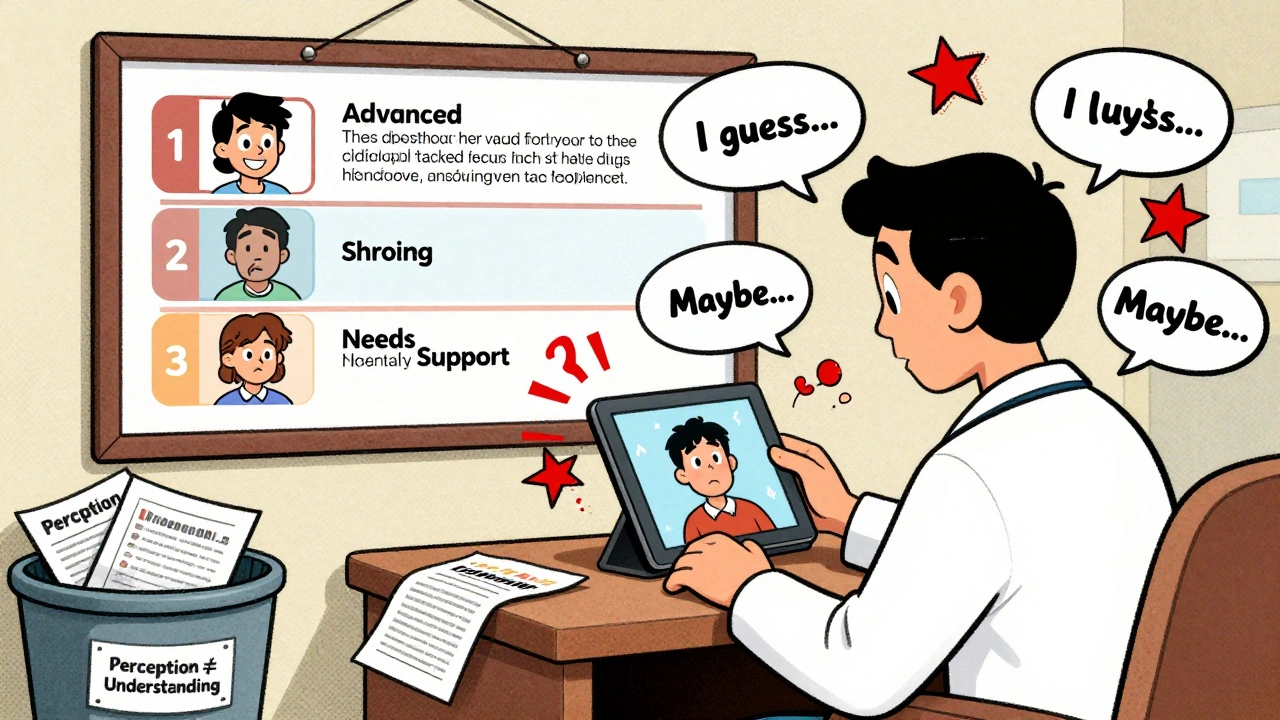
The future isn’t more handouts. It’s smarter feedback. Some hospitals are testing AI tools that analyze patient responses during video consultations. These tools flag phrases like "I guess..." or "I think maybe..." as red flags for uncertainty. One pilot in New Zealand used a simple voice-analysis app to detect hesitation in patient answers. Within four months, staff were able to re-teach concepts before patients left the room-cutting follow-up calls by 50%. This isn’t about replacing humans. It’s about giving them better tools to see what patients really understand.Start small. Measure what matters.
You don’t need fancy tech or big budgets to track generic understanding. Start with one change:- Replace "Do you understand?" with "Can you show me how you’ll take this?"
- Use a three-question exit ticket after every education session.
- Build a simple rubric for your most common teaching topic.
Education isn’t done when the lecture ends. It’s done when the patient can act-on their own, in their own life. That’s the only metric that counts.
What’s the difference between generic understanding and memorization in patient education?
Memorization means a patient can repeat facts, like "take this pill twice a day." Generic understanding means they can apply that knowledge to new situations-like knowing not to take it with grapefruit, or what to do if they feel dizzy after taking it. One is recall. The other is real-world ability.
Why are surveys and brochures poor tools for measuring patient understanding?
Surveys and brochures measure perception, not performance. Patients often say they understand to avoid embarrassment or because they want to please the provider. But when asked to demonstrate their knowledge-like showing how to use an inhaler-many can’t. Real understanding is proven by action, not words.
What’s the easiest way to start measuring understanding in a busy clinic?
Start with a two-question exit ticket: 1) "What’s one thing you’ll do differently tomorrow?" and 2) "What’s one thing you’re still unsure about?" Write their answers down. This takes 30 seconds, gives you immediate feedback, and helps you spot misunderstandings before they become problems.
Can rubrics really improve patient outcomes?
Yes. Rubrics make feedback clear and consistent. Instead of saying "you didn’t get it," you say exactly what’s missing-like "you didn’t mention checking your blood sugar before exercising." This helps patients know exactly how to improve. Clinics using rubrics report 30-40% faster improvement in adherence and fewer errors.
Is AI going to replace doctors in patient education?
No. AI can help flag when a patient sounds uncertain or gives vague answers, but it can’t replace the trust and context a human provider offers. The goal is to use AI as a tool to help providers spot gaps faster-not to take over the conversation.
Next steps: What to do today
If you’re a clinician, start tomorrow:- Replace one "Do you understand?" with a "Show me" question in your next three visits.
- Design a one-page rubric for your most common patient education topic-medication use, diet changes, or symptom tracking.
- Track how many patients can demonstrate correct technique after your next three sessions.
Comments (8)
Kshitij Shah
1 Dec, 2025So you're telling me we've been wasting millions on brochures while patients nod along like they're at a TED Talk? Classic. I've seen this in India - grandmas say 'yes yes' to everything, then throw the pills in the spice rack next to turmeric. Show me how you take it? Now that's a question that actually works.
And don't even get me started on 'Do you understand?' - that's just a polite way of saying 'I'm too tired to explain this again.' We need to stop treating patients like customers and start treating them like humans who are drowning in jargon.
Also, grapefruit. Why does everyone still not know about grapefruit? It's not a conspiracy, it's a pharmacokinetic nightmare.
Someone needs to make a viral TikTok: 'What happens when you take your blood pressure pill with a smoothie.' I'll be the guy in the lab coat holding a grapefruit like it's a weapon.
Sean McCarthy
2 Dec, 2025Studies show 58 percent less readmission. That is a statistically significant result. The p value is below 0.05. Direct assessment is superior to self-report. Self-report is biased. Confirmation bias. Social desirability bias. These are well documented in the literature. The data is clear. We must change practice. No more brochures. No more surveys. No more false positives. Action is the only valid metric. This is not opinion. This is evidence.
Implementation requires training. Training requires funding. Funding requires administrative buy-in. Administrative buy-in requires metrics. We have the metrics. Now act.
Jaswinder Singh
3 Dec, 2025Brochures? Are you kidding me? We're in 2024 and hospitals still think printing a pamphlet is 'education'? That's not care, that's negligence wrapped in paper.
I've seen patients with diabetes who don't know what 'carbs' means. They think 'low sugar' means 'no sugar at all' - so they starve themselves and pass out. And the nurse just hands them a flyer and says 'read this.'
Showing them how to use the inhaler? That's not extra work - that's the job. If you're not watching them do it, you're not teaching. You're just talking.
And don't even mention those 'satisfaction surveys.' I worked in a clinic where they gave out gold stars for high scores. Meanwhile, 60 percent of patients didn't know their own diagnosis. Gold stars? What is this, kindergarten?
We need to stop pretending we're helping people when we're just checking a box. This isn't about being nice. It's about not killing people by accident.
Bee Floyd
5 Dec, 2025I love how this piece doesn't just point out the problem - it gives you the tools to fix it. No jargon. No fluff. Just: show me. write it down. check in. simple. powerful.
I used the exit ticket method with my mom after her last appointment. Asked her what she’d do differently tomorrow. She said, 'I’ll take the pill at breakfast.' Then I asked what she was still unsure about. She said, 'What if I forget and take it twice?'
Turns out she thought doubling up would make it work faster. I almost cried. We talked for 10 minutes. She got it. No brochure needed.
These aren't fancy tech solutions. They're just human moments. And that’s what care is - not pamphlets, not surveys, not slogans. Just someone asking, 'Can you show me?'
And then listening. Really listening.
Jeremy Butler
6 Dec, 2025It is an incontrovertible empirical reality that the epistemological foundation of contemporary patient education is fundamentally flawed. The prevailing paradigm, predicated upon the transmission of discrete informational units, fails to account for the phenomenological dimension of embodied cognition and contextual application.
Generic understanding, as posited herein, constitutes a higher-order cognitive schema that transcends rote memorization - a distinction that aligns with Vygotsky’s zone of proximal development and Dewey’s experiential learning theory.
Furthermore, the reliance upon self-report instruments constitutes a categorical error in measurement theory, as it conflates perceived competence with actual competency - a fallacy that has been extensively documented in the literature on metacognitive bias.
It is therefore not merely advisable, but ethically imperative, that clinical institutions reorient their pedagogical frameworks toward performance-based assessment methodologies. The alternative is not inefficiency - it is harm.
Courtney Co
7 Dec, 2025Wait - so you’re saying we’ve been lying to ourselves for decades? That patients are just smiling and nodding because they’re too scared to say they’re lost? And we call that healthcare?
I had a cousin who died because she didn’t know her pill was supposed to be taken on an empty stomach. She thought 'once daily' meant 'whenever I remember.' She took it after pizza. After ice cream. After coffee. She thought it was like vitamins.
And her doctor? Gave her a brochure. Said 'Do you understand?' She said yes. And then she was gone.
Why are we still doing this? Why aren’t we screaming about this? Why aren’t hospitals being shut down for this? This isn’t just bad practice - it’s criminal negligence.
And you know what? I’m not even mad anymore. I’m just… tired. So tired.
Shashank Vira
7 Dec, 2025How quaint. A whitepaper on patient education that assumes everyone speaks English, has access to smartphones, and lives in a clinic with Wi-Fi. In rural India, patients are given pills in a plastic bag with no label. They don’t know the name of their disease, let alone how to 'show you' how to take it.
You speak of rubrics and AI and exit tickets - as if this were a corporate training seminar. This is not a problem of pedagogy. It is a problem of poverty, caste, language, and colonial healthcare systems that treat bodies like data points.
Until we stop assuming education is a technical fix - and start treating it as a human rights issue - your 'three-question exit ticket' will remain a luxury for the urban elite.
And don’t even get me started on AI voice analysis. What if the patient speaks Tamil with a lisp? Will your algorithm flag 'I think maybe' as hesitation - or just ignorance of their mother tongue?
Eric Vlach
8 Dec, 2025Best thing I’ve read all week. No fluff. No BS. Just real stuff that works.
I’ve been using the 'show me' trick with my diabetic patients for months now. One guy thought his insulin pen was a pen-pen. Like, he was trying to write with it. I didn’t laugh. I just showed him again. Took five minutes.
Now I use a sticky note rubric on the fridge: 'Advanced - knows why, when, how. Developing - knows when, how. Needs support - doesn’t know what it’s for.'
People get it. They feel seen. And honestly? I feel less guilty about my job.
Stop printing. Start watching. It’s that simple.