

Proving that two drugs are equivalent used to be simple. You took a handful of healthy volunteers, gave them Drug A, waited, then gave them Drug B. You measured the blood levels at strict intervals, compared the averages, and if they fell within a narrow range-usually 80% to 125%-you called it a day. But what happens when you need to prove equivalence for a life-saving cancer drug in elderly patients with kidney failure? Or a pediatric antibiotic where drawing ten blood samples is unethical?
The old method breaks down here. It relies on homogeneous groups and intensive sampling that simply isn't feasible or ethical in real-world clinical scenarios. This is where population pharmacokinetics, often shortened to PopPK, steps in. It’s not just a statistical tweak; it’s a fundamental shift in how we use data to prove that different formulations or patient subgroups receive therapeutically equivalent exposure.
Key Takeaways
- PopPK uses sparse data: Unlike traditional studies requiring many blood draws per person, PopPK works with 2-4 samples from hundreds of diverse patients.
- Regulatory acceptance is growing: The FDA’s 2022 guidance explicitly allows PopPK to support equivalence claims and reduce post-marketing requirements.
- It handles variability better: PopPK quantifies how factors like weight, age, and renal function affect drug levels, proving equivalence across heterogeneous groups.
- Software matters: NONMEM remains the industry standard, but Monolix and Phoenix NLME are gaining ground for their user-friendly interfaces.
- Validation is key: The biggest hurdle isn’t the math; it’s convincing regulators that your model accurately reflects reality without overfitting.
Why Traditional Bioequivalence Falls Short
To understand why PopPK is necessary, we have to look at the limitations of conventional bioequivalence (BE) studies. Standard BE trials are crossover designs involving 24 to 48 healthy volunteers. They are expensive, time-consuming, and strictly controlled. Every participant follows the same schedule. Every sample is taken at the exact same minute.
This control is its strength and its weakness. It proves average bioequivalence for a "typical" healthy adult. It tells us nothing about whether a generic version of a drug performs equivalently in an obese patient, a neonate, or someone with hepatic impairment. In these special populations, traditional BE studies are often ethically impossible. You can’t intentionally expose vulnerable patients to high-risk drugs just to measure peak concentrations.
Furthermore, traditional methods ignore individual variability. They assume the population is uniform. But humans aren’t uniform. Weight, genetics, diet, and organ function create massive swings in how drugs move through the body. If you only look at the average, you might miss critical differences in the tails of the distribution-the very patients most likely to experience toxicity or treatment failure.
How Population Pharmacokinetics Works
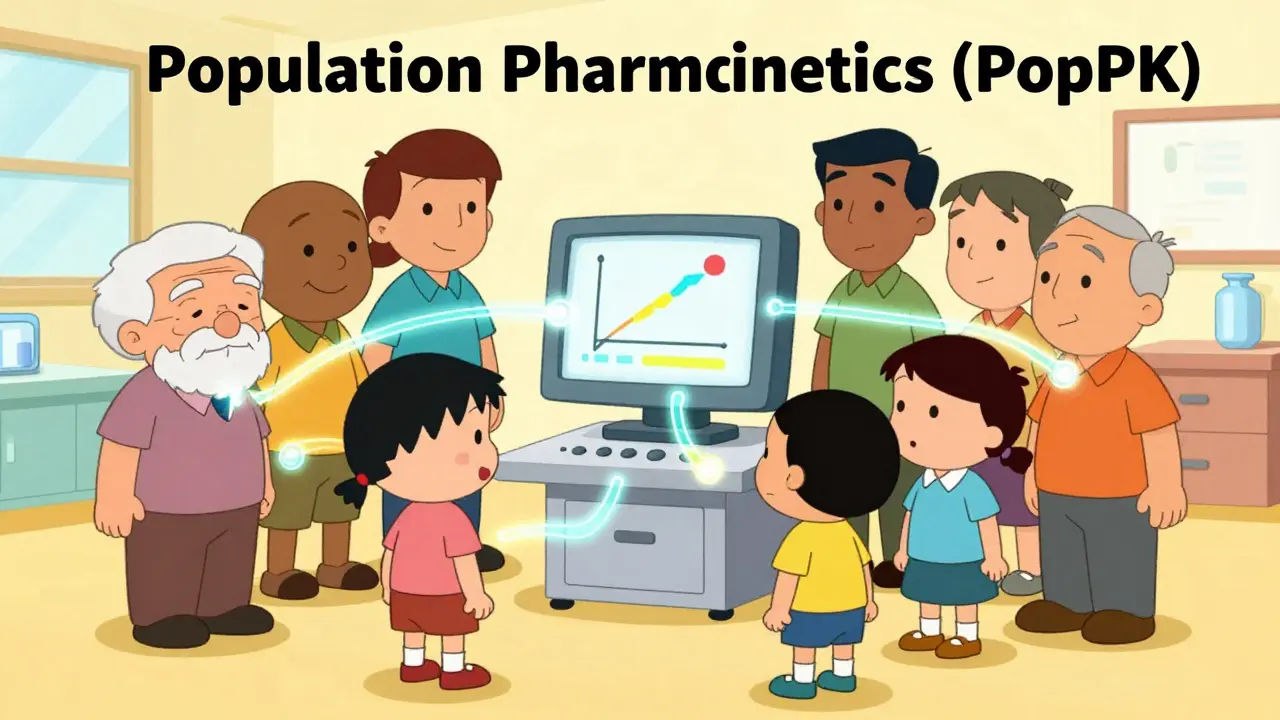
Population pharmacokinetics is a statistical modeling approach that analyzes PK data from multiple individuals to characterize drug concentration-time profiles and identify sources of variability. First pioneered by Sheiner, Rosenberg, and Marathe in 1977, the core idea was revolutionary: instead of studying one person deeply, study many people lightly.
PopPK utilizes nonlinear mixed-effects modeling (NLME). Think of it as a hierarchical system. At the bottom level, you have individual observations-blood concentration measurements from specific patients. At the top level, you have population parameters-the average clearance rate, volume of distribution, and absorption constant for the entire group.
The magic lies in how it handles data. PopPK thrives on sparse, unstructured datasets. In a clinical trial, Patient A might have three blood draws, while Patient B has only one. Their dosing times might differ slightly. Their weights might vary wildly. Traditional analysis would discard this messiness. PopPK embraces it. It uses mathematical algorithms to borrow strength from the population to estimate individual parameters, even when data for those individuals is limited.
By doing so, it quantifies two types of variability:
- Between-Subject Variability (BSV): How much do individuals differ from each other due to covariates like age, weight, or genotype?
- Residual Unexplained Variability (RUV): What variation remains after accounting for known factors? This includes assay error, dosing inaccuracies, and biological noise.
For equivalence determination, BSV is crucial. If Formulation A and Formulation B show similar average exposure but vastly different BSV, they are not clinically equivalent. One might be unpredictable, leading to erratic drug levels in some patients. PopPK detects this nuance.
Proving Equivalence with Sparse Data
So, how exactly does PopPK prove equivalence? It doesn’t rely solely on the 80-125% confidence interval rule used in standard BE studies. Instead, it builds a comprehensive model of drug behavior and tests whether adding a "formulation effect" term significantly improves the model fit.
If the model shows that switching from Brand X to Generic Y causes no statistically significant change in clearance or bioavailability across the entire population-including subgroups defined by renal function or age-then equivalence is supported. This is particularly powerful for narrow therapeutic index (NTI) drugs, where small changes in exposure can lead to serious adverse events.
The FDA’s February 2022 guidance on PopPK marked a turning point. It stated that adequate PopPK analyses could alleviate the need for additional postmarketing commitments. This means regulators now accept PopPK as primary evidence for equivalence in certain contexts, especially when traditional studies are impractical.
Consider a biosimilar antibody. These large molecules have complex PK profiles that don’t fit neatly into standard compartmental models. Traditional BE studies are often inconclusive because the variability is too high. PopPK, however, can integrate immunogenicity data, baseline characteristics, and sparse sampling to demonstrate that the biosimilar behaves equivalently to the reference product across diverse patient populations.
| Feature | Traditional Bioequivalence | Population Pharmacokinetics (PopPK) |
|---|---|---|
| Study Population | Healthy volunteers (homogeneous) | Clinical patients (heterogeneous) |
| Sampling Design | Rich, fixed intervals (many samples/patient) | Sparse, opportunistic (2-4 samples/patient) |
| Variability Handling | Averages only; ignores individual differences | Quantifies BSV and RUV explicitly |
| Covariate Analysis | Limited or none | Identifies impact of weight, age, renal function, etc. |
| Ethical Feasibility | Low for vulnerable populations | High; uses routine clinical data |
| Regulatory Status | Gold standard for generics | Increasingly accepted for NMEs and biosimilars |
The Role of Covariates in Equivalence Claims
One of the most compelling arguments for PopPK is its ability to dissect covariates. In a traditional study, if a drug fails BE, you don’t know why. Was it the formulation? Was it a subset of patients with slow metabolism? With PopPK, you can isolate these effects.
Imagine testing a new extended-release tablet against an immediate-release capsule. You suspect the release mechanism might fail in patients with low gastric pH. A traditional study might average out this effect, showing overall equivalence. PopPK, however, can model gastric pH as a covariate. If the model reveals that the extended-release formulation has significantly lower bioavailability specifically in low-pH patients, you’ve identified a lack of equivalence in a critical subgroup.
This granularity is vital for personalized medicine. It allows manufacturers to define precise dosing guidelines based on patient characteristics rather than offering a one-size-fits-all recommendation. For regulators, it provides a clearer safety profile. If equivalence holds across all covariates, confidence in the drug’s consistency increases dramatically.
Recent advancements in machine learning are enhancing this capability. A 2025 publication in Nature described using ML algorithms to detect non-linear relationships between covariates and PK parameters that traditional linear models might miss. This means PopPK can now uncover subtle interactions-like how a specific genetic variant interacts with food intake to alter drug exposure-that were previously invisible.

Implementation Challenges and Best Practices
Despite its advantages, PopPK is not a plug-and-play solution. It requires sophisticated expertise. The software landscape is dominated by NONMEM, which has been the industry standard since 1980 and is used in approximately 85% of FDA-submitted PopPK analyses. Alternatives like Monolix and Phoenix NLME offer more intuitive interfaces but may lack the same depth of regulatory precedent.
The learning curve is steep. According to Allucent’s 2022 implementation guide, it takes 18-24 months of dedicated training for a pharmacokineticist to achieve proficiency. This isn’t just about coding; it’s about understanding the physiological implications of model choices.
Common pitfalls include:
- Overparameterization: Adding too many covariates to the model, leading to overfitting where the model describes noise rather than signal.
- Inadequate Sampling: Even though PopPK handles sparse data, the sampling must still be informative. Randomly missing early absorption phase data can make it impossible to estimate bioavailability accurately.
- Poor Model Validation: There is no universal consensus on validation metrics. Regulators increasingly demand rigorous qualification steps, such as visual predictive checks (VPCs) and bootstrap resampling, to ensure the model is robust.
A survey by the International Society of Pharmacometrics found that 65% of industry professionals cite model validation as their primary obstacle. To mitigate this, best practices emphasize transparency. Document every step of the model-building process. Justify why certain covariates were included or excluded. Use external datasets to verify predictions whenever possible.
Collaboration is also key. PopPK shouldn’t be siloed in the statistics department. Clinicians, statisticians, and pharmacometricians must work together from Phase 1 development. As Dr. Stephen Duffull of the University of Otago noted, early integration ensures that the data collected is actually useful for answering equivalence questions later.
Regulatory Landscape and Future Directions
The regulatory environment for PopPK is evolving rapidly. The FDA’s 2022 guidance was a landmark, but global harmonization is still a work in progress. While the FDA is highly receptive, some EMA committees remain cautious, preferring traditional BE data unless PopPK is supplemented with rich sampling subsets.
Japan’s PMDA adopted comparable standards in 2020, signaling a trend toward broader acceptance. The biologics sector is driving much of this adoption. Proving equivalence for monoclonal antibodies via traditional PK/PD endpoints is often impossible due to complex mechanisms of action. PopPK offers a viable alternative by integrating multiple data streams into a cohesive narrative of similarity.
Looking ahead, the IQ Consortium’s Pharmacometrics Leadership Group is working toward standardized validation procedures by late 2025. This will help reduce the variability in how different companies build and qualify models, making regulatory reviews more consistent.
Machine learning integration promises to further democratize PopPK. By automating covariate selection and model optimization, AI tools could reduce the expertise barrier, allowing smaller biotechs to leverage PopPK for equivalence claims without hiring armies of specialists.
What is the minimum sample size for a PopPK study?
The FDA recommends at least 40 participants to ensure robust parameter estimation. However, optimal sample sizes depend on the expected magnitude of covariate effects and the desired statistical power. For complex models with many covariates, larger samples (100+) may be needed.
Can PopPK replace traditional bioequivalence studies entirely?
Not yet. For simple generic small-molecule drugs, traditional crossover BE studies remain the gold standard due to their simplicity and regulatory familiarity. PopPK is primarily used for complex cases, special populations, or when traditional studies are ethically or practically unfeasible.
Which software is best for PopPK modeling?
NONMEM is the industry standard and most widely accepted by regulators. Monolix and Phoenix NLME are popular alternatives that offer easier-to-use graphical interfaces. The choice often depends on team expertise and specific regulatory submission history.
How does PopPK handle missing data?
PopPK excels at handling missing data because it uses likelihood-based methods that incorporate all available information. Unlike traditional methods that might exclude subjects with incomplete profiles, PopPK uses the partial data points to inform both individual and population estimates.
Is PopPK accepted for biosimilar equivalence?
Yes, PopPK is increasingly used for biosimilars. Since traditional PK equivalence is difficult to establish for large molecules, PopPK integrates sparse PK data with pharmacodynamic and clinical outcome data to demonstrate overall similarity to the reference product.