
Every time you pick up a prescription, you’re holding a document that could save your life-or hurt you if you don’t understand it. Prescription labels aren’t just tiny strips of paper with a few words. They’re legal, medical, and safety documents packed with critical details. And yet, most people glance at them, grab their meds, and walk out. That’s a risk you don’t have to take.
What’s on your prescription label, really?
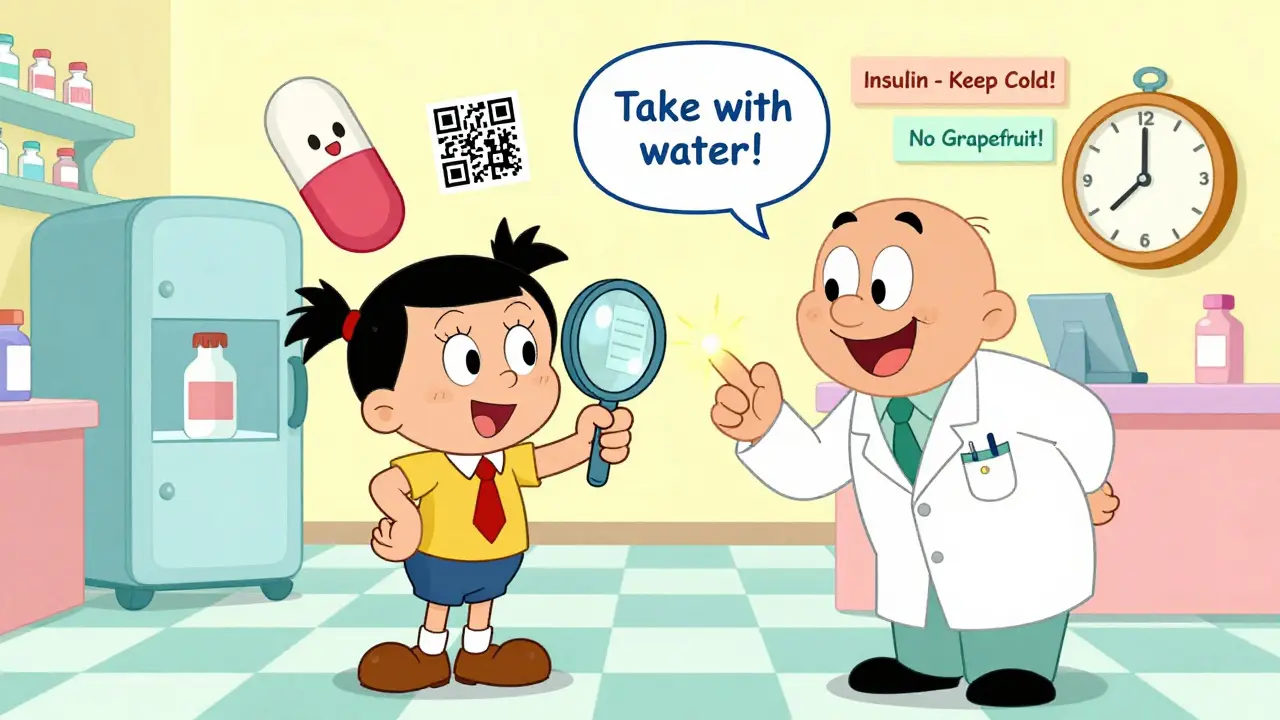
A standard prescription label in the U.S. includes nine mandatory pieces of information, as set by the National Association of Boards of Pharmacy. These are: your full name, the prescriber’s name, the drug name (both brand and generic), strength, dosage form, quantity, directions for use, number of refills, and the pharmacy’s contact info. That’s the bare minimum. Many labels also include expiration dates, storage instructions, warnings, and even a QR code linking to video instructions. But here’s the problem: labels vary wildly between pharmacies. One might print the generic name in bold; another hides it in small print. One might list the dose as “take one by mouth daily”; another says “1 PO QD.” If you don’t know what to look for, you might miss something important-like that your blood pressure pill needs to stay in the fridge, or that your antibiotic shouldn’t be taken with dairy.Always verify the five rights
The Institute for Safe Medication Practices created the “5 Rights” rule for a reason: it works. Before you leave the pharmacy, mentally check each one:- Right Patient - Is your name spelled correctly? Not your spouse’s, not your kid’s, not “Anna S.” but “Anna Smith”?
- Right Medicine - Does the name on the bottle match what your doctor told you? If you were prescribed Lisinopril but the label says Zestril, that’s the same drug-but you should know that.
- Right Amount - Is the strength correct? A 10 mg tablet isn’t the same as a 20 mg. If you’ve taken this drug before, does it look the same? Color, shape, imprint? If not, ask why.
- Right Way - “Take by mouth” or “swallow whole”? Or does it say “place under tongue”? Some pills can’t be crushed. Some must be taken on an empty stomach. Don’t assume.
- Right Time - Once a day? Before bed? Every 8 hours? “Take as needed” doesn’t mean “take whenever you feel like it.” Ask how often is too often.
Studies show patients who verify all five rights reduce medication errors by up to 58%. That’s not luck-it’s habit.
Ask about storage-this gets overlooked
Most people think, “It’s medicine, it’s fine on the counter.” But that’s wrong. According to a 2022 American Pharmacists Association survey, 15% of prescription medications need refrigeration. That includes insulin, certain antibiotics like Augmentin, and even some eye drops. If you store them at room temperature, they can lose potency-or worse, become unsafe. Ask: “Does this need to be kept cold?” If yes, ask how long it’s good once removed from the fridge. Some insulin lasts 28 days at room temp; others expire in 14. Don’t guess. Also ask: “Should I keep it in its original bottle?” Some pills degrade in plastic containers. Others need to stay dry-no bathrooms.What’s the expiration date? And does it matter?
Expiration dates aren’t arbitrary. The FDA requires that drugs maintain their full strength and safety until that date, if stored properly. That doesn’t mean they turn toxic the next day. But potency drops over time. For critical meds-like epinephrine auto-injectors, heart medications, or seizure drugs-using expired versions can be dangerous. Ask: “Is this still good for the full time I need it?” If your prescription lasts three months but expires in six weeks, you’ll need a refill sooner than expected. Also, ask if the expiration date applies to the bottle you’re holding-or if it’s the original manufacturer’s date. Some pharmacies repackage meds, which can shorten shelf life.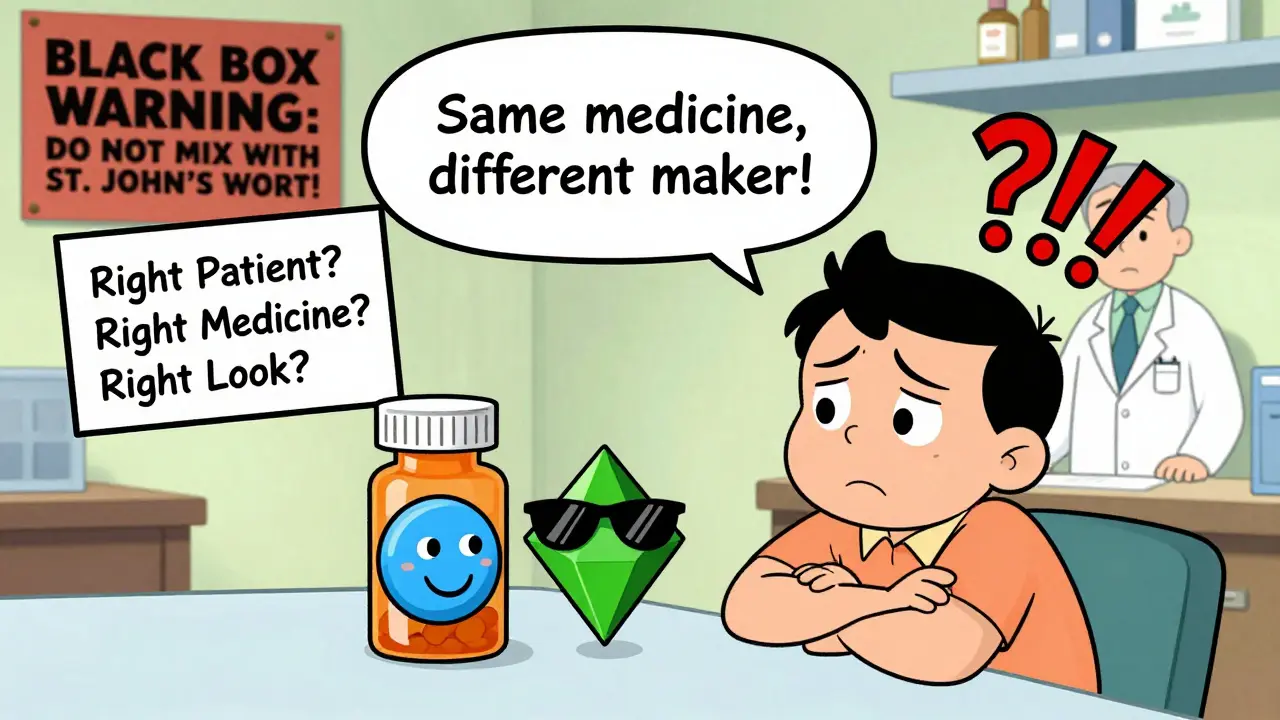
Are there any warnings I should know about?
Some drugs come with black-box warnings-the FDA’s strongest alert. These are for risks like liver damage, suicidal thoughts, or life-threatening allergic reactions. You won’t always see them on the label. But if you’re taking something like opioids, isotretinoin, or certain antidepressants, you should get a Medication Guide-a separate printed sheet that explains risks in plain language. Ask: “Is there a Medication Guide for this?” If the pharmacist says no, ask why. Some high-risk drugs are legally required to come with one. If you’re given a guide, read it. If you can’t read it, ask for help.Also ask: “Can this interact with anything I’m already taking?” Not just other prescriptions-supplements, herbal teas, even grapefruit juice. St. John’s Wort can make birth control fail. Grapefruit can turn a cholesterol drug into a poison. These aren’t myths. They’re documented.
What if I can’t read the label?
One in three U.S. adults has trouble understanding medical instructions. If you struggle with small print, blurry text, or complex language, you’re not alone-and you’re not failing. The system should adapt to you. Ask: “Can you print this in large print?” Almost all U.S. pharmacies can do this for free. Ask for a label with bigger font, clearer spacing, or even color-coded instructions. If you speak another language, ask: “Do you have this in [your language]?” Under the Affordable Care Act, pharmacies receiving federal funds must provide translation services.Some pharmacies now offer QR codes that link to video instructions in multiple languages. Ask if they have that. If they don’t, ask if they can call you with a verbal explanation. Many independent pharmacies do this already. It’s not extra service-it’s basic safety.
How many refills do I have? And when do I need to reorder?
Refill info is often buried at the bottom. But if you run out of your blood thinner or thyroid med, you can’t just “wait until you feel off.” Ask: “How many refills are left?” and “When should I call for the next one?” Some prescriptions expire after one year, even if refills remain. Others need a new prescription every 30 days. Also ask: “Do I need a new doctor’s note for the next refill?” If you’re on a controlled substance like Adderall or oxycodone, federal rules require a new script every time.
What if this looks different from last time?
Generic drugs are chemically identical to brand names-but they look different. Pills change color, shape, or size depending on the manufacturer. That’s normal. But if you’ve never seen this version before, don’t assume it’s wrong. Instead, ask: “Is this the same medicine I got last time? Why does it look different?”Pharmacists are trained to spot differences. If they say, “It’s the same, just a different maker,” ask them to confirm the generic name matches. If they hesitate, walk away and call your doctor. Better safe than sorry.
Can you explain this to me out loud?
The most powerful question you can ask: “Can you walk me through this step by step?” Don’t just nod and smile. Repeat the instructions back. “So, I take one pill every morning with water, not with food, and I don’t stop even if I feel better?” If the pharmacist says yes, you’re good. If they correct you, you just avoided a mistake.Research from the American Association of Colleges of Pharmacy shows patients who do this reduce adverse drug events by up to 47%. That’s not a small number. That’s life-changing.
What’s new in prescription labeling?
The FDA is pushing for change. In 2023, they approved the first augmented reality label system-point your phone at the bottle, and dosage instructions pop up on screen. Walgreens and CVS are testing it. QR codes now link to video instructions in 150+ pharmacies. AI tools are being rolled out to flag confusing language. But these aren’t universal yet. You can’t wait for technology to fix everything. Right now, your best tool is asking questions. Every time. No exceptions.What if something still doesn’t feel right?
Trust your gut. If the label seems off, if the pill looks wrong, if the instructions are confusing, don’t take it. Call your doctor. Call the pharmacy back. Ask for a second pharmacist to review it. You have the right to understand what you’re putting in your body.Medication errors cause 1.3 million injuries in the U.S. every year. Over 22% of them come from misunderstood labels. You don’t have to be a statistic. You just have to ask.
What should I do if my prescription label has a typo?
If your name, dosage, or drug name is wrong, do not take the medication. Return to the pharmacy immediately. Pharmacies are required to correct labeling errors at no cost. If they refuse, ask to speak to the pharmacist-in-charge or call your doctor’s office to verify the prescription. Keep a copy of the label and the correct prescription from your doctor as proof.
Can I get my prescription label in a different language?
Yes. Under the Affordable Care Act, pharmacies that receive federal funding (which includes most major chains and many independents) must provide translation services. Ask for a label in your preferred language. If they don’t have it printed, they can often read it to you over the phone with a live interpreter. Some pharmacies also offer multilingual QR codes that link to video instructions.
Why does my pill look different from last time?
Generic drugs can look different each time because they’re made by different manufacturers. The active ingredient is the same, but the color, shape, or imprint may change. Always check the generic name on the label to confirm it matches your prescription. If you’re unsure, ask the pharmacist to verify it’s the same medication. Never assume it’s safe just because it’s the same drug name.
Do I need to keep the original bottle?
Yes, especially for controlled substances or high-risk medications. The original bottle contains the official label with expiration date, lot number, and pharmacy info needed for recalls or safety alerts. Even if you transfer pills to a pill organizer, keep the original bottle until the prescription is finished. Never throw it away early.
What if I miss a dose because I didn’t understand the label?
Don’t double up unless instructed. Call your pharmacist or doctor immediately. They’ll tell you whether to skip the missed dose, take it late, or adjust your schedule. For some meds, like antibiotics or blood thinners, missing a dose can be dangerous. For others, it’s less critical. Never guess. Always ask.
Comments (14)
Wendy Claughton
18 Jan, 2026I always ask for the big print label now. Last month I nearly took my mom's blood pressure pill because I couldn't read mine. 🙈 Thanks for reminding us this isn't just paperwork-it's safety. 🙏
Stacey Marsengill
19 Jan, 2026Pharmacies are profit machines. They don't care if you live or die-just that you pay. They'll give you a QR code instead of answering your question because it saves them 30 seconds. And don't get me started on how they hide the generic name in tiny font like it's a secret. 🤬
Aysha Siera
19 Jan, 2026They're tracking you through the QR codes. Every scan is logged. Your meds, your habits, your health data-all fed into some government-AI-pharma conglomerate. You think this is about safety? It's about control. They want you dependent. Always ask for paper. Always.
rachel bellet
19 Jan, 2026The 'five rights' framework is foundational, but it's being undermined by systemic pharmacy understaffing and regulatory arbitrage. Most technicians are not trained in pharmacovigilance protocols, and the FDA's labeling standards are non-uniform across dispensing entities. You're not just risking error-you're enabling a failure cascade in the medication safety ecosystem.
Pat Dean
21 Jan, 2026America's healthcare system is broken. You have to fight just to get a label you can read? In China, they hand you a printed sheet with pictures and a nurse explains it. Here? You're lucky if the pharmacist doesn't roll their eyes. We need national standards. Not QR codes. Not apps. Just clear, simple, human language.
Selina Warren
21 Jan, 2026I used to think I was being paranoid. Then my aunt went to the ER because she took her insulin wrong. She thought ‘once daily’ meant ‘whenever I remember.’ That’s not her fault. That’s the system’s fault. If you’re not asking questions, you’re not just being lazy-you’re letting someone else decide if you live or die. Stop being polite. Start being dangerous.
Robert Davis
22 Jan, 2026I’ve been a pharmacist for 22 years. Most people don’t read the label because they don’t want to know. They’re afraid of what they’ll find. I’ve seen people ignore black-box warnings because ‘the doctor knows best.’ Spoiler: the doctor didn’t write the label. The pharmacist did. And we’re tired of being blamed.
Joni O
22 Jan, 2026I used to skip asking questions too… until I got the wrong dose of levothyroxine. My heart was racing for hours. I thought it was anxiety. Turns out it was 2x my normal dose. Now I always say ‘can you read it back to me?’ and I write it down. It’s weird, but it saved my life. Also, I typo a lot so I screenshot the label. 🙈
Ryan Otto
23 Jan, 2026The entire pharmacological supply chain is predicated on obfuscation. The proliferation of generic manufacturers, repackaging, and non-standardized labeling protocols is not an accident-it is a feature designed to maximize profit through consumer ignorance. The notion that a QR code constitutes ‘patient education’ is a neoliberal farce.
Max Sinclair
23 Jan, 2026This is so important. I always ask for the Medication Guide-even if they say it’s not required. I’ve had pharmacists hand me one I didn’t know existed. And I never assume the pill looks right. I check the generic name, the NDC code, and sometimes even call my doctor’s office to confirm. It takes 2 minutes. Worth it.
Praseetha Pn
24 Jan, 2026They’re putting trackers in the pill bottles. The QR code? It’s not for instructions-it’s for your biometrics. They know when you open it. When you miss doses. When you take them with alcohol. This isn’t healthcare. It’s surveillance capitalism. And they’re using your fear of death to sell you more tech. Don’t fall for it.
christian Espinola
25 Jan, 2026If you’re asking questions at the pharmacy, you’re doing better than 90% of Americans. The rest just swallow whatever they’re handed. And then blame the drug when it doesn’t work. Pathetic. This post should be mandatory reading in high school. Or at least before your first prescription.
Robert Cassidy
26 Jan, 2026They’re not just hiding the generic name-they’re hiding the fact that 80% of these drugs were developed by the same 3 corporations. You think your ‘new’ antidepressant is different? It’s a rebrand. Your ‘special’ insulin? Same molecule, different packaging. The label doesn’t lie. The system does.
Andrew Qu
27 Jan, 2026One thing I always tell patients: if you’re unsure, call the pharmacy back. Even if it’s 7pm. Most independent pharmacies will answer. I’ve had people call me at midnight asking about a pill color change. That’s the kind of engagement that saves lives. You’re not bothering us. You’re helping us do our job right.