
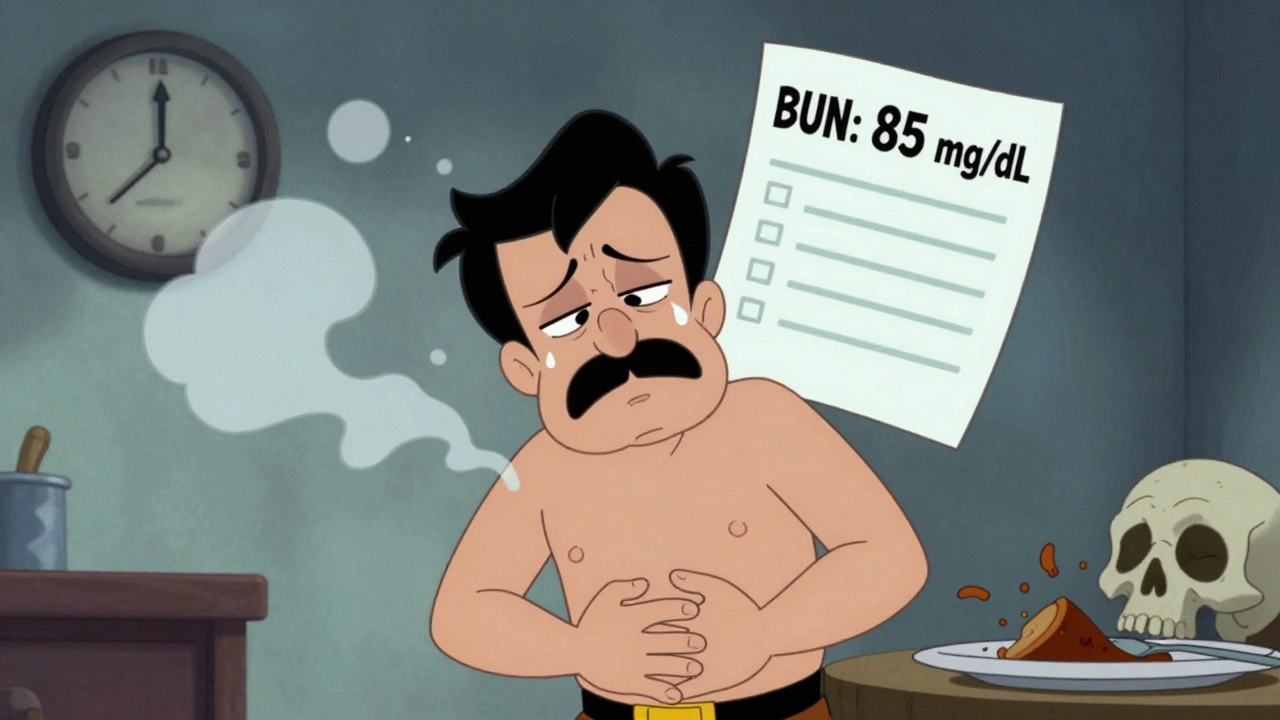
When your kidneys stop working, your body doesn’t just slow down-it starts to poison itself. Uremic symptoms like constant nausea and unbearable itching aren’t just uncomfortable; they’re warning signs that your body is drowning in waste it can’t flush out. For many people with advanced kidney disease, these symptoms don’t show up until it’s almost too late. But knowing what to look for-and when to act-can change everything.
What Exactly Are Uremic Symptoms?
Uremia isn’t a disease. It’s the result of kidney failure. When your kidneys can’t filter blood properly, toxins like urea, creatinine, and other waste products build up in your bloodstream. This isn’t just about high numbers on a lab report. These toxins trigger real, physical reactions in your body that you can feel. The two most common and debilitating symptoms are nausea and itching, but they’re not the only ones. Fatigue, metallic taste in the mouth, muscle cramps, confusion, and swelling are also common. But nausea and itch are the ones that make people finally say, ‘Something’s seriously wrong.’
Nausea in kidney disease isn’t like a stomach bug. It’s persistent. You might eat a bite of food and feel like you’re going to throw up. Or you might just lose your appetite entirely. One study found that 68% of people with stage 5 chronic kidney disease (CKD) experience this. It’s not random. When blood urea nitrogen (BUN) levels climb above 80 mg/dL, the toxins start hitting the brain’s trigger zone, making your body react as if you’ve swallowed something toxic. That’s why many people lose weight-not because they’re trying to, but because eating feels like a chore, or worse, a punishment.
Itching is even more insidious. It’s not dry skin. It’s not an allergy. It’s called uremic pruritus, or CKD-associated pruritus (CKD-aP). And it’s worse at night. You scratch until your skin bleeds, but nothing helps. Studies show that 37% of people not yet on dialysis have it, and nearly 70% of those on hemodialysis do. The itch isn’t localized-it’s all over. Back, arms, legs, chest. Symmetrical. No rash. No visible cause. That’s why so many people see dermatologists, try every lotion, change detergents, and still get no relief. The real culprit? Inflammation. People with severe itching have CRP levels nearly three times higher than those without it. This isn’t just skin deep-it’s systemic.
When Should You Start Dialysis?
For decades, doctors waited until patients were near death before starting dialysis. That’s not the standard anymore. But here’s the catch: starting too early doesn’t save lives. The IDEAL trial, a major study published in the New England Journal of Medicine, showed no survival benefit for starting dialysis when eGFR was 10-14 mL/min versus waiting until it dropped to 5-7 mL/min. So why start at all?
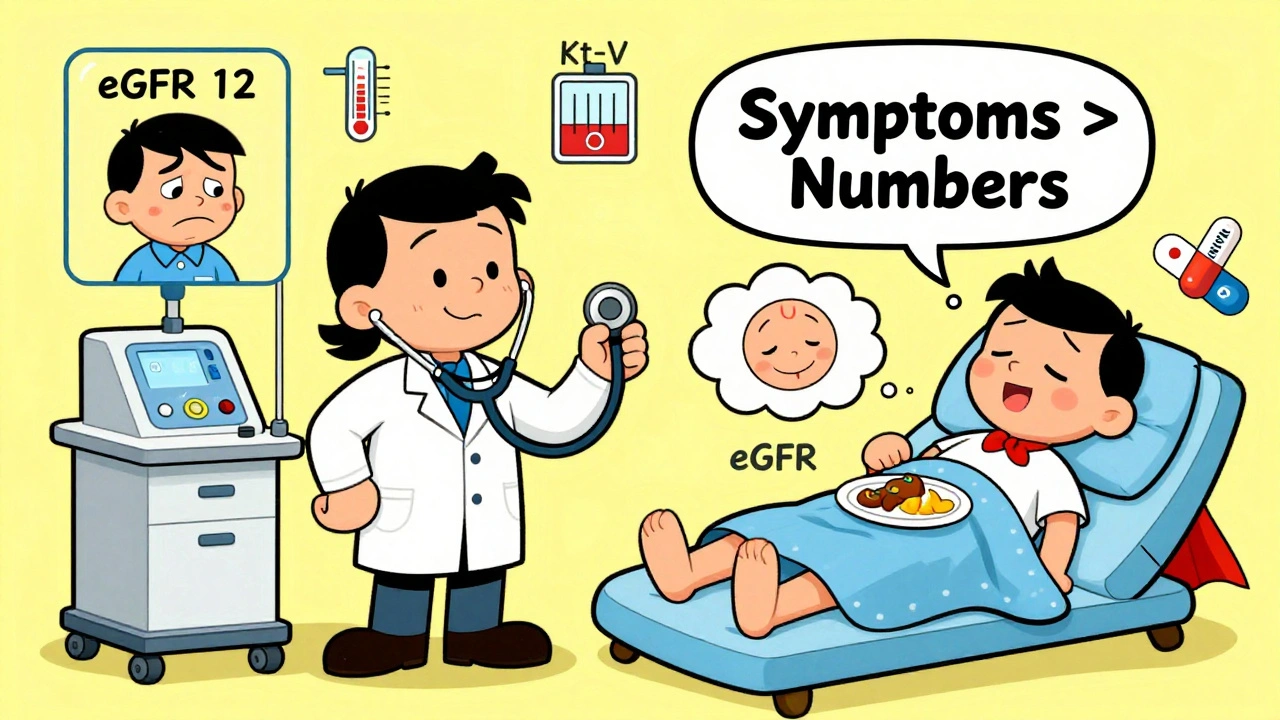
The answer is symptoms-not numbers. The 2023 KDOQI guidelines say dialysis should begin when uremic symptoms become unmanageable. That means:
- Nausea so bad you’ve lost 5% of your body weight in three months
- Itching that scores over 15 on the 5-D Itch Scale (duration, degree, direction, disability, distribution)
- Difficulty sleeping because of constant scratching
- Loss of appetite leading to malnutrition
- Signs of uremic pericarditis (fluid around the heart)
Some doctors still push for early dialysis at eGFR 12-15, citing lower hospitalization rates. But that’s not universal. A 2022 study from Japan showed fewer hospital stays with earlier dialysis, but the same study didn’t show improved survival. The real goal isn’t to hit a number-it’s to restore quality of life.
And here’s the hard truth: many people wait too long. A 2022 University of Michigan poll found that 41% of patients saw three or more doctors before being correctly diagnosed with uremic symptoms. The average delay? Nearly nine months. By then, the damage is done. Nausea has stolen their appetite. Itch has stolen their sleep. Their bodies are already weakened.

How Doctors Manage Uremic Nausea and Itch
Before dialysis, doctors try to control symptoms. But it’s like trying to bail out a sinking boat with a teaspoon.
For nausea, the go-to drug is ondansetron. It blocks the brain’s vomiting center. Doses start at 4 mg, three times a day. If that doesn’t work, domperidone may be added. But it’s risky-domperidone can prolong the QT interval, raising the chance of dangerous heart rhythms. That’s why it’s used cautiously, especially in older adults or those with existing heart issues.
For itching, the approach is layered. First, make sure dialysis is adequate. If you’re on hemodialysis, your Kt/V (a measure of how well toxins are removed) should be at least 1.4. If you’re not on dialysis yet, optimizing phosphate and calcium levels helps. High phosphate (above 5.5 mg/dL) and a calcium-phosphorus product over 55 are linked to worse itching.
Next, medications. Gabapentin is often the first choice. Start at 100 mg at night. If it helps, slowly increase to 300 mg three times a day. But gabapentin is tricky-39% of prescriptions for kidney patients exceed safe dosing levels, raising the risk of dizziness, falls, and confusion.
Then come the newer drugs. Difelikefalin (brand name Korsuva) is FDA-approved specifically for uremic itching. It’s given as an IV during dialysis, three times a week. In trials, it cut itch scores by over 30% in just days. Nalfurafine, another option, works by targeting the same brain receptors as opioids-but without the addiction risk. It’s not available everywhere yet, but it’s showing promise.
One patient, described in a 2021 case study, went from a 5-D Itch Scale score of 18 (severe) to 6 (mild) in four weeks with nalfurafine. She said, ‘I slept through the night for the first time in three years.’ That’s not a miracle. That’s medicine working.
Why Timing Matters More Than You Think
Starting dialysis isn’t like turning on a faucet. It’s a life-altering shift. You’ll spend three to four hours, three times a week, hooked to a machine. You’ll need to change your diet. You’ll have to plan your life around appointments. So why not wait until you’re desperate?
Because waiting too long increases your risk of dying. The IDEAL trial showed that patients who started dialysis late but had uncontrolled symptoms had a 58% higher risk of death than those who started when symptoms became unmanageable-even if their eGFR was higher.
And the burden isn’t just physical. People with severe itching are 64% more likely to say it interferes with daily activities. Nearly one in three have changed jobs or quit work because they couldn’t focus. One Reddit user, ‘DialysisDad,’ wrote: ‘The metallic taste made food taste like sand. I lost 18 pounds in two months.’ That’s not just weight loss-it’s loss of dignity, of joy, of connection.
Meanwhile, disparities persist. Black patients wait an average of 3.2 months longer than white patients before starting dialysis, even when symptoms are similar. That delay leads to 18% more hospitalizations. This isn’t about access to care alone-it’s about recognition. Too many doctors still think, ‘Wait until the numbers are bad enough.’ But the numbers don’t tell the whole story. The patient does.
What You Can Do Right Now
If you have advanced kidney disease and you’re experiencing nausea or itching:
- Track your symptoms. Use a journal. Note when nausea hits, what you ate, how bad the itch is, and whether it wakes you up at night.
- Use the 5-D Itch Scale. Rate your itching on duration (how long it lasts), degree (how bad), direction (does it get worse?), disability (how much it affects your life), and distribution (where it’s located). A score over 12 means it’s severe.
- Ask for a referral to a nephrologist if you haven’t already. Don’t wait for your primary doctor to bring it up.
- Ask about dialysis adequacy. If you’re already on dialysis, ask: ‘Is my Kt/V above 1.4?’ If not, your toxin removal may be inadequate.
- Request screening for phosphate and calcium levels. High levels worsen itching and bone disease.
And if you’re a caregiver: listen. Don’t dismiss itching as ‘just dry skin.’ Don’t assume nausea is ‘just stress.’ These are biological signals. They mean your loved one’s body is in crisis.
What’s Next for Uremic Symptom Management?
The future is shifting from lab numbers to lived experience. The 2024 KDIGO guidelines are expected to include patient-reported outcomes as official triggers for dialysis. That means if you report severe itching or nausea on a validated scale, it could be enough to start treatment-even if your eGFR is still 11 or 12.
New drugs are coming. Nemifitide, a selective kappa-opioid agonist, showed 45% greater itch reduction than placebo in phase 3 trials. It’s not approved yet, but it’s on the horizon. And research is focusing on non-opioid, non-dialysis solutions-because not everyone can or wants to start dialysis right away.
But until then, the best tool you have is awareness. Know the signs. Speak up. Demand answers. Uremic symptoms aren’t normal. They’re not something you just have to live with. They’re a signal. And if you hear it, you have the right to act.
Is nausea always a sign that I need dialysis?
Not always. Nausea can be caused by many things-medications, stomach issues, dehydration. But if you have advanced kidney disease (eGFR below 15) and nausea is persistent, worsening, or causing weight loss, it’s a strong signal that toxins are building up. If dietary changes and anti-nausea meds don’t help, dialysis is likely needed.
Can I treat uremic itching without dialysis?
Yes, but only temporarily. Optimizing phosphate control, using gabapentin, or trying topical moisturizers can help. But since itching is caused by toxins your kidneys can’t remove, these treatments only mask the problem. Without dialysis, itching will return and often get worse. The goal is to use these tools while preparing for dialysis-not as a permanent fix.
Why do some doctors wait to start dialysis?
Because studies show starting too early doesn’t improve survival. Dialysis is a major intervention with risks-low blood pressure, infections, access problems. Doctors used to start dialysis at higher eGFR levels out of caution. But now, guidelines focus on symptoms, not numbers. If you’re not sick, there’s no rush. If you are, waiting too long can be dangerous.
How do I know if my itching is really from kidney disease?
Uremic itching has specific traits: it’s widespread, worse at night, no visible rash, and doesn’t respond to typical skin treatments. Doctors rule out other causes like liver disease, thyroid issues, or eczema. If you have CKD and itching lasting more than six weeks with no other explanation, it’s likely uremic pruritus. The 5-D Itch Scale helps confirm severity.
What happens if I delay dialysis too long?
You risk serious complications: fluid overload leading to heart failure, dangerous electrolyte imbalances, uremic pericarditis (inflammation around the heart), nerve damage, and even seizures. Delaying dialysis when symptoms are severe increases your chance of hospitalization and death. The 58% higher mortality risk from the IDEAL trial isn’t theoretical-it’s based on real outcomes.
Comments (13)
Mellissa Landrum
5 Dec, 2025they dont want you to know this but dialysis is just a money scheme. the pharma giants and big med are hiding the real cure-alkaline water and magnetic bracelets. i lost my cousin to this and he was on dialysis for 3 years. they drained his bank account and then he died. wake up people. the government lets this happen so you keep paying.
Mark Curry
7 Dec, 2025i think the real issue isn’t just the toxins-it’s how disconnected we’ve become from our own bodies. we ignore the whispers until they scream. maybe the answer isn’t just machines, but learning to listen again. i don’t have kidneys, but i’ve watched my dad go through this. he said the itching felt like ghosts scratching inside his skin. that’s not just medical. that’s spiritual.
an mo
7 Dec, 2025the kdoqi guidelines are statistically underpowered and conflict with the 2022 japanese cohort analysis. the ideial trial’s primary endpoint was all-cause mortality, but secondary endpoints like qol and hospitalization were confounded by selection bias. also, ktv >1.4 is outdated-current dialysis efficiency metrics now use urea reduction ratio and normalized protein catabolic rate. if you’re prescribing gabapentin >300mg/day without renal dosing adjustment, you’re committing iatrogenic harm.
aditya dixit
8 Dec, 2025my uncle was on dialysis for 7 years. he never complained. he’d wake up at 4am to walk in the park before his treatment. he said the itching kept him awake, but the silence after the machine turned off? that was peace. i think we focus too much on the numbers and forget the quiet strength of people who live with this every day. don’t rush to fix it-learn from it.
Lynette Myles
9 Dec, 2025the 5-d itch scale is a scam. it was designed by nephrologists funded by korsuva’s manufacturer. no one checks if the scale correlates with actual sleep quality. it’s just another tool to push drugs and dialysis.
Jimmy Jude
10 Dec, 2025you think this is about kidneys? no. this is about control. they make you feel broken so you’ll submit to the machine. they profit from your suffering. they sell you hope wrapped in iv lines. and when you finally get dialysis? you’re not cured-you’re institutionalized. your life becomes a schedule. your body? just a machine part. they don’t want you healthy. they want you dependent.
Michael Dioso
11 Dec, 2025so let me get this straight-you’re telling me i should start dialysis because i can’t sleep from itching, but if my eGFR is 11? i’m fine? what kind of logic is that? if your kidneys are failing, why wait until you’re hallucinating from uremia? it’s like waiting for your house to burn down before calling the fire department. dumb.
Krishan Patel
11 Dec, 2025people like you are why america is dying. you think suffering is a personal choice? no. it’s the result of lazy eating, soda addiction, and ignoring your body. if you had just taken care of yourself, you wouldn’t need dialysis. you’re not a victim-you’re a consequence. stop whining and take responsibility.
sean whitfield
13 Dec, 2025wow. so the solution to kidney failure is… more drugs and more machines? brilliant. next they’ll invent a pill to replace oxygen. at least the itching is honest. at least it screams. unlike your doctors, who smile and say ‘it’s normal.’
Marvin Gordon
13 Dec, 2025you’re not alone. i’ve seen people go through this. the itch, the nausea-it’s brutal. but here’s the thing: you can still live. not just survive. live. find the small joys. a warm blanket. a song that doesn’t hurt your ears. a friend who listens. dialysis isn’t the end. it’s a new chapter. and you get to write it.
Deborah Jacobs
13 Dec, 2025my mom had uremic itching so bad she’d rub her arms raw with ice cubes. she’d laugh and say, ‘it’s like my skin forgot how to be skin.’ she started dialysis after losing 14 pounds and sleeping 2 hours a night. the first night after her first session? she slept 8 hours straight. cried the whole time. not from pain-from peace. i didn’t know a body could feel that kind of relief. if you’re reading this and you’re scared? you’re allowed to ask for help. you’re allowed to want to sleep again.
Lucy Kavanagh
15 Dec, 2025did you know the cdc hides the real death stats for dialysis patients? they reclassify them as ‘heart failure’ to make it look like people are dying of old age. but it’s the toxins. always the toxins. and they know it. that’s why they push the ‘wait until symptoms’ line-it keeps the profit flowing. trust no one. not the doctors, not the guidelines. fight for your life.
Chris Brown
15 Dec, 2025the notion that symptoms should dictate dialysis initiation is a dangerous precedent. it introduces subjectivity into a clinical process that must be governed by objective, reproducible metrics. without standardized thresholds, disparities will increase, not decrease. the nephrology community must uphold evidence-based thresholds, not emotional narratives.